
TL;DR:
- Maintenance contracts in Edmonton transform reactive repairs into scheduled preventive work, safeguarding assets and budgets. They define scope, visit frequency, and reporting standards to control risk and improve cost predictability, especially in harsh climates. Clear, detailed agreements aligned with asset criticality prevent disputes and support effective property management.
Most commercial property managers in Edmonton discover the real role of maintenance contracts only after a $40,000 emergency repair that a $300 quarterly inspection would have prevented. Maintenance contracts are not just paperwork. They are the mechanism that shifts your property from reactive crisis management to scheduled, preventive care, protecting both your assets and your annual budget. For property owners managing asphalt lots, concrete infrastructure, landscaping, and snow removal in Alberta’s harsh climate, understanding how these agreements work and what they actually cover is one of the highest-value decisions you can make.
Table of Contents
- Table of contents
- What maintenance contracts really cover and why they matter
- How maintenance contracts control risk and optimize costs
- Prioritizing maintenance: reliability-centered maintenance (RCM) and asset criticality
- Documentation, compliance, and dispute prevention through contract clarity
- Putting it all together: practical tips for choosing and managing maintenance contracts
- Our perspective: the contract is only as good as the conversation before you sign it
- How ProZone Ltd supports Edmonton property managers
- Frequently asked questions
Key Takeaways
| Point | Details |
|---|---|
| Shift to preventive care | Maintenance contracts convert unpredictable repairs into scheduled, proactive services that extend asset life. |
| Control risk and costs | Defined coverage types and pricing models limit unexpected expenses and aid budgeting. |
| Prioritize critical assets | Using RCM principles focuses maintenance on key systems, optimizing resources and reliability. |
| Ensure clear documentation | Contracts must include detailed scopes and require audit-ready records to comply with regulations. |
| Negotiate contract details | Establish clear obligations and expectations upfront to avoid disputes and improve service quality. |
Table of contents
- What maintenance contracts really cover and why they matter
- How maintenance contracts control risk and optimize costs
- Prioritizing maintenance: reliability-centered maintenance (RCM) and asset criticality
- Documentation, compliance, and dispute prevention through contract clarity
- Practical tips for choosing and managing maintenance contracts
- Frequently asked questions
What maintenance contracts really cover and why they matter
A maintenance contract is a formal agreement between a property owner and a service provider that defines scheduled tasks, visit frequencies, and measurable deliverables. It is not an on-call repair arrangement. The core role of a maintenance contract is to turn reactive “break-fix” work into scheduled preventive work, which changes the entire dynamic of how you manage property assets.
For Edmonton properties, this distinction is significant. Asphalt deteriorates faster in climates with freeze-thaw cycles. Concrete walkways develop cracking patterns that, left unmonitored, require full-slab replacement rather than surface sealing. Landscaping infrastructure that goes unchecked through a single harsh winter can cost more to restore than it would have cost to maintain over three years. A well-structured maintenance contract creates the framework for catching these issues early.
Commercial buildings benefit from maintenance agreements that function as governed service relationships, typically spanning one to three years with defined scope and frequency. The multi-year structure matters: it enables the contractor to plan labor, schedule materials, and develop a deep familiarity with your property’s specific problem areas, rather than approaching each visit as a first-time job.
What a maintenance contract typically includes
A well-drafted agreement for commercial property maintenance should address the following areas:
- Scheduled inspection visits with defined frequency (monthly, quarterly, seasonal)
- Specific task lists per visit, not vague language like “general upkeep”
- Material supply responsibilities, clarifying who sources replacement materials
- Reporting requirements, including condition assessments and photos after each visit
- Escalation procedures for issues discovered during routine inspections
- Exclusions, clearly stating what falls outside the contract scope
- Renewal and termination conditions, including notice periods and price adjustment clauses
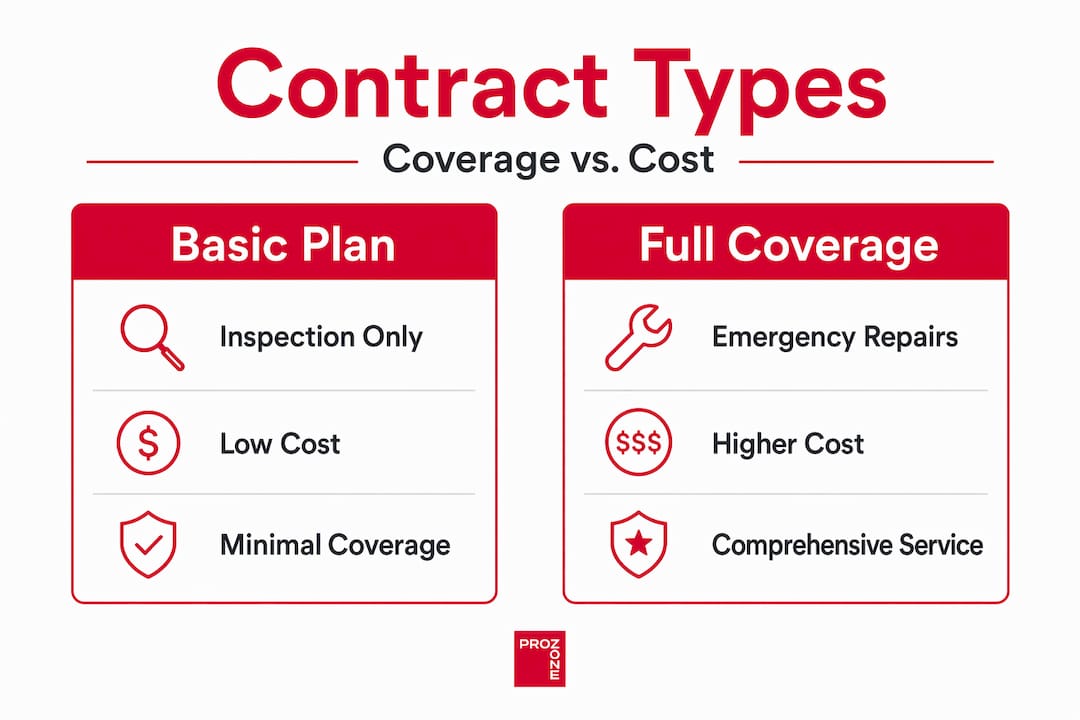
Contract types: a quick comparison
| Contract type | Coverage | Cost level | Best for |
|---|---|---|---|
| Basic inspection plan | Labor and diagnosis only | Low | Lower-risk assets, tight budgets |
| Full-service plan | Labor, materials, and minor repairs | Medium to high | High-traffic surfaces, paved areas |
| Full-coverage plan | Labor, materials, parts, and emergency response | Highest | Mission-critical infrastructure |
| Seasonal contract | Defined season only (e.g., snow removal) | Variable | Climate-specific needs in Edmonton |
Understanding these maintenance contract types helps you match the agreement to the actual risk profile of each asset on your property. A commercial property maintenance services provider should help you identify which level of coverage each asset genuinely requires, rather than applying a single contract tier across your entire site.
How maintenance contracts control risk and optimize costs
Understanding contract scope leads directly into a more financially significant question: how do these agreements actually protect your budget? The importance of maintenance contracts from a cost perspective comes down to one core principle: predictability. When you know what you will spend, you can plan. When you do not, you absorb emergencies.
Full-coverage maintenance plans cost 40 to 80% more than basic inspection-only plans, but they significantly reduce emergency expenditure by catching failures before they become critical. Basic plans, by contrast, exclude parts and emergency dispatch, which means every unexpected failure generates an unbudgeted expense. For property managers working with fixed annual operating budgets, that unpredictability is a real financial liability.

The pricing models used by reputable contractors reflect this risk transfer. Contractors must account for the statistical probability of failures over the contract term, the cost of materials in a future market, and the labor hours required for both routine and unplanned work. Quantitative risk assessment is essential in contract pricing to address these unpredictable future maintenance costs, which is why full-coverage contracts carry higher premiums. You are not just paying for service; you are paying to transfer financial risk to the contractor.
What full-coverage contracts typically protect against
- Unplanned asphalt patching after freeze-thaw heave
- Cracked concrete repair following winter salt damage
- Unexpected landscaping restoration after drainage failures
- Snow removal cost overruns during high-volume winters in Alberta
- Emergency call-out fees during business-critical periods
What basic plans leave exposed
- Any parts or materials required beyond what the contractor provides
- Emergency dispatch outside regular business hours
- Failures that occur between scheduled inspection windows
- Progressive damage discovered during an inspection but not covered for immediate repair
Pro Tip: When reviewing contract proposals, ask contractors to itemize the three most common failure scenarios for your asset type and confirm which coverage tier addresses each one. If a contractor cannot answer this question, the contract scope is likely too vague to be enforceable.
For more on reducing cost and risk with contractors, the structure of the agreement itself is often as important as the contractor’s technical qualifications. A well-priced but poorly written contract can leave you financially exposed in ways that only become visible during a dispute.
Prioritizing maintenance: reliability-centered maintenance (RCM) and asset criticality
Not all property assets carry equal weight. A decorative pathway failing is inconvenient. A main-access parking lot failing during a commercial tenant’s peak season is a liability. This is the core principle behind reliability-centered maintenance, known as RCM, and it has significant implications for how you structure your contracts.
RCM is an asset management framework that aligns maintenance frequency and scope to the criticality of each asset, rather than applying a uniform schedule across the entire property. RCM aligns maintenance to asset importance using targeted inspections and condition-based monitoring rather than treating every surface or system equally. In practical terms, this means your high-traffic paved entrance receives more frequent attention than a low-use access road at the property’s perimeter.
“Not everything deserves equal attention. Federal agencies and commercial operators alike are finding that allocating maintenance resources based on failure impact, not just asset age, produces better outcomes at lower total cost.” — Federal News Network, 2026
How to apply RCM principles when structuring your contracts
- Categorize your assets by failure impact. Rank each asset: what happens to your operations, tenants, or liability exposure if it fails?
- Set inspection intervals based on risk tier. High-criticality assets warrant monthly or quarterly inspections; low-criticality assets may only need annual review.
- Build condition-based triggers into the contract. Specify that certain inspection findings (e.g., crack width exceeding 5mm, drainage blockage, surface frost heave) automatically trigger a repair response.
- Review criticality rankings annually. Tenant mix, traffic patterns, and property use all change. What was low-priority in year one may become high-priority by year two.
- Request contractor condition reports after every visit. These reports become the data source for adjusting your RCM rankings over time.
Edmonton properties that manage both paved infrastructure and landscaping elements benefit considerably from this tiered approach. Concrete parking surfaces, loading docks, and pedestrian walkways typically sit at the top of the criticality ranking. Decorative plantings and ornamental features sit lower. Your contract should reflect that hierarchy.
For property managers reviewing their construction services for Edmonton managers, RCM is the framework that tells you where to spend. It also shapes how contractors should report back to you. A concrete maintenance checklist is a practical starting point for identifying which surface conditions require contract-level attention versus simple monitoring.
Documentation, compliance, and dispute prevention through contract clarity
One of the most underestimated benefits of service agreements is not what they cover, but how they document what was done. When a regulatory inspection arrives, or a tenant dispute surfaces, or an insurance claim requires evidence of maintenance history, your contract documentation is either your best defense or your biggest liability.
Contracts must generate audit-ready service records for compliance inspections to succeed. This means the contract itself must require the contractor to produce standardized, dated, and signed service records after every visit. A verbal agreement that “everything looks fine” is not a compliance record. It is worthless in an enforcement inquiry.
Vague scope language causes disputes; specifying tasks, frequency, and response times prevents conflicts before they start. This is one of the most practically important points in any review of how maintenance contracts work. The words “general maintenance as required” in a contract scope section are an invitation to disagreement. “Quarterly inspection of all paved surfaces including photographic condition report within 48 hours of visit” is enforceable.
Documentation standards every commercial contract should include
- Timestamped service records for every scheduled visit, signed by both the technician and a property representative
- Photo documentation of conditions before and after service
- Jurisdiction-compliant formats that satisfy Alberta occupational health and safety or municipal property standards requirements
- Clear response time standards, distinguishing between emergency response (typically 4 to 24 hours) and routine service windows (typically 2 to 5 business days)
- Escalation documentation, recording any issues found that exceed the contract’s repair scope and the agreed next step
Pro Tip: Before signing any maintenance agreement, request a sample service report from the contractor. If the sample is vague, poorly formatted, or lacks required fields for your jurisdiction, expect the actual records to be the same.
For properties subject to accessibility and surface standards, contract documentation also needs to align with physical compliance requirements. For example, ADA compliance paving standards require not just that surfaces are maintained, but that records demonstrate ongoing compliance. A maintenance contract that does not require this level of documentation creates a gap between physical compliance and documented compliance.
Putting it all together: practical tips for choosing and managing maintenance contracts
Having covered contract features, risk structures, RCM principles, and documentation requirements, the question becomes practical: how do you actually select and manage these agreements for your Edmonton property?
Effective contract management for operations and maintenance requires establishing clear rules at the start to enforce rights and obligations and minimize disputes. This is not about being adversarial with contractors. It is about creating a shared understanding that protects both parties. The maintenance agreement value you receive depends directly on how clearly you define what you expect before the contract is signed.
A practical checklist for selecting and managing maintenance contracts
- Define your asset inventory first. List every surface, structure, and system that needs maintenance. Include square footage, current condition, and failure impact rating before you approach contractors.
- Request itemized proposals. Ask each contractor to quote by service task, not just a lump annual sum. This makes comparison meaningful and reveals gaps in coverage.
- Negotiate parts caps explicitly. Full-coverage contracts should specify the maximum annual liability for parts, and who approves expenditures above that cap.
- Set emergency response time in writing. For Edmonton winters, a 48-hour response to a snow removal failure at a commercial property is operationally unacceptable. Define your acceptable window clearly.
- Build in mid-term reviews. Annual reviews of contract performance against documented service records allow you to adjust scope, address recurring issues, and renegotiate pricing before auto-renewal.
- Request references from comparable properties. A contractor maintaining a retail strip mall has a different operational profile than one maintaining a light industrial site. Match references to your property type.
Pro Tip: The most common point of dispute in commercial maintenance contracts is not price or missed visits. It is the boundary between “routine maintenance” and “repair.” Define this boundary explicitly in dollars and scope before signing. Anything above a certain cost threshold should trigger a separate written quote and approval process.
Managing your paved surfaces under a structured agreement, for example, consistently produces savings over time. Understanding how commercial parking lot maintenance saves money illustrates the financial case for preventive contracts across asphalt and concrete assets, one of the most common and most expensive maintenance categories for Edmonton commercial properties.
Our perspective: the contract is only as good as the conversation before you sign it
Here is something the industry rarely says plainly: most maintenance contracts fail not because the contractor performs poorly, but because the property manager and contractor had two different mental pictures of what was agreed. The contract language looked fine on paper. The practical expectations did not match.
Property managers frequently focus on price. That is understandable. But the more consequential variable is specificity. A contract at a premium price that defines every task, every response window, every reporting requirement, and every exclusion will outperform a cheaper contract with vague language every single time. Vague contracts create gray areas, and gray areas become disputes.
There is also a tendency to treat maintenance contracts as a one-time procurement decision rather than an ongoing management relationship. The most effective approach we observe in well-managed commercial properties is a model where the property manager reviews the contractor’s service reports regularly, flags any emerging issues, and uses the contract’s mid-term review clause as a management tool. The contract becomes a living record of your property’s condition, not just an invoice justification.
Edmonton’s climate adds a layer of urgency that properties in more temperate regions do not face. Freeze-thaw cycling, heavy snowfall, and spring drainage loads create a maintenance window that is significantly compressed compared to, say, a property in Vancouver. That means the consequences of a missed inspection cycle are more severe here than almost anywhere else in Canada. When a contractor skips a late-fall paving inspection because the contract wording was ambiguous about seasonal scheduling, and then spring arrives with extensive surface heaving, the cost of that ambiguity becomes very concrete.
The underlying principle is straightforward: treat your maintenance contract negotiation with the same seriousness you would give a major capital expenditure decision. Because over a five-year horizon, it is one.
How ProZone Ltd supports Edmonton property managers
If you manage commercial, municipal, or industrial property in the Edmonton region and are evaluating commercial property maintenance services, ProZone Ltd provides structured maintenance agreements covering asphalt, concrete, earthworks, snow removal, and outdoor landscaping infrastructure. Our contracts are built on clearly defined task schedules, documented service reporting, and response time commitments that match the demands of Alberta’s operating environment. We work with property managers to structure agreements that reflect actual asset criticality, not uniform one-size-fits-all schedules. If you are ready to move your property from reactive repairs to planned preventive care, contact ProZone Ltd to discuss a maintenance agreement tailored to your site.
Frequently asked questions
What is the main purpose of a maintenance contract for commercial properties?
Maintenance contracts formalize regular preventive services that extend asset life and reduce costly emergency repairs. As industry practice confirms, the primary function is converting reactive “break-fix” responses into scheduled, documented preventive work.
How do maintenance contracts help with budgeting for property managers?
They provide predictable costs and define coverage limits, shifting financial risk from owners to contractors and eliminating unexpected expenditures. Defined coverage models create the cost certainty that fixed operating budgets depend on.
Why is clear contract documentation important?
Clear documentation ensures regulatory compliance and prevents disputes by defining service scopes, visit frequencies, and response time expectations. Contracts that lack compliant records may not satisfy an inspection or enforcement inquiry, and vague scope language consistently generates avoidable conflicts between owners and contractors.
What is reliability-centered maintenance (RCM)?
RCM prioritizes maintenance based on asset importance, using targeted inspections to focus resources on critical equipment and reduce failures. RCM aligns maintenance frequency to the actual failure impact of each asset rather than applying a uniform schedule across all property systems.