
TL;DR:
- Properly designed and compacted road base is essential for distributing load, preventing frost heave, and ensuring long-term durability of pavements in Alberta’s cold climate.
- Selecting the correct material gradation, depth, and installation methodology significantly reduces maintenance costs and extends surface lifespan.
Road base is defined as a compacted layer of crushed stone, gravel, and fine particles engineered to distribute structural loads between a pavement surface and the underlying subgrade. Known in Alberta and across Canada by several names, including base course, ABC stone, and Class 6 aggregate, this material forms the critical foundation beneath roads, driveways, sidewalks, and building pads. Without a properly graded and compacted road base, even the best asphalt or concrete surface will crack, settle, and fail prematurely. Understanding its composition, performance characteristics, and correct application is the difference between a surface that lasts decades and one that requires costly repairs within a few years.
What is road base material and how is it composed?
Road base material is an engineered blend of crushed stone, gravel, sand, and stone dust fines, graded to compact tightly and interlock under load. The base course layer serves as the structural link between the finished pavement and the natural subgrade soil beneath it. Unlike plain gravel or decorative aggregate, road base is specifically designed to achieve high compaction density and resist deformation under repeated traffic loads.
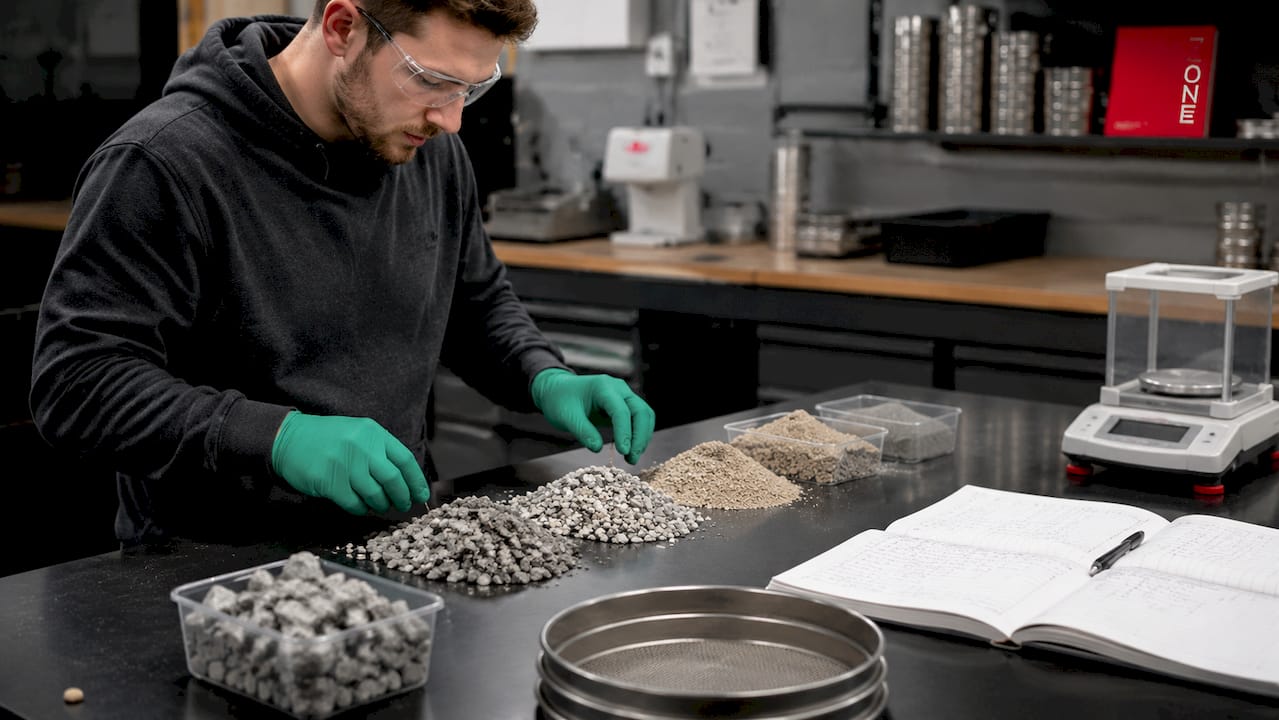
The most common classification in North America is Class 6 road base, which contains particles ranging from fine #200 sieve material up to 3/4 inch stone. This particle size range is deliberate: the coarser stone provides structural skeleton, while the fines fill voids and create interlock that prevents shifting. In Alberta, Class 2 base rock follows a similar gradation philosophy and is widely used in municipal and commercial projects.
The fines content in road base acts as a double-edged lever. Higher fines improve compaction and reduce lateral movement, but they also reduce permeability, meaning water drains more slowly through the layer. This tradeoff requires careful drainage design, particularly in heavy-load applications or areas with high groundwater.
Pro Tip: When reviewing a road base product, ask the supplier for the gradation certificate rather than relying on the product name alone. Two materials both labelled “road base” can behave very differently under load and moisture conditions.
Road base also exists in two broad structural categories: unbound base course, which relies entirely on mechanical interlock and compaction, and hydraulically bound base course, which incorporates a binding agent such as cement or lime to increase rigidity. Unbound base is by far the most common choice for roads, driveways, and landscaping applications across Alberta.
How does road base distribute load, manage drainage, and prevent frost heave?
The primary functions of road base are load distribution, settlement limitation, drainage provision, and frost protection. Each function is interconnected, and a failure in one area typically accelerates failure in the others.
| Function | Mechanism | Consequence if absent |
|---|---|---|
| Load distribution | Spreads point loads across a wider subgrade area | Rutting, cracking, and surface deformation |
| Settlement control | Limits vertical movement under repeated loads | Uneven surfaces and structural failure |
| Drainage | Allows water to move laterally away from the pavement structure | Saturation, loss of bearing capacity |
| Frost protection | Provides a non-frost-susceptible buffer layer | Frost heave, surface upheaval, and cracking |
In Edmonton and the broader Alberta region, frost protection is arguably the most critical function. The city experiences significant freeze-thaw cycling throughout late autumn, winter, and early spring. When moisture-laden subgrade soils freeze, they expand and push upward, a process called frost heave. A properly specified road base layer, placed at adequate depth, acts as a thermal and physical buffer that limits the amount of frost penetration reaching the subgrade.
Base course performance is especially critical for road durability and service life in cold climates. A base that is too thin, too fine, or poorly compacted will allow frost to penetrate more deeply and create differential heave, which is the uneven lifting that produces the characteristic cracking and potholing seen on poorly constructed roads each spring.
Pro Tip: In Edmonton’s climate, specify a minimum base depth of 150 to 300 millimetres depending on traffic load and subgrade conditions. Consult Alberta Transportation’s pavement design guidelines or work with a certified contractor to confirm the correct depth for your specific project.
Drainage design must account for the fines content of the chosen road base. Successful installations require drainage planning to prevent saturation, which reduces bearing capacity and accelerates frost damage. In areas with poor natural drainage, a granular subbase layer or perforated drainage pipe below the road base may be required.
What are the types of road base used in construction and landscaping?
Road base terminology varies significantly by region, which creates confusion when sourcing materials or reviewing specifications. Confirming material specs with grading documentation prevents project failure regardless of what a product is called locally.
The table below summarises the most common road base types and their typical applications:
| Material type | Gradation | Typical use |
|---|---|---|
| Class 6 road base | #200 to 3/4 inch | Roads, driveways, sidewalks, building pads |
| Class 2 base rock | Similar to Class 6 | Municipal roads, commercial projects in Alberta |
| Crusher dust (crusher fines) | Very fine, up to 1/4 inch | Pathways, compacted surfaces, under pavers |
| Open-graded aggregate | Coarse, minimal fines | Drainage layers, French drains, permeable bases |
| Hydraulically bound base | Variable, with binder | High-load roads, bridge approaches, heavy industrial |
Road base differs from plain gravel in a fundamental way. Gravel is sorted by size and contains minimal fines, which means it drains well but compacts poorly and shifts under load. Road base meets APWA specifications and is engineered specifically for structural performance, not just drainage or aesthetics.
Crusher dust is sometimes confused with road base, but it lacks the coarser stone fraction needed for load distribution. It works well as a levelling layer under concrete pavers or flagstone, but it is not a substitute for a properly graded base course beneath asphalt or concrete.
Key distinctions to understand when selecting road base material:
- Unbound base course relies on mechanical interlock and compaction. It is the standard choice for most Alberta road and driveway projects.
- Hydraulically bound base course uses cement or lime to create a semi-rigid layer. It is used where subgrade conditions are poor or loads are exceptionally high.
- Open-graded base prioritises drainage over stability. It is appropriate beneath permeable pavements or as a drainage layer, not as a primary structural base.
- Road crush is a locally common term in Alberta for a crushed gravel base material that closely matches Class 6 gradation and is widely used in residential and commercial construction.
How to select and install road base correctly for Edmonton projects
Selecting the right road base starts with understanding the project’s load requirements, drainage conditions, and subgrade soil type. A residential driveway in Edmonton carries very different loads than a commercial truck yard, and the base specification must reflect that difference.
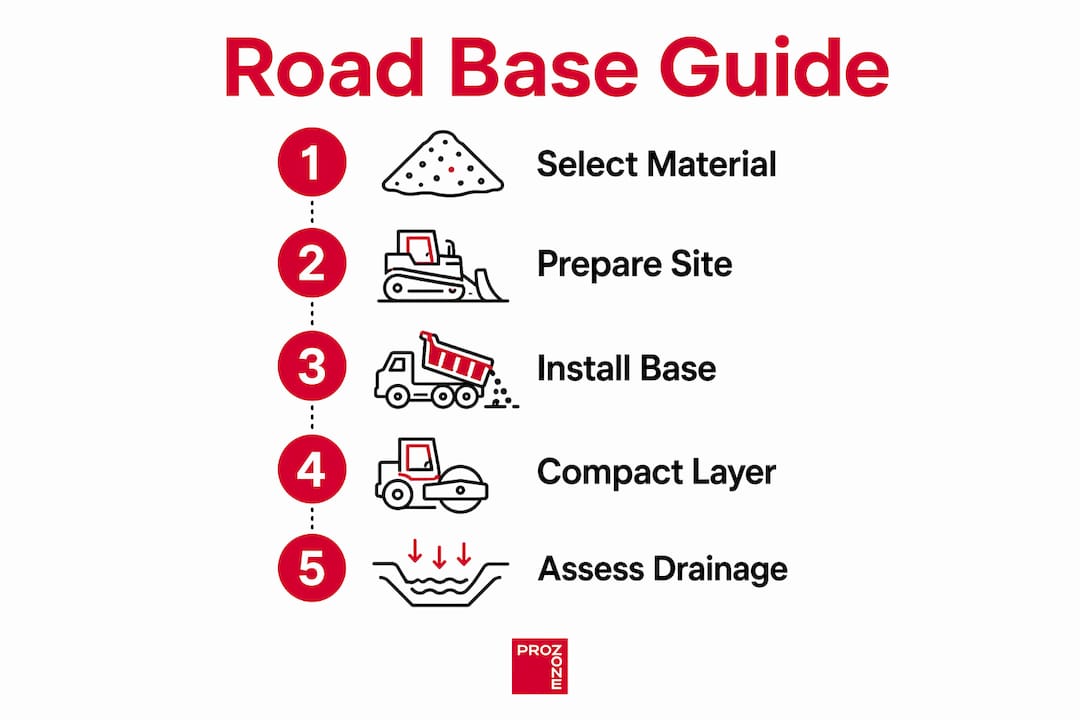
Follow these steps to select and install road base correctly:
- Assess the subgrade. Test the existing soil for bearing capacity and frost susceptibility. Clay-rich soils common in parts of the Edmonton region are highly frost-susceptible and may require a thicker base or a geotextile separation fabric between the subgrade and base course.
- Specify the correct gradation. For most driveways, sidewalks, and light commercial surfaces, Class 6 or equivalent road base is appropriate. For heavy truck traffic or industrial applications, consult a geotechnical engineer for a site-specific design.
- Calculate the required volume. Multiply the area in square metres by the required depth in metres to get the volume in cubic metres. Add 10 to 15 percent for compaction loss. For example, a 100 square metre driveway requiring 200 millimetres of compacted base needs approximately 20 cubic metres of material before compaction factor.
- Place and compact in lifts. Road base should be placed in layers no thicker than 150 millimetres and compacted with a vibratory plate compactor or roller before the next lift is added. Field compaction methodology is as important as material grading to achieve design performance.
- Verify compaction with density testing. A nuclear density gauge or sand cone test confirms that the compacted base meets the specified density. Skipping this step is one of the most common causes of premature pavement failure.
- Confirm material documentation. Request the gradation certificate and any relevant test data from your supplier. Spec documentation, not just names, must guide material verification.
Pro Tip: Never compact road base when it is saturated. Wet fines lose their interlock and the material will not achieve design density regardless of compaction effort. Schedule base work during dry conditions or allow the material to drain before compacting.
Working with certified suppliers and contractors who adhere to Alberta Safety Codes is not optional for commercial or municipal projects. It is a contractual and regulatory requirement that also protects the project owner from liability if a surface fails.
What are the benefits and uses of road base in construction and landscaping?
Road base is one of the most versatile construction materials available, with applications ranging from major roadways to residential garden paths. Its benefits are directly tied to the engineering principles behind its gradation and compaction characteristics.
The primary benefits of using properly specified road base include:
- Structural durability. A well-compacted base course extends the service life of asphalt and concrete surfaces by distributing loads evenly and preventing differential settlement.
- Frost resistance. In Edmonton’s climate, a correctly specified base depth reduces frost heave damage, which is the leading cause of pavement cracking and potholing in Alberta.
- Reduced maintenance costs. Surfaces built on quality road base require fewer repairs over their lifecycle. The upfront investment in proper base preparation consistently outperforms the cost of repeated surface patching.
- Versatility across applications. Road base supports asphalt and concrete surfaces, as well as gravel driveways, sidewalks, building foundation pads, temporary haul roads, and landscaping paths.
- Environmental efficiency. Recycled crushed concrete and reclaimed asphalt pavement can be used as road base material in appropriate applications, reducing the demand for virgin aggregate and diverting material from landfill.
Common applications in the Edmonton region include commercial parking lots, municipal road reconstruction, residential driveways, utility trench backfill, and landscaping aggregate paths. ProZone has completed projects across all of these categories, consistently specifying certified base materials that meet Alberta Transportation and municipal standards. The landscaping aggregate guide from ProZone provides additional detail on material selection for outdoor applications.
Why road base quality is the decision most project owners underestimate
After years of working on construction and infrastructure projects across the Edmonton region, the pattern is consistent: the failures that are most expensive to fix are almost never caused by the surface material. They are caused by what is underneath it.
Inferior base materials, whether under-graded, poorly compacted, or simply the wrong product for the application, create problems that do not appear immediately. A driveway or parking lot can look perfectly acceptable for one or two seasons before the base failures begin to telegraph through the surface as cracking, rutting, or heaving. By that point, the repair cost typically exceeds what a correct base installation would have cost in the first place.
The freeze-thaw cycle in Edmonton is unforgiving. Two products both labelled “road base” can behave very differently under the same environmental stress if their gradations differ. This is why ProZone insists on grading documentation for every base material used on its projects, and why working with suppliers who can provide certified spec sheets is non-negotiable.
The advice here is straightforward: invest in the base course. It is the part of the project that no one sees, but it is the part that determines whether everything above it performs as designed.
— ProZone
Road base solutions from ProZone for Edmonton projects
ProZone supplies and installs certified road base materials for commercial, municipal, and residential projects across Edmonton and the surrounding region. Every material ProZone sources meets Alberta Safety Codes requirements and is accompanied by grading documentation, so project owners and managers can verify compliance without guesswork. ProZone’s road construction services cover the full scope of base preparation, from subgrade assessment and material specification through compaction and density verification. Whether you are planning a commercial parking lot, a municipal road rehabilitation, or a residential driveway, ProZone provides a free estimate and tailored material recommendations. Contact ProZone directly through the online form at prozoneltd.ca or call to speak with a project specialist.
FAQ
What is the road base definition in construction?
Road base is a compacted layer of graded crushed stone and fines placed between the subgrade and the pavement surface to distribute loads, limit settlement, provide drainage, and protect against frost heave. It is also called base course, ABC stone, or Class 6 aggregate depending on the region.
What is the difference between road base and gravel?
Road base contains a specific blend of coarse stone and fine particles engineered for compaction and load distribution, while plain gravel is sorted by size with minimal fines and drains well but shifts under load. Road base meets APWA or equivalent specifications; decorative gravel does not.
How do you calculate road base quantity for a project?
Multiply the area in square metres by the required compacted depth in metres to get the volume in cubic metres, then add 10 to 15 percent to account for compaction loss during installation. For example, a 50 square metre area requiring 200 millimetres of base needs approximately 12 cubic metres of material.
Why is road base particularly important in Edmonton’s climate?
Edmonton’s freeze-thaw cycles cause frost heave in moisture-susceptible subgrade soils, which cracks and deforms pavement surfaces. A correctly specified and compacted road base layer acts as a frost buffer, reducing the depth of frost penetration and limiting differential heave that causes surface damage.
What is the difference between road base and crusher dust?
Road base contains both coarse stone and fines across a broad gradation, giving it structural load-bearing capacity. Crusher dust consists almost entirely of fine particles and is suitable as a levelling layer under pavers, but it lacks the coarse fraction needed to function as a structural base course beneath asphalt or concrete.