
Extending downspouts, adding splash pads, and correcting surface grade solve most minor pooling problems on Edmonton driveways, but standing water at a garage entrance or along a foundation usually needs a trench drain or a French drain engineered for clay. Edmonton’s glacial till clay drains poorly and shifts with every freeze-thaw cycle, so designs that work in sandier soils often fail here within a season or two. Check your grade and downspouts first. If water still reaches the foundation, call ProZone for a free on-site assessment before the problem undermines pavement or footings.
Table of Contents
- Why Edmonton clay and freeze-thaw change what works
- Which driveway drainage fix is right for your situation?
- What does driveway drainage cost in Edmonton?
- How installation works and how long it takes
- City rules and lot grading requirements you need to know
- Keeping your drainage system working for years, not seasons
- How ProZone designs drainage for Edmonton conditions
- Stop the water before you fix the surface
- Get a free ProZone site assessment before winter
- Sources
- FAQ
Why Edmonton clay and freeze-thaw change what works
Edmonton sits on glacial till, a dense clay soil with very low percolation. Water that would drain through sandy soil in hours can sit on clay for days, saturating the base under your driveway and softening the subgrade beneath asphalt or concrete.
That saturation becomes dangerous once temperatures drop, and if your project requires financing, you should consider options like a construction mortgage Alberta that can cover larger drainage or regrading jobs. Frost heave can lift pavement by 5 to 10 centimetres and is a documented cause of pavement deformation in cold Canadian climates, and repeated freeze-thaw cycles work joints and cracks open year after year.
Standard drain kits sold for prairie or coastal soils are not built for this. Clay fines migrate into ordinary gravel backfill and clog the system within a few years unless the design accounts for it.
What actually holds up in Edmonton clay:
- Trenches deep enough to sit below the active frost zone in the drain’s working section
- A full geotextile envelope wrapping the stone, not just a fabric liner on one side
- Coarse 20 to 40 mm clear stone instead of fine gravel, which resists clay infiltration
- Rigid or corrugated perforated pipe rated for the trench depth and load above it
Pro Tip: If your driveway has a low spot that puddles for more than two days after rain, that is a subgrade saturation problem, not just a cosmetic dip. Regrading the surface alone won’t fix it.
Which driveway drainage fix is right for your situation?
Not every wet driveway needs excavation. The right fix depends on how much water you’re dealing with, where it collects, and whether the problem is at the surface or below it.
- Downspout extensions and splash pads. Municipal guidance treats this as the first move because it is cheap and immediate: extending downspouts at least 1.8 to 2 metres from the foundation, per the City of Edmonton’s homeowner’s guide, stops roof runoff from adding to driveway pooling in the first place.
- Spot regrading. If the driveway slopes toward the garage or house instead of away from it, regrading the top few centimetres of surface, or the adjacent lawn, can redirect sheet flow without any drain at all.
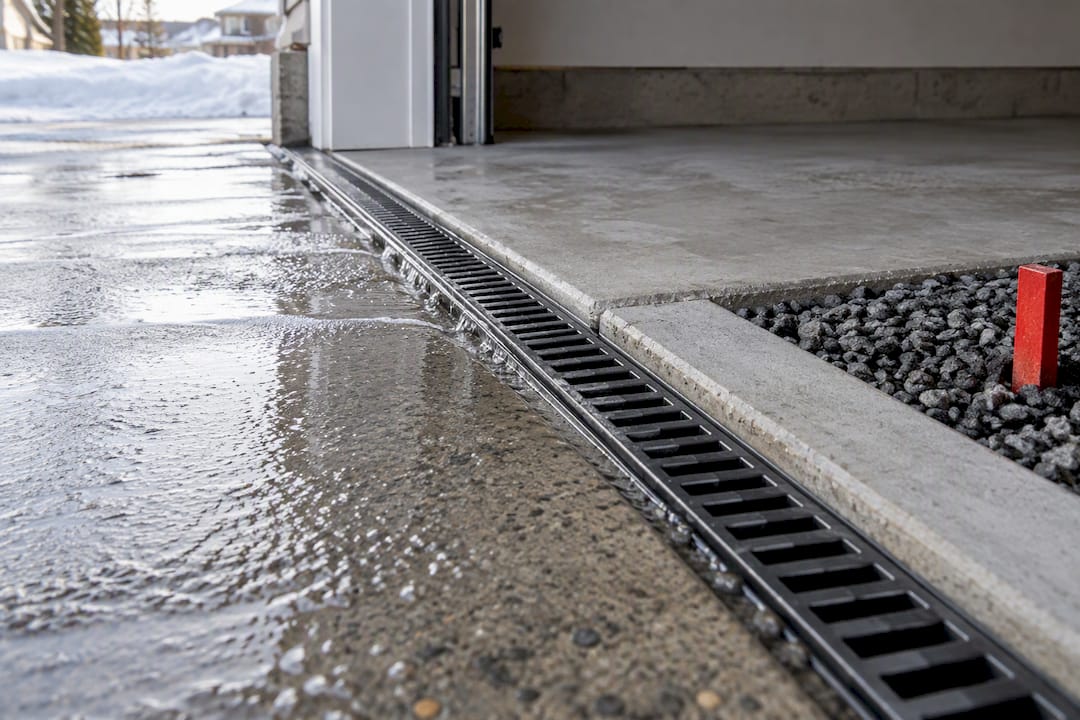
- Trench or channel drains at low points. A metal or polymer channel drain set into the concrete or asphalt at a garage threshold or a low point in the driveway catches surface water before it pools. These hold up well under vehicle loads and are usually the better call than a French drain when the problem is purely surface water crossing a defined line.
- French drains for perimeter and subsurface water. When water is saturating the ground beside the driveway or foundation rather than just running across the surface, a French drain does the real work. National guidance on French drains, trench drains and weeping tiles recommends a sloped trench with filter fabric and aggregate; in Edmonton clay, that means wider trenches and coarser stone than the national minimum.
- Dry wells and daylight outlets. Where there’s no storm connection nearby, water can be piped to a gravel-filled dry well or daylighted to a lower point on the lot. The City’s drainage bylaw restricts where that outlet can discharge, so this option needs a check against your lot grading plan before you dig.
Trench drains cost less to install and are easier to clean out, but they only manage what’s already on the surface. French drains cost more and take longer to install, but they intercept water before it saturates the base under your driveway.
What does driveway drainage cost in Edmonton?
Cost depends heavily on depth, distance to an outlet, and whether pavement has to be cut and repaired. French drain installation in Edmonton typically runs $40 to $80 per linear foot for exterior yard drains, with a standard residential project landing between $2,000 and $6,000 total.
A few factors move a quote up or down significantly:
- Excavation depth and clay disposal. Deeper trenches in dense till mean more machine time and more spoil to haul away, since clay can’t simply be reused as clean backfill.
- Stone quality and quantity. Coarse 20 to 40 mm clear stone costs more per tonne than pit-run gravel but is the material that keeps clay fines out of the pipe.
- Outlet distance. A drain that has to travel 25 metres to daylight or a dry well costs more than one that outlets 5 metres away.
- Surface repair. Cutting and replacing asphalt or a section of concrete driveway to install a channel drain adds a separate line item beyond the drain itself.
- Site access. Tight urban lots with limited equipment access add labour hours compared to a wide-open acreage.
Frozen ground is its own cost driver. Excavation in Edmonton between roughly November and March often requires frost breaking or is postponed until spring, which can push project timelines by months if you wait too long into fall.
A short trench drain at a garage threshold might run near the low end of that per-foot range. A full driveway-length French drain tied into a dry well, with asphalt patching on top, sits at the higher end or above it once surface repair is added.
How installation works and how long it takes
A proper drainage install follows a set sequence, and skipping steps is exactly how a project fails within two winters.
- Utility locates and grading review. Before any excavation, utility lines get located and the crew confirms current lot grading and whether a permit or lot grading approval applies to the work.
- Excavation. The trench is dug to the depth and width the design calls for, typically deeper and wider in Edmonton clay than national minimums suggest.
- Bedding and stone placement. A geotextile liner goes down first, coarse clear stone is placed as bedding, then the perforated pipe is set at the correct slope.
- Backfill and geotextile wrap. The fabric is folded fully over the stone before backfilling, sealing clay fines out of the system.
- Surface repair. Asphalt or concrete is restored over the trench line, matched to the existing surface where possible.
A single trench drain at a garage entrance can often be completed in a day. A full driveway-length French drain with surface repair typically takes two to four days depending on length and weather. Have your lot grading certificate or survey on hand if you have one, since it speeds up the pre-assessment.
City rules and lot grading requirements you need to know
Edmonton property owners are legally responsible for keeping stormwater on their own lot and away from neighbouring properties. The City of Edmonton’s Drainage Bylaw 18093 requires approved lot grading in many cases and prohibits discharging drainage onto adjacent private property.
Key requirements to check before you start work:
- Swales between properties generally need a minimum slope, commonly around 1.5%, and a minimum unobstructed width, under the City’s residential lot grading guidance.
- Downspouts must discharge onto your own property, not directly onto a neighbour’s lot or a shared swale in a way that redirects volume unfairly.
- Any new drain outlet, including a dry well or daylight discharge, has to respect the bylaw’s rules on discharge location.
- Lot grading approval status is worth confirming before excavation starts, since non-compliant grading is a common surprise that stalls permits mid-project.
EPCOR’s surface drainage guidance is a useful reference for downspout placement and swale design if you want to check your setup before calling anyone in. For anything touching a shared property line or an existing lot grading certificate, the City’s lot grading office is the authority to confirm with directly.
Keeping your drainage system working for years, not seasons
Most drain failures in Edmonton aren’t sudden. They’re slow clogs from clay migration or sediment buildup that show up as renewed pooling a few years after installation.
Routine upkeep that actually matters:
- Clear leaves and debris from surface grates and catch basins each spring and fall.
- Check that downspout extensions haven’t been knocked loose or buried by snow removal equipment.
- Watch for soft or sunken spots along the drain line, which can signal gravel settling or geotextile failure underneath.
- Flush accessible cleanouts if your system has them, ideally once a year.
Properly built French drains with a full geotextile wrap and coarse stone commonly last 15 to 20 years in Edmonton clay, though components can fail earlier if the original design skimped on stone size or trench depth. Channel drains have shorter grate lifespans, often 8 to 12 years, before the surface hardware needs replacing.
Pro Tip: A sudden return of pooling at a spot that was previously dry is usually a red flag for pipe collapse or severe sediment blockage, not a minor issue. That’s the point to call a professional rather than try a DIY fix.
How ProZone designs drainage for Edmonton conditions
ProZone builds drainage systems around the same clay and frost realities described above, not around a generic national spec sheet. The scope covers excavation, trench and channel drain installation, aggregate supply, and the asphalt or concrete surface repair that follows.
For Edmonton clay specifically, ProZone’s approach includes:
- Trenches cut deeper than national minimums to sit below the zone most affected by seasonal frost movement
- A full geotextile envelope around industrial-grade coarse stone, matching the design adaptations that hold up longest in local clay
- Washed road crush and drainage aggregate sourced and delivered for the specific bedding and backfill the design calls for
- Site documentation and grading checks consistent with Alberta Safety Codes requirements, rather than an informal eyeball assessment
Before a free site visit, have your current lot grading certificate (if one exists), photos of where water collects, and a rough sense of how long-standing water takes to clear after a rain. That information lets the crew scope excavation depth and outlet routing correctly on the first visit instead of guessing.
Stop the water before you fix the surface
Repairing cracked asphalt or resurfacing a driveway before fixing the drainage underneath it is a waste of money in Edmonton clay. Water finds the path of least resistance, and if that path runs under your new surface, the crack comes back within a season or two.
The sequence that holds up: fix the source of standing water first, whether that’s a downspout, a grading problem, or a subsurface saturation issue, then invest in durable surface materials once the water is under control. A full lot grading plan or an engineered French drain is worth the extra cost specifically when water is reaching the foundation or when repeated patch repairs haven’t held. Skipping straight to surface repair on a site with an unresolved drainage problem is the single most common mistake homeowners make.
— ProZone
Get a free ProZone site assessment before winter
There are cheap fixes worth trying first, and there are situations where a proper trench or French drain is the only thing that actually stops repeat damage. ProZone’s advantage for Edmonton homeowners and property managers is straightforward: a local crew that designs for glacial till clay and freeze-thaw from the start, using deeper trenches, full geotextile wraps, and industrial-grade stone instead of a generic gravel spec that fails within a few winters.
A free on-site assessment covers your current grading, where water is collecting, and whether a channel drain, French drain, or simple regrading solves the problem, with a written estimate to follow. The company also provides excavation, aggregate supply, and asphalt or concrete repair services to coordinate drainage and surface work together.
If your driveway is pooling, cracking, or heaving each spring, visit the ProZone services page or call directly to book your free estimate before frozen ground pushes the work into next year.
Sources
- French drain Edmonton: Exterior drainage for clay soil homes
- Surface drainage – EPCOR
- Mitigation of frost heave around manholes: a proven innovation
FAQ
What’s the best drainage for a driveway in Edmonton?
For surface water at a low point or garage threshold, a trench or channel drain usually performs best. For water saturating the ground beside the driveway or foundation, a French drain built with a full geotextile wrap and coarse stone, designed for clay, holds up longer than a standard gravel design.
How much does it cost to install a French drain system in Edmonton?
French drain installation typically costs $40 to $80 per linear foot for exterior yard drains, with a standard residential project running $2,000 to $6,000 depending on length, depth, and surface repair. ProZone provides exact pricing after a free on-site assessment since excavation depth and outlet distance vary by property.
How deep should a driveway drain be?
Depth depends on the drain type and local frost conditions, but Edmonton designs generally call for deeper trenches than the national minimum recommended for French and trench drains elsewhere in Canada, to sit below the depth most affected by seasonal frost movement.
Can you put a drain in a gravel driveway?
Yes, a French or trench drain can be installed alongside or across a gravel driveway, and the process is often simpler since there’s no asphalt or concrete to cut and patch afterward. The trench still needs the same geotextile wrap and coarse stone specification used for paved driveways, since gravel surfaces sit on the same problematic clay subgrade.