
Concrete curb types fall into seven functional categories: vertical or barrier curbs stop vehicles, mountable or rolled curbs allow controlled crossing, mower curbs edge landscape beds, integral and separate curb and gutter systems manage stormwater, depressed curbs form driveway returns, and decorative curbs add architectural detail. Municipal standard drawings and accessibility requirements determine which profile fits a given site.
Table of Contents
- Common curb types and where they belong on a project
- Curb profiles and the dimensions municipal drawings specify
- How to choose the right curb type for your site
- Concrete mixes and materials built for freeze thaw climates
- Installation standards and the tolerances inspectors enforce
- What ProZone sees in the field on curb and drainage failures
- Get a curb design review from ProZone
- Standards worth checking before you finalize a design
- Sources
- FAQ
Common curb types and where they belong on a project
Each curb type solves a distinct engineering problem, and confusing one for another creates drainage failures or accessibility violations down the line.
Vertical or barrier curbs stand at a full 90 degree face and physically block vehicle movement across the edge. They appear on arterial roads, medians, and anywhere pedestrian separation from traffic is a safety requirement rather than a preference.
Mountable or rolled curbs use a sloped or rounded face that allows a vehicle to cross at low speed without damage to the tire or suspension. Residential streets and driveway aprons use this profile because it tolerates occasional wheel encroachment without restricting parking.
Mower curbs, sometimes called sloped edging curbs, sit nearly flush with adjacent turf to let mower wheels ride over the edge. Landscape beds, boulevards, and low-traffic amenity areas rely on this type to reduce manual trimming.
Integral curb and gutter pours the curb and gutter as a single monolithic unit, while separate curb and gutter places them as distinct pours, often at different times. The choice affects joint behaviour and repair strategy more than appearance.
Depressed curbs, used at driveway returns, lower the curb height to grade so vehicles can enter a driveway without a lip. Decorative curbs add stamped or coloured finishes, most often in commercial plazas or residential frontage where appearance factors into the design brief.
- Vertical or barrier curb: arterial roads and medians where vehicle containment is required.
- Mountable or rolled curb: residential streets and low-speed commercial lots.
- Mower curb: landscape beds and boulevards where maintenance access matters.
- Integral curb and gutter: new construction where monolithic strength is preferred.
- Separate curb and gutter: phased projects or repair work needing independent replacement.
- Depressed curb: driveway returns and commercial access points.
- Decorative curb: plazas and frontage where finish is part of the design.
Vehicle routing, snow storage capacity, and mowing access all shift depending on which type a designer specifies, so the decision belongs early in the site plan, not as an afterthought during construction.
Curb profiles and the dimensions municipal drawings specify
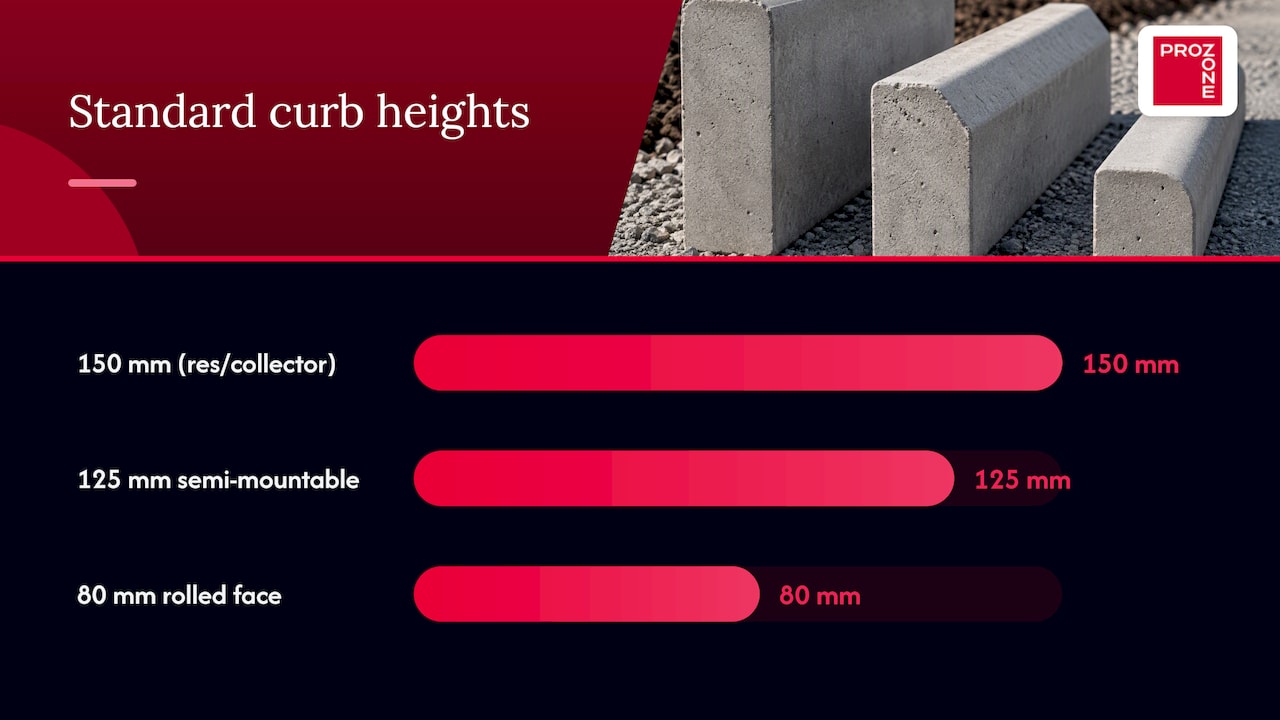
Standard drawings reference a limited set of profiles, and recognizing them speeds up plan review considerably.
City standard drawings typically show a curb paired with gutters of varying widths, along with a 125 mm semi-mountable curb and an 80 mm rolled face mountable curb with V-gutter variants, according to Complete Streets standard drawings. The gutter width chosen affects how much stormwater the curb line can capture before it sheets across the travel lane.
- 150 mm curb with 250 mm gutter: standard residential frontage with light stormwater loads.
- 150 mm curb with 500 mm gutter: collector roads and areas with higher runoff volumes.
- 125 mm semi-mountable curb: transitional zones where some vehicle crossing is expected.
- 80 mm rolled face curb with V-gutter: parking lots and low-speed commercial access.
Bus stops generally call for the taller vertical profile to protect the curb face from repeated wheel contact during docking. Commercial access points favour the mountable profile so delivery vehicles can cross without curb damage. Confirming the exact profile against the current municipal standard drawing set before finalizing a design, avoids a rejected submission later.
How to choose the right curb type for your site
Selecting a curb type means evaluating drainage capacity, vehicle movement, pedestrian accessibility, and snow management together rather than in isolation. A curb that handles stormwater well but blocks accessible route continuity fails the project just as surely as one that meets accessibility rules but pools water at every catch basin.
- Identify expected vehicle loads: heavy trucks and buses need vertical curbs; light residential traffic tolerates mountable profiles.
- Map parking and loading patterns: frequent loading zones often require depressed curbs or wider gutters.
- Locate drainage capture points: catch basin spacing dictates gutter width and curb height at each inlet.
- Verify accessible route continuity: curb ramps must meet accessibility standards for outdoor spaces at every crossing point.
- Assess snow storage needs: boulevards with heavy snow accumulation may need taller curbs or wider furnishing zones to hold plowed snow without blocking sightlines.
Transit operations, frequent commercial loading, or heavy snow storage are red flags that typically rule out a simple mountable curb in favour of a vertical or reinforced profile.
Pro Tip: Walk the site with the municipal standard drawing in hand before pouring forms; a profile that looks correct on paper can miss a catch basin invert by centimetres in the field.
Concrete mixes and materials built for freeze thaw climates
Edmonton’s freeze thaw cycles, where moisture in the concrete expands and contracts as temperatures swing above and below freezing, are the leading cause of curb scaling and cracking. Specifying the right mix matters more than any surface treatment.
- Air entrainment additives create microscopic voids that absorb the pressure of freezing water, reducing surface scaling over repeated cycles.
- Low permeability mixes limit water intrusion into the concrete matrix, slowing the freeze thaw damage that eventually spalls the curb face.
- Proper curing time, typically several days under controlled moisture, lets the concrete reach design strength before winter loading begins.
- Reinforcement bar is added at expansion joints and high load sections to control cracking rather than to increase raw strength.
Material and construction requirements referenced in OPSS.MUNI 353 govern the mix design, testing frequency, and acceptance criteria most municipal contracts follow. Base preparation and compaction underneath the curb matter more to long term performance than any decorative finish applied to the surface.
Installation standards and the tolerances inspectors enforce
Concrete curb installation lives or dies on tolerance compliance, not on how clean the forms looked on pour day.
Deviation beyond ±10 mm of the specified profile is grounds for removal and replacement on municipal projects, according to transportation inspector guidelines. That tolerance applies to curb height, gutter width, and face slope alike, and inspectors check it at multiple points along every run.
- Monolithic curb and gutter pours reduce joint count and are preferred for new construction with continuous grade.
- Separate pours suit repair work where only the curb or only the gutter needs replacement.
- Catch basin frames must be set to exact grade before the surrounding curb is poured to prevent ponding.
- Face forming against existing asphalt for short repairs is only acceptable when the adjacent edge is straight and free of cracking.
Contractors who test concrete to OPSS standards and confirm dimensions against the drawing before the pour cures avoid the cost of tearing out noncompliant sections. That single inspection step, done early, prevents most of the rework claims that follow municipal curb projects.
What ProZone sees in the field on curb and drainage failures
Most curb failures ProZone encounters trace back to a gutter width or catch basin placement that didn’t match the actual drainage load, not to a flaw in the concrete itself. Widening the gutter or repositioning an inlet by even a short distance often resolves recurring icing at a low point.
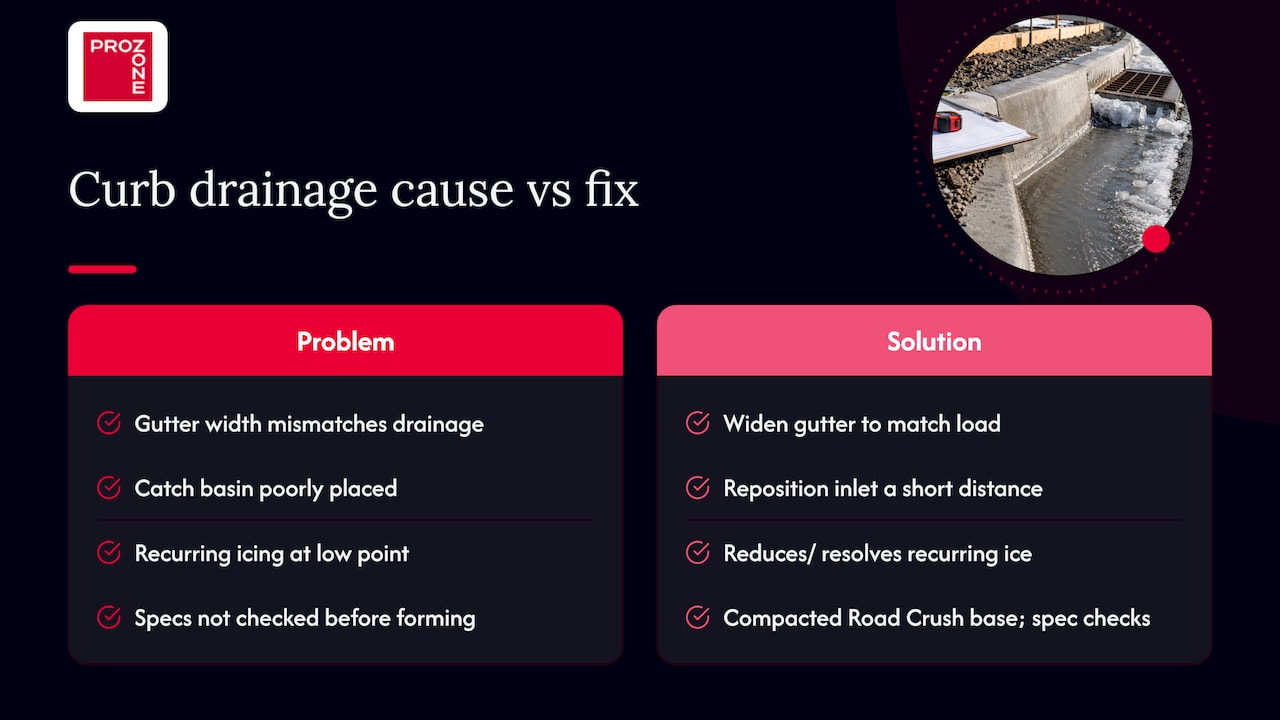
ProZone builds curb sections over a properly compacted Road Crush base and checks every specification against the municipal drawing before forms go in. That step, more than any surface treatment, is what keeps a curb from settling or heaving through its first winter.
Property managers and municipal engineers working through a design or a suspected failure can request a specification review as part of a free on-site consultation.
— ProZone
Get a curb design review from ProZone
Choosing the correct curb type on paper is only half the job. Certified crews, Alberta Safety Codes compliance, and freeze thaw rated concrete mixes are applied to every curb and sidewalk installation to reduce callbacks from cracking after winter.
- Curb and sidewalk installation matched to municipal standard drawings.
- Concrete services covering everything from new pours to targeted repairs.
- Landscaping and hardscaping materials supply for projects that pair curbs with adjacent grading.
Property managers, municipal contacts, and contractors can request a free on-site estimate through the curb and sidewalk services page or by calling ProZone directly to discuss a project scope.
Standards worth checking before you finalize a design
Municipal standard drawings, accessibility standards for curb ramps and tactile indicators, and OPSS.MUNI material specifications should sit on every designer’s desk. For compliance context beyond curbs, construction compliance guidance covers related 2026 requirements.
Sources
- Complete Streets standard drawings and volume 2 roadways
- Accessibility standards for outdoor spaces and curb ramps
FAQ
What are the different types of concrete curbs?
The main types are vertical or barrier curbs, mountable or rolled curbs, mower curbs, integral curb and gutter, separate curb and gutter, depressed driveway curbs, and decorative curbs. Each is chosen based on drainage needs, vehicle movement, and accessibility requirements at the site.
What is the best type of concrete for curbs?
There is no single best type; the right mix depends on climate and load. In freeze thaw regions, an air entrained, low permeability mix meeting OPSS.MUNI material standards performs best against scaling and cracking.
What is the difference between D curb and F curb?
Curb naming conventions vary by jurisdiction, so definitions of D curb and F curb differ between municipal standard drawing sets. Designers should confirm the exact profile letter designation against the current local drawing set rather than assume a universal definition.
What are the different types of curbing?
Curbing types include vertical, mountable, mower, integral, separate, depressed, and decorative variations, each tied to a specific function like traffic control, drainage, or landscape edging. Selection depends on the site’s drainage capture points, vehicle loads, and accessibility route requirements.