
TL;DR:
- Understanding construction site terminology is essential for safe and efficient project delivery across all roles.
- Consistent use of safety, contract, and structural terms improves communication, reduces delays, and minimizes risks.
Understanding construction site terminology is not optional for anyone working in or managing a build. Miscommunication caused by unclear or inconsistent terminology in construction leads to delays, budget overruns, and preventable safety incidents. Whether you are a site foreman, project manager, subcontractor, or infrastructure professional, knowing your construction vocabulary with precision directly affects how safely and efficiently work gets done. This guide covers the core terms, safety language, contract vocabulary, and practical strategies you need to communicate with authority on any job site.
Table of Contents
- Core construction site terminology by category
- Standardizing safety terminology across your site
- Contract terminology: JCT vs NEC explained
- Applying construction vocabulary on site every day
- My perspective on why terminology is a leadership issue
- How Prozoneltd supports professional site standards
- FAQ
Core construction site terminology by category
Construction vocabulary covers a broad range of fields, from structural components and plant equipment to contractual obligations and safety protocols. Getting grounded in the most common categories is where effective communication on site begins.
Structural and material terms
Formwork refers to temporary molds used to shape poured concrete until it sets. On large pours such as retaining walls or bridge decks, specifying the formwork type (timber, steel panel, or proprietary system) matters because each carries different load ratings and stripping timelines. Rebar (short for reinforcing bar) is the steel embedded in concrete to provide tensile strength. Calling it “steel” or “wire” on site creates confusion with mesh reinforcement, which serves a different structural purpose.
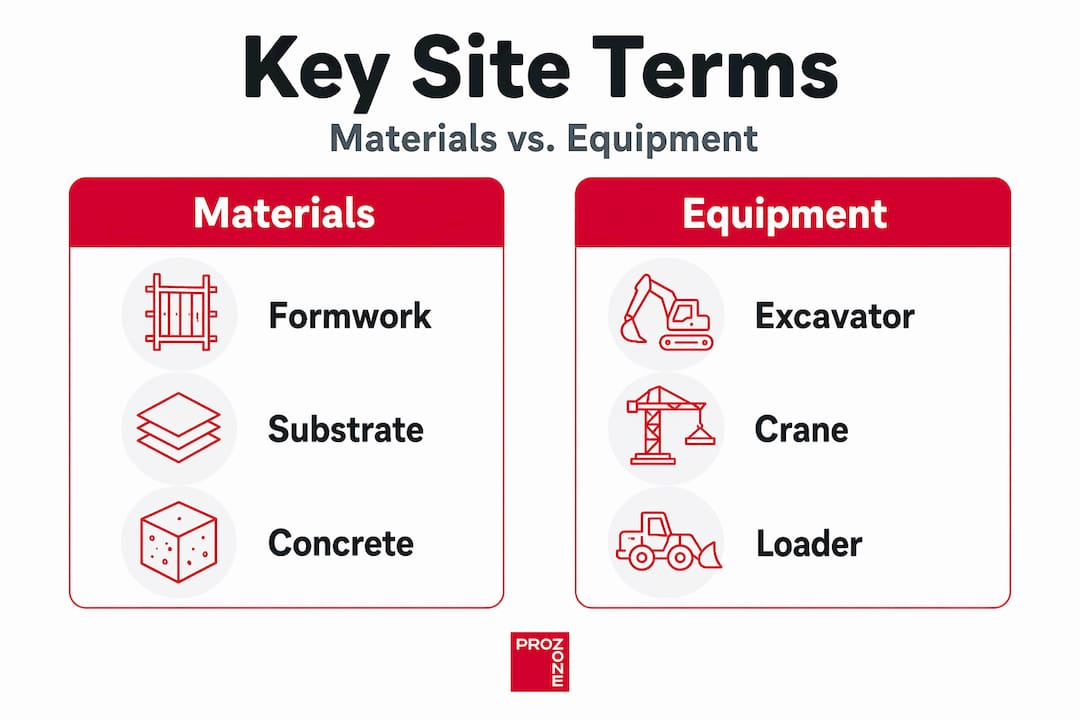
Substrate is the underlying material or surface to which something is applied or upon which it rests. For paving and concrete work, correctly identifying whether the substrate is compacted granular base, existing asphalt, or native ground determines the preparation method. Mixing this term up with “subgrade” (the natural or compacted soil layer below all constructed layers) is a common error that can compromise a pavement design.
Plant and equipment terms
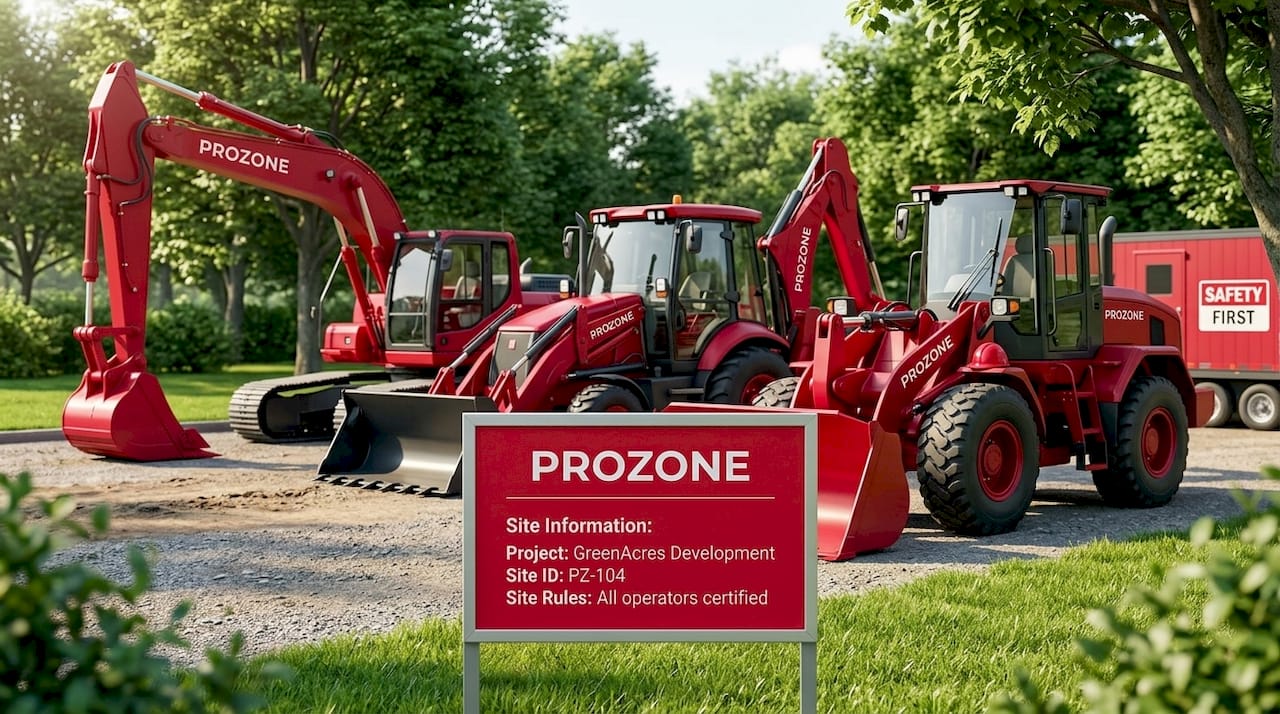
Knowing the difference between excavator, backhoe, and loader prevents costly ordering mistakes. An excavator digs with a fixed cab rotating on a tracked base. A backhoe is typically a wheeled machine with a digging bucket on the rear and a loader bucket on the front. A loader moves and loads bulk materials but does not dig with precision. Calling the wrong machine creates scheduling gaps and idle time.
Crane lift plans and rigging procedures are documents that accompany every crane operation. They specify load weights, lift radii, crane configurations, and ground bearing requirements. Referring to a lift plan simply as “the crane paperwork” loses the specificity that safe operations depend on.
Key safety terms on site
Understanding safety-related construction terms protects workers and keeps projects legally compliant. Here are the most critical ones you will encounter:
- RAMS (Risk Assessment and Method Statement): A combined document that identifies hazards for a specific task and details the safe working method to mitigate them. RAMS must be task-specific, not generic.
- TBT (Toolbox Talk): A short, focused safety briefing held on site before a task begins or at the start of a shift. TBTs are most effective when they address current site conditions, not scripted generic topics.
- PTW (Permit to Work): A formal authorization confirming that safety measures are in place before high-risk work such as hot work, confined space entry, or work near live utilities begins. A permit to work verifies RAMS adherence but can become a tick-box exercise if overused, creating what the industry calls “permit fatigue.”
- Near Miss: Any unplanned event that did not result in injury or damage but had the potential to do so. Reporting near misses is a leading indicator of site safety culture.
- Exclusion Zone: A defined area around hazardous operations (crane lifts, ground works near utilities, demolition) where unauthorized personnel are prohibited.
Pro Tip: When writing RAMS documents, tie each hazard control directly to the method step it covers. A RAMS where controls are listed separately from the method is harder to use in the field and more likely to be ignored.
Contract and project management terms
Programme: The construction schedule, not just a timeline. A programme shows logical sequencing, dependencies, float (spare time in a task sequence), and critical path. On NEC contracts, the Accepted Programme is a formal contract document. Getting this wrong costs money.
Variation: A formal change to the contracted scope of work, typically issued under JCT contracts. It triggers a valuation process using contract rates or daywork. The term “change order” is more commonly used in North American contracts and carries the same core meaning.
Compensation Event: The NEC equivalent of a variation. It covers scope changes, employer risk events, and other defined triggers that entitle the contractor to additional time and cost. Calling a compensation event a “variation” on an NEC project signals that someone does not understand the contract they are working under.
Standardizing safety terminology across your site
Why inconsistency causes accidents
Only 45% of hazards are identified during pre-job planning. That statistic is directly tied to how teams talk about risk. When one trade calls a barrier a “crash fence,” another calls it a “hoarding,” and a third calls it a “pedestrian barrier,” the shared mental picture breaks down. In an emergency, that confusion costs time. Time costs lives.
Construction Safety Week 2026 has placed unified jobsite safety language at the center of its agenda, specifically targeting terms like RAMS, TBT, and hazard categories to build a consistent framework across trades and regions. The underlying logic is sound: if every worker on a mixed trade site uses identical terms for the same hazard controls, recognition and response speed both improve.
OSHA fall protection: a terminology case study
Fall protection is where terminology confusion has real regulatory consequences. OSHA fall protection standards have been the most cited violation for 15 consecutive years. In fiscal year 2025, OSHA issued 5,914 fall protection citations with penalties reaching $165,514 for willful violations.
The terminology itself creates confusion. Many field workers believe the fall protection trigger is always 6 feet. It is not. OSHA requires fall protection on unprotected sides and leading edges at 6 feet but at any height for holes and dangerous equipment below. Scaffolding carries a 10-foot threshold under separate standards. Field personnel often confuse the 6-foot rule with the 10-foot scaffold threshold, which leads to frequent noncompliance and citations.
Fall protection systems include three distinct types, each with different applications:
- Guardrail systems: Physical barriers installed at open edges. Passive protection that does not require worker action.
- Safety nets: Catch systems installed below work areas. Used where guardrails are impractical, such as on steel erection.
- Personal fall arrest systems (PFAS): Harness, lanyard, and anchor point combinations that stop a fall in progress. Workers must be trained on inspection, donning, and anchor point selection.
“A single safety language framework improves risk communication, speeds hazard recognition, and reduces delayed emergency responses. Industry leaders increasingly view terminology standardization as a non-negotiable element of site safety management.”
Additionally, 29 CFR 1926.503 mandates comprehensive training on fall hazards and the correct use of fall protection equipment before workers are exposed to those hazards. Knowing what a PFAS is in name alone is not compliance. Workers must be trained on its components and proper use.
Practical steps your team can take to standardize safety language on site:
- Adopt a site-specific safety glossary as part of your project start-up documentation.
- Reference OSHA and industry-standard definitions during TBTs rather than using informal site slang.
- Require RAMS documents to use agreed terminology consistently across all subcontractors.
- Brief site supervisors to correct terminology misuse in real time, not just during formal audits.
- Use Construction Safety Week resources to align your team with current industry language standards.
Contract terminology: JCT vs NEC explained
Why the contract form changes the vocabulary
Most construction professionals work across both JCT and NEC contracts at some point in their careers. The problem is that the two forms use fundamentally different language for similar concepts. Treating them as interchangeable creates risk in cost control, schedule management, and dispute resolution.
| Concept | JCT Term | NEC Term |
|---|---|---|
| Schedule | Contract programme | Accepted Programme |
| Scope change | Variation | Compensation event |
| Change valuation method | Retrospective, using rates or daywork | Prospective, against Accepted Programme |
| Risk event (employer caused) | Relevant event / relevant matter | Compensation event |
| Notice of delay | Contractor’s written notice | Early warning |
| Payment mechanism | Interim certificates | Payment assessment |
| Dispute resolution | Adjudication | Adjudication / Senior rep |
The difference between JCT and NEC is most visible in how changes are managed. JCT values variations retrospectively using contract rates or daywork sheets, meaning the price is calculated after the work is done. NEC assesses compensation events prospectively, forecasting the impact before committing to the work. This fundamentally changes how site managers should document and submit change-related records.
Critical terms to understand for cost control
Early Warning: Under NEC4, any party who becomes aware of a matter that could affect cost, time, quality, or an employer’s objectives is obligated to notify the other party via an early warning. Failing to issue early warnings can reduce the compensation you are entitled to claim. NEC4 contracts are management-driven, emphasizing live programme updates and early warnings rather than the traditional, role-based approach of JCT.
Float: The spare time built into a programme between tasks. On NEC contracts, ownership of float matters for compensation event assessments. If the Accepted Programme shows float before a completion date and a compensation event uses that float, it may not entitle the contractor to additional time. On JCT contracts, float is typically treated as a contractor-owned resource.
Daywork: A valuation method under JCT for work that cannot be priced using contract rates, typically minor instructed changes carried out under conditions that make accurate measurement difficult. Daywork sheets must be submitted and signed promptly or they lose validity.
Pro Tip: On NEC projects, keep your Accepted Programme updated monthly at minimum. An out-of-date programme weakens every compensation event you submit because the baseline for assessment becomes disputed.
Understanding the NEC and JCT contract differences helps contractors avoid common pitfalls in cost and schedule management that are otherwise only discovered after disputes arise.
Applying construction vocabulary on site every day
Mastering the building site glossary is only useful if it translates into how your team actually communicates. Here is where many sites fall short. The terms are known in the office but drift back into informal language on the ground.
Effective daily application of construction site jargon comes down to three areas: documentation discipline, verbal communication consistency, and cross-trade alignment.
- Documentation discipline: Use standard terminology in every written record. Daily reports, NCR (Non-Conformance Reports), RFIs (Requests for Information), and site instructions should use terms that match the contract and regulatory framework. Informal language in formal records creates ambiguity that is exploited in disputes.
- Verbal consistency: Site supervisors set the tone. When a supervisor uses precise terms during briefings and corrections, the team follows. When they use slang or shorthand, terminology degrades site-wide. Consistency starts at the supervisory level.
- Cross-trade alignment: On multi-trade projects, effective project planning documentation should include a shared glossary that all trade supervisors sign off on at mobilization. This prevents the scenario where different crews use different terms for the same hazard or process.
Additional practices that support consistent terminology use:
- Hold a project-specific terminology review at the pre-construction meeting, covering both safety and contract terms relevant to that scope.
- Post key terms and their definitions in the site cabin or welfare area where workers gather before shifts.
- When new subcontractors mobilize, include a terminology orientation as part of their site induction rather than assuming familiarity.
- Revisit terminology during TBTs when specific tasks, such as excavation near utilities or work at height, introduce terms that are not commonly understood.
- Audit site paperwork quarterly to identify where informal language is creeping back into formal records, then address it in supervisor briefings.
What does construction terminology mean in practical terms? It means having a shared language that allows every person on site, regardless of trade or background, to understand hazards, scope, schedule, and quality expectations without ambiguity.
My perspective on why terminology is a leadership issue
I have seen the direct consequences of terminology breakdowns on active projects, and the pattern is consistent. The failure rarely happens because someone does not know what a term means. It happens because two people think they are using the same term to mean the same thing, and they are not.
On one project I was involved with, the site team consistently referred to the “programme” as the “schedule” in daily verbal communication. That seems minor. But when compensation events were being assessed under the NEC4 contract, the Accepted Programme carried legal weight and the informal “schedule” did not. Records that referenced the “schedule” were treated as informal and excluded from the formal assessment. The contractor lost recoverable time entitlement because of that language gap.
What I have learned is that terminology is not just a communication preference. It is a technical control. On safety-critical tasks, a TBT that uses precise OSHA-defined terms for fall protection systems means workers go to the task with a shared and accurate mental model of what protection they have and when it applies. On contract matters, using the correct NEC or JCT term in every correspondence creates a paper trail that is unambiguous.
My advice to anyone in a supervisory or management role is to champion precise language actively. Correct informal usage in the field without making it a disciplinary event. Build it into inductions, TBTs, and documentation reviews. The sites that operate most efficiently are those where everyone, from the laborer to the project director, uses the same words to mean the same things. That consistency is built deliberately, not by accident.
— ProZone
How Prozoneltd supports professional site standards
Professional construction work demands more than technical skill. It requires clear communication, regulatory knowledge, and consistent site practices across every crew and task. Prozoneltd brings that discipline to every project it undertakes in Edmonton and the surrounding region.
From road construction services that comply with municipal safety and documentation standards, to concrete, excavation, and earthworks executed under established site protocols, Prozoneltd operates with the terminology, systems, and experienced teams that professional clients expect. Every site follows safety documentation requirements, including RAMS-aligned procedures and clearly defined permit-to-work processes where applicable.
If you are managing a construction or infrastructure project in Alberta and want a partner who understands both the technical work and the standards that govern it, review the full range of construction services for Edmonton managers that Prozoneltd offers. The combination of field experience and professional site management makes Prozoneltd a dependable choice for corporate, municipal, and private clients who cannot afford communication gaps on site.
FAQ
What is construction site terminology?
Construction site terminology is the specialized vocabulary used by construction professionals to communicate about tasks, hazards, materials, equipment, and contractual obligations on a job site. Using consistent terminology reduces miscommunication and supports both safety and project efficiency.
What does RAMS mean in construction?
RAMS stands for Risk Assessment and Method Statement. It is a combined document that identifies hazards for a specific construction task and outlines the safe method of work to control those hazards before the task begins.
What is the difference between a variation and a compensation event?
A variation is the JCT contract term for a formal change to the scope of work, valued retrospectively. A compensation event is the NEC equivalent, assessed prospectively against the Accepted Programme, covering scope changes and employer risk events.
When is fall protection required on a construction site?
OSHA requires fall protection at heights of 6 feet or more on unprotected sides and leading edges, and at any height when work is performed over dangerous equipment or holes. Scaffolding has a separate 10-foot threshold under its own standard.
What is a toolbox talk (TBT) in construction?
A toolbox talk is a short safety briefing conducted on site before a task or shift begins. It covers specific hazards relevant to the current work and is most effective when it uses standardized safety language aligned with the site’s RAMS documentation.
Key takeaways
| Point | Details |
|---|---|
| Safety terms must be standardized | Only 45% of hazards are identified during pre-job planning; consistent use of RAMS, TBT, and OSHA-defined terms closes that gap. |
| OSHA fall protection thresholds vary | The 6-foot rule applies to unprotected edges; scaffolding triggers protection at 10 feet. Confusing these leads to noncompliance and citations. |
| JCT and NEC use different vocabulary | Variations, programmes, and daywork under JCT have direct NEC equivalents with different processes. Using the wrong term in formal records creates contract risk. |
| Permit to work requires active management | PTWs are a strong control measure, but overuse leads to permit fatigue, reducing their effectiveness on site. |
| Terminology is a leadership responsibility | Consistent terminology starts with supervisors. Documentation discipline and cross-trade glossaries prevent language drift across a project lifecycle. |