
Professional rout-and-seal crack sealing in Edmonton typically runs $3 to $8 per linear metre for hot-pour rubberized sealant, while basic cold-pour filler costs $1.50 to $4 per linear metre. Hot-pour work suits driveways and lots facing repeated freeze-thaw cycling. Cold-pour filler fits low-traffic, low-movement cracks on a tighter budget. Either way, contractors price by measured crack length, not driveway square footage.
Table of Contents
- What does crack sealing cost in Edmonton? A line-item breakdown
- What actually drives the cost of crack sealing
- When can you actually seal cracks in Edmonton?
- When crack sealing isn’t the right fix
- How to get a fair, comparable crack sealing estimate
- Why ATT-73 compliance separates real contractors from the rest
- Our take: stop pricing by square footage
- Get a measured, no-surprise crack sealing estimate
- Sources
- FAQ
What does crack sealing cost in Edmonton? A line-item breakdown
Most Edmonton contractors quote crack sealing by the linear metre, and that single detail explains why two driveways of the same size can generate very different bids. A driveway with 20 metres of hairline cracking costs far less to treat than one with 60 metres of wider, actively moving cracks, even if both are 1,500 square feet.
Cold-pour crack filler generally runs $1.50 to $4 per linear metre installed. Hot-pour rubberized sealant, applied after routing, typically lands between $3 and $8 per linear metre, reflecting the extra labour and material cost of a longer-lasting repair.
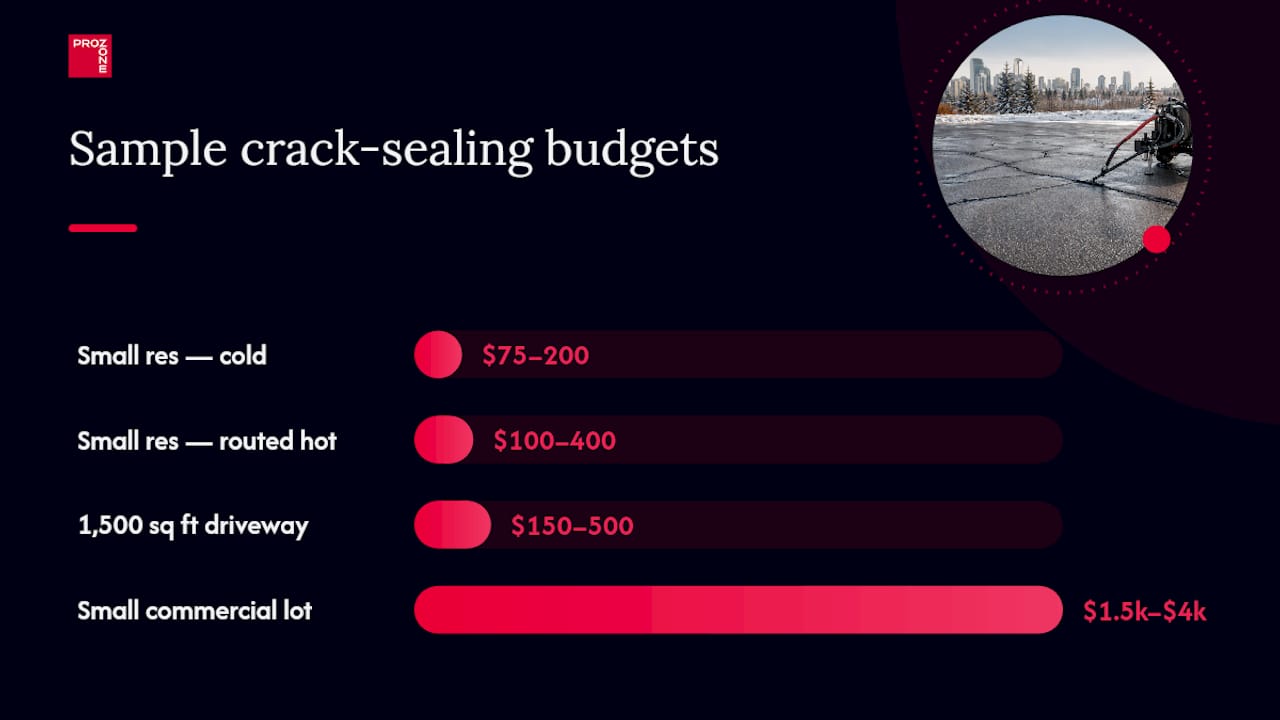
A few sample budgets illustrate the range:
- Small residential driveway (15 to 25 linear metres of cracking): roughly $75 to $200 for cold-pour, or $100 to $400 for routed hot-pour.
- 1,500 sq ft driveway with moderate cracking (40 to 60 linear metres): commonly $150 to $500 depending on material and routing needs.
- Small commercial lot (200 to 400 linear metres across multiple crack networks): often $1,500 to $4,000 once mobilization and traffic control are added.
These figures track with the wider local market. HomeStars’ Edmonton paving cost guide reports an average paving project cost near $5,389, with a full range of $800 to $16,000 depending on scope, which shows why a generic “driveway sealing” price without measured lengths is close to meaningless.
A proper quote itemizes routing, sealant material, mobilization, and any traffic control separately, rather than bundling everything into one flat number. Watch for quotes missing a measured length entirely. That is usually a sign of a rough visual estimate rather than a real site assessment.
What actually drives the cost of crack sealing
Total linear crack length is the number that matters most. An estimator who skips measuring and eyeballs the job instead is guessing, and that guess tends to land on the high side to cover their own risk.
Crack width and movement matter almost as much. A “working crack” that opens and closes with temperature swings needs a flexible rubberized sealant, while a stable, non-working hairline crack can often take a cheaper cold-pour product.
Preparation adds real hours to the invoice. Routing to create a proper reservoir, hot-air lance cleaning to remove debris, drying time, and oil or vegetation removal all show up as line items on a legitimate quote.
- Total linear metres of crack (the base unit for pricing)
- Crack width and whether it is actively moving
- Routing and cleaning requirements
- Material choice: cold-pour filler versus rubberized hot-pour sealant
- Site access, mobilization, and any required traffic control
Lifecycle cost matters more than sticker price. NRC guidance on crack sealing cost-effectiveness shows rout-and-seal has a higher installation cost but a lower annualized cost when service life is longer, compared to filling alone.
Pro Tip: Ask your estimator for the total linear metres measured on your property, not just a lump-sum number. If they cannot produce that figure, they likely priced the job by eye rather than by proper site assessment.
When can you actually seal cracks in Edmonton?
Timing determines whether a crack sealing job lasts one winter or five. The reliable window for hot-pour rout-and-seal work runs from late summer through mid-fall, when cracks are wide open from summer heat cycling and before the first hard frost locks in moisture.
Some cold-pour work can proceed in late spring once the surface has fully dried from snowmelt. Temperature is not a suggestion here. NRC guidance specifies cold-pour emulsions need air temperatures above roughly 10 to 15°C, with surface-dry times of 15 to 45 minutes at 15°C and full curing taking 8 to 12 hours.
Rain, dew, high humidity, and frost risk all threaten adhesion during that curing window. A contractor working in Edmonton’s shoulder seasons needs to track forecasts closely and be willing to delay a job rather than seal a damp crack that will debond by spring.
When crack sealing isn’t the right fix
Crack sealing is a preventive treatment for structurally sound pavement, and it will not fix a surface that has already failed structurally. Applying sealant over a broken base just delays the inevitable, at your expense.
Watch for these signs that you need patching, localized replacement, or reconstruction instead:
- Alligator cracking: a web of interconnected cracks signalling base failure
- Heaving or settled areas: uneven surface movement from subgrade problems
- Ponding water: poor drainage that will keep undermining any sealant
- Edge failure or crumbling: material breakdown beyond a simple crack
Alberta’s crack maintenance guidelines explicitly separate crack treatment from repairs where alligator cracking, settlement, or failed base material is present. A quote should reflect that same separation, listing crack sealing and any patching or plastasphalt repair as distinct line items rather than one vague “asphalt fix” price. Walk your property before calling anyone and photograph anything beyond a clean linear crack.
How to get a fair, comparable crack sealing estimate
Getting quotes that you can actually compare starts with your own prep work, not the contractor’s. Walk the property, mark or photograph every crack, and estimate total linear length for each area. Alberta’s estimating guidance recommends noting movement, intersecting cracks, and any oil contamination, since these details change both method and price.
A written quote should include:
- Measured crack length in linear metres, not an estimated square footage
- Routing method and whether a reservoir cut is included
- Sealant type or performance grade (cold-pour filler versus rubberized hot-pour)
- Temperature controls and curing time before the surface reopens to traffic
- Warranty or workmanship terms in writing
If two quotes differ significantly, ask each contractor for their measured linear metres first. That single number usually explains the gap faster than any conversation about pricing.
Why ATT-73 compliance separates real contractors from the rest
Edmonton’s freeze-thaw cycle punishes shortcuts. A crack sealed with the wrong material, at the wrong temperature, or without proper routing can fail within a single winter, and NRC cold-climate testing shows poorly selected or applied sealants can debond within three years, versus five or more when installed correctly.
The crack sealing process is built around Alberta’s ATT-73 specification rather than generic industry practice. That means:
- Rout cross-section and crack length measured to spec, not estimated
- Sealant discharge temperature checked and documented during application
- Surface moisture and weather conditions verified before work proceeds
- Scope kept separate: crack sealing quoted apart from patching or reconstruction
That discipline is what ATT-73’s quality assurance requirements exist to enforce, and it is the difference between a repair that survives an Edmonton winter and one that reopens by March.
Our take: stop pricing by square footage
Most homeowners still ask “what does it cost per square foot,” and that is the wrong question. Crack sealing is priced and specified by linear metre, and any contractor quoting by driveway area alone is either simplifying for convenience or has not actually measured your property.
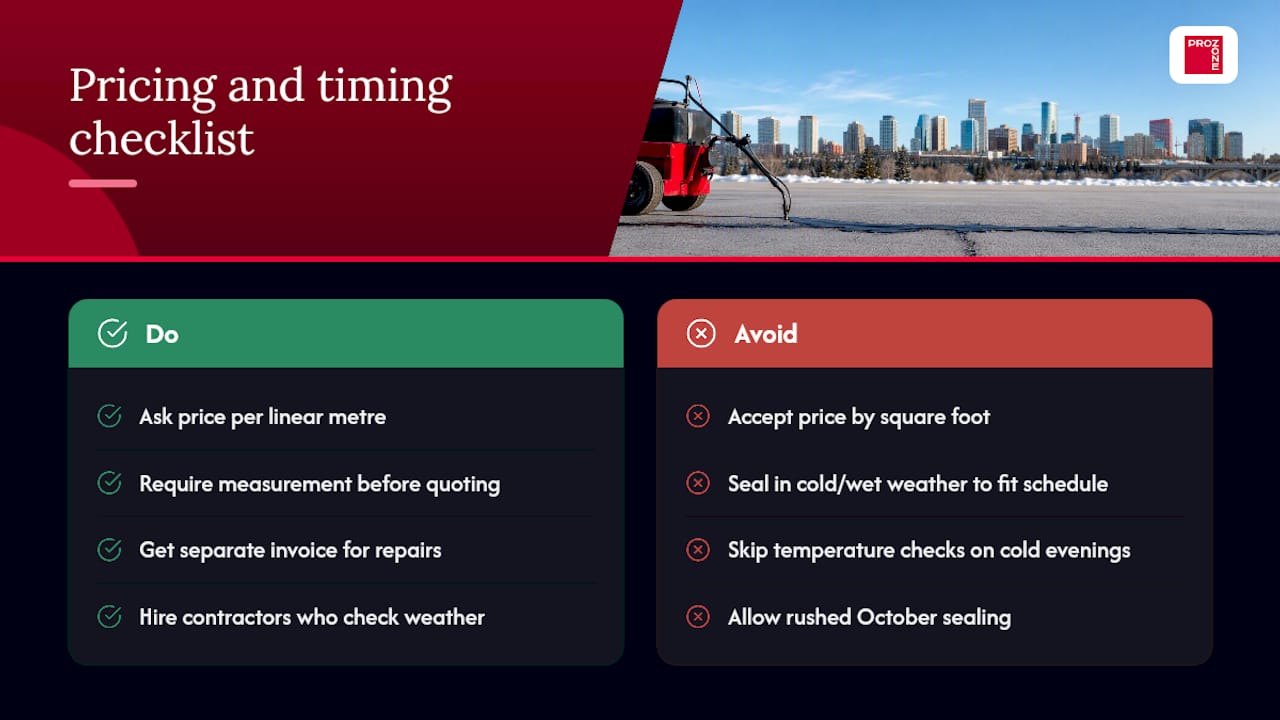
The bigger issue we see across Edmonton properties is timing, not price. A contractor who will seal cracks in October rain to fit a schedule, or who skips a temperature check on a cold October evening, hands you a repair that fails before the sealant has done a single season of work. NRC’s curing data and Alberta’s ATT-73 temperature checks exist precisely because cold-climate sealing punishes rushed work.
Prioritize a contractor who measures before quoting, separates crack sealing from structural repair on the invoice, and will tell you “not yet” if the weather is wrong. That patience costs nothing and saves you a repeat repair bill next spring.
— ProZone
Get a measured, no-surprise crack sealing estimate
Every crack sealing job is priced by measured linear metre against ATT-73 specification, not by guessing at driveway size, so quotes reflect the actual work rather than a generic square-footage average. That is the gap between a contractor who eyeballs your driveway and one who inspects it against a provincial standard.
To speed up your estimate, have a few photos of the worst cracking ready, a rough sense of total crack length if you have measured it, and note any drainage or ponding issues you have noticed. From there, request a free on-site consultation within 100 km through our asphalt services page, or reach out directly through our contact form to book an estimate. Every job follows Alberta specification for routing, temperature control, and quality assurance, so what you’re quoted is what actually gets installed.
Sources
- Guidelines for sealing and filling cracks in asphalt concrete pavement (NRC)
- Crack maintenance guidelines and procedures (Alberta government)
- Paving contractor cost guide Edmonton (HomeStars)
FAQ
How much should crack sealing cost per linear metre in Edmonton?
Cold-pour filler typically runs $1.50 to $4 per linear metre, while routed rubberized hot-pour sealant runs $3 to $8 per linear metre. The final number depends on crack width, movement, and how much routing and cleaning the surface needs.
How much does it cost to repair foundation cracks in Edmonton?
Foundation crack repair is a separate structural trade from asphalt or driveway crack sealing, and pricing depends on crack depth, location, and whether water intrusion is present. If your issue is driveway or parking lot surface cracking rather than a building foundation, that falls under standard crack sealing pricing, not foundation repair.
How much does it cost to seal a 1,500 sq ft driveway?
A 1,500 sq ft driveway with moderate cracking, typically 40 to 60 linear metres of cracks, generally costs $150 to $500 depending on material choice and routing needs. Larger crack networks or heavily working cracks push costs toward the higher end of that range.
What is the typical cost of sealing a driveway in Canada?
Costs vary by region, material, and crack length, but Edmonton-area rates of $1.50 to $8 per linear metre are consistent with broader Canadian averages for cold-pour and hot-pour sealants. Local guides like HomeStars’ Edmonton paving cost data show overall paving and repair project costs ranging from $800 to $16,000 depending on scope, which reinforces why a measured, itemized quote matters more than a flat average.