
Seven decorative rock categories cover nearly every landscaping job: river rock, pea gravel, crushed rock, granite, limestone, basalt and slate, and decorative boulders. The core rule is simple: choose by function first (drainage, stability, mulch coverage or visual accent), then confirm the stone’s density holds up to repeated freeze-thaw cycling. Premium graded stone is available for order.
Table of Contents
- Common decorative rock types and what each is best for
- How to choose decorative rock for function and climate
- Sizing, grading and installation essentials
- Maintenance, longevity and cost considerations
- Installer priorities for durability in freeze-thaw climates
- How to order stone or book an estimate with ProZone
- Sources
- FAQ
Common decorative rock types and what each is best for
Each rock type carries its own size range, density and intended use. Matching the material to the job prevents the two most common failures: migration under traffic and surface breakdown after repeated freezing.
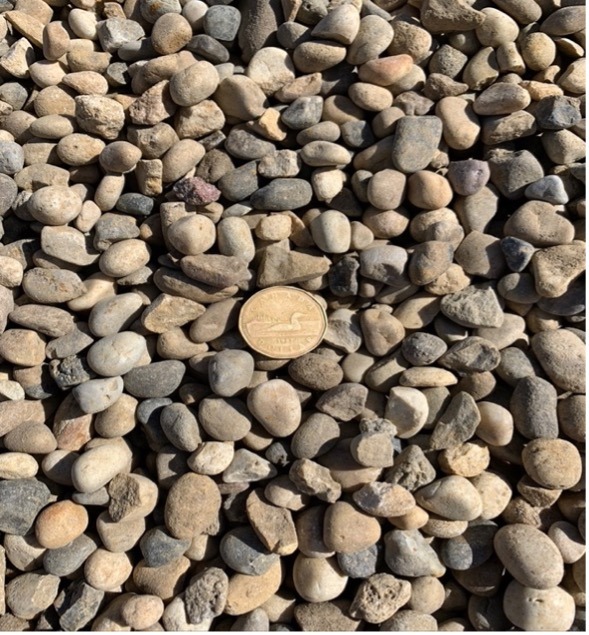
River rock is a smooth, water-tumbled stone sold in ranges from about 20 to 300 millimetres. Smaller grades work as groundcover and drainage beds, while larger stones serve as accents around downspouts and dry creek beds. ProZone’s river rock in the 20 to 40 millimetre range suits tight borders, while the 100 to 300 millimetre stock handles larger accent features and erosion control.
Pea gravel runs roughly several millimetres and compacts loosely, which makes it a common choice for pathways and mulched beds. It drains well but does not lock together the way angular stone does, so it migrates under foot traffic and needs periodic topping up.
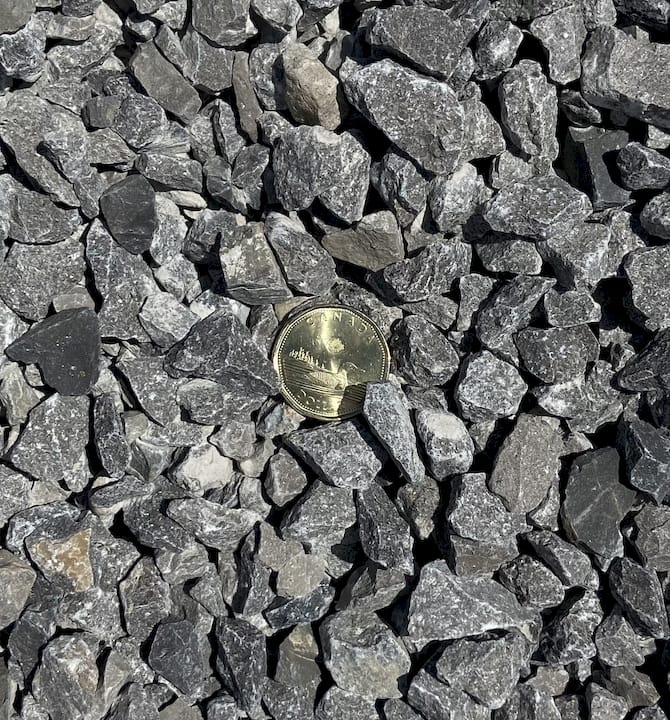
Crushed rock, often called road crush, is angular and compacts tightly when mechanically packed. That interlocking structure makes it the standard subbase material for driveways, parking areas and paths carrying regular loads. ProZone’s road crush is a common base layer under surface stone.
Granite is dense and resists water absorption, which is the property that matters most where ground temperatures swing above and below freezing through the winter. According to Natural Resources Canada, granite typically absorbs less than 0.4% of its weight in water, a figure that explains why it holds up to repeated freeze-thaw cycles better than more porous stone.
Limestone offers a soft, light aesthetic and is popular for pathways and accent borders, but it is more porous than granite. In climates with frequent freeze-thaw swings, that porosity allows absorbed moisture to expand and contract within the stone, which can accelerate surface flaking over time.
Basalt and slate bring darker, textured finishes suited to modern garden designs and accent borders. Both are reasonably dense and perform well as decorative surface stone, though neither is typically specified as a structural subbase material.
Decorative boulders and slabs anchor larger landscape features and retaining wall faces. They require mechanical handling and excavation planning before placement, since even modest boulders weigh several hundred pounds.
For readers shortlisting in-market products, ProZone carries Crystal White Rocks, a washed white stone suited to bright accent beds, alongside Majestic Midnight Rock for dark contrast borders and Montana Rainbow Rock for multi-tone accent applications. The full decorative rock and landscape stone selection covers sizing and colour options for both residential and commercial projects.
- River rock: smooth, 20 to 300 millimetres, best for drainage beds and accents.
- Pea gravel: 6 to 10 millimetres, best for pathways and loose mulch coverage.
- Crushed rock: angular, compacts tightly, best for driveway and path subbase.
- Granite: dense, low absorption, best for exposed freeze-thaw locations.
- Limestone: porous, best for low-exposure accent and border use.
- Basalt and slate: textured, best for modern accent borders.
- Decorative boulders: large format, best for retaining features and focal points.
How to choose decorative rock for function and climate
Start with the job the stone needs to do. Drainage beds call for angular or rounded stone with enough void space to move water; stability under a driveway calls for crushed, compactable material; a visual accent bed calls for colour and finish over structural performance.
Freeze-thaw exposure changes that priority list, a factor critical when considering options like siding vs stucco for Canadian homes that must endure harsh exterior climates. In locations where stone sits exposed to repeated freezing and thawing, denser, low-absorption materials like granite hold up better than porous sedimentary stone, since trapped moisture that expands during freezing is what drives surface damage.
Rounded river rock and angular crushed stone behave differently under load. Angular edges interlock and resist lateral movement, which is why crushed rock is the default subbase choice, while rounded river rock shifts more easily and suits decorative beds rather than load-bearing applications.
Spec-aware buyers working to municipal or commercial standards should confirm gradation against recognized benchmarks. City of Brampton landscape specifications reference sieve gradation limits and testing to ASTM and CAN/CGSB standards, and most municipal contracts require submitting samples for sieve analysis before installation.
Pro Tip: Request a sieve gradation sheet from your supplier before ordering bulk stone for any municipal or commercial contract.
- Match stone function to the job: drainage, stability or accent.
- Favour low-absorption stone like granite for exposed freeze-thaw areas.
- Use angular crushed stone where load-bearing stability matters.
- Confirm gradation against ASTM or CAN/CGSB benchmarks on spec-driven projects.
Sizing, grading and installation essentials
Stone size determines function as much as material choice does. Gravel smaller than roughly 0.5 inch packs tightly enough to suppress weeds and regulate soil moisture, while larger accent stone trades that mulch-like benefit for visual presence.
A sound subbase prevents the two most common cold-climate failures: frost heave and surface settling. The NRC-IRC frost heave digest notes that coarse sand and clean gravel resist heaving, while fine sand and silt are frost-susceptible, and an added six inches of clean granular fill meaningfully reduces spring thaw softening under surface coverings.
Geotextile fabric placed between native soil and aggregate prevents fine soil from migrating up into the stone layer, which Natural Resources Canada notes helps preserve drainage and reduces long-term maintenance.
- Excavate to the required depth and remove organic material.
- Lay geotextile fabric across the exposed subgrade.
- Place and compact clean granular fill in layers.
- Install edge restraint to contain the stone layer.
- Spread and level the decorative stone to final grade.
Maintenance, longevity and cost considerations
Smaller, lighter-coloured stone shows organic debris and staining faster than large, dark aggregate, so white or pale stone beds need more frequent rinsing or raking to stay clean. Porous stone also traps organic matter in surface pits, which accelerates discolouration compared with dense, low-absorption material.
Winter maintenance adds its own pressures. Snow clearing on stone beds risks scattering material if equipment operators are not careful, and de-icing salt can stain porous stone over repeated seasons.
Smaller gravels under about 0.5 inch work better as functional mulch for weed suppression and moisture regulation, while larger stone trades that benefit for appearance; this background framing is consistent with industry guidance on aggregate sizing for landscape beds.
Dense stone like granite or basalt typically outlasts porous limestone in exposed freeze-thaw beds before surface flaking requires a top-up or replacement. Cost drivers include specialty colour or imported stone, delivery and handling to the site, and whether the material has been screened and washed to remove fines.
- Lighter-coloured stone requires more frequent cleaning than dark aggregate.
- De-icing salt can stain porous stone over multiple winters.
- Dense, low-absorption stone generally lasts longer in exposed beds.
- Specialty colour, delivery and washing are the main cost drivers.
Installer priorities for durability in freeze-thaw climates
Most decorative rock failures trace back to two shortcuts: skipping geotextile fabric and under-building the granular subbase. Installers who test subgrade conditions and specify dense, low-absorption stone see far fewer callback requests after the first freeze-thaw season.
Property managers preparing to order should confirm stone density, gradation and delivery volume before the project date. Current product stock and project experience provide a practical starting point for that conversation.
How to order stone or book an estimate with ProZone
Choosing the right decorative rock is only half the job. Getting graded, properly sourced material delivered on schedule is where most landscaping timelines actually slip, and that is where ProZone’s landscape supplies centre and project services close the gap for Edmonton-area property managers and homeowners.
ProZone supplies decorative rock alongside base materials and full installation support, so you order stone and schedule the groundwork through one contact.
- Browse Crystal White Rocks, Majestic Midnight Rock and Montana Rainbow Rock for in-stock colour options.
- Review the full services menu for excavation, base work and delivery support.
- Request a free on-site estimate through the online contact form or by calling ProZone directly.
For project-specific questions on sizing, gradation or delivery timelines, reach ProZone through the contact page to book a free estimate.
Sources
- CBD-26. Ground freezing and frost heaving – NRC-IRC
- City of Brampton landscape specifications section 02701
FAQ
What are the different types of decorative rocks?
The main categories are river rock, pea gravel, crushed rock, granite, limestone, basalt and slate, and decorative boulders. Each suits a different function, from drainage and pathways to structural subbase and accent features.
What are the different types of decorative stones?
Decorative stones generally fall into the same categories as decorative rocks: rounded river stone, crushed angular aggregate, and dense ornamental stone like granite, basalt or slate. The choice depends on whether the job needs drainage, compaction strength or visual contrast.
What is the most popular decorative stone?
River rock and granite are among the most widely used decorative stones because of their versatility and, for granite, its low water absorption and strong freeze-thaw performance noted by Natural Resources Canada. Popularity varies by region and by whether the project needs structural stability or purely decorative coverage.
What type of rock is best for landscaping?
There is no single best rock for every job: crushed rock suits driveways and paths that need stability, while dense, low-absorption stone like granite suits exposed beds in freeze-thaw climates. Pea gravel and river rock work well for mulch coverage and drainage where load-bearing strength is not required.