
TL;DR:
- Contractor models save Edmonton property managers 40-50% compared to in-house staffing costs.
- Professional contractors reduce project overruns and increase on-time, on-budget completion rates.
- Hybrid approaches balance routine maintenance with specialized contractor expertise for optimal results.
Most property managers in Edmonton assume keeping construction and maintenance work in-house saves money. It feels logical: you control the schedule, you know your staff, and you avoid contractor markups. But that assumption quietly costs you more than you realize. The real math, when you factor in wages, benefits, equipment, training, liability, and project overruns, tells a very different story. Contractors bring economies of scale, specialized skills, and risk management tools that in-house teams rarely match. This guide breaks down the actual numbers, the risk factors, and the hybrid strategies that Edmonton’s most effective property managers are already using to protect their budgets and their portfolios.
Table of Contents
- Hidden costs and real savings: In-house vs. contractors
- Faster, safer projects: Project management and risk mitigation
- Specialized skills and hybrid approaches: Finding the right fit
- Beyond the build: Value adds for property managers
- Why the conventional wisdom on construction staffing misses the mark
- Find the right construction partner for your Edmonton property
- Frequently asked questions
Key Takeaways
| Point | Details |
|---|---|
| True cost savings | Contractors reduce overall expenses by avoiding the hidden costs of maintaining full in-house construction teams. |
| Less risk of overruns | Experienced contractors manage projects and risks, minimizing costly delays and budget surprises. |
| Access to specialists | Hiring contractors gives you expert skills and equipment when you need them, without long-term commitments. |
| Flexible, scalable solutions | Hybrid and contractor models adjust easily to changing property needs, from urgent repairs to major infrastructure upgrades. |
| More than construction | Contractors deliver ongoing value through vendor discounts, lower liability, and reduced property turnover costs. |
Hidden costs and real savings: In-house vs. contractors
Let’s start with the number most property managers never calculate: the true annual cost of a single in-house maintenance or construction worker. In Alberta, a skilled tradesperson earns between $65,000 and $90,000 per year in base wages. Add employer-side payroll taxes, health benefits, Workers’ Compensation Board premiums, vacation pay, and training costs, and that number climbs by 25 to 35 percent. Before that employee touches a single project, you’re already spending over $100,000 annually.
Then there’s equipment. Asphalt pavers, concrete mixers, compactors, and snow removal machinery each carry purchase, maintenance, storage, and depreciation costs that rarely show up in a simple budget line. A mid-size paving machine alone can cost $80,000 to $150,000, and it sits idle for months at a time in Edmonton’s shoulder seasons.
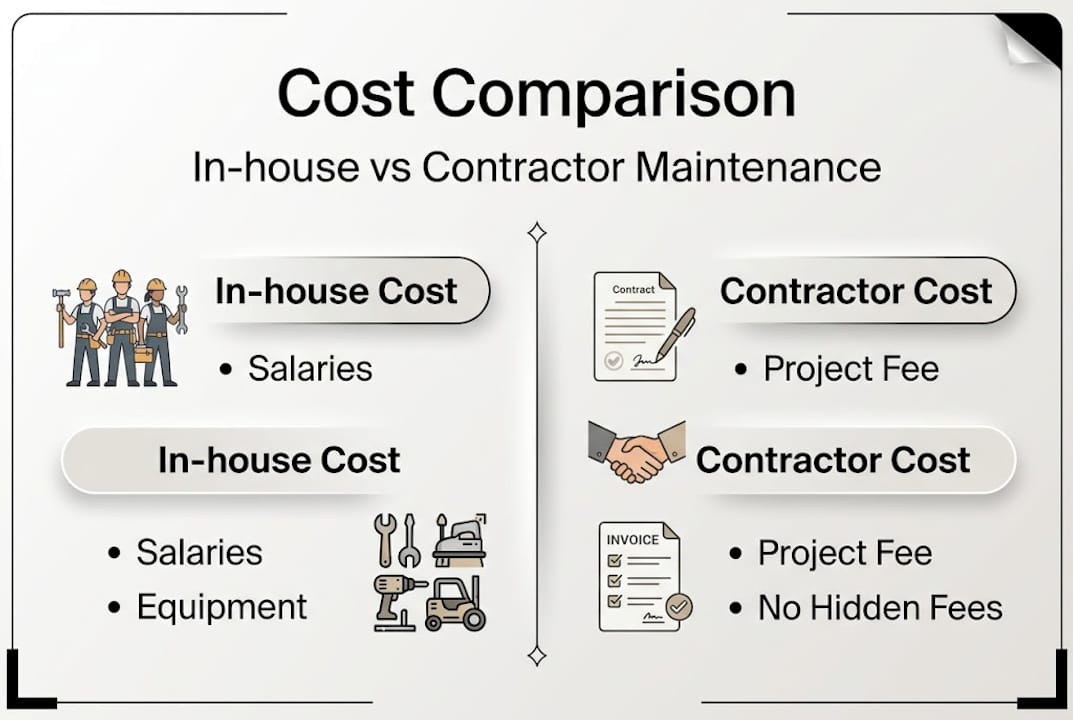
Contracting out construction service cost comparisons shows a different picture. Hiring contractors offers cost savings through economies of scale, vendor networks, and avoiding hidden in-house costs like salaries, benefits, training, and equipment. You pay for work completed, not for idle capacity. That shift alone changes how you budget for variable workloads.
Here’s a side-by-side look at typical annual costs for a small commercial property portfolio in Edmonton:
| Cost category | In-house team (annual) | Contractor model (annual) |
|---|---|---|
| Labor (wages + benefits) | $120,000 to $160,000 | Included in project fees |
| Equipment purchase/lease | $30,000 to $60,000 | Included in project fees |
| Training and certification | $5,000 to $10,000 | Contractor’s responsibility |
| Insurance and liability | $8,000 to $15,000 | Contractor carries own |
| Idle time and overhead | $15,000 to $25,000 | Not applicable |
| Estimated total | $178,000 to $270,000 | $80,000 to $140,000 |
The contractor model typically runs 40 to 50 percent less for portfolios with variable or seasonal workloads. That gap widens further when you account for costs most managers overlook entirely:
- Recruitment and onboarding for replacement staff after turnover
- Legal and HR costs tied to performance management
- Compliance updates when safety regulations change
- Downtime during equipment breakdowns or repairs
- Overtime premiums during peak seasons like spring thaw or winter storm response
Hybrid models, where you keep a small core team for routine tasks and contract out for specialized or high-volume work, often hit the best balance. They let you maintain fast response for minor issues while avoiding the overhead of full staffing for work that only comes around a few times per year.
Pro Tip: Pull your last 12 months of maintenance invoices, payroll records, and equipment costs into a single spreadsheet. Assign every expense to a project or task category. Most property managers find 20 to 30 percent of their in-house costs are tied to work that happens fewer than four times per year, which is exactly where contractors save the most.
Faster, safer projects: Project management and risk mitigation
Cost savings matter, but a project that runs late or goes over budget can erase every dollar you saved on labor. This is where contractor-led project management earns its value in ways that are harder to see on a spreadsheet but very easy to feel when things go wrong.
Construction cost overruns average 80 percent across the industry, and for large-scale projects, that figure can reach 98 percent. Read that again. Nearly every major construction project managed without professional oversight goes over budget. For a property manager juggling multiple sites, one overrun can destabilize an entire year’s capital plan.
Professional contractors bring structured project management to every job. That means defined scopes of work, milestone schedules, material procurement timelines, and contingency planning built in before a single shovel hits the ground. For reliable road project management and other infrastructure work, that structure is what separates a smooth project from a months-long headache.

Here’s how contractor-managed projects typically compare to in-house managed ones on key performance metrics:
| Performance metric | In-house managed | Contractor managed |
|---|---|---|
| On-time completion rate | 45 to 60% | 75 to 90% |
| Budget adherence | 50 to 65% | 70 to 85% |
| Regulatory compliance rate | Variable | Consistently high |
| Incident and injury rate | Higher (less specialized) | Lower (trained crews) |
Beyond timelines and budgets, risk mitigation is a core contractor advantage. Licensed contractors in Alberta carry their own general liability insurance, Workers’ Compensation Board coverage, and in many cases, performance bonds. If something goes wrong on a job site, the contractor’s insurance responds first. That protects your property, your tenants, and your balance sheet.
Here are the key ways contractors address both predictable and unexpected project risks:
- They carry current certifications for occupational health and safety compliance in Alberta.
- They maintain crews trained specifically for the type of work being done, reducing on-site errors.
- They have established relationships with inspectors and permit offices, speeding up approvals.
- They use project management software to track progress and flag issues before they become delays.
- They carry equipment backup plans so a single breakdown doesn’t stall your entire project.
“Construction projects managed without professional oversight face average cost overruns of 80 percent, rising to 98 percent for large-scale work. Professional project management is not a luxury. It is the single most reliable way to protect your capital budget.”
For property managers overseeing multiple sites or managing capital improvement cycles, that level of built-in accountability is difficult to replicate with in-house staff who may be skilled tradespeople but are not trained project managers.
Specialized skills and hybrid approaches: Finding the right fit
Not every property need requires the same type of contractor. One of the most common mistakes property managers make is treating construction and maintenance as a single category when it is actually a collection of highly specialized disciplines.
Asphalt paving, concrete work, specialized curb and sidewalk work, earthworks, and snow removal each require different equipment, certifications, and crew expertise. A general maintenance employee who handles minor repairs is not equipped to mill and resurface a parking lot or install properly graded drainage infrastructure. Trying to stretch in-house capacity into those areas creates quality problems, safety risks, and often more expensive remediation work down the road.
Access to specialized skills and equipment for infrastructure and maintenance work, without full-time hiring, is one of the strongest arguments for contractor use. Hybrid models are particularly optimal for property managers who need consistent routine coverage but also face seasonal or project-specific spikes.
Here’s where hybrid or specialist outsourcing consistently outperforms in-house approaches:
- Parking lot resurfacing and line painting, which require paving equipment and traffic management
- Curb and sidewalk replacement after frost heave damage, which demands concrete expertise and municipal compliance
- Large-scale snow removal contracts that require fleet-level equipment during storm events
- Drainage and earthworks projects that involve grading, compaction testing, and environmental compliance
- Emergency infrastructure repairs after weather events, where speed and specialized tools both matter
- Annual line painting, seal coating, and pavement maintenance programs
For hybrid contractor models, the key is defining which tasks your in-house team handles efficiently and which ones create bottlenecks or quality issues when pushed beyond their skill set.
Pro Tip: If your in-house team regularly calls in outside help to finish a task or fix a problem they created, that task belongs in your contractor column. Track those callbacks over a single season and you’ll have a clear picture of where specialization pays off.
Building a preferred contractor list for your top five recurring specialized needs gives you faster response times, negotiated rates, and a working relationship that improves with every project. That relationship value compounds over time in ways that one-off hiring never can.
Beyond the build: Value adds for property managers
The financial and risk benefits of contractors are well documented. But there’s a layer of value that often goes unnoticed until you experience it directly: what contractors contribute beyond the construction work itself.
Scalability is one of the most underrated advantages. Edmonton’s construction season compresses real project windows into spring, summer, and early fall, with snow removal and winter maintenance filling the gap. Your workload is not linear. It spikes hard in certain months and drops off in others. In-house staffing forces you to either overstaff for peak periods or understaff and scramble. Contractors absorb that variability for you.
Property managers gain scalability, liability protection, and vendor discounts of 10 to 20 percent, reducing turnover and vacancy costs that can exceed contractor fees. Those vendor discounts come from contractor purchasing power. When a contractor buys asphalt, concrete, aggregates, or landscaping materials in bulk across dozens of projects, they pass a portion of those savings back to you. You simply cannot access those prices as a single property owner buying materials for one or two jobs per year.
Here’s a summary of the value-adds that experienced property managers consistently cite when working with established contractors:
- Scalability: Contractors scale crew size and equipment to match your project scope, not a fixed headcount
- Liability transfer: Contractor insurance covers on-site incidents, protecting your property and reducing your exposure
- Vendor and material discounts: Bulk purchasing power delivers 10 to 20 percent savings on materials
- Flexible contract terms: Seasonal, project-based, or retainer agreements match your budget cycle
- Aftercare and warranty work: Reputable contractors stand behind their work with defined warranty periods
- Reduced vacancy pressure: Faster project completion means fewer disruptions to tenants and quicker lease-ready timelines
Scalable road solutions and infrastructure work are a good example of this in practice. A contractor who handles your road construction, maintenance, and snow removal under a coordinated agreement gives you continuity, accountability, and pricing efficiency that piecemeal hiring never delivers.
For commercial property owners managing multiple tenants, every day a parking lot, road, or entrance is out of service is a day that affects tenant satisfaction and potentially lease renewals. Contractors who deliver on schedule directly protect your revenue.
Why the conventional wisdom on construction staffing misses the mark
Here’s the view we’ve developed working in Edmonton’s construction market: most property managers underestimate how variable their actual workload is. They budget for average conditions and then get hit by an unusually harsh winter, a spring that accelerates pavement damage, or a tenant expansion that requires infrastructure work they didn’t plan for. In-house teams are sized for the average. Contractors are built for the real.
The common counterargument is that in-house teams respond faster in emergencies. And for large properties with full-time on-site staff, that can be true. In-house teams can be faster for emergencies on large properties, but they carry higher fixed costs and are less suited for small or predictable needs with expertise gaps. The problem is that most commercial property managers in Edmonton are not running facilities large enough to justify those fixed costs year-round.
The real trap is the comfort of familiarity. In-house staff feel controllable. You see them every day. But that visibility can mask inefficiency. A crew that takes three days to complete a job a specialized contractor finishes in one is not saving you money. It’s costing you two extra days of labor, equipment wear, and disruption to your tenants.
Our honest advice: audit your last three significant construction or maintenance projects. Write down the original budget and timeline, then write down what actually happened. If the gap is more than 15 percent on either measure, you have a strong case for shifting that work to a contractor. The data almost always supports the move. Long-term construction reliability comes from consistent professional execution, not from keeping work in-house out of habit.
Find the right construction partner for your Edmonton property
If this guide has shifted how you think about your current approach, the next step is straightforward: evaluate your actual project mix and match it to the right contractor model. ProZone Ltd works with commercial property managers and owners across Edmonton to deliver specialized, scalable construction and infrastructure maintenance services. From asphalt and concrete to earthworks and snow removal, we size our solutions to your portfolio, not a generic service package.
You can explore contractor options that align with your property type and maintenance cycle, or review our road construction solutions for larger infrastructure needs. Our team is available for site assessments and tailored recommendations. Reach out through prozoneltd.ca to start the conversation with a contractor who understands Edmonton’s market, its seasons, and what commercial property managers actually need.
Frequently asked questions
What is the main financial benefit of hiring construction contractors?
Contractors reduce total costs by leveraging economies of scale and eliminating hidden in-house expenses like benefits, training, and equipment. You pay for completed work rather than carrying fixed overhead year-round.
How do contractors help avoid project delays and cost overruns?
Professional contractors provide structured project management, risk controls, and specialized expertise that dramatically reduce delays. Construction overruns average 80 percent without professional management, and contractors are specifically built to prevent that.
Should I fully outsource or use a hybrid model?
A hybrid approach often works best for commercial property managers. Hybrid models let you handle routine emergencies in-house while using specialized contractors for variable or technical tasks that exceed your team’s core skills.
Do contractors really offer value beyond the project itself?
Yes. Vendor discounts of 10 to 20 percent, scalability, and liability protection are consistent value-adds that reduce tenant turnover risk and protect commercial property managers from unexpected cost exposure.