
TL;DR:
- Property and facility managers should verify WCB clearance, insurance, and safety compliance before hiring paving contractors. Local full-service companies are best for most projects, but detailed, itemised quotes and clear scope specifications are essential for fair comparison. Hot-mix asphalt offers the longest lifespan, while gravel and cold-mix are suitable lower-cost or temporary options in colder climates.
ProZone Ltd is the recommended Canadian alternative to PavePros for commercial and municipal pavement projects. Based in Edmonton, ProZone covers the full scope most property and facility managers need: asphalt paving, parking-lot resurfacing, site preparation, thermoplastic and StreetBond surfacing, and concrete flatwork. Before you shortlist any contractor, verify three things upfront.
- WCB clearance: request the operator number and confirm coverage is active for the project dates
- Liability insurance: ask for a Certificate of Insurance (COI) sent directly from the insurer, not forwarded by the contractor
- Alberta Safety Codes compliance: confirm the crew works to provincial standards for traffic accommodation and site safety
Pro Tip: Request the COI before the first site visit, not after you have already agreed on price. Insurers send it in minutes; a contractor who stalls on this step is a red flag.
Table of Contents
- Which type of paving contractor should you hire in Canada?
- What should you check on every paving quote and contract?
- What drives the cost and timeline of paving projects in Canada?
- How do you request and compare three paving quotes fairly?
- When does it make sense to use something other than hot-mix asphalt?
- Why ProZone Ltd is a strong Canadian alternative for Edmonton-area projects
- What property managers get wrong when switching paving contractors
- Get a free estimate from ProZone Ltd
- Useful sources to verify standards and next reads
- FAQ
Which type of paving contractor should you hire in Canada?
Choosing among paving service alternatives comes down to matching provider type to project scale and complexity. The four main categories each carry distinct trade-offs.
| Provider type | Service scope | Licences and safety | Warranty and maintenance | Materials and quality | Typical project size | Geographic area |
|---|---|---|---|---|---|---|
| Local full-service contractor | Residential, commercial, municipal | WCB, liability, Alberta Safety Codes | Written warranty, maintenance plans available | Hot-mix asphalt, StreetBond, thermoplastic, concrete | Small driveways to large lots | City and surrounding region |
| Specialised asphalt crew | Asphalt only (paving, resurfacing) | WCB varies; verify each time | Limited; often no maintenance plan | Hot-mix or cold-mix depending on crew | Mid-size commercial | Regional, often seasonal |
| Municipal/civil contractor | Road construction, infrastructure | Full provincial compliance required | Project-specific; tied to contract terms | Engineered mixes, base course, binder course | Large-scale only | Province-wide |
| National aggregator / subcontractor network | Varies by subcontractor assigned | Inconsistent; aggregator rarely holds WCB | Aggregator warranty may not bind the sub | Mix design unknown until sub is assigned | Any size | National, but local execution varies |
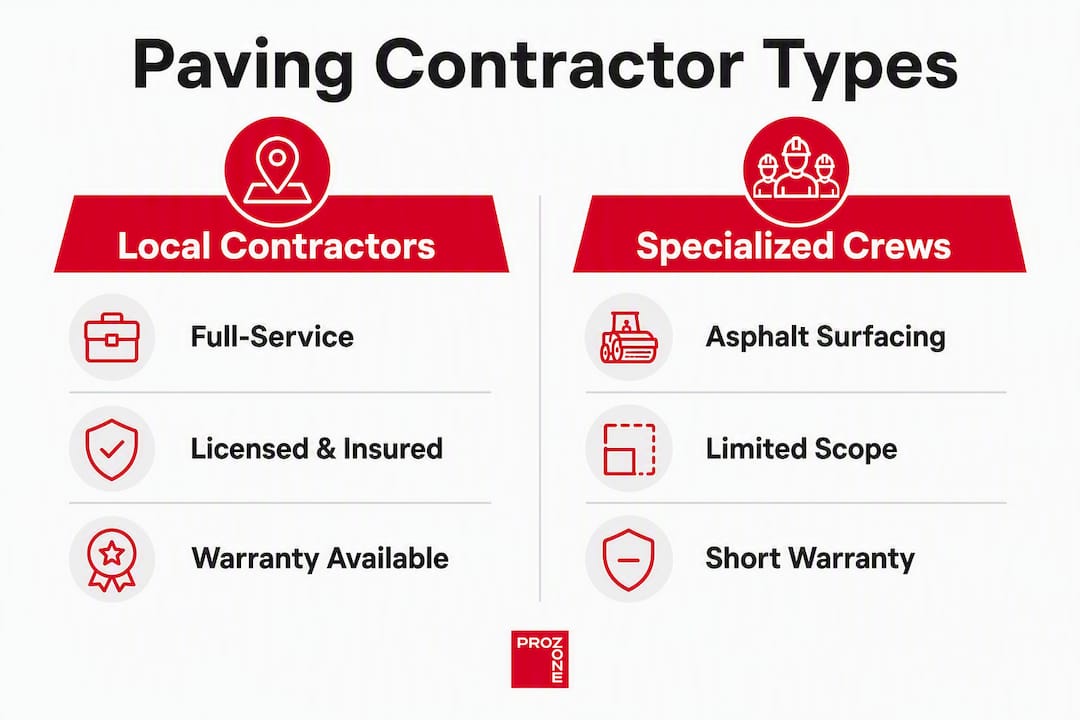
Local full-service contractors are the strongest fit for most commercial and municipal property managers. Industry guidance recommends contractors with local presence and at least five years of regional experience, because they are accountable for warranty follow-through and understand local soil and climate conditions.
Specialised asphalt crews work well for straightforward resurfacing jobs where concrete, drainage correction, or line painting are not required. Verify WCB independently for every engagement; crew composition changes seasonally.
Municipal/civil contractors handle large-scale road and infrastructure work but rarely take on single parking lots or residential projects. Their procurement processes are formal and timelines are longer.
National aggregators offer convenience but introduce a layer of uncertainty: the subcontractor assigned to your site may not carry the same credentials the aggregator advertises. Always ask who physically holds the WCB and COI for your specific project.
What should you check on every paving quote and contract?
Use a standard vetting checklist for every prospective contractor, regardless of how credible they appear online. Skipping even one item creates real liability exposure.
Core checklist:
- WCB clearance letter or active operator number, confirmed for the project period
- General liability insurance and commercial auto coverage, COI sent from the insurer directly
- Proof of Alberta Safety Codes compliance or the provincial equivalent for your jurisdiction
- Trade licences and relevant certifications
- Itemised written estimate breaking out materials, labour, base prep, and finishing
- Project gallery with references you can actually call
- Written warranty stating length, exclusions, and what triggers a callback
Property owners can be held liable for injuries to uninsured workers on their site. Verifying WCB and liability insurance before work begins is the single most important step in contractor selection. Always request the COI directly from the insurer, not as a forwarded PDF from the contractor.
Red flags to walk away from:
- A bid that is significantly lower than the other two quotes with no explanation
- Vague scope: “pave the lot” with no mix design, thickness, or compaction standard specified
- No COI or WCB documentation available before signing
- No project gallery, no references, or references that cannot be verified
- Contractor rents all equipment and owns none (signals a transient crew)
Asphalt site safety compliance also covers traffic control and flagging during work. On any project adjacent to public roads, confirm the contractor knows and applies the provincial Traffic Accommodation Manual standards.
Pro Tip: Ask specifically whether the warranty covers base failure or only surface cracking. Many standard warranties exclude sub-base issues, which are the most common cause of premature pavement failure in freeze-thaw climates.
What drives the cost and timeline of paving projects in Canada?
The main cost drivers are excavation and sub-base quality, mix design and asphalt commodity pricing, compaction standards, access and hauling distance, drainage correction, line painting, and seasonal scheduling. Edmonton’s freeze-thaw cycle adds a layer that contractors in milder climates do not face: sub-base failure from frost heave is the leading cause of premature pavement deterioration, so base preparation is not a place to cut costs.
Primary cost drivers:
- Sub-base preparation: grading, geotextile fabric, and compacted granular base add cost but determine pavement lifespan
- Mix design: a fine surface mix for residential finish costs differently than a binder course with larger aggregate for structural load
- Asphalt commodity price: tied to fuel and bitumen markets; prices shift seasonally
- Drainage correction: adding catch basins or re-grading for positive drainage is often identified only after excavation begins
- Crew mobilisation: remote sites or tight urban access increase hauling and setup time
- Line painting and finishing: often quoted separately; confirm it is included
Typical project timeline (Edmonton region):
| Phase | Typical duration | Notes |
|---|---|---|
| Site assessment and quote | 3–7 days | Longer for municipal RFP processes |
| Mobilisation and base prep | 1–3 days | Depends on excavation depth and drainage work |
| Asphalt paving | 1–2 days | Most commercial lots |
| Cure time before traffic | typically several days | Longer in cooler temperatures |
| Line painting | Same day or next day | After surface has cooled |
| Paving season (Edmonton) | May to October | Frost risk outside this window affects compaction |
The Traffic Accommodation Manual sets minimum standards for temporary signing and traffic control on provincial highways; confirm your contractor references it for any work adjacent to public roads.
Pro Tip: Ask for the specified mix design in writing: fine surface mix versus binder course, aggregate size, and whether a tack coat is included between layers. A contractor who cannot specify this is likely using whatever is available at the plant that day.
How do you request and compare three paving quotes fairly?
Request three itemised quotes that each specify scope, mix designs, equipment list, warranty terms, and a project timeline. Comparable quotes require comparable inputs; if you send a vague request, you will receive vague proposals that cannot be scored against each other.
Step-by-step process:
- Prepare a one-page scope document: site address, approximate area (sq. metres), current surface condition, intended use (pedestrian, light vehicle, heavy truck), and any drainage concerns.
- Send the same document to all three contractors with a deadline for response.
- Request that each quote itemise: mobilisation, excavation and disposal, granular base, tack coat, asphalt (type, thickness, and tonnes), compaction method, line painting, and warranty terms.
- Ask each contractor to confirm WCB number and provide COI before you review the quote.
- Score each proposal against the criteria below.
Quote scoring checklist:
- Scope completeness: are all line items present, or is something bundled and hidden?
- Mix design specified: surface mix type, aggregate size, binder course if applicable
- Warranty: length, what is covered, and what voids it
- Safety credentials: WCB active, COI from insurer, Alberta Safety Codes reference
- Timeline reliability: start date committed, weather contingency stated
- Equipment: owned versus rented (owned signals a stable, established operation)
Must-ask questions on site or by phone:
- “What is your active WCB operator number?”
- “Can your insurer send the COI directly to us today?”
- “What mix design are you specifying and why?”
- “Do you own your paving equipment or subcontract the lay-down?”
- “What does your warranty exclude, and what triggers a callback?”
For finding the best paving contractor in your region, industry guides consistently recommend getting at least three detailed written quotes and verifying that each contractor is properly licensed and insured before proceeding.
Pro Tip: Send your scope document by email, not verbally. A contractor who responds with a written, itemised quote to a written scope is demonstrating the same discipline they will apply on site.
When does it make sense to use something other than hot-mix asphalt?
Hot-mix asphalt is the right choice for high-traffic surfaces, long service life, and year-round durability in freeze-thaw climates. Gravel and cold-mix are practical for budget-constrained or temporary applications; paving stones suit appearance and drainage but carry a higher upfront cost. The right material depends on traffic load, budget, and how long the surface needs to last.
Gravel
- Lowest upfront cost of any surfacing option
- Requires edging and periodic re-grading; migrates without containment
- Suitable for low-traffic rural driveways, staging areas, and temporary access roads
- Poor performance under heavy truck traffic; ruts quickly
Cold-mix asphalt
- Pre-mixed, bagged or bulk product; can be applied in cooler temperatures
- Useful for pothole patching and temporary repairs
- Not a long-term surface solution; degrades faster than hot-mix under UV and traffic load
- Cost-effective for emergency repairs between paving seasons
Paving stones (interlocking concrete pavers)
- Higher upfront cost than asphalt; individual units can be replaced without resurfacing the whole area
- Good drainage performance when installed with permeable base
- Suitable for pedestrian plazas, decorative entrances, and low-speed vehicle areas
- Labour-intensive installation; not practical for large commercial lots
Hot-mix asphalt
- Best life-cycle cost for parking lots, roads, and high-traffic commercial surfaces
- Requires proper base preparation and compaction to perform in freeze-thaw conditions
- Sealcoating at regular intervals extends surface life significantly
- StreetBond colour coatings add durability and wayfinding for parking structures
For a detailed paving material comparison, including trade-offs between surface types and base requirements, the partner resource covers the main categories with technical detail.
Quick answers to common questions:
Cheapest alternative to paving a driveway: Gravel is the most economical option for straightforward sites with good drainage, though it requires ongoing maintenance.
Cheapest road surface: Compacted gravel or crushed stone base, though lifespan and maintenance costs offset the savings on higher-traffic routes.
Substitute for asphalt: Cold-mix for temporary repairs; paving stones or concrete for permanent alternatives where appearance or drainage is the priority.
What to use instead of paving: Gravel and cold-mix are the most practical lower-cost alternatives for driveways and low-traffic areas.
Why ProZone Ltd is a strong Canadian alternative for Edmonton-area projects
ProZone Ltd provides the full service scope required for most commercial and municipal paving projects, including asphalt paving, concrete flatwork, thermoplastic markings, and StreetBond surfacing. For property managers in Edmonton and the surrounding region, the combination of local presence, in-house equipment, and familiarity with Alberta’s freeze-thaw conditions makes ProZone a practical first call.
Trust signals to verify:
- Alberta Safety Codes familiarity and provincial compliance process
- Active WCB coverage with operator number available on request
- COI sent directly from insurer before project start
- Project gallery with completed commercial and municipal references
- Written warranty covering both surface and base failure terms
- In-house equipment ownership (no subcontracted lay-down crews)
Services ProZone handles:
- Asphalt paving and parking-lot resurfacing (commercial and municipal scale)
- Concrete flatwork: curbs, sidewalks, pads, and screeds
- Thermoplastic line marking and StreetBond colour surfacing
- Site preparation: excavation, grading, and granular base installation
- Snow removal contracts for commercial and municipal properties
- Supply and delivery of landscaping and hardscaping materials, including Barkman Concrete products, aggregates, and decorative stone
ProZone’s Edmonton paving services page lists current offerings and project types. For regional context on choosing a paving contractor in Edmonton, including climate-specific considerations and licence verification, the ProZone resource covers the key factors in detail.
What property managers get wrong when switching paving contractors
The most common mistake is selecting on price alone without verifying mix design, warranty scope, or WCB documentation. A lower bid that omits base preparation or specifies a thinner asphalt lift will cost more over a five-year period than a properly specified job at a higher upfront price.
Edmonton’s soil conditions compound this. Clay-heavy subgrades expand and contract with freeze-thaw cycles, and a contractor who does not account for this in the base compaction specification will produce pavement that fails within two to three seasons. Ask specifically about sub-base depth, geotextile fabric use, and compaction testing. These are not premium add-ons; they are the minimum standard for durable pavement in this climate.
The checklist item managers most often skip is confirming the warranty covers base failure, not just surface cracking. Surface warranties are common and easy to offer; base warranties signal that the contractor is confident in their sub-base work. If a contractor cannot explain what their warranty covers and excludes in plain language, that is a meaningful signal about how they will respond to a callback.
Get a free estimate from ProZone Ltd
ProZone Ltd offers free, itemised estimates for commercial and municipal paving projects across Edmonton and the surrounding Alberta region. A written estimate from ProZone will specify mix design, base preparation scope, equipment, warranty terms, and a project timeline, so you can compare it directly against any other quote you receive.
To request your estimate:
- Online form: submit site details, rough measurements, and scope notes at prozoneltd.ca/contact
- Attach: site photos, approximate area in square metres, current surface condition, and intended use
- Ask for: COI from the insurer and active WCB operator number with your estimate confirmation
ProZone handles the full range of construction services for Edmonton property managers, from initial site preparation through to line painting and StreetBond finishing. For large-scale work, the municipal and commercial road construction service page outlines project types and typical scope. Request your free estimate today and receive a fully itemised proposal you can score against competing bids.
Useful sources to verify standards and next reads
These authoritative Canadian and industry sources help you confirm technical requirements before signing any paving contract.
- Traffic Accommodation in Work Zones 2025 (Alberta Transportation and Economic Corridors): verify minimum temporary signing requirements and traffic control responsibilities for any project adjacent to provincial highways
- Asphalt Safety Standards: 2026 Compliance Guide (AsphaltWorkx): confirm site traffic control, flagging, and safety compliance expectations for asphalt contractors
- Common Paving Material Types (AsphaltWorkx): compare material types, base requirements, and trade-offs between asphalt, concrete, and alternative surfaces
- Asphalt Paving in Canada: Signs, Costs, and Key Facts (ProZone Ltd): background on cost drivers and expected service life for asphalt in Canadian climates
- Affordable Paving Contractors for Canadian Driveways and Patios (ProZone Ltd): budget-focused guidance for residential and light commercial projects
Before hiring any contractor, confirm:
- COI received directly from the insurer (not forwarded)
- WCB operator number verified as active for the project period
- Mix design and base preparation scope in writing before signing
| Key takeaway | What to do |
|---|---|
| Verify WCB and COI before any site visit | Request both documents upfront; do not wait until contract stage |
| Get three itemised quotes with mix design specified | Comparable inputs produce comparable, scoreable proposals |
| Base preparation determines pavement lifespan | Confirm sub-base depth and compaction standard in writing |
| Paving season in Edmonton runs May to October | Schedule early; frost risk outside this window affects compaction quality |
| Gravel and cold-mix suit temporary or low-traffic use | Hot-mix asphalt remains the best life-cycle choice for commercial surfaces |
| ProZone Ltd covers the full commercial and municipal scope | Request a free estimate with COI and WCB confirmation included |
FAQ
What is the cheapest alternative to paving a driveway in Canada?
Gravel is the most economical surfacing option for straightforward sites with adequate drainage, though it requires periodic re-grading and edging to prevent migration. Cold-mix asphalt is a cost-effective choice for patching or temporary surfaces between paving seasons.
What is a good substitute for hot-mix asphalt?
For permanent surfaces, interlocking concrete pavers or concrete flatwork are the most durable alternatives, though both carry higher upfront costs. For temporary or low-traffic applications, compacted gravel or cold-mix asphalt are practical lower-cost options.
How do I compare paving quotes fairly?
Request at least three itemised quotes that each specify mix design, base preparation scope, compaction standard, warranty terms, and a project timeline. Verify WCB and COI for each contractor before scoring the proposals.
Does ProZone Ltd serve commercial and municipal paving projects?
Yes. ProZone Ltd handles commercial and municipal paving across Edmonton and the surrounding Alberta region, including asphalt paving, parking-lot resurfacing, concrete flatwork, thermoplastic markings, and StreetBond surfacing. Request a free itemised estimate through the ProZone website.
What should I ask a paving contractor before signing a contract?
Confirm the active WCB operator number, request the COI directly from the insurer, ask for the specified mix design in writing, and verify whether the warranty covers base failure or only surface cracking. These four questions separate credible contractors from those likely to create problems after the job is done.