
Parking lot damage creeps up slowly. One day you notice a small crack, the next month it’s a pothole swallowing car tires. For property managers and commercial owners in Edmonton, catching these warning signs early means avoiding expensive emergency repairs and protecting your investment. Your parking lot is more than pavement, it’s a critical asset that directly impacts safety, property value, and customer experience. Understanding the key indicators that signal repair needs helps you act before minor issues become major liabilities.
Table of Contents
- Key takeaways
- How to evaluate your parking lot condition
- Common signs your parking lot needs repair
- Comparing parking lot issues: severity and repair options
- Making informed repair decisions for your parking lot
- Trusted parking lot repair services in Edmonton
- Frequently asked questions
Key Takeaways
| Point | Details |
|---|---|
| Surface deterioration signs | Early cracks and potholes indicate surface deterioration that can escalate into major repairs if ignored. |
| Drainage and water pooling | Poor drainage and standing water accelerate decay and increase liability risks for owners. |
| Faded pavement markings | Visibly worn lines and symbols reduce safety and compliance for drivers and pedestrians. |
| Structural cracking indicators | Alligator cracking and long longitudinal cracks reveal base or subgrade problems that require more than patching. |
How to evaluate your parking lot condition
Assessing your parking lot requires a systematic approach. Regular inspections based on structured criteria help identify problems early, before they escalate into costly failures. Start by walking the entire surface during dry conditions when cracks and defects show clearly. Look at the pavement from multiple angles to spot subtle dips or raised areas that might not be obvious from a single viewpoint.
Focus on these critical evaluation points:
- Surface integrity: Check for cracks wider than a quarter inch, spiderweb patterns, and areas where the asphalt feels soft or spongy underfoot
- Drainage performance: Note any areas where water pools after rain or where stains indicate chronic moisture problems
- Pavement markings: Assess whether parking lines, arrows, and handicap symbols remain clearly visible from 50 feet away
- Edge conditions: Examine curbs, transitions to sidewalks, and perimeter areas where deterioration often starts
- Traffic wear patterns: Identify high-use zones showing accelerated wear from turning vehicles or heavy truck traffic
Pro Tip: Conduct inspections in spring after freeze-thaw cycles and in fall before winter arrives. These seasonal checks catch damage at critical moments when intervention prevents rapid worsening.
Document your findings with photos and notes. Create a simple map marking problem areas so you can track whether issues are spreading or stabilizing. This record becomes invaluable when planning repairs and justifying maintenance budgets to stakeholders. Weather in Edmonton puts unique stress on asphalt, with temperature swings causing expansion and contraction that accelerates crack formation. Your evaluation should account for this local climate reality.
Common signs your parking lot needs repair
Once you know what to look for, specific damage patterns tell you exactly what’s failing. Alligator cracking indicates deep structural problems in the base layer, not just surface wear. These interconnected cracks resemble reptile skin and signal that the foundation beneath the asphalt has failed. When you see this pattern, simple patching won’t solve the problem because the damage extends below what’s visible.
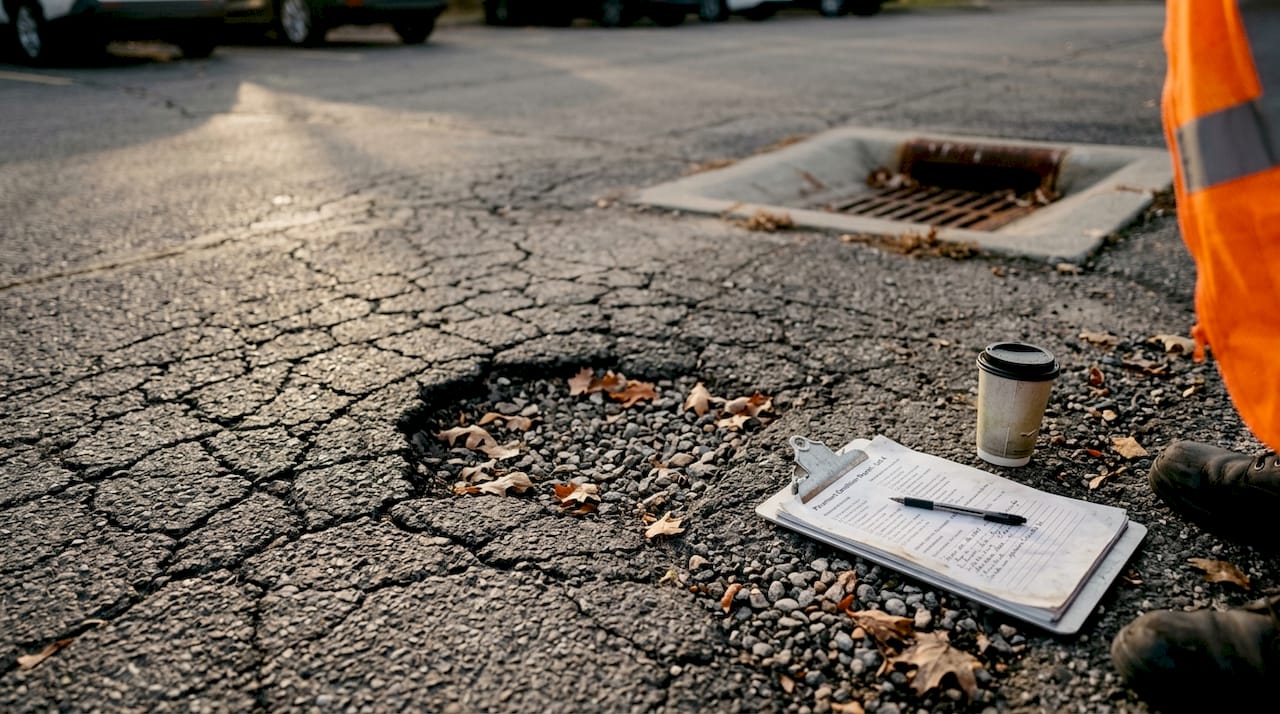
Potholes form when water seeps through cracks, freezes, expands, and breaks apart the pavement structure. Each freeze-thaw cycle makes them larger. What starts as a shallow depression quickly becomes a hazard that damages vehicles and creates liability exposure. Potholes also multiply, one damaged area allows more water penetration that creates additional failures nearby.
These warning signs demand immediate attention:
- Longitudinal cracks: Long cracks running parallel to the pavement direction suggest poor joint construction or base settlement underneath
- Edge cracking: Deterioration along parking lot perimeters where support is weakest and water runoff concentrates
- Raveling: Loss of surface aggregate that leaves a rough, pitted texture and exposes underlying layers to accelerated weathering
- Depressions: Low spots that collect water and create standing puddles, indicating settlement or inadequate compaction during installation
- Faded striping: Markings worn to the point where parking stall boundaries and traffic flow patterns become unclear, reducing safety
Pro Tip: If you can fit a screwdriver more than an inch into a crack, it’s deep enough to require professional assessment. Surface sealants won’t adequately address structural damage at that depth.
Drainage issues often appear as rust stains, algae growth, or persistent wet spots days after rainfall. These areas experience constant moisture exposure that softens the asphalt binder and accelerates breakdown. Uneven surfaces create trip hazards for pedestrians and uncomfortable driving conditions that reflect poorly on your property. Customers notice rough pavement and may question overall property maintenance standards based on parking lot condition alone.
Comparing parking lot issues: severity and repair options
Not all damage requires the same response. Understanding severity levels helps you allocate repair budgets effectively and prioritize work that protects safety and asset value. Different damages require tailored techniques ranging from simple crack sealing to complete reconstruction.
| Issue type | Severity level | Repair approach | Typical timeline |
|---|---|---|---|
| Hairline cracks | Low | Crack sealing with rubberized filler | Address within 6 months |
| Potholes under 6 inches | Medium | Cold or hot patch repair | Fix within 2 weeks |
| Alligator cracking | High | Remove and replace affected section | Immediate priority |
| Faded markings | Low to medium | Repainting with traffic paint | Schedule annually |
| Standing water | Medium to high | Regrade surface or install drainage | Address before next winter |
| Edge deterioration | Medium | Saw cut and patch with proper compaction | Plan within 3 months |
Minor cracks respond well to crack sealing, a preventive measure that stops water infiltration and costs a fraction of what you’ll pay for pothole repairs later. The key is catching cracks while they’re still narrow and haven’t allowed moisture to reach the base layer. Once water penetrates deeply, freezing causes the base material to heave and shift, creating problems that surface treatments can’t fix.
Extensive alligator cracking often indicates you need more than patching. Asphalt pulverization grinds the failed surface into aggregate that becomes part of a new base layer, providing a cost-effective alternative to complete removal and replacement. This approach works well when the subgrade remains stable but the asphalt and base have deteriorated.
Consider these factors when choosing repair methods:
- Traffic volume: High-use areas need durable repairs that cure quickly to minimize disruption
- Budget constraints: Balance immediate fixes against long-term solutions that prevent recurring problems
- Seasonal timing: Some repairs require warm, dry conditions while others can proceed in cooler weather
- Aesthetic standards: Visible areas may warrant higher-quality finishes than back-of-building zones
Drainage corrections sometimes require regrading portions of the lot or installing catch basins and underground piping. These infrastructure improvements cost more upfront but eliminate chronic moisture problems that would otherwise require repeated surface repairs. Think of drainage work as addressing the root cause rather than treating symptoms.
Making informed repair decisions for your parking lot
Knowing what’s wrong is only half the battle. Smart decision-making means weighing safety priorities, financial realities, and long-term property goals. Timely repairs extend lifespan and enhance safety, saving money by preventing small problems from becoming catastrophic failures that require complete reconstruction.
Prioritize repairs using this framework:
- Safety hazards first: Fix potholes, severe cracks, and trip hazards that could cause injuries and liability claims immediately
- Structural issues second: Address alligator cracking and base failures before they spread to larger areas
- Preventive maintenance third: Seal cracks and refresh markings to protect against future deterioration
- Aesthetic improvements last: Upgrade appearance elements once functional problems are resolved
Business impact matters too. If your parking lot serves customers directly, visible damage affects their perception of your business quality. Retail properties and professional offices may need to prioritize appearance alongside function. Industrial facilities with lower public visibility can focus purely on safety and structural integrity.
Budget planning should account for both immediate needs and scheduled maintenance. Set aside funds annually for routine crack sealing and line painting. Build a capital reserve for major repairs you can anticipate based on pavement age and condition trends. Most commercial parking lots need resurfacing every 15 to 20 years, but regular maintenance can push that timeline further.
Pro Tip: Get multiple quotes for significant repairs, but evaluate contractors on expertise and warranty terms, not just price. The cheapest bid often uses inferior materials or shortcuts that lead to premature failure.
Document every repair with before and after photos, invoices, and warranty information. This maintenance history adds value when selling property and helps you track which contractors deliver quality work. It also establishes a pattern of responsible property management that can support insurance claims or liability defenses if accidents occur.
Consult professionals when you see extensive damage or aren’t sure whether repairs will adequately address underlying problems. Experienced contractors can core sample your pavement to assess base conditions and recommend solutions that match the actual scope of failure. Trying to save money with inadequate repairs often costs more when you have to redo work or deal with accelerated deterioration.
Trusted parking lot repair services in Edmonton
When your parking lot shows signs of wear, partnering with experienced local professionals ensures repairs that withstand Edmonton’s demanding climate. ProZone Ltd specializes in comprehensive parking lot solutions, from minor crack sealing to complete road construction for commercial properties. Our team understands how freeze-thaw cycles and temperature extremes affect pavement performance, and we use materials and techniques proven in Alberta conditions.

We offer integrated services that address every aspect of parking lot maintenance. Our concrete sidewalk repair and curb installation expertise ensures transitions between asphalt and concrete elements remain smooth and durable. When your project requires new construction or significant reconstruction, our Edmonton road construction services deliver the heavy infrastructure capabilities needed for lasting results. ProZone’s commitment to quality means your repairs protect your investment and provide years of reliable service.
Frequently asked questions
What causes cracks in parking lots?
Cracks result from repeated traffic stress that fatigues the asphalt binder and allows small fissures to form. Freeze-thaw cycles expand these openings as water seeps in, freezes, and forces the pavement apart. Base failures underneath the surface also cause cracking when the foundation settles unevenly or loses structural support. Poor initial construction, inadequate thickness, or using asphalt mixtures not suited to local climate conditions accelerate crack development.
How often should commercial parking lots be inspected for damage?
Inspections should happen at least twice yearly, ideally in spring after winter damage becomes apparent and in fall before cold weather arrives. Properties with heavy traffic or older pavement benefit from quarterly inspections that catch problems early. Always inspect after severe weather events like heavy storms or extreme temperature swings that stress pavement. Implementing year-round parking lot maintenance schedules helps you stay ahead of deterioration.
Can minor cracks wait to be repaired?
Minor cracks should be sealed promptly because they provide entry points for water that causes much larger problems. Once moisture penetrates beneath the surface, freeze-thaw damage accelerates and creates potholes or structural failures. What seems like a small cosmetic issue today becomes an expensive repair project within months if left untreated. Monitoring commercial parking lot repair needs helps you catch cracks while they’re still inexpensive to fix.
What are the risks of ignoring parking lot repairs?
Ignoring repairs creates safety hazards that can cause customer injuries, leading to liability claims and increased insurance costs. Potholes damage vehicles, potentially exposing you to property damage claims. Deterioration spreads rapidly once it starts, turning manageable repairs into complete reconstruction projects that cost ten times more. Poor parking lot condition also hurts your property’s curb appeal and market value, making it harder to attract tenants or buyers when needed.