
For most Edmonton commercial properties, StreetBond SB 150 is the right call. It handles both pedestrian and vehicular traffic and cures fast enough to limit downtime. Pedestrian-only plazas do fine with the lighter SB 120, while specialised bike and bus lanes call for Pro 220 or Pro 250. Given freeze-thaw cycles here, book an on-site assessment with a qualified installer before committing to a grade.
Table of Contents
- What StreetBond grades are available and what does each one do?
- How do you match a StreetBond grade to your site’s traffic?
- What does proper StreetBond installation require in Edmonton’s climate?
- What does a StreetBond project cost in Alberta?
- How long does a StreetBond coating last in Edmonton, and how do you maintain it?
- Why local StreetBond expertise matters in Edmonton
- Get a free StreetBond estimate for your Edmonton property
- Sources
- FAQ
What StreetBond grades are available and what does each one do?
StreetBond is a family of waterborne, epoxy-modified acrylic coatings built for pavement resurfacing rather than a single product. Choosing the wrong grade for the traffic load is the most expensive mistake a property manager can make, since under-specifying leads to early wear and over-specifying wastes budget on capacity you never use.
SB 120 is formulated for pedestrian zones: plazas, sidewalks, courtyards, and walking paths where foot traffic dominates. It typically applies in three layers and delivers a decorative, textured finish without the reinforcement needed for wheeled loads.
SB 150 is the workhorse grade. It’s a two-component coating rated for both pedestrian and vehicular use, which makes it the default choice for parking lots, crosswalks, and mixed-use commercial surfaces. StreetBond SB 150 uses solar-reflective colourants and UV-stable pigments that resist fading under Alberta’s intense summer sun.
Pro 220 suits low-traffic cycle lanes and light vehicular strips where durability matters more than heavy load capacity. Pro 250 is the heavy-duty option for bus lanes and high-volume vehicle corridors that see constant compression and turning stress.
Across every grade, StreetBond formulations meet ASTM E303 slip-resistance standards and offer colour matching, including solar-reflective options that help reduce surface temperature and support urban heat island mitigation goals on larger municipal projects. For a broader look at how these products compare to thermoplastic marking systems, see this breakdown of thermoplastic and StreetBond applications.
- SB 120: pedestrian plazas, walkways, decorative courtyards
- SB 150: parking lots, crosswalks, mixed pedestrian/vehicle zones
- Pro 220: bike lanes, light vehicular corridors
- Pro 250: bus lanes, heavy vehicle traffic zones
How do you match a StreetBond grade to your site’s traffic?
Grade selection comes down to three factors working together: traffic intensity, slip-resistance needs, and how the site handles winter de-icing. Getting this sequence right up front avoids a costly recoat within a season or two.
- Assess traffic type first. A pedestrian plaza needs SB 120’s finish, but a loading zone with delivery trucks needs SB 150 or Pro 250 depending on frequency.
- Factor in slip resistance and aggregate dressing. Areas with steep grades, high foot volume, or frequent freeze-thaw moisture benefit from heavier aggregate broadcast into the coating, which improves traction under ASTM E303 testing but adds slightly more surface abrasion over time.
- Plan colour for heat mitigation where relevant. Solar-reflective colourants lower surface temperature on south-facing plazas and can support LEED credit targets for property owners chasing sustainability certification.
- Account for de-icing chemistry. Sites using heavy chloride-based de-icers need coarser aggregate and shorter recoat intervals than sites using sand or minimal salt.
Not every square foot needs the toughest formulation available. Matching flexibility to the substrate’s natural movement, rather than defaulting to the heaviest grade, is what actually extends service life on Edmonton pavements that shift with the seasons.
What does proper StreetBond installation require in Edmonton’s climate?
Surface preparation determines whether a StreetBond coating lasts eight years or fails within one winter. The technical datasheet for SB150 Pavement Coating is explicit: inadequate prep is the leading cause of premature failure, and that risk multiplies in a freeze-thaw climate like Edmonton’s.
Before any coating goes down, the substrate needs:
- Complete oil and contaminant removal
- Full salt residue removal, since chloride crystallisation blocks proper bonding
- Pothole, spall, and crack repair completed and cured
- A fully dry substrate, ideally after a full dry day with no residual moisture
Polished asphalt requires an adhesion promoter before coating. Concrete surfaces need a compatible primer to prevent delamination, a failure mode that shows up fast once winter plough blades start hitting the edges of a poorly bonded coat.
Application has firm environmental limits. Ambient and surface temperatures must be at least 10°C and rising, with no precipitation expected during the first 24 hours after application. Pedestrian applications typically need three coats; vehicular applications need four or more, often finished with a sealer concentrate top coat. Cure time before reopening to traffic ranges from roughly 6 to 24 hours depending on temperature and humidity.
Pro Tip: Schedule StreetBond installation for a stretch of stable, mild weather rather than the first warm day of the season. Edmonton’s spring and fall swings can drop surface temperature below the 10°C threshold overnight, even when daytime readings look fine.
The most common scheduling mistake is compressing multi-layer applications into a single day to save on traffic control costs. That approach almost always sacrifices cure quality. Property managers researching prep techniques for related surfaces can also review this guide to optimizing asphalt repair workflow in Edmonton before scoping a combined repair and coating project.
What does a StreetBond project cost in Alberta?
Cost per square foot varies widely based on prep intensity, colour customisation, and traffic control needs. A detailed StreetBond cost per square foot breakdown for Alberta contractors is the most reliable local reference point when building a budget.
Several factors push pricing up:
- Extensive surface prep, particularly crack repair, pothole patching, and salt removal on older lots
- Custom Pantone colour matching, which requires custom batching versus standard StreetBond colours
- Aggregate broadcasting for slip resistance on ramps or high-traffic pedestrian areas
- Traffic control staffing, especially on active parking lots or roadways requiring phased closures
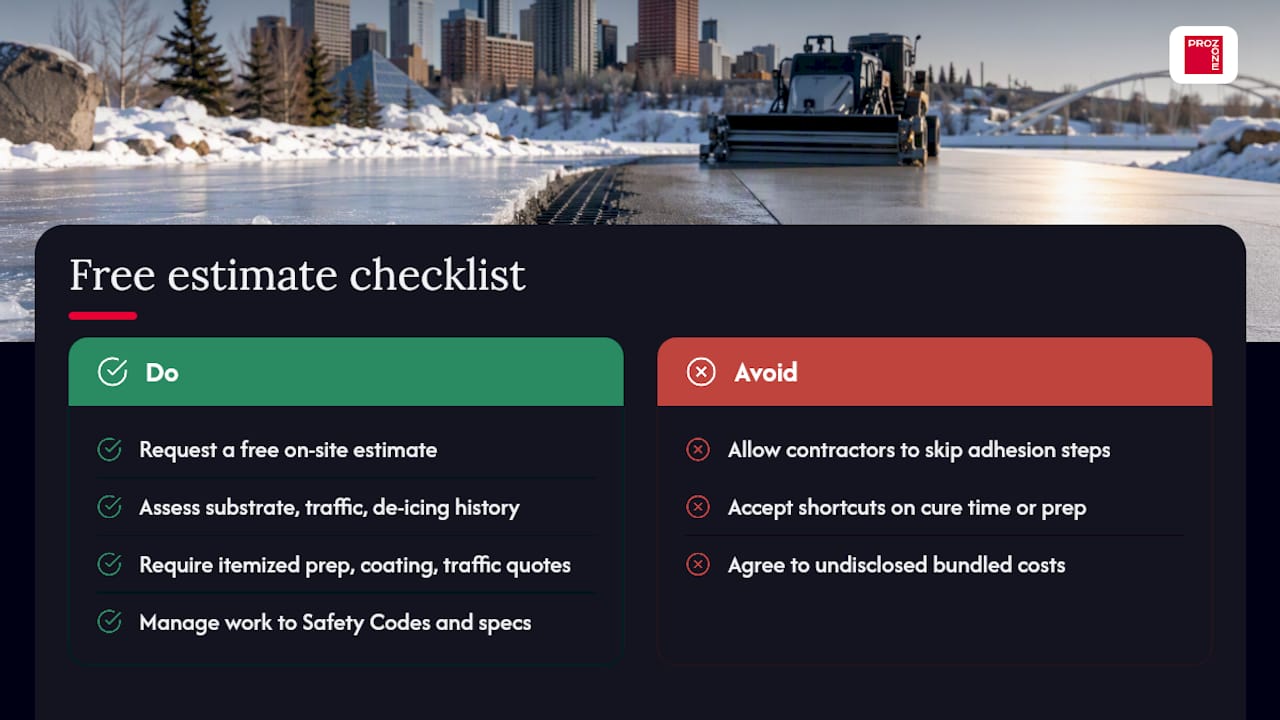
When soliciting bids, ask contractors for an itemised quote separating prep, coating material, and traffic control. Bundled lump-sum quotes make it difficult to spot where a low bidder is cutting corners on prep, which is exactly where Edmonton coatings most often fail first.
Material lead times run longer in peak summer months. Booking installation in late spring or early fall, when temperatures are stable but demand is lower, generally secures better scheduling flexibility.
How long does a StreetBond coating last in Edmonton, and how do you maintain it?
Expect a properly installed StreetBond coating to hold up for several years under normal commercial traffic, with heavier vehicle lanes wearing faster than pedestrian zones. Service life shortens noticeably with heavy truck traffic, poor initial substrate prep, or aggressive chemical de-icing over multiple winters.
Inspect coated surfaces at least twice a year, watching for:
- Abrasion or colour fade concentrated in wheel paths
- Aggregate loss in high-traffic pedestrian corridors
- Edge lifting near expansion joints or drainage points
Winter maintenance matters as much as the initial install. Use soft-edge plough blades rather than metal scrapers, which gouge the coating surface on contact. Favour sand or moderate de-icing salt over heavy chloride applications where the coating’s aggregate dressing allows it, since aggressive de-icers accelerate colour fade and surface erosion over successive seasons.
Why local StreetBond expertise matters in Edmonton
Coating specification is only half the job. The other half is knowing how Edmonton’s freeze-thaw cycles, municipal right-of-way requirements, and traffic control bylaws affect scheduling and prep. ProZone brings certified installers, on-site assessment, and material supply together under one contract, which removes the coordination gaps that cause delays on multi-trade projects.
Local knowledge also means recognizing which substrates need extra dry time before coating and which municipal specifications apply to a given right-of-way. ProZone’s broader service capabilities cover the asphalt and concrete repair work that often needs to happen before a StreetBond crew ever shows up, keeping the whole project under one point of contact.
— ProZone
Get a free StreetBond estimate for your Edmonton property
Generic contractors often skip the adhesion promoters, primers, and cure-time discipline that separate a StreetBond installation that lasts years from one that fails by the second winter. Projects are managed against Alberta Safety Codes and manufacturer specifications, avoiding shortcuts, which is crucial when freeze-thaw cycles start testing a coating’s bond.
Request a free on-site estimate to have substrate condition, traffic patterns, and de-icing history assessed before recommending a grade. Estimates include itemised quotes separating prep, coating, and traffic control to avoid surprises at tender review, regardless of project size.
Visit the ProZone services page to review capabilities or call directly to schedule a site walk this season. Property owners planning a combined restoration project can also browse landscape supply options for adjacent sod or aggregate needs, and sites requiring turf reinstatement after paving work can look at sod installation services as a complementary step.
Sources
Technical claims in this guide draw on manufacturer specifications and local costing data: the StreetBond SB 150 product page, the SB150 technical datasheet, the StreetBond Canadian distributor listing, and ProZone’s own StreetBond cost per square foot guide for Alberta budgeting.
FAQ
What is the difference between StreetBond SB 120 and SB 150?
SB 120 is designed for pedestrian-only surfaces like plazas and walkways, while SB 150 is rated for both pedestrian and vehicular traffic. SB 150 typically needs a fourth finish layer and sealer top coat for vehicle zones, where SB 120 stops at three.
How long does StreetBond take to cure before traffic can return?
Cure time ranges from roughly 6 to 24 hours depending on ambient temperature and humidity at the time of application. Faster cure happens closer to warmer, drier conditions, which is why scheduling around stable Edmonton weather windows matters.
Can StreetBond be applied in Edmonton’s cold or wet weather?
No. Manufacturer guidance requires ambient and surface temperatures of at least 10°C and rising, with no precipitation forecast in the following 24 hours. Applying outside this window is the leading cause of coating delamination in cold climates.
Does ProZone offer StreetBond installation in Edmonton?
Yes. ProZone provides certified StreetBond and thermoplastic installation across Edmonton and surrounding Alberta areas, including surfacing and repair services for commercial and municipal clients. Current project pricing is available through a free on-site estimate rather than a published rate sheet.
How much does StreetBond cost per square foot in Alberta?
Cost depends heavily on surface prep needs, colour customisation, and traffic control requirements for the site. ProZone’s StreetBond cost per square foot guide breaks down these variables for Alberta contractors building a project budget.