TL;DR:
- Well-maintained landscaping significantly increases property value by 5% to 15%, especially in premium markets. Proper design, plant selection, and hardscaping tailored to Edmonton’s climate are essential for retaining and enhancing this value. Regular maintenance and strategic investments in lawn care, trees, and durable features provide the highest return and protect asset worth over time.
Well-maintained, professionally designed landscaping is defined as one of the highest-return investments a homeowner or real estate investor can make, with documented value increases of 5% to 15% on residential properties and premium markets reaching up to 20%. The role of landscaping in property value extends beyond aesthetics. It signals property condition, reduces buyer hesitation, and directly influences appraisal outcomes through comparative market analysis. Research from Virginia Tech, the National Association of Realtors (NAR), and the USDA consistently confirms that both curb appeal and functional landscaping features contribute measurable equity gains. For Edmonton homeowners and real estate investors, the region’s freeze-thaw climate adds a layer of complexity that makes plant selection, hardscaping durability, and maintenance consistency especially critical to protecting and growing that value.
How does landscaping influence a property’s market value?
Landscaping affects market value through three interconnected mechanisms: buyer perception, appraisal methodology, and time-on-market. Each operates differently, but all three respond to the same underlying signal: a well-maintained exterior communicates that the entire property has been cared for.
Curb appeal is the primary driver. 94% of Realtors recommend improving landscaping before listing a property, recognising that buyers form strong first impressions before they step through the front door. A property with defined garden beds, healthy turf, and mature plantings reduces the perceived risk a buyer associates with unknown interior conditions.
From an appraisal standpoint, landscaping does not appear as a discrete line item on a valuation report. Instead, professional landscaping is factored into the overall condition rating and the comparable sales analysis. An appraiser comparing two similar homes on the same street will assign a higher condition grade to the property with cohesive, maintained grounds, which shifts the final figure upward.
Buyer psychology also responds to design sophistication. A yard with layered plantings, clean edging, and seasonal colour reads as intentional and cared-for, while a yard with random or sparse plantings reads as neglected even when technically maintained. Design sophistication drives perceived value increases of up to 12.7%, which is a meaningful gap that costs far less to close than most interior renovations.
In Edmonton specifically, the freeze-thaw cycle between October and April creates visible wear on poorly chosen plant species, cracked concrete edging, and heaved walkways. Buyers familiar with the local climate notice these signs immediately. Choosing frost-tolerant species and durable hardscaping materials is not optional here. It is the baseline for maintaining value through seasonal transitions.
- Defined garden beds and clean edging signal intentional maintenance
- Healthy turf reduces buyer concern about drainage and soil conditions
- Mature trees indicate long-term property stewardship
- Frost-tolerant species avoid visible die-back that undermines first impressions
- Consistent seasonal colour (spring bulbs, summer perennials) sustains appeal across listing windows
Pro Tip: Select native Alberta species such as Siberian larch, wolf willow, or prairie crocus for front-yard plantings. These species tolerate Edmonton’s freeze-thaw cycles without annual replacement, reducing maintenance costs while maintaining consistent visual appeal year-round.
What specific landscaping elements add the most value?
Not all landscaping investments return equally. Understanding which elements deliver the strongest return on investment (ROI) allows homeowners and investors to allocate budgets with precision rather than guesswork.
| Landscaping element | Estimated ROI | Typical cost range |
|---|---|---|
| Routine lawn care | ~217% | Under $500/season |
| Mature tree planting | 7%–19% value uplift | $200–$1,000 per tree |
| Layered planting design | Up to 12.7% value increase | $1,500–$5,000 |
| Hardscaping (patios, walkways) | ~95% cost recovery | $3,000–$15,000 |
| Landscape lighting | 50%–75% ROI | $500–$3,000 |
| Automated irrigation | 15%–20% value perception boost | $1,500–$4,000 |
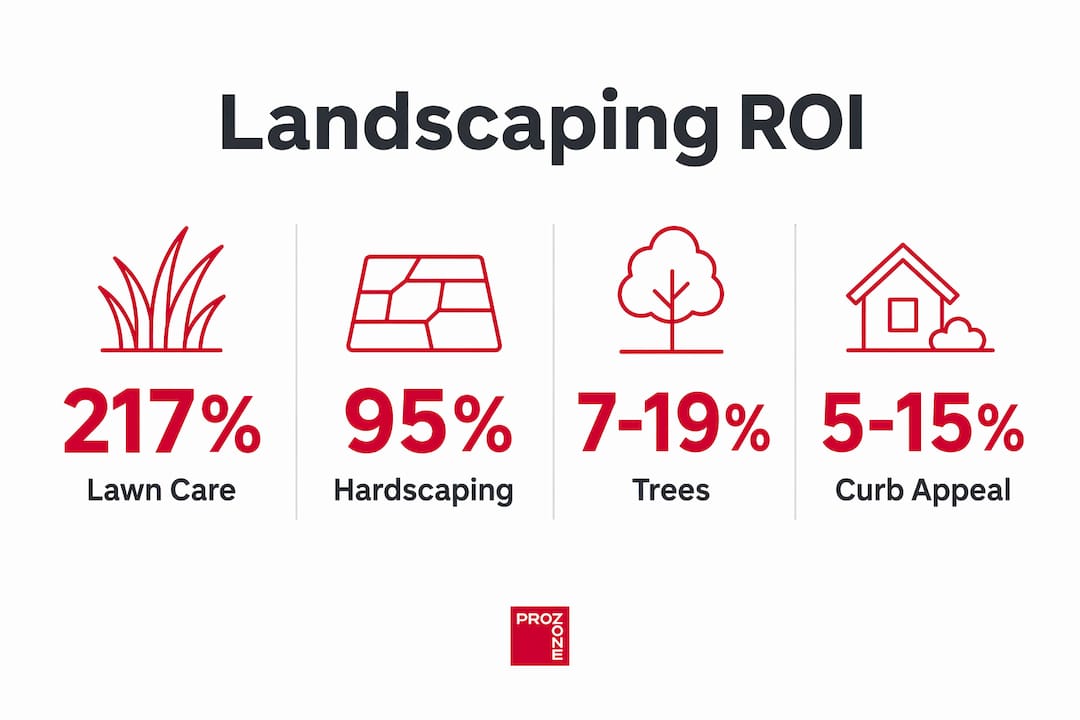
Routine lawn care delivers the highest ROI at approximately 217%, making it the single most cost-effective landscaping investment available. Neglecting basic mowing, edging, and seasonal cleanup can cost a homeowner $15,000 to $45,000 in lost value on a $300,000 property. That figure makes a $400 annual lawn care contract look like a straightforward financial decision.
Mature trees are the compounding asset of residential landscaping. Trees add 7% to 19% to property value while simultaneously reducing energy costs by up to 25% through strategic shade placement. USDA data confirms that trees positioned on south and west-facing walls reduce energy costs by up to 30%, a benefit buyers increasingly factor into their purchase calculations. Homeowners who plant fast-growing shade trees early capture this compounding value effect over time.
Hardscaping features including patios, walkways, and defined edging return close to 95% cost recovery at resale when designed with universal appeal in mind. In Edmonton, concrete and interlocking stone must be installed with proper base compaction and drainage to survive freeze-thaw cycles without heaving. Poor installation eliminates the ROI entirely and creates a liability rather than an asset.
Features with poor ROI include koi ponds, elaborate water features, and highly customised garden structures. These narrow the buyer pool and require ongoing maintenance that most buyers are unwilling to absorb. Overly personalised features consistently underperform compared to universally appealing landscaping basics.
Pro Tip: When planning hardscaping in Edmonton, specify a minimum 300mm compacted granular base beneath any concrete or interlocking stone surface. This depth accommodates frost penetration and prevents heaving, protecting your investment through multiple freeze-thaw seasons.
How to avoid landscaping pitfalls that reduce property value
Poor landscaping does not simply fail to add value. It actively subtracts it. Neglected or unkempt landscaping reduces a home’s sale price by 5% to 15%, a range confirmed by 70% of estate agents surveyed. On a $500,000 Edmonton property, that represents a $25,000 to $75,000 reduction in achievable sale price, a figure that dwarfs the cost of basic maintenance.
The most common value-reducing landscaping mistakes fall into two categories: neglect and over-personalisation. Neglect is straightforward to address with consistent maintenance routines. Over-personalisation is more subtle and often more damaging because homeowners invest significant money into features that reduce their buyer pool rather than expanding it.
Common landscaping value killers and how to address them:
- Overgrown or dead plantings: Remove dead material immediately and replace with low-maintenance, frost-tolerant species suited to Edmonton’s climate
- Cracked or heaved walkways: Repair or replace with properly compacted bases; visible structural damage signals deferred maintenance to buyers
- Inconsistent lawn condition: Bare patches, moss, or weed-heavy turf signal drainage or soil problems; address with aeration, overseeding, and targeted fertilisation
- Highly customised features: Koi ponds, elaborate topiary, and niche garden structures appeal to a narrow buyer segment; replace with clean, defined beds and healthy turf
- Cluttered front yards: Excessive garden ornaments, mismatched containers, and dense plantings create visual noise that reduces perceived space and value
- Ignored seasonal transitions: Leaving dead annuals or uncut perennials through winter signals low maintenance standards to spring buyers
For pre-sale landscaping, a budget of $300 to $1,000 spent on basic cleanup and curb appeal improvements delivers the strongest return relative to investment. Fresh mulch, pruned shrubs, and seasonal colour plantings create a strong buyer impression for minimal outlay. The front yard takes priority because it determines whether buyers schedule a showing at all.
Pro Tip: Keep a simple landscaping maintenance log noting dates of fertilisation, aeration, pruning, and any plant replacements. Presenting this record to buyers during a sale demonstrates consistent stewardship and removes a common objection about unknown maintenance history.
How to strategically use landscaping to maximise long-term value
A strategic approach to landscaping treats the property’s exterior as a managed asset rather than a maintenance obligation. For Edmonton homeowners and real estate investors, this means planning investments across two time horizons: immediate resale impact and long-term equity growth.
The following priorities are ordered by budget and time horizon:
- Establish a recurring lawn care routine (immediate, under $500/year): Mowing, edging, and seasonal cleanup protect the baseline value of any property. This is the non-negotiable foundation before any other investment is considered.
- Plant fast-growing shade trees (1 to 5 years, $200 to $1,000 per tree): Species like Manitoba maple or trembling aspen establish quickly in Alberta’s climate and begin delivering energy savings and value uplift within three to five growing seasons.
- Invest in front-yard design sophistication (pre-sale or 1 to 2 years, $1,500 to $5,000): Layered plantings, defined beds, and clean edging produce the 12.7% perceived value increase documented in design research. This is where professional consultation pays for itself.
- Install automated irrigation (1 to 2 years, $1,500 to $4,000): Drip irrigation and zone-controlled systems reduce water consumption and eliminate the inconsistency of manual watering, which is particularly valuable during Alberta’s dry summers.
- Add functional hardscaping (2 to 5 years, $3,000 to $15,000): Patios, walkways, and defined edging with proper Edmonton-grade installation deliver near-full cost recovery and expand the property’s usable outdoor space.
- Incorporate native and drought-resistant plantings (ongoing): Species adapted to Alberta’s climate require less water, survive freeze-thaw cycles without replacement, and increasingly appeal to buyers who prioritise low-maintenance properties.
Professional consultation at the design stage consistently improves ROI. Virginia Tech research confirms that design sophistication rather than plant quantity drives the highest value perception gains. A professional designer who understands Edmonton’s soil conditions, sun angles, and frost depths will specify plantings and materials that perform over multiple seasons rather than requiring annual correction.
For real estate investors managing multiple properties, the calculus is straightforward. 97.7% of real estate agents agree that good landscaping improves home value by at least 5%, with over half believing it can push value up by 15% or more. Applying even the lower figure to a portfolio of properties represents a material uplift in total asset value for a relatively modest per-property investment.
Pro Tip: For Edmonton investment properties, prioritise Edmonton curb appeal improvements in spring immediately after snowmelt. The window between late April and mid-May is when buyer activity peaks and first impressions carry the most weight in the local market.
What experience with Edmonton properties has taught us about landscaping value
Working across Edmonton’s residential and commercial properties, the pattern that stands out most clearly is the gap between what homeowners spend on landscaping and what they protect in equity. The properties that hold value through market fluctuations are almost always those with consistent, maintained exteriors, not necessarily elaborate ones.
Edmonton’s freeze-thaw cycle is genuinely unforgiving to substandard work. Walkways installed without adequate base compaction heave within two seasons. Plant species chosen without regard for hardiness zones die back visibly and signal neglect to buyers. These are not cosmetic issues. They are structural signals that buyers and appraisers both read as indicators of broader maintenance standards.
The most common mistake we observe is treating landscaping as a one-time pre-sale expense rather than an ongoing asset management practice. Properties that receive annual lawn care, periodic pruning, and timely hardscape repairs consistently achieve faster sales and stronger prices than those that receive a rushed cleanup in the weeks before listing.
Sophisticated design does not require a large budget. Clean bed lines, consistent mulch depth, and well-chosen plant combinations create a premium impression that distinguishes a listing in any price bracket. The benefits of outdoor landscaping compound over time when the work is done correctly from the start.
For any project involving hardscaping, earthworks, or material supply, working with contractors certified under Alberta Safety Codes is the standard that protects both the investment and the property owner’s liability exposure. Generic contractors who skip base preparation or use materials not rated for Alberta’s climate create problems that cost more to fix than the original work.
— ProZone
How ProZone supports Edmonton property owners and investors
ProZone delivers professional landscaping construction, hardscaping, and material supply services across Edmonton and the surrounding region, with all work completed to Alberta Safety Codes standards. Whether you are preparing a residential property for sale or managing a commercial real estate portfolio, ProZone’s team brings the technical expertise to specify and install landscaping that performs through Edmonton’s demanding climate cycles. From landscaping materials for Alberta properties to concrete screeds, asphalt, and earthworks, ProZone provides the full scope of exterior construction services that protect and grow property value. Contact ProZone through the online enquiry form or call directly for a free estimate on your next project.
FAQ
Does landscaping really increase property value?
Yes. Well-maintained landscaping increases home market value by 5% to 15%, with premium markets reaching up to 20%, according to Virginia Tech research and multiple 2026 industry surveys. The impact is consistent across residential property types.
What landscaping investment has the highest ROI?
Routine lawn care delivers the highest ROI at approximately 217%, costing under $500 per season while preventing $15,000 to $45,000 in value loss on a typical $300,000 property. It is the most cost-effective landscaping investment available.
Can poor landscaping reduce my home’s sale price?
Yes. Neglected or unkempt landscaping reduces a home’s sale price by 5% to 15%, with 70% of estate agents confirming this range. On a $500,000 property, that represents a potential loss of $25,000 to $75,000.
How does Edmonton’s climate affect landscaping value?
Edmonton’s freeze-thaw cycle damages poorly installed hardscaping and kills non-hardy plant species, both of which signal deferred maintenance to buyers. Specifying frost-tolerant plants and properly compacted hardscape bases is necessary to maintain landscaping value through Alberta winters.
Is professional landscaping worth the cost before selling?
Professional landscaping consistently ranks among the top value-recovery projects before a sale, often outperforming many interior renovations according to NAR Remodeling Impact Report data. Even a $300 to $1,000 investment in basic cleanup and curb appeal improvements can prevent price reductions measured in thousands of dollars.