
TL;DR:
- Proper sub-base preparation involves layering, compaction, moisture control, and verification to ensure pavement longevity. In Edmonton, angular crushed aggregate is the standard material used to resist frost heave and provide effective drainage. Ensuring correct procedures prevents early pavement failure and extends the lifespan of outdoor surfaces.
Sub-base preparation is the engineered process of building a drained, compacted aggregate layer over a prepared subgrade to support pavement or concrete flatwork. Done correctly, it delivers four measurable outcomes on every project: a formation at the designed compacted depth, a verified relative compaction level, a clear drainage path away from the structure, and a proofrolled surface free of soft spots. For a residential patio or shed base, a typical compacted sub-base thickness is 75–100 mm, increased to 150 mm on clay subgrade. Driveways generally require a minimum of 150 mm, and commercial parking areas or road subgrades need a more substantial depth, adjusted according to load and soil conditions.
Pro Tip: Before placing any material, check the moisture content of your subgrade. Compacting over saturated or bone-dry soil prevents the sub-base from reaching target density, no matter how many passes you make.
Table of Contents
- What does a sub-base actually do for your pavement?
- Which sub-base materials work best in Canadian conditions?
- How do you prepare a sub-base from start to finish?
- How thick should your sub-base be?
- Why frost and drainage matter so much in Edmonton
- Can you pour concrete directly on a sub-base?
- Testing, inspection, and mistakes that cause rework
- ProZone’s perspective on sub-base preparation
- ProZone sub-base and site preparation services in Edmonton
- Useful Canadian sources and references
- FAQ
What does a sub-base actually do for your pavement?
A pavement system is a layered structure. The natural soil underneath is the subgrade. Above it sits the sub-base, a layer of engineered granular material. The base course goes on top of that, and the wearing surface, whether asphalt or concrete, finishes the stack. Each layer has a specific job, and the sub-base carries five of the most critical ones.
Poor sub-base preparation produces predictable failure modes: differential settlement that cracks slabs, pumping where fines migrate upward under load, and frost heave that buckles surfaces after a single Alberta winter. Skipping or rushing this stage is the most common reason a pavement fails years before its design life.
Which sub-base materials work best in Canadian conditions?
Material choice depends on load, drainage requirements, and the frost susceptibility of the underlying soil. The table below summarises the most common options used on Alberta projects.
| Material | Typical use | Key characteristic |
|---|---|---|
| Well-graded crushed aggregate (road crush) | Driveways, parking lots, roads | Angular particles interlock well; achieves high density |
| Granular sub-base (pit-run or processed) | Patios, sheds, light commercial | Cost-effective; verify fines content before accepting |
| Fractured washed rock | Drainage-critical zones | Excellent permeability; low fines, poor load-spread alone |
| Cement-treated granular sub-base | Heavy commercial, weak subgrade | High stiffness; requires curing time before loading |
| Lean concrete | Rigid pavement sub-base | Maximum stiffness; used under concrete roads and slabs |
For most Edmonton-area projects, angular road crush is the default. Its particle shape locks under compaction and resists the displacement that freeze-thaw cycles cause in rounded materials.
A few additional points worth noting before you order:
- Fines content matters. Material with more than 8–10% passing the 75-micron sieve is frost-susceptible and will pump water under load in spring thaw conditions.
- Angularity is not optional. Rounded river gravel compacts poorly and shifts under dynamic loads.
- On soft, clay, or waterlogged ground, place a geotextile separation membrane before any aggregate to stop material migrating into the subsoil and losing its engineered properties.
- Verify gradation certificates from your supplier. Accepting material on visual inspection alone is a common and costly mistake.
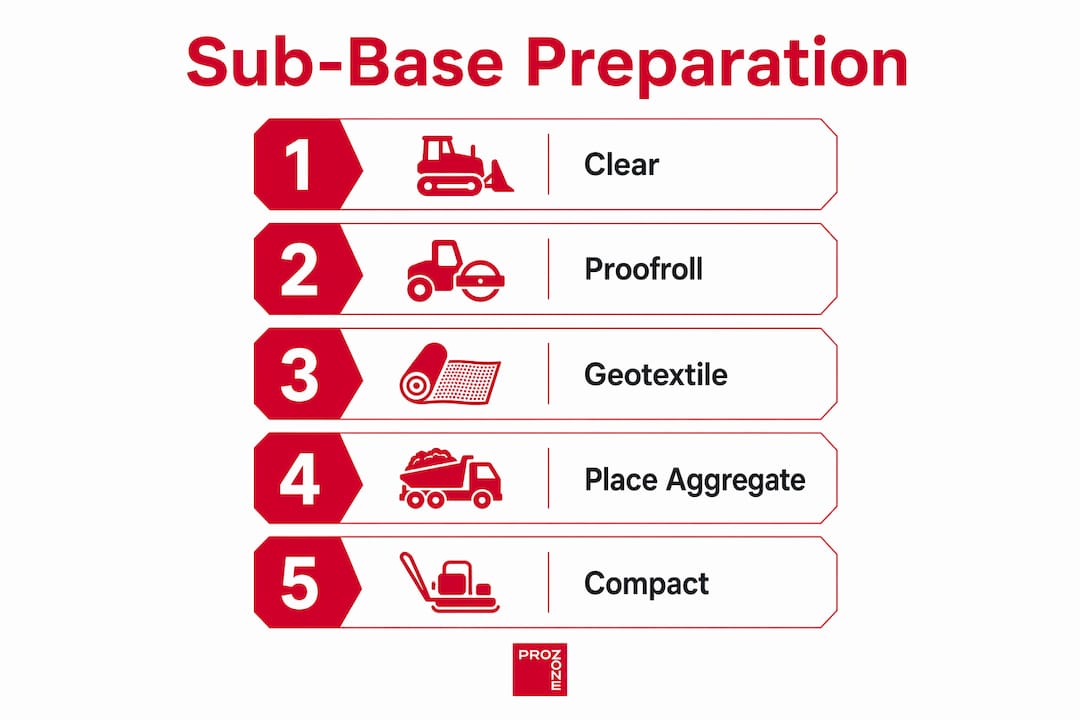
How do you prepare a sub-base from start to finish?
Follow this sequence on every project. Skipping steps does not save time; it creates rework.
- Strip and clear the site. Remove topsoil, vegetation, and any organic material. Organic content compresses over time and causes settlement regardless of how well the aggregate above it is compacted.
- Set finished levels and falls. Mark the target formation level and confirm positive drainage falls, typically a minimum 1:40 cross-fall, before excavation begins. Refer to grading and grade control principles when setting out.
- Assess and proofroll the subgrade. Run a loaded roller or heavy vehicle across the formation. Any rutting or deflection under the wheel indicates a soft spot that needs undercutting and replacement with stable material. Proofrolling is the standard field verification step before any aggregate goes down.
- Place geotextile where required. On clay or wet ground, lay the separation membrane across the full formation before the first lift of aggregate.
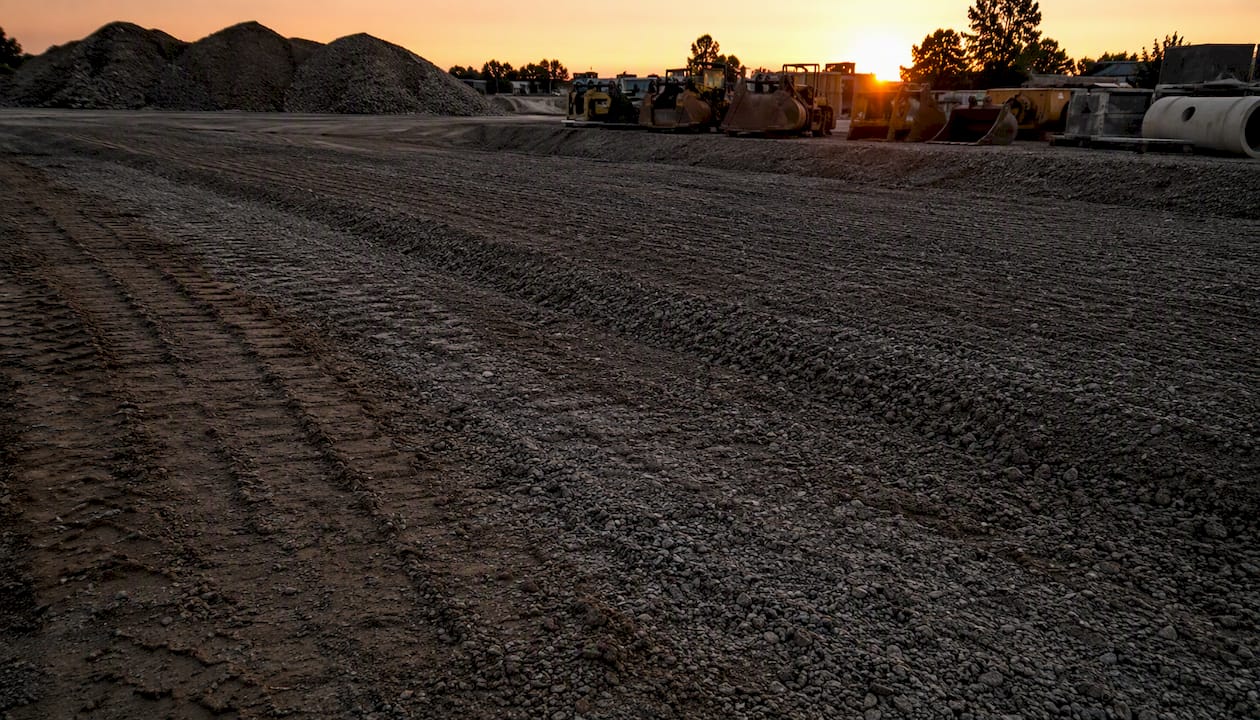
- Deliver and spread material in controlled lifts. Loose lift thickness should stay within 150–250 mm depending on your compaction equipment. Placing the full depth in a single thick lift is one of the most common errors on site; the compactor cannot reach the bottom of a deep lift, leaving a weak zone that only shows up after the pavement is in service.
- Condition moisture and compact each lift. Aim for moisture content within plus or minus 2% of optimum before compacting. Too dry and the material bridges; too wet and it pumps. Use a vibrating plate or roller appropriate to the lift thickness and material type.
- Regulate the surface and blind if required. Trim high spots and fill low spots to achieve the design level. For paving applications, a thin blinding layer of fine material, around 10 mm, gives a better bedding interface and reduces loss of bedding sand into large-void aggregate.
- Protect the formation. Keep construction traffic off the finished sub-base until the next layer is placed. Rutting a completed sub-base and then covering it is a defect, not a shortcut.
Pro Tip: Coordinate material delivery so each lift is placed and compacted the same day. Leaving loose aggregate overnight in wet weather changes the moisture content and forces re-conditioning before you can compact.
For broader site sequencing, ProZone’s site preparation guide for project managers covers the full workflow from clearing through to finished grade.
How thick should your sub-base be?
Depth is not a fixed number. It depends on the load the surface will carry, the strength of the subgrade below, drainage conditions, and frost depth. The table below gives practical starting points for Alberta conditions; treat them as minimums on competent subgrade.
| Application | Typical compacted depth | Notes |
|---|---|---|
| Patio or shed base | 75–100 mm | Increase to 150 mm on clay subgrade |
| Residential driveway | 150 mm | Standard for passenger vehicles |
| Commercial parking lot | 200–250 mm | Verify with geotechnical report for heavy trucks |
| Municipal road or heavy haul | 300 mm or more | Structural design required |
Target in-place density for granular sub-bases is 95–98% of maximum dry density from a modified Proctor test, with the higher end applying to high-demand pavements and roads. Lift thickness must match your compaction equipment: a vibrating plate compactor suits 150 mm loose lifts; a smooth-drum roller handles 200–250 mm lifts on larger sites.
When to request geotechnical input or a structural engineer:
- Subgrade CBR (California Bearing Ratio) is unknown or suspected to be low
- The project involves heavy vehicles, municipal roads, or loading docks
- Subgrade stabilisation using lime, cement, or engineered stabilisers may be needed for weak soils where replacement is impractical
- Site drainage is poor and subdrain design is required
- Previous pavement on the same footprint failed early
Why frost and drainage matter so much in Edmonton
Edmonton sits in a climate zone where ground temperatures cycle repeatedly through freezing and thawing from October through April. That freeze-thaw pattern is the single biggest threat to pavement longevity in the region, and the sub-base is the primary defence against it.
Frost heave occurs when capillary water rises through fine-grained or frost-susceptible soil and freezes, expanding and lifting the pavement above. A well-designed sub-base reduces capillary rise and provides a drainage path so water cannot accumulate at the formation level. The practical measures that make the difference are:
- Use free-draining angular aggregate with low fines content to break the capillary path.
- Provide sufficient granular thickness to keep the frost line within the sub-base rather than in the subgrade.
- Install edge drains or subdrains on sites with poor natural drainage or high water tables.
- Place geotextile at the subgrade interface on clay sites to prevent fines pumping upward into the aggregate during spring thaw.
- Maintain positive surface drainage falls so meltwater sheds away from the pavement edge.
Moisture control during construction is equally important. Compacting at the correct moisture content, within plus or minus 2% of optimum, produces a dense, stable matrix that resists water infiltration through the winter months. For more on how Alberta winters affect pavement performance, ProZone’s article on freeze-thaw impacts on asphalt covers the mechanisms in detail.
Pro Tip: Schedule sub-base compaction for periods when overnight temperatures are above freezing. Compacting frozen or near-frozen aggregate produces false density readings and a layer that loosens when it thaws.
Can you pour concrete directly on a sub-base?
Yes, but only when the sub-base meets four conditions: correct compaction, accurate level, appropriate moisture, and a clean surface. Concrete Alberta guidance is explicit that concrete must not be placed on a frozen subgrade, and that a dry granular sub-base should be dampened before pouring to prevent it from drawing water out of the fresh mix and weakening the concrete.
Do:
- Verify compaction with a density test before forming up.
- Check the surface level against the design; tolerance is typically plus or minus 10 mm for flatwork.
- Dampen a dry granular surface lightly before placing concrete.
- Apply a bond-breaker where specified for lean concrete sub-bases under rigid slabs.
- Blind the surface with fine material if the aggregate is coarse-void and bedding loss is a risk.
Do not:
- Pour onto a frozen, icy, or snow-covered sub-base under any circumstances.
- Place concrete on a loose, dusty, or recently disturbed surface.
- Skip proofrolling or compaction verification to save time before forming up.
- Allow construction traffic to rut the sub-base after final regulation and before the pour.
Testing, inspection, and mistakes that cause rework
Key tests and what they confirm
| Test | What it measures | When to use it |
|---|---|---|
| Proofrolling | Soft spots, water-affected zones | Before any aggregate placement and after final regulation |
| Nuclear density gauge | In-place dry density and moisture | After each compacted lift |
| Sand-cone density test | In-place dry density (reference method) | Where nuclear gauge is unavailable or for verification |
| Moisture content check | Proximity to optimum moisture | Before and during compaction |
| Gradation/sieve analysis | Particle size distribution of delivered material | On material acceptance at site |
Compaction targets map directly to performance. Achieving 95–98% of modified Proctor MDD is the accepted range for granular sub-bases; anything below 95% on a trafficked surface is a defect waiting to appear.
Common inspection mistakes that lead to rework:
- Accepting a single thick lift without density testing through its depth.
- Ignoring moisture variability across a large site; one corner may be at optimum while another is saturated.
- Skipping proofrolling because the subgrade “looks fine.”
- Failing to document lift-by-lift test results, leaving no record if a dispute arises later.
Stop work and call a geotechnical engineer when proofrolling shows consistent deflection across a zone, when density tests repeatedly fail to reach the target, or when unexpected groundwater or soft organic material is encountered below the design formation level.
ProZone’s perspective on sub-base preparation
Sub-base preparation is where pavement quality is either built in or permanently compromised. The wearing surface gets the attention, but the sub-base determines how long it lasts. In Edmonton’s climate, a pavement built on a poorly compacted or inadequately drained sub-base will not survive five winters without visible distress. That is not a prediction; it is a pattern ProZone sees repeatedly when taking over rehabilitation projects from sites where the foundation work was rushed.
ProZone’s standard practice on every sub-base project includes multi-lift compaction with density verification after each lift, moisture conditioning within plus or minus 2% of optimum, and proofrolling before any material is placed. These are not premium add-ons; they are the baseline for work that meets Alberta Safety Codes and holds up under real conditions. Contractors who skip proofrolling or compact in a single deep lift are not saving money for the client. They are deferring a repair cost that will be larger and more disruptive than the original build.
The decision to invest in proper sub-base preparation is straightforward when you consider the alternative: premature cracking, heave, and the cost of removing and replacing a surface that should have lasted decades.
ProZone sub-base and site preparation services in Edmonton
ProZone delivers road construction and sub-base preparation for municipal, commercial, and residential clients across Edmonton and the surrounding Alberta region. Every project includes documented QA procedures, Alberta Safety Codes compliance, and geotechnical coordination where the scope requires it.
Services relevant to sub-base and site preparation work include:
- Excavation, subgrade assessment, and undercut replacement
- Supply and placement of granular sub-base and road crush materials
- Multi-lift compaction with density verification
- Concrete flatwork and asphalt paving on prepared formations
- Drainage grading and edge drain installation
For project managers coordinating sub-base works within a larger schedule, construction task management tools like Buildberry can help sequence trades and track inspection hold points efficiently.
Contact ProZone through the online form at prozoneltd.ca or call directly for a free site assessment and estimate. ProZone typically responds to enquiries within one business day and can mobilise for site visits across the Edmonton metro area within the week.
Useful Canadian sources and references
| Resource | What it covers |
|---|---|
| FHWA Bases and Subbases for Concrete Pavement | Compaction targets, material specs, frost protection design |
| Concrete Alberta Residential Flatwork Guide | Moisture control, freeze-thaw requirements, sub-base preparation before pouring |
| Subbase (pavement) — Wikipedia) | Layer definitions, functions, and material overview |
| Zalig.ca — Subgrade Stabilisation Guide | Lime, cement, and engineered stabiliser options for weak subgrades |
| Build-Construct — Subbase Layers Guide | Installation sequence, proofrolling, and compaction practice |
For project-specific specifications, request the applicable provincial or municipal engineering standard from your authority having jurisdiction. Alberta Transportation and municipal engineering departments publish standard drawings and material specifications that govern public infrastructure projects and are a useful benchmark for private work as well.
FAQ
What is a sub-base in construction?
A sub-base is the engineered granular layer placed between the natural subgrade and the base course or wearing surface. It distributes loads, provides drainage, and protects against frost heave.
How do you prepare a sub-base correctly?
Strip topsoil, proofroll the subgrade, place geotextile on soft ground, then compact granular material in controlled lifts of 150–250 mm, verifying density after each lift before adding the next.
Can you pour concrete directly on a sub-base?
Yes, provided the sub-base is compacted to the specified density, at the correct level, and at appropriate moisture. Never pour onto a frozen sub-base, and dampen a dry granular surface before placing concrete.
What material is used for a sub-base?
Angular crushed aggregate or road crush is the standard choice for most Alberta projects. It compacts well, resists frost displacement, and drains effectively when fines content is kept low.
What compaction level does a granular sub-base need?
Target 95–98% of maximum dry density from a modified Proctor test. The higher end of that range applies to roads and commercial pavements carrying heavy vehicle loads.