
TL;DR:
- Property managers in Edmonton often underestimate the complexity of outdoor material supply for commercial projects, risking delays and cost overruns. Effective procurement requires precise material takeoffs, staged deliveries, supplier evaluation, and adherence to performance specifications suited for heavy-duty applications. Treating outdoor supply as a structured, phased process ensures on-time, budget-conscious project completion.
Property managers overseeing commercial sites in Edmonton often make the same costly assumption: that ordering outdoor materials is as simple as calling a local landscape store and picking up a few bags of mulch. That assumption gets expensive fast. Outdoor material supply at a commercial scale involves coordinated procurement, spec-grade product selection, staged delivery scheduling, and supplier vetting that basic consumer guides simply don’t address. This article walks you through everything you need to know, from defining what outdoor material supply actually covers to evaluating suppliers and understanding why commercial projects demand a fundamentally different approach.
Table of Contents
- Defining outdoor material supply for Edmonton properties
- Key processes in outdoor material supply procurement
- Evaluating reliable outdoor material suppliers in Edmonton
- Commercial-grade material specs and project requirements
- Why most managers underestimate outdoor material supply complexity
- Connect with Edmonton’s outdoor material supply experts
- Frequently asked questions
Key Takeaways
| Point | Details |
|---|---|
| Broad material coverage | Outdoor material supply includes soil, mulch, gravel, pavers, and blocks needed for property projects. |
| Procurement best practices | Quantifying needs, planning for long-lead materials, and scheduling deliveries drives project success. |
| Supplier selection matters | Reliable suppliers align inventory and logistics with commercial-scale requirements. |
| Commercial specs are vital | Spec-grade materials and contract clarity prevent performance issues for large properties. |
| Avoid last-minute surprises | Following a documented supply pipeline reduces cost and availability risks. |
Defining outdoor material supply for Edmonton properties
Let’s start by clearing up the most common point of confusion. Outdoor material supply is not the same as picking up a bag of topsoil at a hardware store. At the commercial level, outdoor material supply refers to sourcing and delivering a broad range of materials used for exterior, landscape, and site-work projects, including soil, mulch, gravel, stone aggregates, pavers, and hardscape blocks. The distinction matters because the scale, specification requirements, and logistics of commercial procurement are fundamentally different from what any residential guide will prepare you for.
When we talk about outdoor material supply for a commercial Edmonton property, we’re talking about materials that must perform under traffic loads, Alberta freeze-thaw cycles, and municipal drainage standards. A parking lot expansion needs crushed limestone with specific compaction grades. A corporate campus walkway needs pavers rated for heavy foot traffic and wide temperature swings. A retention pond edge needs engineered gravel with controlled particle size for drainage performance. None of these needs are met by browsing a general landscaping catalog.
Here are the core material categories that fall under commercial outdoor supply:
- Soils and growing media: Engineered topsoil blends, sandy loam, clay, compost-amended fill
- Gravel and aggregates: Crushed stone, road base, drainage gravel, decorative river rock
- Mulch and organic materials: Wood chip mulch, bark mulch, compost, shredded cedar
- Pavers and hardscape blocks: Concrete pavers, natural stone, retaining wall blocks, edging products
- Sand: Bedding sand, polymeric sand for joint filling, utility sand
- Decorative materials: Colored stone, pea gravel, gabion rock, boulders
Suppliers like ProZone Ltd stock gravel and sand options suited for heavy-duty commercial use, including bulk delivery in job-site quantities. You can also source mulch chips inventory for large planted areas or green space buffers, and topsoil and sod for site restoration and finished grading work.
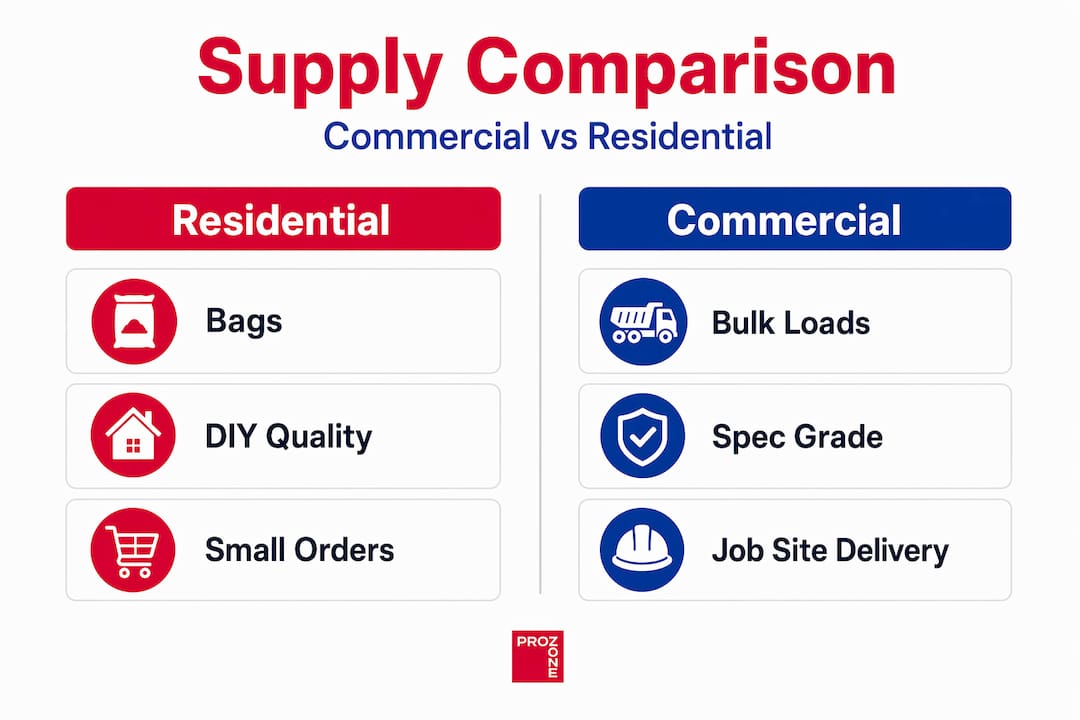
The gap between residential and commercial supply needs is more than just quantity. It’s a difference in quality standards, delivery logistics, and documentation requirements. Here’s a simple comparison:
| Factor | Residential supply | Commercial supply |
|---|---|---|
| Volume per order | Bags or small bulk loads | Bulk truckloads, multi-stage deliveries |
| Spec documentation | Rarely required | Often contractually required |
| Delivery coordination | Single drop-off | Staged to match project phases |
| Material performance | General use | Load-rated, frost-resistant, drainage-engineered |
| Pricing structure | Retail or per-bag | Volume pricing, account-based contracts |
| Lead time sensitivity | Flexible | Tied to construction schedule |
Understanding this comparison is what separates a well-run commercial project from one that burns through budget chasing materials after the fact.
Key processes in outdoor material supply procurement
Understanding the types of materials is only half the equation. Property managers need a reliable process to ensure timely, cost-effective supply for their projects. The good news is that construction materials procurement follows a predictable methodology that you can adapt for outdoor supply: it starts with material takeoff and quantification from project drawings, moves into identification of long-lead items, and then aligns delivery scheduling to the overall project timeline. Skip any one of these steps and you’ll likely face either a surplus you’re storing on-site or a shortage that stalls a crew.
Here’s how that three-step framework applies in practice for Edmonton commercial properties:
-
Material takeoff and quantification. Before you call a single supplier, pull your site plans and calculate the actual volume of each material category you need. For gravel, that means cubic meters based on area and compaction depth. For topsoil, it means surface area multiplied by installation depth plus a waste factor of roughly 10 to 15 percent. For pavers, it means total square footage with a 5 to 8 percent cut waste allowance. Skipping this step and ordering by rough estimate almost always results in either expensive over-ordering or mid-project shortages.
-
Identify long-lead items. Not all outdoor materials are available on short notice. Specialty pavers, large natural boulders, specific grades of crushed limestone, and custom-blended growing media can have lead times ranging from two to six weeks, depending on season and supplier inventory. In Edmonton’s short construction season, a two-week delay on a key material can push an entire project past the frost window. You need to flag these items early and place orders before site work even begins.
-
Schedule deliveries to match project phases. This is where commercial supply gets genuinely complex. You don’t want ten truckloads of gravel on-site when the drainage contractor hasn’t finished grading. You don’t want topsoil delivered when the site is still under fill operations. Work with your supplier to stage deliveries so each material arrives when the relevant trade is ready to use it. This protects material quality, reduces site congestion, and keeps your project on schedule.
Pro Tip: Treat your outdoor material supply as a pipeline with clear intake and output points. Map each material to a specific project phase, assign a lead-time buffer, and schedule supplier check-ins at least weekly during active phases. This alone prevents the most common budget surprises in Edmonton commercial landscaping projects.
Here’s a practical reference for common materials and their typical lead times during Edmonton’s peak construction season (May through September):
| Material | Typical lead time | Peak season risk |
|---|---|---|
| Bulk topsoil | 3 to 7 days | Moderate |
| Crushed gravel (standard) | 2 to 5 days | Low |
| Specialty pavers | 2 to 6 weeks | High |
| Natural boulders | 1 to 3 weeks | Moderate |
| Custom soil blends | 1 to 2 weeks | High |
| Cedar mulch (bulk) | 3 to 5 days | Low to moderate |
| Polymeric sand | 1 to 5 days | Low |
Browsing all landscaping supply categories early in your project planning gives you a clear picture of what’s stocked locally and what may need a longer ordering window. If you’re managing multiple properties, reviewing landscaping materials for commercial properties can help you build a consistent supply list across sites.
Evaluating reliable outdoor material suppliers in Edmonton
With a procurement process in mind, it’s crucial to select suppliers who can reliably deliver both the materials and the operational support needed for large projects. This is where many property managers make a critical mistake: choosing a supplier based on price alone, without checking whether that supplier can actually support a commercial project from start to finish.
When evaluating suppliers for commercial property landscaping or infrastructure in Edmonton, three criteria stand out consistently: inventory breadth across core outdoor material categories, the ability to deliver job quantities rather than retail loads, and operational practices that align deliveries with staged construction or landscape work. A supplier who can only offer retail-quantity pickups is not a commercial supplier, regardless of what their website says.
Here’s what to look for when assessing a potential outdoor material supplier for your Edmonton commercial property:
- Inventory breadth: Can they supply all your core material categories from one location? Consolidating supply with fewer vendors reduces coordination complexity and often unlocks better pricing.
- Bulk delivery capability: Do they have the equipment to deliver truckload quantities directly to your site? Confirm payload sizes and whether they can navigate your site’s access constraints.
- Staged delivery experience: Have they worked with commercial contractors and property managers on multi-phase projects? Ask for references from comparable projects.
- Spec documentation: Can they provide material data sheets, gradation reports, or compaction specs for aggregates? This matters if your project involves engineered fills or municipal inspections.
- Contract flexibility: Are they able to set up account pricing, volume discounts, or committed supply agreements for longer projects?
- Responsiveness: How quickly do they respond to order changes or urgent requests? In commercial construction, site conditions change daily and your supplier needs to keep up.
“When evaluating suppliers for commercial property landscaping and infrastructure in Edmonton, look for inventory breadth across core outdoor material categories, ability to deliver job quantities, and operational practices that align deliveries with staged construction or landscape work.” This is the standard that separates a reliable commercial supplier from one that will leave your project stalled at a critical phase.
Pro Tip: When vetting a new supplier, ask these three specific questions before signing any supply agreement. First, what is your typical lead time for bulk aggregate orders during June and July? Second, can you provide a sample material data sheet for your crushed limestone? Third, what is your policy if a delivery arrives outside the agreed window? The answers reveal more about operational reliability than any sales presentation will.
Suppliers who carry decorative rocks and stones alongside engineered aggregates and soils are better positioned for the full scope of commercial landscaping work. When you’re comparing options, reviewing resources on best outdoor materials for Edmonton conditions helps you understand what specs to ask for. Pulling together a complete landscaping supply checklist before your first supplier conversation is always time well spent.
Commercial-grade material specs and project requirements
Identifying the right supplier is only effective if you understand the actual specs your project requires and how commercial needs differ from basic landscaping. This is where most generic supply guides fall short. Consumer-facing landscaping guides describe materials at a high level, but commercial property managers need more detailed information on spec-grade performance, tolerances, drainage engineering, and contractual terms that basic overviews simply don’t cover.
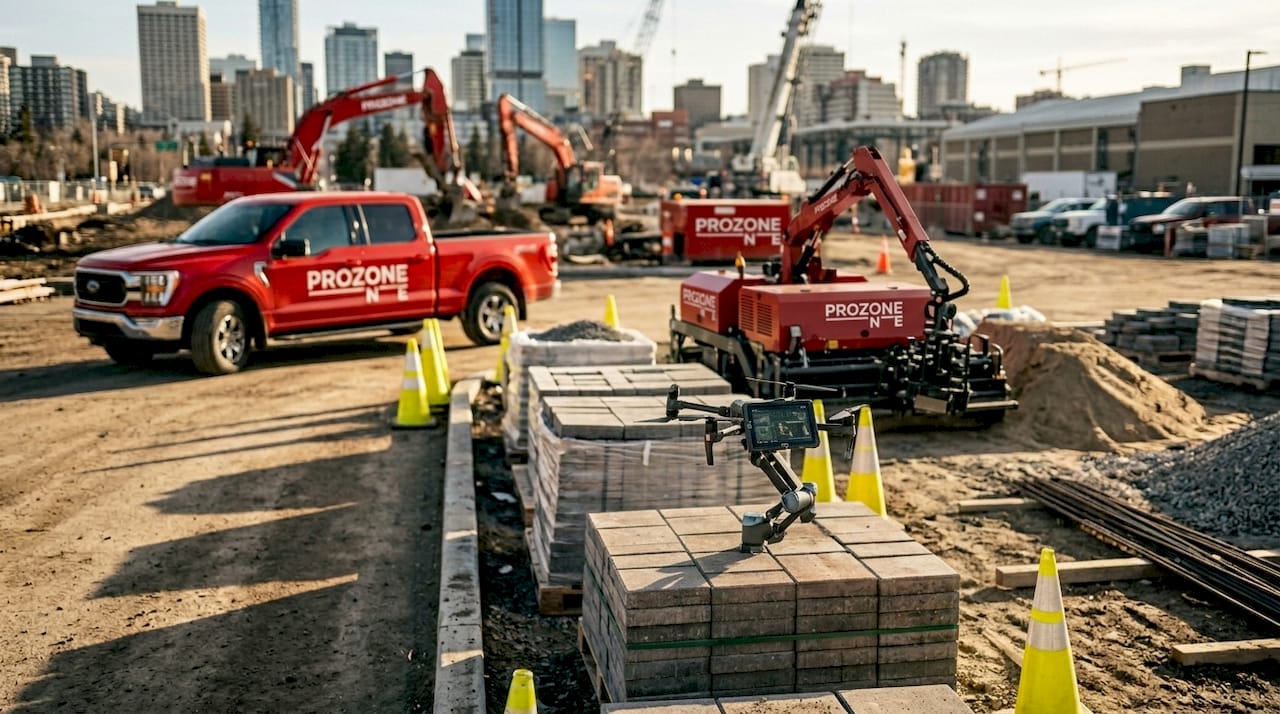
What does “spec-grade” actually mean in practice? It means materials have been tested, graded, and certified to meet defined performance thresholds. For aggregates used in sub-base construction, that might mean a specific Proctor density, Los Angeles abrasion value, or sodium sulfate soundness rating. For topsoil, it might mean a defined organic content percentage, pH range, and particle size distribution. These are not specifications you’ll find on a bag label at a retail garden center.
Here are the most commonly overlooked commercial spec requirements that property managers need to address before procurement:
- Frost resistance: Alberta’s freeze-thaw cycles are brutal. Aggregates used in walkways, patios, and parking areas need to meet Canadian Standards Association (CSA) freeze-thaw durability ratings to avoid cracking and heaving within a few seasons.
- Drainage engineering: Gravel used for perimeter drainage, French drains, or infiltration trenches needs to meet specific gradation requirements. Using the wrong gradation leads to clogging, waterlogging, and costly remediation.
- Load-bearing capacity: Aggregates used in vehicle traffic areas need to meet sub-base compaction standards. Ordering decorative gravel for a parking lot sub-base is a mistake that ends with potholes in year two.
- Contamination controls: Fill material and topsoil used on commercial sites may need to meet Alberta environmental guidelines for clean fill, particularly near stormwater features or areas of ecological sensitivity.
- Documentation for inspection: Many commercial projects in Edmonton are subject to municipal inspection or insurance requirements that demand material traceability. Your supplier needs to be able to provide delivery records and product data sheets on request.
One statistic worth keeping in mind: according to industry data, material-related delays and specification errors account for a significant portion of commercial construction cost overruns. Getting the spec wrong on a bulk material is not a small mistake. You may be looking at replacement costs, disposal fees, and lost project time all at once.
The landscaping supplies center at ProZone Ltd covers a range of commercial-grade materials, and working with a supplier who understands these performance requirements saves you from costly substitutions later in the project.
Why most managers underestimate outdoor material supply complexity
Here’s an uncomfortable truth about how most commercial property managers approach outdoor material supply: they treat it like a shopping task rather than a project management function. They wait until the contractor asks for materials, then scramble to find a supplier, order what seems right by approximate volume, and hope it arrives on time. This approach works about as well as you’d expect.
The real problem is that the gap between what a basic supply guide describes and what a commercial project actually requires is enormous, and very few resources bridge that gap honestly. Most online content about landscaping materials is written for homeowners or small contractors. It describes product types at a surface level, lists some general applications, and calls it done. It doesn’t address staging, specifications, inspection documentation, or the operational realities of managing supply across a multi-phase commercial project in a city with a five-month construction window.
From our experience working with property managers across Edmonton and the surrounding Alberta region, the three most common errors are predictable. The first is neglecting scheduling entirely, placing one large order and expecting it to serve the whole project, which creates site congestion early and shortages later. The second is ignoring material specs, accepting whatever the supplier has in stock without asking whether it meets the project’s engineering requirements. The third is failing to formalize contract terms, leaving delivery windows, quality standards, and return policies undefined, which creates disputes when something goes wrong.
The practical wisdom is straightforward: always treat outdoor material supply as a staged, documented process. Every material should be tied to a project phase. Every order should include a spec reference. Every delivery should be documented with a receipt that includes product type, grade, quantity, and delivery date. This is not bureaucratic overhead. It’s the difference between a project that runs smoothly and one that runs over budget by 20 percent.
For a clearer picture of what a well-managed commercial supply process looks like in Alberta, the Alberta commercial property supply resource covers the local context well. And if you’re interested in how supply chain visibility connects to broader project outcomes, landscaping SEO strategies offers some interesting perspective on how the industry is evolving digitally.
The managers who get this right are not the ones with the most experience or the biggest budgets. They’re the ones who take supply seriously as a discipline, not an afterthought.
Connect with Edmonton’s outdoor material supply experts
If you want supply done right for your Edmonton property, here’s how to take the next step. ProZone Ltd has built its reputation across Alberta by combining deep local knowledge with a stocked inventory of commercial-grade outdoor materials. Whether you’re managing a corporate campus, a commercial retail site, or a multi-unit residential development, the team at ProZone understands what staged, spec-aligned delivery actually looks like in practice. Explore the full Edmonton landscaping supply store to see what’s available for your next project. If you want to start with the materials best suited for Edmonton’s climate and commercial performance requirements, the guide on best durable landscaping materials is a practical first step before your first supplier conversation.
Frequently asked questions
What materials are included in outdoor material supply for commercial Edmonton properties?
Outdoor material supply covers soil, mulch, gravel, stone aggregates, pavers, hardscape blocks, and other essentials for exterior landscaping and site-work projects. For commercial sites, these materials must often meet performance specifications beyond standard retail grades.
How should property managers start the procurement process for outdoor materials?
Begin by completing a material takeoff from your project drawings to establish exact volumes, then identify long-lead items and build a staged delivery schedule that aligns with your construction phases. This sequence prevents the most common supply disruptions in commercial projects.
What are the main criteria for choosing a reliable outdoor material supplier?
Prioritize inventory breadth, the ability to deliver job-site quantities, and operational experience with staged commercial deliveries. A supplier who can only handle retail volumes or single drop-offs is not suited for complex property management projects.
Why do commercial properties require spec-grade material supply?
Commercial projects require higher standards around material performance, frost resistance, drainage engineering, and contamination controls that go well beyond what residential landscaping guides address. Contractual documentation and inspection traceability add further requirements not typically found in retail supply.
How can Edmonton property managers avoid supply delays and budget surprises?
Treat material supply as a documented pipeline: quantify needs from project plans early, flag long-lead items for advance ordering, and coordinate phased deliveries with your site schedule. Building in lead-time buffers of at least two weeks for specialty materials is a reliable safeguard during Edmonton’s peak construction season.