
Selecting the right materials for outdoor landscaping in Edmonton isn’t just about aesthetics. It’s about survival. Edmonton’s extreme freeze-thaw cycles, with temperatures swinging from minus 30°C in winter to plus 30°C in summer, destroy poorly chosen materials within a few seasons. Property and facility managers face a critical decision: invest in durable, climate-appropriate materials now, or budget for costly repairs and replacements year after year. This guide walks you through the essential criteria for material selection and highlights the top performers that withstand Edmonton’s harsh conditions while minimizing maintenance demands.
Table of Contents
- Key takeaways
- Key criteria for selecting outdoor landscaping materials in Edmonton
- Top durable materials: freeze-thaw resistant concrete and natural stone
- Local aggregates, mulches, and native plants for low-maintenance landscaping
- Site preparation and grading essentials to prevent damage and ensure drainage
- Enhance your Edmonton landscaping projects with ProZone Ltd.
- Frequently asked questions
Key Takeaways
| Point | Details |
|---|---|
| Freeze thaw durability | Freeze thaw resistant concrete and natural stone outperform other surfaces under Edmonton extreme cycles. |
| Local supplier range | Local suppliers provide a wide range of aggregates and organic materials. |
| Xeriscaping with natives | Native plants reduce maintenance and water use. |
| Grading and permeable bases | Proper grading with a two percent slope away from structures and permeable bases prevent ice damage and runoff. |
Key criteria for selecting outdoor landscaping materials in Edmonton
Before you order a single pallet of pavers or plant a single shrub, you need to evaluate materials against Edmonton’s unique environmental and regulatory landscape. The wrong choice doesn’t just look bad. It fails structurally, creating safety hazards and budget overruns.
Freeze-thaw resistance tops the list. Edmonton experiences over 100 freeze-thaw cycles annually. Water seeps into porous materials, freezes, expands, and cracks them from the inside out. Materials with low water absorption rates (under 3%) survive. Everything else crumbles. Proper grading with a 2% slope away from structures and permeable materials prevent ice damage and runoff that accelerate deterioration.
Material longevity and maintenance needs directly impact your operating budget. A material that requires annual sealing, frequent repairs, or replacement every five years costs far more over its lifecycle than a premium option that lasts decades with minimal intervention. Calculate total cost of ownership, not just initial purchase price.
Municipal compliance can’t be ignored. The City of Edmonton requires specific tree and shrub densities and security measures for commercial landscaping. Violating these standards triggers fines and project delays. Review local bylaws before finalizing your design.
Environmental performance matters for both regulatory compliance and operational efficiency. Drought-tolerant plants reduce irrigation costs. Permeable surfaces manage stormwater runoff. Heat-absorbing dark materials create uncomfortable microclimates and stress vegetation. Choose materials that work with Edmonton’s climate, not against it.
Site preparation factors like grading, base material quality, and drainage infrastructure determine whether your materials perform as designed or fail prematurely. Even the best pavers crack when installed over poorly compacted soil. Even the hardiest plants die in standing water. Invest in proper commercial landscaping materials and installation practices from the start.
Pro Tip: Create a material selection matrix scoring each option on freeze-thaw resistance, maintenance requirements, municipal compliance, environmental impact, and total lifecycle cost. This data-driven approach eliminates guesswork and justifies budget allocations to stakeholders.
Top durable materials: freeze-thaw resistant concrete and natural stone
When Edmonton’s winter hits, your hardscaping either survives or it doesn’t. Two material categories consistently outperform everything else: freeze-thaw resistant concrete products and natural stone.
Freeze-thaw resistant concrete pavers and blocks last 30+ years and dramatically outperform poured concrete, which cracks under Edmonton’s conditions. The secret lies in their flexibility. Individual pavers can shift slightly during freeze-thaw cycles without cracking. When damage does occur, you replace individual units rather than demolishing entire sections. Modern concrete pavers achieve water absorption rates below 5%, meeting ASTM standards for severe weathering regions.
Poured concrete seems economical initially, but it’s a false economy. Rigid slabs can’t flex with ground movement. Cracks appear within two to three winters. Water infiltrates, freezes, and the damage cascates. Repairs require expensive demolition and replacement. Skip poured concrete for Edmonton outdoor applications unless you enjoy perpetual maintenance.
Natural stone offers excellent longevity and frost resistance, lasting 40+ years with water absorption rates often below 1%. Granite, limestone, and quartzite provide superior durability in freeze-thaw environments. Stone develops a natural patina over decades, adding character rather than showing wear. Unlike manufactured materials that fade or deteriorate, stone improves aesthetically with age.
The tradeoff? Cost and weight. Natural stone commands premium pricing and requires structural support for elevated installations. But when you calculate cost per year of service life, stone often wins. A granite patio installed today will still look impressive in 2066.
| Material | Lifespan | Maintenance | Freeze-thaw resistance | Cost |
|---|---|---|---|---|
| Concrete pavers | 30+ years | Low (occasional re-leveling) | Excellent | Moderate |
| Natural stone | 40+ years | Very low (none required) | Superior | High |
| Poured concrete | 5-10 years | High (crack repairs, sealing) | Poor | Low initial, high lifecycle |
Pro Tip: Source your concrete contractor services and landscape stone options from suppliers experienced with Edmonton’s climate. They stock products proven in local conditions and understand installation requirements that prevent premature failure.
Local aggregates, mulches, and native plants for low-maintenance landscaping
Hardscaping forms your project’s skeleton, but aggregates, mulches, and plants bring it to life while controlling maintenance demands. Smart material choices here slash your annual operating costs.
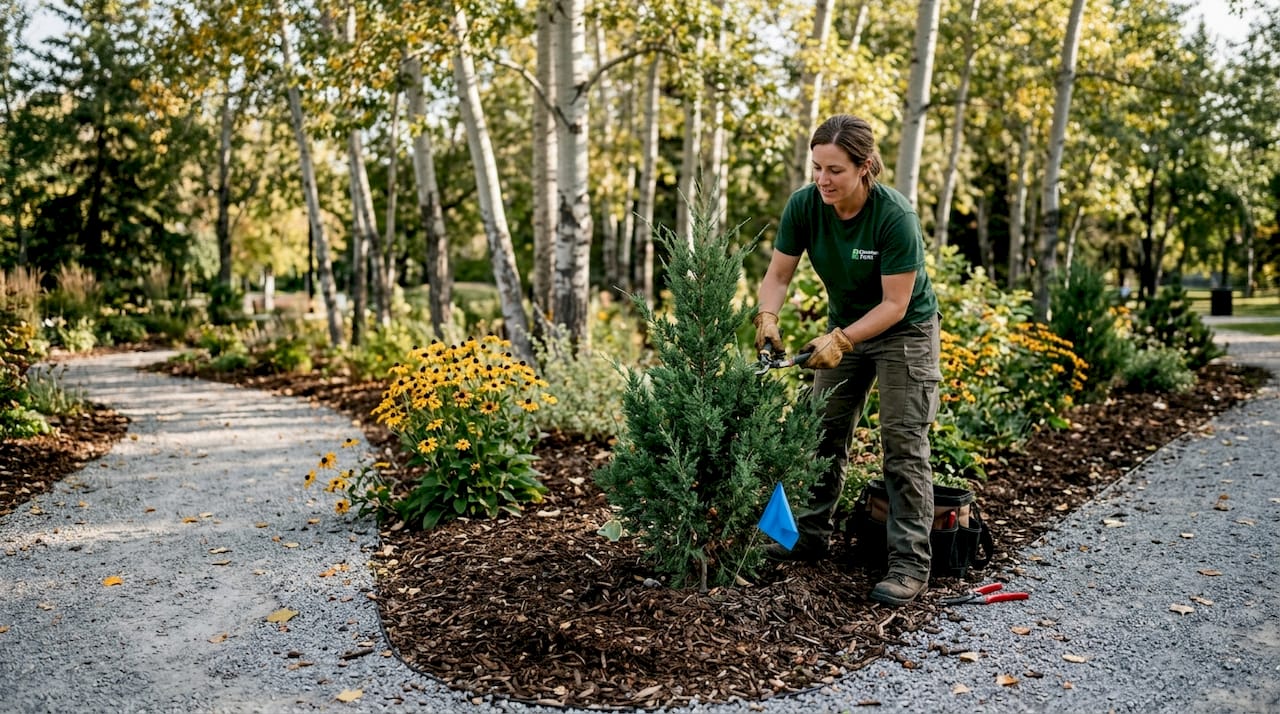
Local suppliers provide aggregates like gravel, rock chips, mulch, and topsoil specifically suited for Edmonton commercial landscaping. Working with regional sources eliminates shipping delays and ensures you receive materials tested in local conditions. Crushed limestone and river rock from Alberta quarries perform reliably in freeze-thaw cycles because they’ve already survived millions of years in similar conditions.
Mulches serve multiple functions: weed suppression, soil temperature regulation, moisture retention, and aesthetic appeal. Cedar and spruce chips decompose slowly in Edmonton’s climate, providing two to three years of service before requiring replenishment. They insulate plant roots during winter temperature swings and keep soil cooler during summer heat waves. Avoid dyed mulches, which fade quickly and may contain chemicals that stress plants.
Drought-tolerant natives like Black-eyed Susan and Juniper reduce water use and maintenance dramatically. These species evolved in prairie conditions similar to Edmonton’s climate. They thrive in clay soils, tolerate temperature extremes, and require minimal irrigation once established. Xeriscaping with native plants can reduce landscape maintenance by over 50% during Edmonton’s dry summers, cutting both water bills and labor costs.
Native plant benefits extend beyond water savings. They support local pollinators and wildlife, meeting environmental certification requirements for green building projects. They resist local pests and diseases without chemical interventions. They maintain visual interest across seasons, from spring blooms through winter seed heads.
One critical mistake: never use rock mulch directly around plants. Dark rocks absorb and radiate heat, creating microclimates that stress vegetation and increase water demands. Reserve rock mulch for pathways and decorative accents away from root zones.
Source your materials strategically. Local gravel and sand supplies, mulch chip options, and topsoil and sod supplies from Edmonton-area suppliers ensure compatibility with local conditions and simplify logistics for large commercial projects.
Site preparation and grading essentials to prevent damage and ensure drainage
Even premium materials fail when installed over inadequate bases. Site preparation determines whether your landscaping investment lasts decades or requires reconstruction within five years. Edmonton’s freeze-thaw cycles punish shortcuts mercilessly.
Grading establishes the foundation for everything else. Ensure at least a 2% slope grading away from structures to prevent water pooling and ice buildup. Water that collects near foundations freezes, expands, and causes structural damage to both buildings and hardscaping. A proper grade directs runoff to designated drainage areas, preventing erosion and ice formation.
Base preparation with 6 inches of gravel and geotextile fabric is essential under all hardscape surfaces. The gravel provides a stable, free-draining foundation that prevents frost heaving. Geotextile fabric separates the gravel from underlying soil, preventing migration that would compromise stability. Compact the gravel in 2-inch lifts using a plate compactor. Inadequate compaction allows settling that creates uneven surfaces and premature failure.
De-icing salt management protects your investment. Road salts degrade asphalt and concrete over time. Consider zeolite additives in asphalt mixes for enhanced cold weather durability. Design drainage to direct salt-laden runoff away from planted areas, as most vegetation suffers from salt exposure.
Mulch application requires consistency. Maintain 2 to 3 inches of organic mulch around plants. Too little provides inadequate insulation and weed suppression. Too much smothers roots and creates habitat for rodents. Replenish mulch annually as it decomposes.
Follow these numbered steps for site preparation that ensures longevity:
- Survey and mark existing utilities to prevent damage during excavation
- Remove existing vegetation, topsoil, and organic matter to stable subgrade
- Establish proper grades with a 2% minimum slope away from structures
- Excavate to design depth, accounting for base material and surface thickness
- Compact subgrade soil to 95% density using appropriate equipment
- Install geotextile fabric over compacted subgrade, overlapping seams 12 inches
- Place and compact gravel base in 2-inch lifts to specified depth
- Verify final grade and drainage patterns before installing surface materials
Pro Tip: Schedule inspections during spring and fall freeze-thaw transitions. Early detection of minor settling, drainage issues, or material movement allows inexpensive repairs. Ignored problems escalate into expensive failures. Document conditions with photos to track performance and justify maintenance budgets. Review concrete protection best practices annually to stay current on maintenance techniques.
Enhance your Edmonton landscaping projects with ProZone Ltd.
You’ve seen how material selection, proper installation, and strategic planning determine landscaping success in Edmonton’s demanding climate. ProZone Ltd. brings decades of experience delivering exactly these solutions to commercial and municipal clients across the Edmonton region.
We supply the complete range of commercial landscaping materials covered in this guide, from freeze-thaw resistant concrete products to locally sourced aggregates and organic mulches. Our team understands Edmonton’s climate challenges because we work in them every day. We’ve completed hundreds of projects that prove proper materials and installation practices deliver decades of reliable performance.
Beyond materials, ProZone Ltd. offers comprehensive road construction services and Edmonton concrete contractor expertise for integrated site development. Partner with a local supplier who streamlines procurement, ensures code compliance, and stands behind every product. Contact ProZone Ltd. to discuss your next landscaping project and discover how the right materials and expert execution protect your investment for the long term.
Frequently asked questions
What materials resist Edmonton’s freeze-thaw cycles best?
Concrete pavers and natural stone with water absorption below 5% provide superior freeze-thaw resistance. These materials prevent water infiltration that causes cracking when temperatures fluctuate. Avoid poured concrete, which cracks within a few winters under Edmonton conditions.
How does proper grading prevent landscaping damage?
A minimum 2% slope away from structures directs water runoff and prevents pooling that leads to ice formation and structural damage. Proper grading combined with permeable base materials ensures water moves through and away from hardscaping rather than freezing in place and causing heaving or cracking.
Why choose native plants for Edmonton commercial landscaping?
Native species like Juniper and Black-eyed Susan evolved in prairie conditions similar to Edmonton’s climate, requiring minimal irrigation once established. They reduce maintenance costs by over 50% during dry summers, tolerate temperature extremes, thrive in local clay soils, and support municipal environmental requirements without chemical treatments.
What base preparation do hardscape surfaces require?
Install 6 inches of compacted gravel over geotextile fabric beneath all hardscape surfaces. The gravel provides drainage and prevents frost heaving, while fabric prevents soil migration into the base. Compact in 2-inch lifts to 95% density for long-term stability.
Do Edmonton regulations affect commercial landscaping design?
Yes, the City of Edmonton mandates specific tree and shrub densities, security measures, and vegetation types for commercial properties. Review municipal bylaws during design to ensure compliance and avoid fines or project delays. Regulations influence both plant selection and overall project costs.
Recommended
- Everything You Need for Your Landscaping in Edmonton – ProZone Ltd. – Home, Main office, asphalt, concrete, snow removal, Alberta, Edmonton, SherwoodPark, rubber paving, streetbond, thermoplastic, landscaping supplies
- Landscaping materials for Alberta commercial properties
- Interlocking vs Concrete – Impact on Outdoor Living