
TL;DR:
- Sand and gravel are essential construction materials with supply risks amplified by global demand and environmental regulations. Alberta’s complex regulatory environment and source variability require proactive procurement strategies, detailed documentation, and supplier diligence to ensure project schedule and quality. Recognizing sand and gravel as strategic resources rather than commodities enhances supply reliability, supporting long-term infrastructure development.
Sand and gravel are among the most extracted natural resources on earth, yet most procurement officers treat them like they treat printer paper: order when needed, assume it arrives on time. That assumption is increasingly dangerous. The role of sand and gravel supply in Alberta construction is more complex than most project managers realize, and global sand extraction is estimated at around 50 billion tonnes per year, with building-related sand use projected to rise by up to 45% by 2060. Supply disruptions that once seemed like someone else’s problem are now showing up in Alberta project schedules and budgets.
Table of Contents
- Understanding sand and gravel supply in Alberta
- Global and environmental factors shaping supply risks
- Ensuring quality and schedule certainty through supplier diligence
- Navigating the nuances of sand and gravel sourcing
- Applying Alberta’s regulatory and operational changes to procurement strategies
- Why viewing sand and gravel as strategic resources transforms project success
- Explore reliable sand, gravel, and construction services in Edmonton
- Frequently asked questions
Understanding sand and gravel supply in Alberta
Having introduced the importance of sand and gravel supply, we now explore Alberta-specific extraction and regulatory frameworks that affect your project timelines and procurement decisions directly.
Sand and gravel are not a single commodity. They exist in a wide range of grades, types, and processing states, each suited to a specific construction application. Concrete work requires washed, graded sand with low silt content. Road base construction calls for crushed gravel with angular particles that lock together under compaction. Drainage applications need open-graded material with minimal fines. Ordering the wrong grade is not a minor inconvenience. It can trigger quality rejections, rework, and schedule shifts that ripple through an entire project program.
Common material types and their primary uses in Alberta construction:
- Pit-run gravel: Unprocessed material used for subgrade fill and temporary access roads
- Crushed gravel: Angular, processed aggregate for road base, driveways, and structural fills
- Washed concrete sand: Cleaned fine aggregate for concrete mixes, mortar, and screeds
- Washed drainage gravel: Open-graded material for French drains, bedding, and pipe surrounds
- Screenings: Fine crushed material used for paver base and compacted surface finishes
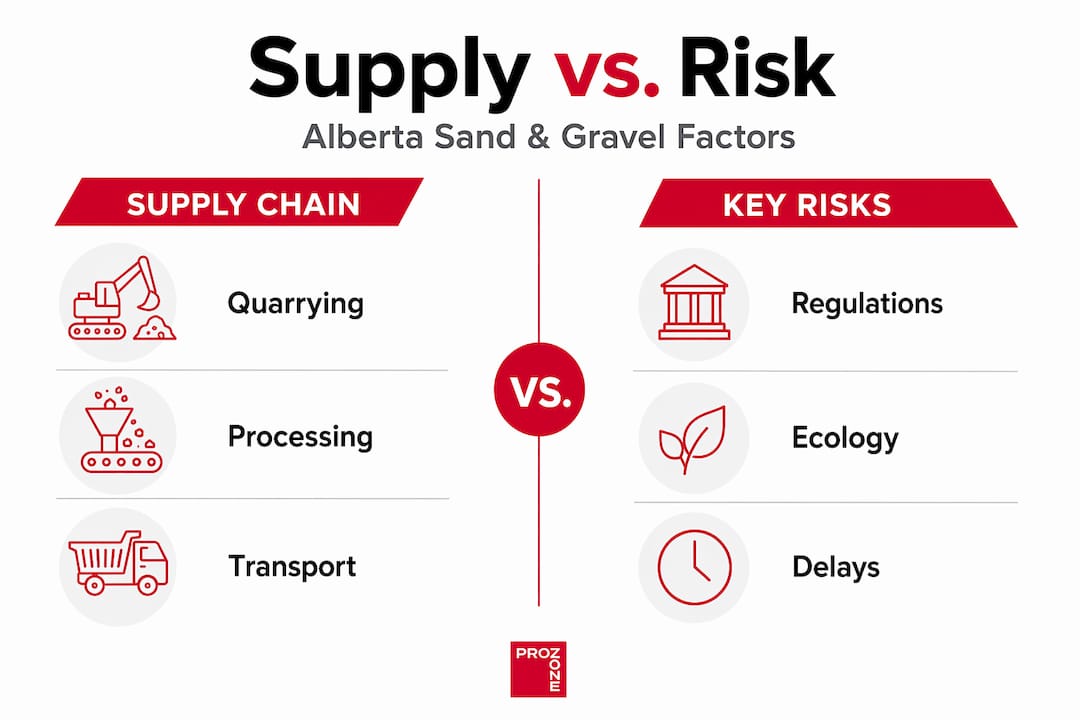
The extraction and processing chain that delivers these materials involves quarrying, crushing, screening, and washing, each step adding cost and time. Understanding washed sand and gravel supply options available locally helps you match product specifications to project needs before committing to a procurement timeline.
Regulatory complexity adds another layer. Alberta’s Sand and Gravel Task Force produced 15 recommendations designed to streamline regulatory compliance and reduce lead times through formal service standards and concurrent processing of applications. These reforms are still being implemented, which means approval timelines for new extraction sites remain variable. Procurement officers working on projects with long material lead times should factor this uncertainty into contracts and scheduling. You can also find practical guidance on material supply cost-saving strategies relevant to Alberta regulatory compliance.
Global and environmental factors shaping supply risks
With an understanding of Alberta’s supply framework, we turn to how global and environmental forces create complex supply risks that must be addressed in project planning.
Most project managers mentally categorize sand and gravel as abundant, low-risk materials. The data does not support that view. Surging global demand is outpacing sustainable supply and threatening ecosystems and livelihoods through extraction practices that deplete riverbeds, wetlands, and coastal systems. When extraction removes natural habitats faster than they can regenerate, downstream effects include increased flooding risk, reduced water quality, and loss of biodiversity. These are not abstract concerns. Regulatory responses to ecological damage are already tightening in multiple Canadian provinces.
“Sand is both essential for infrastructure and critical to maintaining natural ecosystem functions, making sustainable management a strategic consideration for governments and industry alike.” UN Wetlands
For Alberta procurement officers, the practical implications are significant:
- Regulatory closures of ecologically sensitive extraction sites can eliminate a supplier from your approved list without warning
- Increased compliance costs at extraction sites translate to higher per-tonne pricing over time
- Environmental assessments tied to new pit approvals create unpredictable delays in supply expansion
- Public opposition to extraction near communities or water bodies can delay or cancel approvals entirely
- Seasonal restrictions at river-adjacent sites limit availability during high-flow periods, often coinciding with peak construction season
The sand and gravel industry in Alberta sits at the intersection of infrastructure demand and ecological stewardship. When scoping landscaping materials considerations for commercial properties, this supply context matters because landscaping projects often require specific washed sands and decorative gravels that draw from a narrower pool of compliant suppliers.
The impact of sand and gravel decisions extends beyond the project site. Procurement officers who recognize this reality position themselves to manage supply risk proactively rather than reactively.
Ensuring quality and schedule certainty through supplier diligence
Understanding supply challenges and ecological concerns, let’s focus on how to maintain quality and schedule certainty through rigorous supplier evaluation.
Quality failures with sand and gravel are expensive and often avoidable. The most common cause is insufficient documentation at the procurement stage. A supplier quoting a product as “concrete sand” is not providing enough information to confirm it will pass a mix design’s silt content or gradation requirements. Reliable suppliers provide detailed spec sheets and batch-specific test results that minimize delays from failed quality checks, which is vital for maintaining infrastructure project schedules.
What quality documentation should you require before placing an order:
- Sieve analysis (gradation report): Confirms particle size distribution against specification limits
- Silt content or plasticity index: Ensures material meets purity thresholds for concrete or base course
- Crushing value and flakiness index (for gravel): Measures resistance to load and angular particle shape
- Batch number and extraction date: Enables traceability if a dispute arises after delivery
- Third-party lab certification: Confirms results are independent, not self-reported by the supplier
Certifications need to be current, not pulled from a two-year-old approval. Material properties at the same pit can change as extraction advances into different geological layers. A spec sheet from a previous project is not a substitute for a current batch test. You can review real-world project quality assurance examples to understand the standard of documentation and material performance expected on professional Alberta construction sites.
Pro Tip: Always request that certifications list the specific extraction pit or processing facility, not just the supplier’s business name. This matters when a supplier aggregates material from multiple sources and resells under one label.
Spec risk reduction also applies to schedule management. When materials are rejected on arrival, the time lost to reordering, re-delivery, and retesting often exceeds the cost of the rejected load. Building supplier quality audits into your procurement process, particularly for large infrastructure contracts, is a direct investment in schedule protection. Staying current on compliance standards in Alberta gives you the baseline to evaluate whether a supplier’s documentation actually meets provincial requirements.
Navigating the nuances of sand and gravel sourcing
Now that you understand quality requirements, let’s explore the subtle sourcing complexities that influence your procurement risk exposure.
Not all sand and gravel are geologically equivalent, even when they meet the same gradation specification on paper. Material sourced from dynamic environments, such as riverbeds and wetland margins, tends to have rounder, smoother particles due to water transport. Material from static terrestrial sources like upland pits and quarries is typically more angular from mechanical crushing. Rounded particles affect workability in concrete but may reduce friction in compacted road base layers. Knowing the source environment helps you anticipate material behavior on site.
Sand and gravel supply chains involve dynamic extraction from rivers and static terrestrial sources, with blending common downstream. Blending happens when a supplier mixes material from multiple pits to hit a target gradation or manage inventory. This is not inherently problematic, but it does reduce traceability and can create inconsistency batch to batch if the blend ratios are not tightly controlled.
| Source type | Particle shape | Typical uses | Traceability risk |
|---|---|---|---|
| River / wetland (dynamic) | Rounded, smooth | Concrete sand, drainage fill | Higher; seasonal and regulated |
| Upland pit / quarry (static) | Angular, crushed | Road base, structural fill | Lower; accessible year-round |
| Blended (mixed source) | Variable | General fill, landscaping | Medium to high; requires documentation |
| Recycled aggregate | Angular, variable | Sub-base, non-structural fill | Medium; depends on source material |
Steps to improve sourcing traceability in your procurement process:
- Require suppliers to declare the extraction site and province on all delivery documentation
- Ask for a material origin statement that identifies whether the product is blended or single-source
- Include contract language requiring notification if source pits change mid-supply
- Verify pit approval status through Alberta’s regulatory database before finalizing a supplier agreement
- Retain batch test reports by delivery date to support any future quality dispute
Pro Tip: When reviewing sourcing and blending nuances for landscaping aggregate types in Alberta, pay particular attention to decorative gravels, which are frequently blended across multiple quarry sources and can vary significantly in color, texture, and gradation from order to order.
Understanding how gravel is produced at the source, not just how it arrives on your site, is one of the clearest differentiators between procurement officers who manage supply confidently and those who are consistently surprised by material variability.
Applying Alberta’s regulatory and operational changes to procurement strategies
Having explored technical sourcing, the next focus is adapting procurement strategies to Alberta’s evolving regulatory environment for greater project success.
Alberta’s regulatory landscape for aggregate extraction is in active transition. The province committed to implementing 15 task force recommendations by end of 2026, aiming to accelerate approval timelines and improve supplier availability. For procurement officers, this creates both opportunity and short-term uncertainty. Approvals that once took years may eventually process faster, but during the transition period, suppliers are navigating new requirements that can introduce unexpected delays.
Key regulatory changes affecting procurement planning:
- Formal service standards for application reviews reduce, but do not eliminate, processing time variability
- Concurrent processing of environmental and operational approvals shortens timelines when submissions are complete
- New reclamation security requirements may increase capital costs for smaller operators, reducing supplier options
- Community consultation requirements at new extraction sites add unpredictable lead times for expansion approvals
The following table outlines how regulatory stages map to procurement timeline risks:
| Regulatory stage | Estimated duration | Procurement risk level | Suggested mitigation |
|---|---|---|---|
| Initial application submission | 2 to 6 months | Medium | Start sourcing 12 to 18 months ahead |
| Environmental review | 3 to 12 months | High | Qualify backup suppliers early |
| Approval and licensing | 1 to 4 months | Medium | Build 8-week material buffer into schedule |
| Site establishment and production | 4 to 8 weeks | Low to medium | Confirm pit-to-site logistics before award |
Pro Tip: Include a regulatory contingency clause in your sand and gravel supply contracts that allows for price and timeline adjustments if a supplier’s pit approval status changes during your project. This is increasingly standard practice as procurement strategy adapts to Alberta’s shifting regulatory environment.
For infrastructure projects where compacted granular base is critical, understanding regulatory timelines is inseparable from schedule certainty. Review current base course paving practices to see how material availability and quality directly affect road durability outcomes in Alberta’s climate.
Why viewing sand and gravel as strategic resources transforms project success
Most procurement conversations about sand and gravel begin and end with price per tonne. That framing is understandable. These materials are abundant enough that they rarely appear on an executive risk register, and their unit cost is low relative to engineered materials like structural steel or precast concrete. But the conventional commodity mindset misses something important: supply disruptions with sand and gravel are not minor. They halt paving crews, delay concrete pours, and push project completion dates into seasonal windows that affect cost and quality in ways that are hard to recover from.
We’ve watched projects in Alberta get caught flat-footed because a preferred supplier lost pit access mid-season due to regulatory issues that were publicly visible months earlier. The information was available. The procurement process simply wasn’t designed to monitor it. Sand resources are not infinite and require wise use with coordinated governance to sustain long-term infrastructure and ecological health. That’s not environmental advocacy. It’s supply chain reality.
The procurement officers who manage sand and gravel most effectively treat them the way they treat structural materials: with documented qualification criteria, pre-approved backup suppliers, and contract terms that reflect real supply risk. They also recognize that suppliers who invest in sustainable extraction practices, detailed traceability, and current certifications are generally more reliable partners than those competing purely on lowest quoted price.
Integrating environmental stewardship with procurement decisions is not idealism. Suppliers operating responsibly within Alberta’s regulatory framework are less likely to face sudden site closures or enforcement actions that disrupt your supply mid-project. That reliability has direct dollar value on a project schedule. Explore strategic supply approaches that align procurement decisions with both regulatory compliance and long-term material availability.
The sand and gravel industry in Alberta is capable of supporting the province’s infrastructure ambitions. But only procurement officers who treat these materials strategically will consistently access reliable, quality-confirmed supply when and where they need it.
Explore reliable sand, gravel, and construction services in Edmonton
With strategic insights into Alberta’s sand and gravel supply environment, you can advance your projects confidently by working with a trusted local provider who understands both the regulatory landscape and the quality requirements your projects demand. ProZone Ltd supplies specification-compliant washed sand and gravel products suited for infrastructure, paving, and landscaping applications across Edmonton and the surrounding region. Our team supports procurement officers and project managers with material guidance, documentation, and scheduling coordination. Whether you need to understand your options for an upcoming infrastructure contract or plan material supply for a commercial landscaping program, our construction services for Edmonton managers cover the full project scope. We also offer professional road construction services for municipalities and commercial clients where aggregate quality directly determines pavement durability.
Frequently asked questions
Why is sand and gravel supply critical for Alberta construction projects?
Sand and gravel form the foundational materials for concrete, asphalt, and road bases, and Alberta’s infrastructure depends on consistent access to quality-graded aggregate for both durability and regulatory compliance. Without reliable supply, paving crews stall, concrete pours get rescheduled, and project completion dates shift into costlier seasonal windows.
How do regulatory changes in Alberta affect sand and gravel procurement?
New regulations streamline approval processes and introduce formal service standards, but the transition period creates variable lead times that require flexible contracting. Alberta committed to implementing 15 task force recommendations by end of 2026, meaning supplier availability is actively shifting and procurement contracts should reflect that uncertainty.
What quality documentation should I require from sand and gravel suppliers?
Request batch-specific test reports with gradation data, silt content measurements, and third-party lab certification to confirm material meets spec before delivery. Reliable suppliers provide up-to-date batch-specific test results that prevent delays from quality failures on site.
What are dynamic vs static sand and gravel extraction environments?
Dynamic environments involve materials sourced from moving waters like rivers and wetlands, producing rounder particles, while static environments like upland quarries yield angular, crushed material suited for compacted applications. Sand and gravel supply chains often blend materials from both source types downstream, which can affect consistency and traceability.
How can I reduce supply risk when ordering sand and gravel?
Confirm supplier compliance with current Alberta pit approvals, require batch-specific test documentation, verify the source environment and whether materials are blended, and include regulatory contingency terms in your supply contracts. Procurement teams that require origin disclosure and detailed batch testing consistently experience fewer disputes and delays than those relying on general supplier assurances.