
TL;DR:
- Choosing the right concrete finish is crucial for balancing durability, safety, and aesthetics in Alberta’s climate. Contractors and property managers must evaluate freeze-thaw resistance, slip resistance, maintenance needs, and intended use before selecting a finish. Proper timing, sealing, and precise flatness specifications ensure long-lasting performance across residential and commercial projects.
Choosing the right concrete finish involves far more than picking a look you like. For contractors, architects, and homeowners across Alberta, the decision directly affects how a surface performs through freeze-thaw cycles, how much maintenance it demands over decades, and whether it meets safety standards for foot traffic or heavy equipment. Understanding the types of concrete finishes available means weighing aesthetics against durability, budget against lifecycle value, and personal preference against the realities of Edmonton winters. This guide breaks down every major finish option, compares them for residential and commercial use, and gives you a clear framework for making the right call.
Table of Contents
- Key criteria for evaluating concrete finishes in Alberta
- 1. Broom finish
- 2. Trowel finish
- 3. Exposed aggregate finish
- 4. Stamped concrete finish
- 5. Polished concrete finish
- 6. Salt finish
- 7. Acid-stained concrete finish
- 8. Concrete finish comparison: residential vs. commercial projects
- 9. Decision-making guide: matching the right finish to your project
- My perspective on concrete finishing in Alberta
- Get expert concrete finishing guidance from Prozoneltd
- FAQ
Key criteria for evaluating concrete finishes in Alberta
Before selecting any finish, you need an evaluation framework that reflects Alberta’s specific conditions. Concrete finishing is functional, not just aesthetic. It directly affects structural performance, slip resistance, and how long a surface lasts under real-world stress.
The following criteria should guide every finish decision:
- Freeze-thaw durability. Alberta experiences dramatic temperature swings, and moisture that penetrates an unsealed or poorly finished surface will expand, contract, and eventually crack the concrete from within.
- Slip resistance. Outdoor surfaces in particular need adequate texture to prevent falls on wet or icy concrete. Some finishes, like polished concrete, require non-slip additives when used outdoors.
- Maintenance requirements. Some finishes need resealing every two to three years. Others are nearly maintenance-free for decades. Factor in the true cost of upkeep, not just the installation price.
- Aesthetic flexibility. Color, pattern, and texture options vary widely across finish types. Consider how the surface integrates with surrounding architecture and landscaping.
- Climate-specific sealing needs. Decorative finishes exposed to Alberta winters require sealing as a mandatory step, not an optional upgrade. Neglect results in surface erosion, stone loosening, and increased slipperiness.
- Installation timing sensitivity. Concrete finishing is time-sensitive, dependent on the bleed water cycle, temperature, humidity, and wind. Cold Alberta weather can extend finishing windows dramatically, while hot summer days shrink them, increasing the risk of surface crusting.
Pro Tip: Always schedule concrete pours around weather forecasts in Alberta. Even a modest temperature drop during finishing can compromise surface quality, particularly for polished or trowel finishes that demand precision timing.
1. Broom finish
Broom finish is the most common and cost-effective concrete finish for exterior slabs in North America. After the concrete is screeded and floated, a stiff broom is dragged across the surface to create a series of parallel ridges. Those ridges give the surface traction, which makes it the go-to choice for driveways, sidewalks, patios, and garage aprons throughout Alberta.
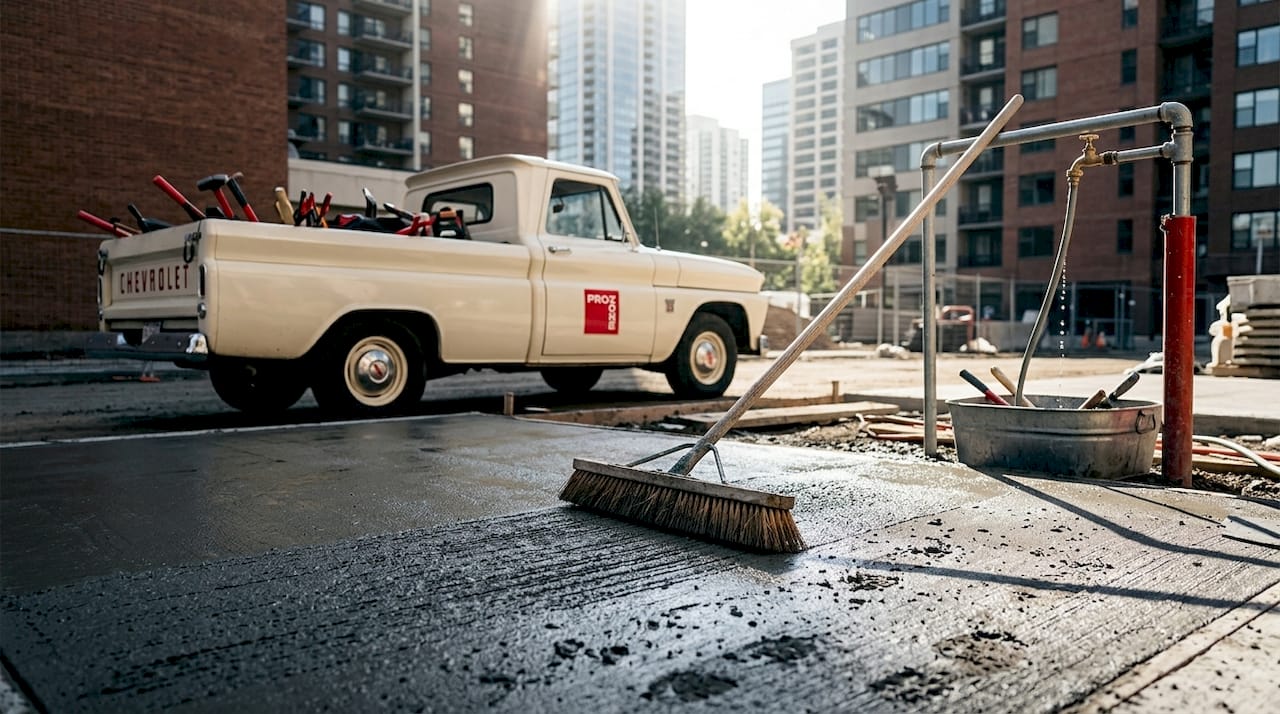
The finish is practical in every sense. It requires no special tools beyond the broom itself, it takes little additional time after the float stage, and it delivers reliable slip resistance even in wet or icy conditions. It is not the most visually refined option, but it suits utilitarian applications where performance matters more than appearance.
What to know about broom finish
- Best suited for driveways, walkways, pool decks, and utility slabs
- Texture depth varies based on broom stiffness and timing of application
- Low installation cost and minimal maintenance compared to decorative alternatives
- Can be combined with coloring agents for improved aesthetics
2. Trowel finish
A trowel finish produces a smooth, dense surface by working the concrete with a steel trowel either by hand or with a power trowel machine. The result is a hard, flat surface with minimal texture. This makes it the preferred choice for interior floors, warehouse slabs, and any application where flatness and levelness are non-negotiable.
The density achieved through troweling also improves abrasion resistance, which matters in commercial environments with forklift traffic or constant foot wear. However, this same smoothness creates a hazard outdoors or in wet environments unless a non-slip sealer or surface treatment is applied.
For commercial projects, flatness standards matter as much as the finish itself. ACI 117 and ASTM E1155 define quality benchmarks, with polished or trowel-finished concrete often requiring FF 35+ and FL 25+ ratings to prevent flatness defects that affect racking systems or machinery.
3. Exposed aggregate finish
Exposed aggregate is one of the most durable decorative options available. The process involves removing the top layer of cement paste, either by washing, brushing, or using a chemical retarder, to reveal the stone or gravel aggregate beneath. The result is a naturally textured surface with genuine visual character.
In Alberta, this finish performs well on patios, driveways, and commercial entryways because the aggregate itself provides slip resistance without requiring additional additives. That said, the porous nature of an exposed aggregate surface requires diligent sealing. Without resealing every 2 to 3 years, moisture intrusion leads to cement paste breakdown, surface scaling, and stone loosening, particularly during the freeze-thaw cycles that define Alberta winters.
Pro Tip: When specifying exposed aggregate for an Alberta project, request that non-slip additives be mixed into the sealer coat. This maintains traction after resealing, when the surface can briefly become slippery until the sealer fully cures.
4. Stamped concrete finish
Stamped concrete offers a way to replicate the appearance of natural stone, brick, slate, or wood at a fraction of the material cost. Rubber stamps are pressed into the fresh concrete before it sets, creating texture and pattern. Integral color or surface-applied color hardeners add depth and realism to the finished surface.
Stamped concrete is popular for patios and entryways precisely because it delivers high visual impact at a cost that falls well below natural stone installation. The trade-off is maintenance. Stamped surfaces require resealing regularly to protect the color, prevent UV fading, and guard against freeze-thaw damage. Without it, the surface loses its color vibrancy and becomes vulnerable to surface scaling. You can learn more about pavement sealing requirements to understand what this maintenance commitment actually involves.
Stamped concrete is also less slip-resistant than broom-finished surfaces, particularly when sealed. Specifying a non-slip additive in the sealer is strongly recommended for any exterior application in Alberta.
5. Polished concrete finish
Polished concrete involves mechanically grinding and refining the concrete surface through a series of progressively finer diamond abrasive pads. The result ranges from a satin matte to a high-gloss mirror finish, depending on the level of refinement specified.
Polished concrete is the most durable finish for high-traffic areas and requires minimal ongoing maintenance. It does not need sealing in the traditional sense because the densifier applied during the process fills surface pores and hardens the concrete at a molecular level. This makes it exceptional for commercial showrooms, retail floors, office lobbies, and any interior space where appearance and longevity must coexist.
From a cost perspective, polished concrete floors run $4 to $10+ per square foot, depending on the level of gloss and aggregate exposure selected. That investment pays back through dramatically reduced maintenance costs over the life of the floor.
6. Salt finish
A salt finish is created by pressing rock salt crystals into fresh concrete and then washing them away after the surface hardens, leaving behind small pits and voids that create a textured, subtly decorative appearance. It is a regional favorite in warmer climates for pool decks because the texture provides solid grip.
In Alberta, salt finishes require careful consideration. The same pitting that creates texture also creates pathways for moisture. Without thorough sealing and regular maintenance, those pits can expand through freeze-thaw action, leading to accelerated surface deterioration. Salt finishes are better suited to covered patios or sheltered areas in Alberta than to fully exposed driveways or walkways.
7. Acid-stained concrete finish
Acid staining is a surface treatment, not a structural finish in the traditional sense. A diluted acid solution reacts chemically with the minerals in the concrete to produce permanent, variegated color that cannot peel or chip because it becomes part of the concrete itself. The color palette tends toward earthy tones such as terra cotta, amber, and brown, and the variation across the surface gives it an organic, hand-crafted appearance.
For interior applications like retail floors, restaurant dining rooms, or residential basement suites, acid-stained concrete delivers exceptional aesthetics at a reasonable cost. It requires a sealer to protect the surface and maintain the color’s depth. As a concrete surface treatment rather than a textured finish, it is not suitable for exterior use in Alberta without very careful sealing protocols and covered protection from the elements.
8. Concrete finish comparison: residential vs. commercial projects
Not all concrete finish options perform equally across project types. The table below provides a structured comparison to help contractors, architects, and property managers align finish selection with project requirements.
| Finish Type | Residential Use | Commercial Use | Maintenance Frequency | Slip Resistance | Climate Suitability (Alberta) |
|---|---|---|---|---|---|
| Broom | Excellent | Moderate | Low | High | Excellent |
| Trowel | Good (indoor) | Excellent | Low | Low (outdoors) | Good (interior) |
| Exposed Aggregate | Excellent | Good | Resealing every 2 to 3 years | High | Good with sealing |
| Stamped | Excellent | Moderate | Resealing every 2 to 3 years | Moderate | Good with sealing |
| Polished | Good (interior) | Excellent | Very Low | Low (add additive) | Excellent (interior) |
| Salt Finish | Good (covered) | Low | Moderate | Moderate | Limited |
| Acid Stain | Good (interior) | Good (interior) | Moderate | Low | Interior only |
Key considerations for commercial projects
Commercial concrete floors must meet flatness and levelness standards that residential projects rarely require. Ambiguous flatness specifications cause disputes, and defining clear ASTM E1155 test methods before pouring prevents costly callbacks and remediation. Architects specifying polished or trowel finishes for commercial spaces should define the required FF and FL values in the project drawings, not leave them open to contractor interpretation.
For residential applications, the priorities shift toward aesthetics, budget, and outdoor performance. Stamped and exposed aggregate finishes dominate Alberta residential patios and driveways because they balance visual appeal with reasonable maintenance demands when properly sealed.
9. Decision-making guide: matching the right finish to your project
The right concrete finish depends on a combination of factors that are specific to your project. Use the following checklist to narrow your options before engaging a concrete contractor.
Project evaluation checklist:
- What is the primary use of the surface? (pedestrian, vehicular, decorative, industrial)
- Is the application interior or exterior?
- What is the expected traffic volume and type?
- What is the annual maintenance budget for this surface?
- Does the surface need to meet specific flatness or levelness standards?
- How exposed is the surface to Alberta’s freeze-thaw cycles?
- What aesthetic expectations does the client or homeowner have?
- Is slip resistance a safety requirement under local codes?
For high-traffic commercial floors, polished concrete or power-trowel finishes with appropriate flatness specifications will deliver the best long-term performance. Pair those specifications with a concrete maintenance checklist to set clear expectations for ongoing care.
For residential patios and driveways in Alberta, broom finish provides the most reliable, low-cost baseline. If budget allows and aesthetics matter, exposed aggregate or stamped concrete adds significant curb appeal with manageable maintenance when sealed correctly. Review how concrete types affect performance to understand how mix design interacts with your finish choice.
For budget-conscious projects, broom and trowel finishes keep costs low without sacrificing durability. For premium applications, polished concrete and acid staining offer the highest return on aesthetics and longevity in appropriate settings.
Pro Tip: Always factor in the total lifecycle cost, not just the installation price. A stamped concrete patio that costs $15 per square foot installed but requires resealing every two years over 20 years may cost more in total than a polished or exposed aggregate alternative with lower ongoing maintenance.
My perspective on concrete finishing in Alberta
I’ve worked on and observed concrete finishing projects across Alberta long enough to develop opinions that differ from what most guides will tell you. The biggest one: most clients underestimate the impact of timing on finish quality, and most contractors don’t push back hard enough when conditions are not ideal.
In my experience, the most common finishing errors I’ve seen in Alberta don’t come from choosing the wrong finish type. They come from finishing concrete when it isn’t ready, either too early before bleed water has fully evaporated, or too late when the surface has begun to stiffen. Both produce defects that no amount of post-installation treatment can fully correct.
On the question of cost versus durability, I’ve seen homeowners and property managers select stamped concrete because the initial price looks attractive compared to stone. What they don’t account for is that decorative finishes in freeze-thaw climates require mandatory resealing, and skipping even one cycle can cause irreversible surface damage. Polished concrete costs more upfront, but for commercial interiors, it is genuinely the lower-cost choice over a 20-year horizon.
My strongest advice for architects: never leave flatness and levelness specifications vague. Disputes about floor flatness and levelness are among the most common sources of post-project conflict in commercial construction. Define your FF/FL requirements in the drawings, reference ASTM E1155, and hold the contractor to those numbers at acceptance. Doing so protects your client, protects the contractor, and produces a better floor.
— Prozoneltd
Get expert concrete finishing guidance from Prozoneltd
Prozoneltd provides professional concrete construction services for residential, commercial, and municipal clients across Edmonton and the surrounding area. From broom-finished driveways to polished commercial floors and exposed aggregate patios, the team at Prozoneltd understands how Alberta’s climate shapes every finishing decision. Whether you are a contractor looking for a reliable execution partner, an architect specifying finishes for a complex commercial build, or a homeowner planning an outdoor upgrade, Prozoneltd offers consultations tailored to your project scope and budget.
To explore the full range of construction services in Edmonton or to discuss a specific concrete finishing project, reach out to the Prozoneltd team directly. Local expertise, climate knowledge, and a track record of quality work make Prozoneltd the right partner for Alberta concrete projects of any scale.
FAQ
What is concrete finishing, and why does it matter?
Concrete finishing is the process of treating a freshly poured concrete surface to achieve the desired texture, smoothness, and appearance. It directly affects slip resistance, durability, and how well the surface performs over its service life.
Which concrete finish is best for Alberta driveways?
Broom finish is the most practical choice for Alberta driveways due to its high slip resistance, low cost, and ability to withstand freeze-thaw cycles without resealing. Exposed aggregate is a strong alternative for homeowners who want improved aesthetics with comparable durability when properly sealed.
How often do stamped and exposed aggregate finishes need resealing?
Stamped and exposed aggregate finishes require resealing every 2 to 3 years in freeze-thaw climates like Alberta to prevent moisture intrusion, surface scaling, and color degradation.
What flatness standards apply to commercial concrete floors?
Commercial concrete floors are commonly evaluated using FF and FL ratings defined by ACI 117 and tested per ASTM E1155. Polished and trowel finishes for commercial spaces typically require FF 35+ and FL 25+ to prevent flatness defects that affect operations.
Can polished concrete be used outdoors in Alberta?
Polished concrete is not recommended for exposed outdoor surfaces in Alberta. Its low surface texture creates slip hazards in wet or icy conditions, and while it is extremely durable indoors, outdoor freeze-thaw exposure requires finishes with more inherent texture and sealing protection.