
TL;DR:
- Professional commercial landscaping involves comprehensive, structured services that protect property value and ensure regulatory compliance. It offers measurable financial benefits through maintenance, risk reduction, and sustainable design, all supported by accountable contract management. Viewing landscaping as a strategic asset with qualified vendors delivers long-term savings and enhanced property performance.
Commercial landscaping is one of the most underestimated strategic investments a property manager or municipal authority can make. Most people picture it as occasional mowing and a bit of seasonal cleanup. The reality is that why choose commercial landscaping as a question deserves a thorough, data-backed answer. Professional commercial landscaping services operate through structured contracts, documented processes, and skilled personnel who manage everything from irrigation winterization to erosion control. This article breaks down the full scope of what you’re actually purchasing, why the financial and operational benefits far exceed the cost, and how to evaluate whether a provider is genuinely qualified to manage your property.
Table of Contents
- Why choose commercial landscaping: the full scope of services
- Key financial and operational benefits
- Contract structure and operational accountability
- Sustainability and plant selection in commercial landscapes
- My perspective on commercial landscaping as a strategic asset
- How Prozoneltd supports commercial property managers
- FAQ
Why choose commercial landscaping: the full scope of services
The most common misconception about commercial landscaping is that it involves the same activities as residential yard care, just performed at a larger scale. That framing misses most of what professional providers actually do.
A properly structured commercial landscaping contract covers a broad set of ongoing tasks performed on a defined schedule. Consider the scope applied at the National Laboratory of the Rockies, where approximately 197 acres are maintained through mowing, weed control, trimming, fertilization, aeration, overseeding, debris removal, and full irrigation system management. That kind of complexity requires coordinated crews, specialized equipment, and documented accountability at every phase.
The core maintenance activities in a commercial program typically include:
- Mowing and edging across defined acreage on a scheduled frequency
- Weed control using targeted chemical and mechanical treatments
- Fertilization and aeration to maintain turf density and soil health
- Overseeding to address thinning or seasonal grass transitions
- Debris and leaf removal before and after seasonal weather events
- Irrigation maintenance including spring system start-up, seasonal monitoring, and full winterization
- Smart irrigation controls such as WeatherTRAK systems that adjust output based on real-time weather data
Each of these services requires trained personnel operating within documented standards. The contractual structure includes staffing qualifications, site safety protocols, and reporting requirements that hold the provider accountable across every visit.
Pro Tip: When reviewing a commercial landscaping proposal, ask for a sample Statement of Work. A provider that cannot produce one with defined acreages, task frequencies, and personnel qualifications is not operating at a professional level.
Environmental and regulatory compliance is another layer most property managers do not consider until there is a problem. Professional providers understand local ordinances around pesticide application, water use restrictions, and waste disposal. They carry the necessary licenses, and their work practices are documented in ways that protect you from liability. That accountability structure is part of what makes choosing a landscaping service at the professional level a fundamentally different decision from hiring a crew for seasonal cleanups.
Key financial and operational benefits
Understanding the benefits of commercial landscaping requires separating what you can measure from what you can observe. Both matter, but the measurable outcomes are often what justify the budget to stakeholders.
-
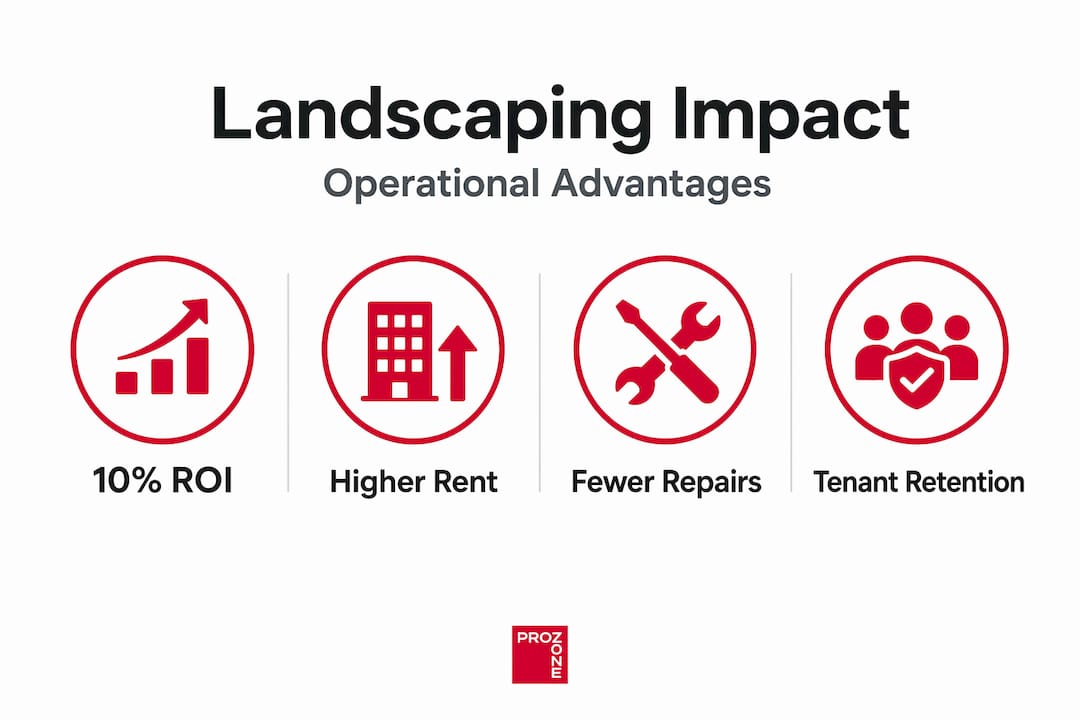
Property value and tenant attraction. Routine lawn care produces a fuller, cleaner, and more uniform appearance that directly affects how clients, tenants, and visitors perceive a property. Commercial tenants consistently rate exterior appearance as a factor in lease decisions, and deteriorating grounds can accelerate vacancy rates. Professional landscaping is not decoration. It is a retention and leasing tool.
-
Recurring maintenance protects asset value. 83% of landscaping revenue comes from commercial maintenance contracts, which signals how central recurring service is to protecting property value over time. A one-time cleanup does not sustain curb appeal or plant health. Scheduled, documented service does.
-
Preventive maintenance reduces emergency repair costs. Irrigation systems that receive proper seasonal start-up and winterization experience far fewer emergency failures after freeze and thaw cycles. Addressing turf stress and soil compaction proactively avoids the much higher cost of full sod replacement or structural erosion repair.
-
Safety and liability risk reduction. Overgrown vegetation near buildings creates wildfire risk in dry climates. Uncleared debris on pathways creates slip-and-fall exposure. A professionally managed property with clear sightlines, maintained walkways, and trimmed perimeters reduces the frequency and severity of insurance claims.
-
Sustainability and reduced operating costs over time. Choosing drought-tolerant species and designing for low irrigation needs translates directly to lower utility and labor costs year over year. This is not just an environmental posture. It is a budget management strategy.
“Landscaping in professional commercial settings is a measurable service, not just an aesthetic add-on, providing a foundation for predictable budgeting and planning.” NLR Landscaping Contract
The advantages of professional landscaping over unmanaged or reactive approaches compound over time. Properties with consistent maintenance histories command higher appraisal values and attract better tenants. Properties maintained reactively tend to require expensive remediation during ownership transitions.
Contract structure and operational accountability
One of the most practical reasons to hire a landscaping company at the professional level rather than engaging casual labor is the accountability structure built into formal service contracts. That structure is what transforms landscaping from an unpredictable expense into a manageable operational line item.
What a Statement of Work actually controls
A formal Statement of Work defines the property acreage covered, the specific tasks included, the schedule for each task, and the standards against which performance is measured. Government facility landscaping incorporates defined documentation requirements, staffing qualifications, and reporting obligations that eliminate ambiguity about what was done and when. The same structure applies to any well-run commercial contract.
Personnel qualifications and site leadership
Professional contracts specify minimum qualifications for key roles. Personnel qualifications typically include requirements for Project Managers and Landscape Architects to hold relevant certifications and documented experience. This matters because the person overseeing your property’s maintenance is making daily decisions about plant health, chemical application rates, and equipment deployment. Unqualified site leadership is one of the most common sources of grounds deterioration in commercial properties.
Reactive vs. contract-managed models
The table below contrasts the two approaches directly:
| Factor | Reactive / Ad Hoc | Contract-Managed |
|---|---|---|
| Service schedule | Called in as needed | Defined in advance, calendar-driven |
| Accountability | Verbal, informal | Documented, reportable |
| Budget predictability | Variable, hard to forecast | Fixed or clearly scoped |
| Irrigation oversight | Addressed after failure | Seasonal start-up and winterization scheduled |
| Personnel standards | Varies per crew | Specified in contract |
| Emergency repair frequency | Higher due to deferred care | Lower due to preventive approach |
| Compliance documentation | Often absent | Required and maintained |
The seasonal plus preventive management model consistently outperforms reactive cleanup. Irrigation systems that are properly winterized do not burst. Turf that receives scheduled aeration and overseeding does not require full replacement. The cost differential becomes clear over a two to three year period.
Pro Tip: Request the provider’s service reporting format before signing any contract. If they cannot show you how completed tasks are documented and communicated back to you as the property manager, that gap will create disputes during the contract term.
A practical landscaping maintenance workflow built around defined milestones and reporting cycles gives property managers the transparency they need to manage vendor relationships confidently.
Sustainability and plant selection in commercial landscapes
The importance of commercial landscaping extends well beyond appearance. The plant selection and design decisions made at the outset of a project shape maintenance costs, water consumption, and ecological outcomes for years.
Sustainable commercial landscaping uses xeriscaping principles and native or drought-tolerant plant species to reduce both irrigation demand and labor hours. In Alberta’s climate, this is particularly relevant. Plants selected without regard for regional hardiness require frequent replacement, supplemental watering, and protection from temperature extremes. Native species, by contrast, are adapted to local soil and precipitation patterns and require less intervention once established.
Key principles that professional commercial landscapers apply to sustainable design include:
- Native and indigenous plant palettes to minimize supplemental water and reduce maintenance frequency
- Invasive species monitoring to prevent aggressive non-native plants from displacing native ecosystems and creating compliance or liability issues
- Soil and site evaluation before planting to match species to drainage, pH, and sun exposure conditions
- Mulching and edging to suppress weed growth, retain soil moisture, and define beds clearly
- Companion planting to use plant relationships for natural pest suppression and nutrient cycling
The design choices for materials matter equally. Using stone, concrete, and defined planting beds controls erosion, suppresses weeds, and reduces the labor required for ongoing upkeep. Hardscaping integrated with planted areas creates a lower-maintenance environment without sacrificing visual quality.
The table below summarizes how different design choices affect long-term maintenance demands:
| Design Choice | Maintenance Impact | Cost Trend Over Time |
|---|---|---|
| Native plant palette | Low irrigation, minimal replacement | Decreasing |
| Exotic or non-adapted species | High supplemental watering, frequent replacement | Increasing |
| Mulched planting beds | Reduced weeding and moisture loss | Stable to decreasing |
| Bare soil around plantings | High weed pressure, erosion risk | Increasing |
| Defined hardscape borders | Minimal edging labor, erosion control | Stable |
| Undefined turf edges | Frequent edging, creep into beds | Increasing |
Sustainable plant palette design also requires ongoing monitoring. A plant that performs well in year one may become invasive by year three if it is not appropriate for the site. Professional providers track this proactively rather than waiting for visible damage.
The right selection of landscaping materials for Alberta properties also plays a direct role in durability. Alberta’s freeze-thaw cycles and variable precipitation require materials and plant choices calibrated to those conditions specifically.
My perspective on commercial landscaping as a strategic asset
I’ve spent considerable time working with property managers and municipal clients who initially view commercial landscaping as a line item to reduce. In my experience, that instinct consistently leads to higher costs within two to three years. Not because landscaping vendors take advantage of neglected properties, but because plant health, turf structure, and irrigation systems all deteriorate in compounding ways when maintenance is deferred.
What I’ve found genuinely separates successful property managers from those constantly dealing with grounds-related issues is a shift in how they categorize landscaping. The ones who treat it as a managed service with documentation requirements, qualified vendors, and seasonal protocols rarely face emergency repair situations. The ones who treat it as discretionary spend call in reactive crews, spend more per visit, and have no documentation trail when disputes arise.
Vendor selection is where I’ve seen the most consequential decisions made. A provider with a clear Statement of Work, qualified site personnel, and a reporting structure aligned to your needs will almost always outperform a cheaper alternative that operates informally. The price difference in year one rarely reflects the full cost difference by year three.
My honest recommendation: before choosing a landscaping service, ask the provider to walk you through how they handled a property through one full seasonal cycle. Ask what happened to the irrigation system in fall, what the turf looked like after spring activation, and what documentation exists. That conversation tells you more than any proposal document. Treat your commercial grounds as a strategic property asset and select your vendor accordingly.
— CSolution
How Prozoneltd supports commercial property managers
When you’re managing a commercial property or municipal infrastructure in Edmonton and the surrounding region, the grounds component rarely exists in isolation. Sidewalk integrity, curb condition, road surfaces, and landscape materials all interact with how your property functions and how it is perceived. Prozoneltd brings together professional commercial landscaping expertise with complementary construction services designed specifically for corporate, municipal, and commercial property needs.
From supplying the right landscaping materials for Alberta to handling concrete sidewalk and curb repair that keeps your property compliant and safe, Prozoneltd operates as a single source for the full scope of exterior property maintenance. Their commercial landscaping services are structured around the contract-managed model described throughout this article, with documented scopes, qualified personnel, and reporting that gives property managers genuine visibility.
For municipalities and larger commercial properties also requiring road construction or infrastructure work, Prozoneltd’s road construction services round out a fully integrated approach to exterior property management in Alberta.
FAQ
What does commercial landscaping include beyond basic mowing?
Commercial landscaping includes weed control, fertilization, aeration, overseeding, debris removal, irrigation maintenance, seasonal winterization, and compliance documentation. Full-scale programs can cover hundreds of maintained acres under a single structured contract.
Why hire a landscaping company instead of managing it in-house?
Professional providers bring qualified personnel, specialized equipment, documented accountability, and regulatory compliance expertise that internal staff rarely replicate at comparable cost. They also carry liability coverage and licensing that protect the property owner.
How does commercial landscaping improve property value?
Consistent, professional lawn care produces uniform, well-maintained grounds that improve tenant retention, attract better-quality occupants, and support stronger appraisal outcomes compared to properties with deferred maintenance.
What makes a commercial landscaping contract different from residential service?
Commercial contracts include formal Statements of Work, defined acreages, scheduled service documentation, staffing qualification requirements, and performance reporting. Residential service agreements rarely include any of those elements.
How do sustainable plant choices reduce long-term landscaping costs?
Native and drought-tolerant species require less supplemental irrigation and replacement planting over time, while xeriscaping design principles reduce labor hours and water costs across the full contract term.
Key takeaways
| Point | Details |
|---|---|
| Commercial landscaping is contract-managed | Professional services operate through documented Statements of Work with defined tasks, schedules, and qualified personnel |
| Financial ROI is measurable | Recurring maintenance protects property value, improves tenant retention, and reduces emergency repair frequency |
| Sustainability reduces long-term costs | Native plant palettes, xeriscaping, and hardscaping lower irrigation and labor demands year over year |
| Accountability separates providers | Reporting structures, personnel qualifications, and seasonal protocols are the markers of a genuinely professional vendor |
| Reactive management costs more | Deferred or ad hoc landscaping consistently produces higher cumulative costs compared to contract-managed preventive service |