
TL;DR:
- Building site-specific assessments and SOPs improves maintenance consistency and addresses Edmonton’s seasonal challenges.
- Integrating technology and sustainable practices reduces costs, environmental impact, and increases workflow flexibility.
- Proper planning, safety protocols, and regular reviews prevent costly errors and enhance landscape health.
Streamline your landscaping maintenance workflow in 6 steps
Inconsistent landscaping at commercial and municipal properties does not just look bad. It drives up operational costs, creates safety liabilities, frustrates tenants, and puts your reputation on the line. For property and facility managers in Edmonton, where seasons shift hard and fast, a poorly structured maintenance routine can spiral into expensive emergency repairs and compliance headaches almost overnight. The good news is that building a clear, repeatable landscaping maintenance workflow solves most of these problems before they start. This guide walks you through every stage: from your first site assessment to sustainable technology integration, common pitfalls, and the process improvements that separate reactive property managers from proactive ones.
Table of Contents
- Assessing site needs and planning your workflow
- Building effective landscaping standard operating procedures (SOPs)
- Integrating technology and sustainability into maintenance routines
- Common workflow pitfalls and how to avoid them
- Why sustainable workflows beat old-school landscaping
- Take your property maintenance further with ProZone
- Frequently asked questions
Key Takeaways
| Point | Details |
|---|---|
| Site-specific planning | Start with a tailored assessment and detailed checklist for each property. |
| Standardized procedures | Reliable SOPs ensure safe, consistent, and efficient landscaping operations. |
| Tech and sustainability | Integrating smart tools and greener practices improves workflow, cuts costs, and benefits the environment. |
| Watch for workflow pitfalls | Avoid issues like mowing wet turf or missing safety checks by maintaining flexible but disciplined processes. |
Assessing site needs and planning your workflow
Before you can build a reliable maintenance workflow, you need a precise picture of what you are actually managing. This sounds obvious, but many facility managers in Edmonton skip a formal site assessment and jump straight into scheduling. The result is a generic routine that misses property-specific challenges, wastes crew time, and leaves gaps that show up at the worst moments.
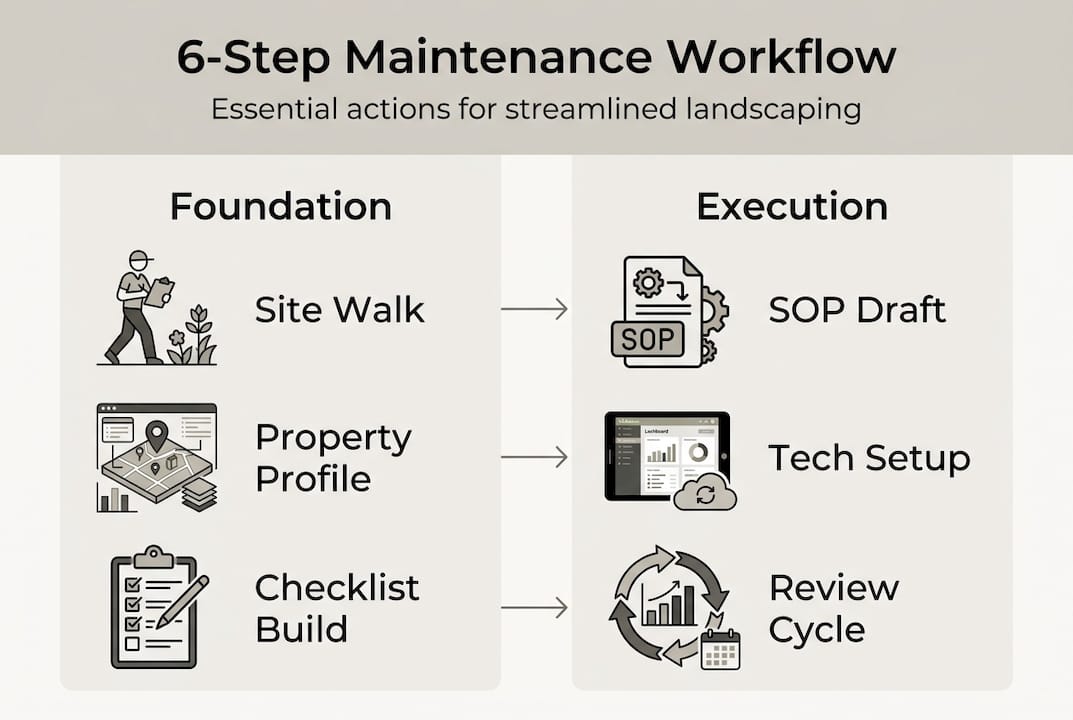
Start by walking every zone of your property with fresh eyes. Note the lawn type, whether that is Kentucky bluegrass, fescue blends, or sod sections common to Alberta commercial installations. Identify all planting beds, hardscape elements like concrete paths and asphalt parking areas, drainage patterns, retaining features, and usage zones. A high-traffic entrance corridor needs a completely different maintenance frequency than a buffer strip along a back fence. Treating them the same way wastes resources and often damages the turf.
Once you have your observations, translate them into a structured property profile. This profile becomes the foundation for every task list and schedule you build afterward. Property-specific plans and quality checklists are essential in landscaping SOPs (standard operating procedures), and skipping this step is one of the most common reasons maintenance programs fail to scale.
For properties in Edmonton, factoring in local climate is non-negotiable. The city sees cold, dry winters, late spring frosts, periods of drought in summer, and early fall freezes. Your workflow needs seasonal anchors: spring activation tasks, summer management routines, fall preparation, and winter dormancy care. Ignoring these transitions means missing critical windows for fertilization, aeration, and winterization that protect your investment year-round.
Once you have your site data, review commercial landscaping tips specific to Edmonton’s conditions to cross-check your plan against proven practices. For properties that involve significant planted areas or hardscape installations, a deeper look at landscape construction in Edmonton will help you understand how installation decisions affect long-term maintenance requirements.
Here is a sample input table to structure your initial site assessment:
| Property element | Key data to capture | Common Edmonton challenges |
|---|---|---|
| Lawn area (sq ft) | Turf type, grade, irrigation coverage | Frost heave, dry spells, compaction |
| Planting beds | Species, mulch depth, edging condition | Winter dieback, spring weed pressure |
| Hardscapes | Surface type, condition, drainage slope | Freeze-thaw cracking, salt damage |
| Trees and shrubs | Species, size, proximity to structures | Snow load, pruning cycles, root zones |
| Drainage features | Location, capacity, current performance | Spring melt overload, pooling areas |
| Usage zones | Foot traffic level, tenant activity | Turf compaction in high-traffic areas |
With this data in hand, you can build task-specific checklists tied to each zone and season. These checklists become living documents, updated as conditions change and as your crew flags new issues.
Pro Tip: Involve your onsite maintenance crew in reviewing checklists before finalizing them. Crew members who work a site daily often spot drainage quirks, problem turf patches, and hidden obstacles that do not show up in a single walkthrough. Their input improves accuracy and increases crew buy-in from day one.
Key elements your site-based checklist should address:
- Mowing frequency and height targets per zone
- Pruning cycles and seasonal timing
- Irrigation schedules and audit points
- Fertilization windows and product selection
- Pest and weed monitoring checkpoints
- Hardscape inspection and cleaning tasks
- Seasonal transition milestones
Building effective landscaping standard operating procedures (SOPs)
With site planning in place, turn to the heartbeat of any efficient workflow: rigorously crafted SOPs. An SOP is a clear, detailed written instruction set for each core maintenance task. It tells your crew exactly what to do, how to do it, what equipment and materials to use, and what safety steps to follow. Without SOPs, every crew member interprets tasks differently, quality varies shift to shift, and training new staff takes far longer than it should.
SOPs are essential for consistency, covering mowing (including height settings by turf type and season, mowing patterns to prevent compaction, and blade sharpness standards), pruning according to ANSI A300 standards, chemical application under Integrated Pest Management (IPM) protocols, irrigation audits, equipment safety, PPE requirements, and property-specific quality checklists. That is a wide scope, but every item matters.
Here is how SOPs with and without standardization compare in practice:
| Workflow element | Without standardization | With SOPs in place |
|---|---|---|
| Mowing consistency | Varies by crew member and day | Same height, pattern, and frequency every visit |
| Chemical application | Risk of unlicensed use or overuse | Licensed applicator, documented IPM records |
| Safety compliance | Inconsistent PPE and equipment checks | Embedded in every task procedure |
| New staff training | Long ramp-up, high error rate | Faster onboarding with clear reference documents |
| Quality auditing | Reactive, after complaints | Proactive, tracked against checklist benchmarks |
| Seasonal transitions | Ad hoc, often missed or delayed | Scheduled, documented, accountable |
To create your own site-specific SOPs, follow these steps:
- List every core maintenance task your property requires, from mowing and edging to irrigation checks, pruning, mulching, chemical applications, and seasonal preparation.
- Write each task as a step-by-step procedure, starting with required equipment and materials, then the exact method, then the quality standard to check before moving on.
- Embed safety requirements directly into each procedure. Do not separate safety into a standalone document that gets ignored. PPE requirements, equipment pre-checks, and hazard awareness belong inside each task instruction.
- Attach regulatory and licensing notes to any task that involves chemical application. In Alberta, pesticide applicators must hold the correct license under provincial regulations. Your SOP should specify which license category is required and where to verify current credentials.
- Set review triggers so SOPs are updated after seasonal changes, after any incident, or when new equipment or products are introduced.
- Train your crew on each SOP before implementation and document that training. This protects you legally and ensures consistency.
Safety is not a sidebar in landscape maintenance. Every SOP must embed PPE requirements, equipment pre-checks, and hazard controls as core steps, not afterthoughts. A crew member skipping a safety check is a workflow failure, not just a personal oversight.
For guidance on how to align your SOPs with Alberta-specific requirements, reviewing landscaping SOPs in Alberta gives useful context on local standards. Selecting the right materials for Alberta properties is equally important, since some materials require specific handling procedures that belong in your SOPs from the start.
One detail that many managers overlook: mowing patterns. Alternating patterns each visit prevents soil compaction, reduces turf stress, and extends the life of high-traffic lawn areas. This is the kind of specific, actionable instruction that belongs in an SOP and almost never makes it in without one.
Integrating technology and sustainability into maintenance routines
Once your SOPs are established, workflow improves further when you build technology and sustainability in as core pillars rather than optional add-ons. This is where many property managers in Edmonton are still leaving significant value on the table.
Smart irrigation is the most immediate technology win available. Modern smart controllers adjust watering schedules based on weather data, soil moisture readings, and plant water demand. For a commercial property in Edmonton, where summer temperatures vary widely and fall frosts arrive without much warning, this kind of automated adjustment prevents both overwatering and drought stress. Workflow success relies on SOPs for scalability, and integrating tech like smart irrigation amplifies their efficiency by removing manual guesswork from one of the most time-consuming maintenance decisions.
IPM, or Integrated Pest Management, is a systematic approach that prioritizes prevention, monitoring, and targeted intervention over routine chemical application. It reduces costs, lowers exposure to chemicals for crew and site users, and keeps your operation on the right side of Alberta’s pesticide regulations. An IPM plan starts with identifying pest pressure thresholds and uses chemical intervention only when monitoring data shows thresholds have been crossed.
Sustainable approaches like reduced mowing, native plants, and IPM balance appearance, safety, cost, and biodiversity gains. For Edmonton properties, native plant species like buffalo berry, wolf willow, and native grasses offer genuine maintenance advantages. They are adapted to Alberta’s climate, require less irrigation once established, and support local pollinators.
For lower-traffic zones on your property, consider scheduled low-mow or rewilding areas. These zones are mowed less frequently, allowing native grasses or wildflower mixes to establish. This reduces crew hours in those zones, lowers fuel and equipment costs, and creates biodiversity corridors that contribute to environmental certification goals some municipal properties are now tracking.
Choosing durable outdoor materials for hardscapes and landscape borders reduces long-term replacement frequency and supports a lower-maintenance property profile overall. For parking lot areas integrated with landscaping, reviewing parking lot landscaping tips helps align surface maintenance with your broader landscape workflow.
Tangible sustainability benefits worth tracking in your workflow metrics:
- Reduced water consumption through smart irrigation (often 20 to 50 percent compared to manual scheduling)
- Lower chemical inputs and associated licensing and disposal costs
- Decreased crew hours in low-traffic zones through planned rewilding
- Extended turf and plant life through species-appropriate care
- Reduced equipment fuel costs in zones with less-frequent mowing
- Improved site biodiversity measurable through pollinator activity
- Stronger alignment with municipal environmental standards and tenant expectations
Pro Tip: Use dedicated workflow and task management software, such as platforms built for field service teams, to assign tasks, log completions, attach photos, and track exceptions in real time. This gives you and your crew instant visibility into what is done, what is overdue, and where problems are emerging. It also creates an audit trail that protects you if compliance questions arise.
Common workflow pitfalls and how to avoid them
With workflow design and improvements covered, it is time to anticipate and address the issues that derail even the best plans. No matter how solid your SOPs and site assessments are, real-world maintenance always surfaces edge cases and human errors.
Edge cases include avoiding mowing wet turf, verifying applicator licensing before chemical use, embedding safety in all SOPs, and rescheduling for weather. Each of these is a genuine, recurring problem at commercial and municipal properties, not a theoretical risk.
Mowing wet turf is one of the most common and costly mistakes. It causes ruts in the soil, spreads fungal disease between plants, clogs equipment, and creates slip hazards for crew. Edmonton’s spring season brings extended wet periods, and the pressure to stay on schedule often pushes crews to mow anyway.
Never mow wet turf. The risk of disease spread, soil compaction, and rut formation is highest when turf is saturated. Reschedule, adjust your task sequencing, and make wet-weather alternatives a documented part of every spring and fall SOP.
Key pitfalls to watch for, with corrective actions:
- Mowing when wet: Reschedule mowing tasks, shift to edging or bed maintenance on wet days, and document the decision for accountability.
- Missing licensing for chemical applications: Verify applicator credentials before every chemical task, not just at season start. Licenses can lapse.
- Skipping equipment safety checks: Build pre-use inspection into every equipment SOP as a non-optional first step.
- Ignoring weather forecast integration: Review a five-day forecast weekly and adjust your schedule proactively rather than reactively.
- Failing to adapt to Edmonton’s unpredictable shoulder seasons: Late spring freezes and early fall frosts require flexible workflow triggers, not rigid calendar-based scheduling.
- Neglecting drainage maintenance: Blocked drainage in spring melt or after heavy rain causes turf loss and hardscape damage faster than almost any other issue.
- Under-communicating with tenants: Property users who know what to expect from maintenance schedules cause fewer workflow interruptions and report issues earlier.
Downtime caused by workflow errors, whether from equipment damage, turf disease, or regulatory non-compliance, can trigger costly landscape repairs that far exceed what a proactive process investment would have cost. A single rescheduled mowing or a licensing check takes minutes. The repairs that follow from skipping those steps can run into thousands of dollars and significant tenant disruption.
Flexibility is the key to weather adaptation in Edmonton. Your workflow plan should distinguish between fixed tasks (those that must happen within a specific window regardless of conditions) and flexible tasks (those that can shift by a few days without consequence). Knowing which category each task falls into lets you make fast, confident decisions when weather throws your schedule off.
For properties with year-round maintenance needs including winter operations, understanding year-round maintenance best practices ensures your workflow does not stop being proactive the moment the first snow falls.
Why sustainable workflows beat old-school landscaping
Here is something most landscaping guides will not say directly: the traditional approach to commercial landscape maintenance is expensive, fragile, and increasingly out of step with what tenants, municipalities, and insurers actually expect from managed properties.
The old model relies on intensive, schedule-driven routines: mow everything on the same day, apply chemicals on a calendar basis, and respond to visible problems after they become impossible to ignore. It keeps crews busy. It does not keep properties healthy.
Traditional intensive maintenance contrasts sharply with sustainable approaches like reduced mowing frequency, native plant integration, and IPM protocols, which balance appearance and safety with lower costs, reduced emissions, and measurable biodiversity gains. Rewilding and low-mow zones work well in low-traffic areas but do require proper health and safety zoning so site users are informed and pathways remain clear.
What we have seen working with commercial and municipal properties across Edmonton is that checklist-driven, SOP-backed workflows do more than just reduce errors. They create crew autonomy. When team members have clear procedures and know exactly what good looks like, they make better field decisions without constant oversight. That reduces your management burden and builds a more capable, confident team.
Sustainability in this context is not just an environmental story. It is a cost control framework. Native species reduce irrigation demand. IPM reduces chemical purchasing. Low-mow zones reduce fuel and labor hours. These savings compound across a full season and across multiple properties. They also make your program more resilient when budget pressures arrive.
Technology-driven workflows enable faster pivots when regulations change, when new products become available, or when a property’s needs shift. Static schedules cannot do that.
Pro Tip: Treat workflow improvements and process investments the same way you treat capital equipment purchases: as core operating expenditures that protect and grow property value, not as optional extras to cut when budgets tighten.
Selecting the right Alberta sustainable materials from the start locks in lower maintenance requirements and supports the kind of durable, low-intervention landscape that sustainable workflow models depend on.
Take your property maintenance further with ProZone
Building a smarter landscaping maintenance workflow is the right first step. Connecting that workflow to professional support ensures it holds up through Edmonton’s most demanding seasons and across your most challenging properties.
At ProZone Ltd, we work directly with property managers and facility managers across Edmonton and the surrounding area on exactly these challenges. Whether you need expert guidance on materials selection, hardscape integration, asphalt and concrete maintenance that aligns with your landscaping program, or year-round preventative maintenance planning, our team brings hands-on experience with commercial and municipal properties of every scale.
Our services are built around the same principles this guide covers: structured planning, documented procedures, seasonal adaptability, and sustainable outcomes. Visit ProZone Ltd to explore how our maintenance and construction solutions can plug directly into your existing workflow and take the operational load off your team.
Frequently asked questions
What should be included in a landscaping maintenance SOP?
A landscaping SOP should cover task methods, safety procedures, equipment pre-use checks, property-specific plans, required licenses, and quality benchmarks. SOPs covering mowing, pruning, chemical application, irrigation, and PPE are the foundation of any consistent, auditable maintenance program.
How can technology improve landscape maintenance workflow?
Smart scheduling platforms, workflow tracking apps, and smart irrigation controllers save time, cut costs, and reduce human error at commercial properties. Tech like smart irrigation paired with SOP-driven processes gives crews both structure and real-time flexibility.
What are common mistakes in landscape maintenance?
The most frequent mistakes include mowing wet turf, skipping pre-use equipment safety checks, using unlicensed applicators for chemicals, and failing to reschedule tasks around weather. Avoiding wet-turf mowing and verifying licensing before each chemical application prevents the most costly errors.
Why is sustainability important in landscape workflows?
Sustainable practices lower input costs, reduce regulatory risk, and support long-term property value through healthier turf and plantings. Reduced mowing, native plants, and IPM deliver measurable financial and environmental benefits alongside consistent site appearance.
How often should a landscape maintenance workflow be reviewed?
Workflows should be formally reviewed at least once per year and after each major seasonal transition. Properties in Edmonton benefit most from reviews at the end of winter, mid-summer, and late fall to capture weather-driven changes and update procedures before the next season begins.