
TL;DR:
- Outdoor construction projects involve transforming exterior spaces through structural, hardscaping, or landscape engineering work, ranging from amphitheatres to hillside terraces and outdoor kitchens. Successful projects require early planning of materials, drainage, structural integration, and phased construction to address climate conditions like freeze-thaw cycles in Edmonton. Proper design and sequencing enhance longevity, safety, and functionality, whether in large-scale developments or DIY builds.
Outdoor construction projects are defined as any planned build or site modification that transforms exterior space through structural, hardscaping, or landscape engineering work. The range is broad: commercial amphitheatres seating 12,000 people, hillside residential terraces with engineered retaining walls, outdoor kitchens integrated into flagstone patios, and innovative timber gridshell pavilions all qualify as examples of outdoor construction projects. For property developers, contractors, and DIY enthusiasts working in Edmonton and comparable Canadian climates, understanding this range matters because freeze-thaw cycles, drainage demands, and Alberta Safety Codes shape every material choice and structural decision from the ground up.
1. Large-scale commercial amphitheatre construction
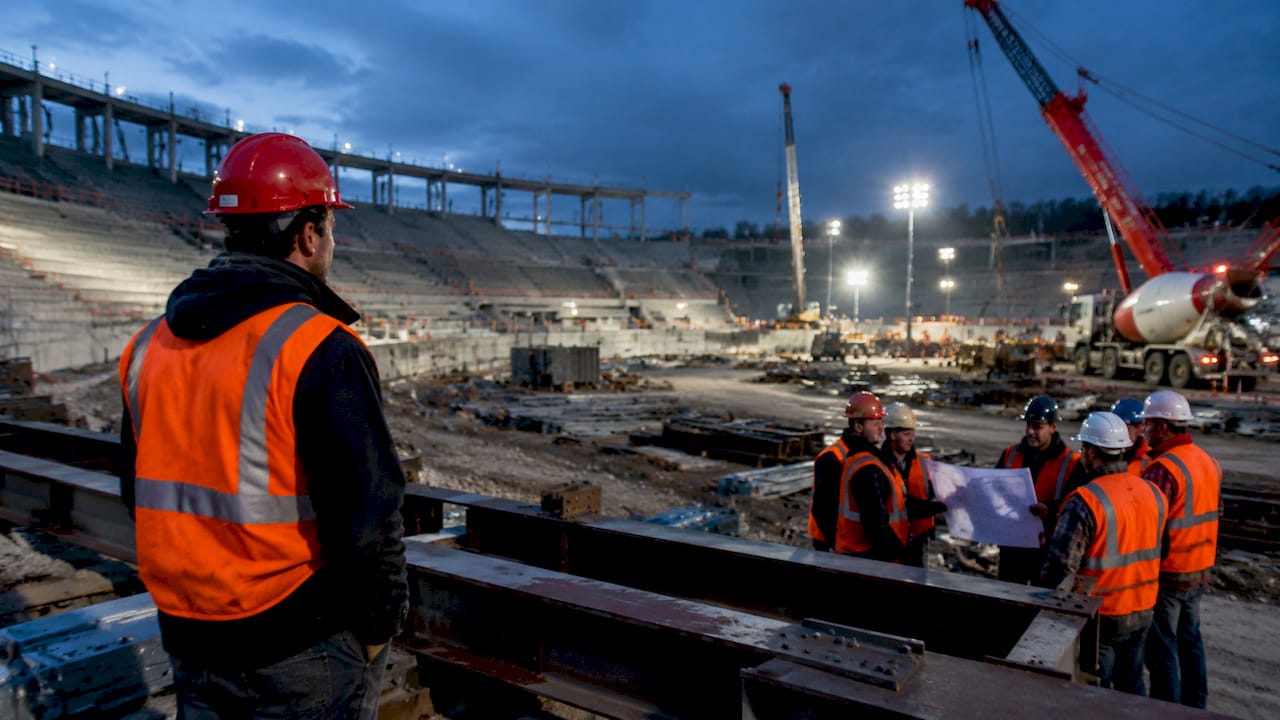
A 12,000-seat amphitheatre is one of the most demanding examples of commercial outdoor construction, requiring peak onsite workforce over 350 workers and a total project workforce of approximately 1,200 people. That scale of coordination means material logistics, sequencing, and site access planning must be resolved before a single footing is poured. The $184 million project cost reflects not just materials but the complexity of integrating structural concrete, drainage infrastructure, electrical systems, and landscape grading across a large riverside site.
For developers and contractors, the key lesson from amphitheatre-scale builds is that outdoor material supply and logistics planning are as critical as the structural design itself. Delays in material delivery on a site with 350 active workers compound quickly. Procurement schedules, laydown areas, and phased delivery windows must be built into the project plan from day one.
- Structural concrete and cast-in-place foundations form the backbone of large outdoor venues
- Drainage infrastructure must be engineered to handle both stormwater and crowd-generated surface runoff
- Electrical and mechanical coordination requires early-phase underground conduit planning
- Landscape grading around the structure determines long-term site drainage and pedestrian safety
2. Hillside terraced residential landscapes
Hillside terraced projects represent some of the most technically demanding residential outdoor building ideas, combining structural engineering with landscape architecture on sloped and unstable ground. One documented example, the Grand Summit project by Tepe Landscape & Design Group, involved an 11-month construction timeline with budgets in the $200,000 to $210,000 range for decks and patios alone. That timeline reflects the precision required: retaining walls, staircases, and patio slabs must all be surveyed and aligned before any concrete is poured.
Structural engineering integration with landscape architecture is not optional on sloped sites. Lateral loads from retained soil place significant stress on wall footings, and any misalignment between walls, stairs, and patio edges becomes permanent once concrete sets. The triangulation process, confirming alignment across all three elements before casting, is the single most important quality control step on a hillside terrace build.
- Survey and triangulate retaining wall positions, stair stringers, and patio edges before any formwork is set
- Select freeze-thaw-resistant materials such as natural limestone, granite, or concrete block rated for Alberta’s climate range
- Install drainage sub-base layers beneath all patio slabs to prevent frost heave and water infiltration
- Phase the build from bottom to top, completing lower retaining walls before constructing upper terraces
- Integrate planting zones between structural elements to stabilise soil and reduce surface runoff velocity
Pro Tip: On hillside sites in Edmonton, specify a minimum 200mm granular sub-base beneath all flagstone or concrete patio surfaces. This layer manages frost movement and prevents the slab cracking that undermines the entire terrace system within two to three winters.
Functional zones within a terraced residential project typically include fire pit areas, covered pavilions, raised garden beds, and level lawn panels. Each zone requires its own drainage solution and surface treatment. Natural stone is the preferred material in Edmonton-area projects because it tolerates freeze-thaw cycling without the surface spalling that affects lower-grade concrete pavers.
3. Outdoor kitchens and functional dining zones
An outdoor kitchen is a purpose-built cooking and dining structure integrated into a patio or terrace, typically including a grill station, counter surfaces, storage, and utility connections. Effective outdoor kitchen design requires at least 36 inches of counter space on each side of the grill and 4 to 6 feet of clearance between the kitchen counter and any dining furniture. These clearances are not aesthetic preferences. They are functional requirements that prevent traffic congestion during use and reduce fire risk near combustible materials.
Material selection for outdoor kitchens in Canadian climates must account for sustained moisture exposure, UV degradation, and freeze-thaw stress. Stainless steel appliance frames, concrete block or natural stone counter bases, and porcelain tile or granite counter surfaces all perform reliably through Edmonton winters. Avoid composite wood cabinetry in exposed outdoor kitchens. It delaminates within two seasons under freeze-thaw conditions.
For outdoor kitchen planning, electrical and plumbing rough-ins must be specified during the design phase, not added after construction. Underground conduit for outlets, lighting circuits, and gas lines must be installed before the patio slab is poured. Retrofitting these systems after the fact requires breaking finished concrete, which adds cost and compromises the slab’s structural integrity.
Pro Tip: Specify compact, purpose-rated outdoor appliances rather than residential indoor units repurposed for exterior use. Outdoor-rated grills, refrigerators, and side burners are built with sealed components that resist moisture ingress and corrosion, extending service life significantly in freeze-thaw climates.
4. Innovative timber gridshell structures
A timber gridshell is a structural system formed by bending flat wood laths into a double-curved shell shape, producing a lightweight, self-supporting canopy with high structural efficiency. Bending-active wood laths allow complex curved forms to be fabricated from straight, flat timber stock, reducing material waste and eliminating the need for heavy formwork. North America’s first timber gridshell debuted in Georgia ahead of the FIFA World Cup, demonstrating both the fabrication challenges and the striking aesthetic potential of this construction typology.
| Feature | Timber gridshell | Conventional steel canopy |
|---|---|---|
| Material weight | Low | High |
| Fabrication complexity | High (bending and assembly) | Moderate |
| Aesthetic appeal | Distinctive organic form | Industrial appearance |
| Environmental impact | Low (renewable timber) | Higher (steel production) |
| Weather resilience | Requires protective cladding | Inherently weather-resistant |
The Georgia gridshell used stainless steel shingles as the weather cladding layer, combining the structural efficiency of bent timber with a durable, low-maintenance exterior surface. This combination is directly applicable to permanent public outdoor spaces such as transit shelters, market pavilions, and park structures.
“Innovative timber gridshells represent an underused outdoor construction typology with strong aesthetic appeal and material efficiency.” — ENR, North America’s first timber gridshell
For developers and municipal planners, timber gridshells offer a way to create landmark outdoor structures without the carbon footprint of steel-dominated construction. The fabrication process requires specialist carpentry and precise digital modelling, which means early engagement with structural engineers and timber fabricators is non-negotiable.
5. Retaining walls and hardscaping systems
Retaining walls are engineered structures that hold back soil on sloped sites, and they are among the most common landscape construction examples in residential and commercial development. A retaining wall that fails does not just collapse. It destabilises the entire terrace above it, damages adjacent paving, and can undermine building foundations. Proper wall design accounts for soil type, hydrostatic pressure from groundwater, and the surcharge load from any structures or vehicles above the wall.
In Edmonton, retaining walls must be designed for frost penetration depths that regularly exceed 1.5 metres. Footings placed above the frost line will heave seasonally, causing progressive wall displacement and joint cracking. Geogrid reinforcement behind segmental block walls and granular backfill with perforated drain tile are standard practice for walls over 600mm in height.
Hardscaping systems, including interlocking concrete pavers, natural stone walkways, and exposed aggregate driveways, complement retaining wall structures by managing surface water and defining circulation routes. Patios require a minimum slope of 1/8 inch per linear foot away from structures, combined with catch basins and layered drainage sub-bases, to prevent water pooling and long-term foundation damage. Drainage is the most frequent failure point in outdoor hardscaping projects, and it is also the most preventable.
6. Phased landscape design-build projects
Phased construction is a project delivery method where outdoor environments are built incrementally across multiple seasons, allowing the design to adapt to site conditions discovered during construction. Phased, patient construction processes produce more cohesive, site-adapted outdoor environments than single-phase builds because they allow grading, drainage, and planting decisions to respond to observed site behaviour rather than assumptions made on paper. This approach is particularly well-suited to Edmonton-area projects where spring thaw reveals drainage patterns that are impossible to predict from a winter survey.
The practical implication for contractors and developers is that multi-phase project planning must be built into contracts and client expectations from the outset. Scope documents should identify which elements are fixed in phase one and which are intentionally deferred pending site observation. This protects both the contractor and the client from costly redesigns caused by unforeseen conditions.
Landscape contractors consistently report that collaborative refinement between designer, contractor, and client across multiple phases produces better long-term outcomes than rushed single-phase builds. The Elm Grove project documented by David J. Frank Landscaping is a well-cited example of this approach, where drainage corrections and planting adjustments made in year two significantly improved the performance of hardscaping installed in year one.
7. DIY outdoor projects: patios, arbours, and fire pits
Do-it-yourself outdoor projects cover a wide range of builds, from simple planter boxes and gravel pathways to timber arbours, fire pit surrounds, and small retaining walls. The most successful DIY outdoor projects share one characteristic: they are planned with the same attention to drainage, material selection, and structural basics that professional contractors apply to larger builds. Skipping the sub-base on a DIY patio or ignoring slope requirements produces the same frost heave and water pooling problems that occur on professionally built projects.
For DIY enthusiasts in Edmonton, material selection is the first critical decision. Pressure-treated lumber rated for ground contact (UC4B or higher), natural stone, and concrete block all tolerate freeze-thaw cycling. Composite decking and untreated softwood degrade rapidly under repeated freeze-thaw stress and should be avoided for ground-level or partially buried applications.
DIY solar electrical planning for outdoor lighting and heating benefits from ballasted panel mounting, which avoids roof penetrations and simplifies installation. Electrical systems must be integrated into the design phase rather than added after construction. Retrofitting outlets and lighting circuits into a finished pergola or patio structure is significantly more expensive and disruptive than planning conduit runs before the concrete is poured.
Pro Tip: Before starting any DIY patio or walkway project, establish your drainage outlet point first. Every surface must slope toward that point at a minimum of 1/8 inch per linear foot. Building the surface before confirming the drainage path is the single most common and costly DIY mistake in outdoor hardscaping.
What ProZone’s experience shows about outdoor project success
The projects that perform best over time in Edmonton’s climate are not necessarily the most expensive or the most complex. They are the ones where structural engineering and landscape design were integrated from the start, where drainage was treated as a primary design constraint rather than an afterthought, and where the construction sequence respected the site’s actual conditions rather than an idealised plan.
Phased approaches consistently outperform single-phase builds in my observation. A client who accepts an 18-month timeline for a terraced residential landscape gets a finished environment that has been adjusted and refined through at least one full freeze-thaw cycle. That cycle reveals drainage paths, frost heave points, and soil movement that no survey can fully predict. Addressing those conditions during construction rather than after completion is the difference between a project that lasts 30 years and one that requires remediation within five.
The timber gridshell example from Georgia is worth noting for Edmonton developers and municipal planners. Sustainable structural typologies like this are underused in Canadian outdoor construction, partly because the fabrication expertise is less common here. That gap represents an opportunity for forward-thinking developers to create distinctive public spaces that also meet sustainability targets.
For DIY enthusiasts, the most valuable thing you can do before starting any outdoor build is consult a structural engineer or experienced contractor on your drainage and sub-base plan. That single conversation prevents the majority of failures seen in DIY outdoor projects across the Edmonton region.
— ProZone
Plan your outdoor construction project with ProZone
ProZone provides professional construction and infrastructure services across Edmonton and the surrounding Alberta region, covering commercial and residential outdoor builds from site preparation through to finished hardscaping and material supply. All work is delivered in compliance with Alberta Safety Codes, with quality assurance processes built into every phase of construction. ProZone’s services include earthworks, concrete screeds, asphalt laying, retaining wall construction, and landscaping material supply, giving developers and contractors a single point of contact for complex outdoor projects. For large-scale road and infrastructure work or residential site preparation, ProZone’s project managers bring the regional expertise that Edmonton’s freeze-thaw climate demands. Request a free estimate through the online form at prozoneltd.ca or call ProZone directly to discuss your project scope.
FAQ
What counts as an outdoor construction project?
An outdoor construction project is any planned build that modifies exterior space through structural, hardscaping, or landscape engineering work. Examples include amphitheatres, retaining walls, terraced patios, outdoor kitchens, and timber pavilions.
How long does a residential terraced landscape take to build?
Complex hillside terraced projects typically require 11 months or more for the primary construction phase, with full completion sometimes extending across two seasons as drainage and planting adjustments are made after the first freeze-thaw cycle.
What drainage slope is required for an outdoor patio?
Patios require a minimum slope of 1/8 inch per linear foot directed away from structures, combined with catch basins and a layered granular drainage sub-base, to prevent water pooling and frost heave damage.
Are timber gridshells suitable for permanent outdoor structures?
Yes. Timber gridshells using bending-active wood laths with protective cladding such as stainless steel shingles are suitable for permanent public outdoor spaces including market pavilions, transit shelters, and park structures.
When should electrical planning happen in a DIY outdoor project?
Electrical conduit, outlet locations, and lighting circuits must be planned and installed before the patio slab or pergola base is poured. Adding these systems after construction requires breaking finished surfaces and significantly increases project cost.