
TL;DR:
- Proper grading shapes land to control water runoff and ensures the durability of hardscaped surfaces. It must meet measurable standards such as a minimum slope of 0.25 inches per foot and specific elevation fall requirements for foundation protection. Early planning and precise final grading are essential to prevent structural failures caused by water pooling and freeze-thaw damage.
Grading in hardscaping is defined as the deliberate shaping and sloping of land to control water runoff and provide a structurally stable base for paved surfaces, retaining walls, and outdoor structures. The role of grading in hardscaping extends well beyond simple levelling. It is a structural engineering function that determines how water moves across a site, how soil behaves under load, and how long a hardscaped asset will perform before requiring repair. For property developers and landscape architects working in Edmonton and across Alberta, grading is also a regulatory obligation governed by Alberta Safety Codes and municipal stormwater management requirements. Getting it right at the design stage is the single most effective way to protect a project’s long-term value.
What technical standards and slopes are required for grading in hardscaping?
Grading standards are not guidelines. They are measurable thresholds that determine whether a hardscape drains correctly or fails prematurely. The industry standard requires a minimum slope of 0.25 inches per foot away from any paved surface or structure. That figure translates directly into the rate at which stormwater clears a surface before it can pool or infiltrate the subgrade.
For foundation protection, standard elevation design requires a fall of 6 inches over 10 feet, which equals a 5% slope. This threshold is the accepted minimum for residential and light commercial sites in Canada. Anything below it creates conditions where water lingers near footings, accelerating freeze-thaw damage in Edmonton’s climate.
Grading plans become a formal requirement once a project crosses specific thresholds. Grading plans are typically required when earthwork exceeds 50 cubic yards, cut or fill depths exceed 2 feet, or slopes are steeper than 10–15%. These triggers are not arbitrary. They mark the point at which site-wide water management becomes complex enough to require engineered documentation.
| Threshold | Requirement triggered |
|---|---|
| Earthwork exceeding 50 cubic yards | Formal grading plan required |
| Cut or fill depth exceeding 2 feet | Engineered slope design required |
| Slopes steeper than 10–15% | Erosion control and transition zone design required |
| 0.25 inches per foot minimum slope | Standard drainage away from hardscaped surfaces |
| 6 inches fall over 10 feet (5%) | Foundation protection standard |
Pro Tip: Always calculate finished surface elevations after accounting for base aggregate thickness. Contractors who set grade stakes to subgrade and then add base material without recalculating frequently end up with finished surfaces that are too high or too low, creating drainage errors that are expensive to correct.
How does grading affect the long-term durability of hardscaped surfaces?
Accurate grading directly impacts drainage, stability, frost heaving resistance, and overall hardscape longevity. In Edmonton’s climate, where freeze-thaw cycles occur repeatedly between october and april, this connection is not theoretical. Water that pools beneath a paved surface expands when it freezes, lifting and cracking concrete, asphalt, and interlocking pavers from below.
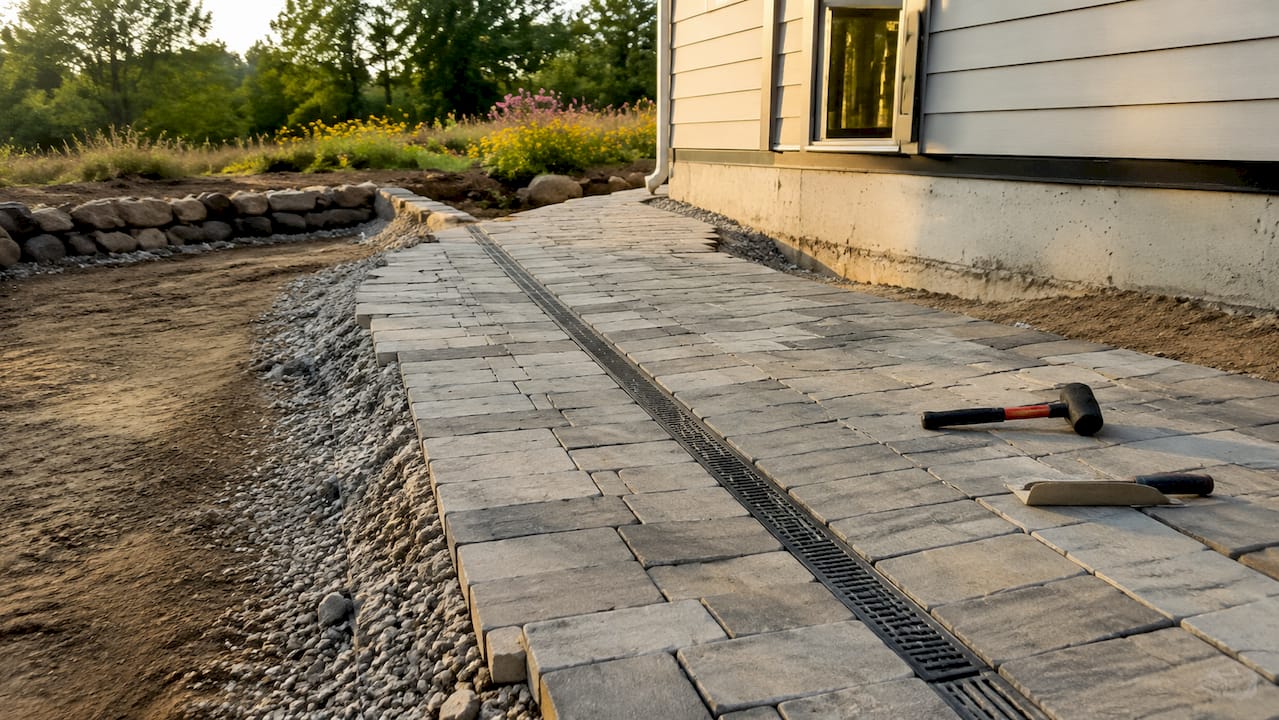
Poor grading creates conditions where water retention near paved areas is chronic rather than occasional. Chronic moisture weakens the subgrade, reduces bearing capacity, and accelerates soil erosion at the edges of hardscaped zones. The result is uneven settlement, surface cracking, and joint failure. These are not cosmetic problems. They are structural failures that require full reconstruction rather than patching.
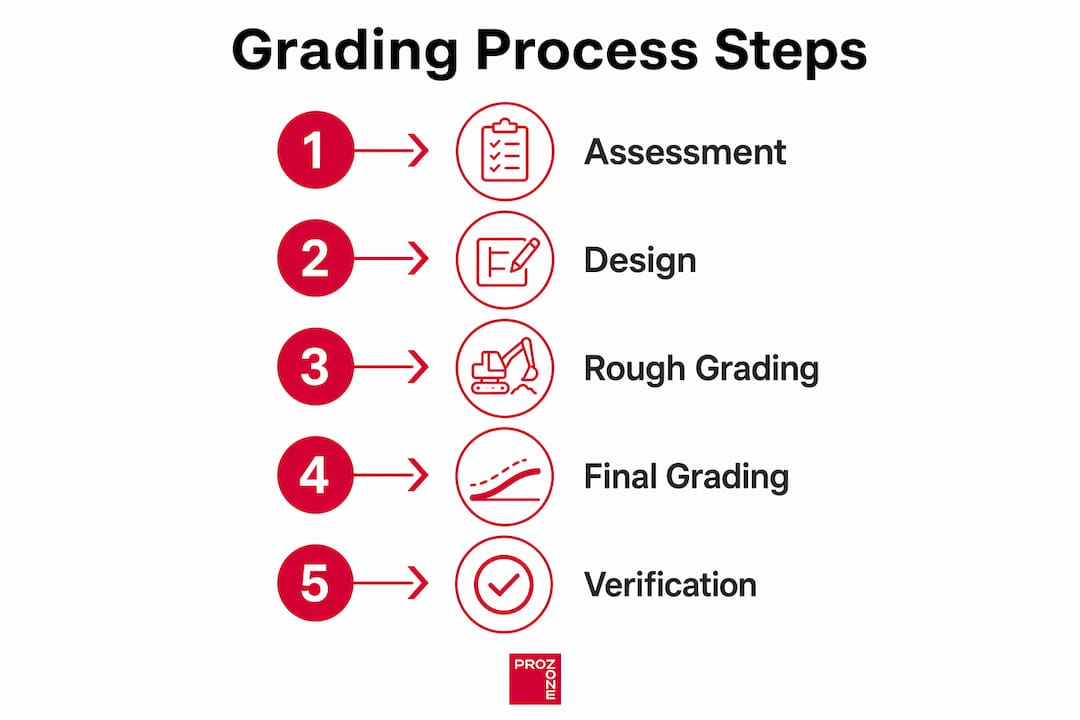
Rough grading establishes general site contours; final grading uses GPS-guided machinery to meet design elevations exactly. The distinction matters because rough grading alone is insufficient for hardscape installation. Final grading must account for the thickness of base aggregate layers, compaction rates, and the finished surface material. Skipping or rushing final grading is one of the most common causes of drainage failure on otherwise well-designed projects.
The benefits of correct grading across a project’s lifecycle include:
- Elimination of standing water that accelerates freeze-thaw damage to pavement and joints
- Stable subgrade bearing capacity that prevents differential settlement under load
- Reduced soil erosion at hardscape edges, protecting adjacent landscaping and structures
- Lower long-term maintenance costs by preventing premature surface deterioration
- Compliance with Alberta Safety Codes, reducing liability exposure for developers and owners
Pro Tip: Request a final grading report from your contractor before any base aggregate is placed. This document confirms that subgrade elevations match the design plan and gives you a baseline for any future drainage disputes.
What are the most common grading mistakes in hardscaping?
The most damaging grading mistake is treating grading as simple levelling rather than a structural engineering function. Misunderstanding grading as just levelling causes design flaws that lead to water damage and structural risk. This misconception is common among general contractors who lack specialised earthworks experience, and it consistently produces sites where water flows toward foundations rather than away from them.
The following errors appear repeatedly on hardscape projects across Edmonton and Alberta:
-
Treating grading as a construction prep step rather than a design phase activity. Grading decisions made late in a project are constrained by existing site conditions. Slope options narrow, drainage solutions become more expensive, and coordination with other trades becomes reactive rather than planned.
-
Ignoring edge effects from large hardscaped surfaces. Runoff concentration at hardscape edges requires swales or drywells planned during the grading phase. A large patio or parking area sheds significantly more water per unit area than natural ground. Without planned drainage features at the perimeter, that concentrated runoff erodes adjacent soil and saturates foundations.
-
Failing to coordinate grading with drainage installation. Grading and drainage are interdependent systems. Installing catch basins or French drains after grading is complete frequently results in mismatched invert elevations, meaning the drainage infrastructure cannot accept flow at the designed rate.
-
Not accounting for base aggregate thickness in elevation calculations. A 150-millimetre compacted granular base changes finished surface elevation significantly. Contractors who set grade to subgrade without factoring in base thickness produce finished surfaces that deviate from design intent, creating low points where water collects.
-
Failing to engage multi-agency review early. Projects with earthwork exceeding 50 cubic yards are subject to review by zoning, public works, and building departments, as well as stormwater pollution prevention requirements. Discovering this requirement mid-project causes delays and design revisions that are far more costly than early consultation.
How should grading be integrated into hardscape design and planning?
Grading is a design phase activity, not a construction preparatory task. Grading plans serve as site roadmaps guiding drainage, structural stability, and regulatory compliance. When grading decisions are deferred to the construction phase, the project loses the ability to coordinate slope design with building layout, utility placement, and landscaping zones. That coordination is where the real value of early grading planning is realised.
The table below compares the outcomes of early versus late grading integration on a typical commercial hardscape project:
| Planning stage | Grading integrated early | Grading deferred to construction |
|---|---|---|
| Drainage design | Coordinated with site layout | Retrofitted, often inadequate |
| Regulatory compliance | Addressed in design documents | Discovered mid-project, causing delays |
| Base material specification | Matched to design elevations | Adjusted on site, creating elevation errors |
| Cost of drainage corrections | Minimal, addressed in design | High, requires reconstruction |
| Multi-agency review | Completed before construction | Triggered unexpectedly during build |
Coordination between drainage engineers, site planners, and earthworks contractors must begin at the schematic design stage. For Edmonton projects, this coordination also needs to account for the City of Edmonton’s Drainage Bylaw and Alberta Safety Codes requirements for stormwater management. Without grading plans and design integration, site-wide artificial flooding or erosion can result from improper water diversion.
Grading plans submitted for multi-agency review must address stormwater pollution prevention, erosion control during construction, and post-construction drainage performance. These are not optional components. They are conditions of permit approval in most Alberta municipalities. Landscape architects who treat grading plans as a formality rather than a technical deliverable consistently encounter permit delays and post-construction drainage failures.
For outdoor construction projects that include both hardscaping and soft landscaping, grading also determines topsoil depth, planting zone drainage, and the stability of retaining structures. A grading plan that accounts for all these elements produces a site that functions as a unified water management system rather than a collection of independent features.
Why grading is the most undervalued decision in hardscape projects
Working on Edmonton construction sites across multiple seasons makes one pattern impossible to ignore. The projects that fail drainage inspections, require reconstruction within five years, or generate disputes between owners and contractors almost always share the same root cause: grading was treated as a minor site preparation task rather than a primary design decision.
The importance of grading in landscaping and hardscaping is consistently underestimated because the consequences of poor grading are not immediately visible. A patio that drains incorrectly looks fine on the day it is completed. The problems appear in the second or third winter, when freeze-thaw cycles have had time to work on a saturated subgrade. By then, the contractor has moved on and the owner is facing a reconstruction bill.
The practical advice is direct: insist on a grading plan before any earthworks contract is signed. Verify that the plan specifies finished surface elevations, not just subgrade elevations. Confirm that your contractor’s team has experience with GPS-guided final grading, not just rough cut-and-fill work. And for any project in Edmonton or the surrounding region, confirm that the grading plan has been reviewed against the City of Edmonton’s stormwater requirements and Alberta Safety Codes before construction begins. These steps add time at the front end. They eliminate far larger costs at the back end.
— ProZone
Prozoneltd’s grading and site preparation services for Edmonton projects
Prozoneltd delivers site preparation and grading services for commercial, municipal, and private hardscape projects across Edmonton and Alberta, with full compliance to Alberta Safety Codes and City of Edmonton stormwater requirements. ProZone’s certified earthworks teams use GPS-guided machinery for final grading, ensuring finished surface elevations match design documents precisely. Every project includes coordination with drainage engineers and multi-agency review support where required. ProZone supplies quality base materials including crushed stone and road crush to specification, eliminating the elevation errors that come from substituting substandard fill. Contact ProZone directly for a free project estimate using the online form at prozoneltd.ca or by calling the Edmonton office.
FAQ
What is the minimum slope required for hardscape drainage?
The industry standard requires a minimum slope of 0.25 inches per foot away from any paved surface or structure. For foundation protection, a fall of 6 inches over 10 feet (5%) is the accepted minimum.
When is a formal grading plan required for a hardscape project?
A formal grading plan is required when earthwork exceeds 50 cubic yards, cut or fill depths exceed 2 feet, or slopes are steeper than 10–15%. These thresholds also trigger multi-agency regulatory review in most Alberta municipalities.
How does poor grading damage hardscaped surfaces in Edmonton’s climate?
Poor grading allows water to pool beneath paved surfaces. In Edmonton’s freeze-thaw climate, that water expands when it freezes, lifting and cracking concrete, asphalt, and interlocking pavers from below and requiring full reconstruction rather than repair.
What is the difference between rough grading and final grading?
Rough grading establishes general site contours and removes or places bulk fill material. Final grading uses GPS-guided machinery to achieve precise design elevations, accounting for base aggregate thickness and compaction to produce a finished surface that drains correctly.
Why should grading be addressed in the design phase rather than during construction?
Grading decisions made during construction are constrained by existing site conditions, making drainage corrections expensive and often inadequate. Early grading integration allows full coordination with drainage engineering, regulatory compliance, and base material specification before any earthworks begin.