
TL;DR:
- Stamped concrete offers a cost-effective and durable option that mimics natural stone and brick. Proper installation and maintenance ensure a lifespan of over 25 years, even in Alberta’s harsh freeze-thaw climate.
Stamped concrete is defined as poured concrete that is textured and patterned before it sets, replicating the look of natural stone, brick, or wood at a fraction of the cost. For property owners and developers in Alberta, the advantages of stamped concrete are both practical and financial. It costs $8–$18 per square foot, which is 40–60% less than natural stone or quality pavers. With proper installation and maintenance, it lasts 25 years or more. In a climate defined by freeze-thaw cycles, those numbers matter.
1. What are the core advantages of stamped concrete?
Stamped concrete delivers three advantages that no other single paving material matches at the same price point: cost efficiency, design versatility, and a seamless surface. Natural stone offers beauty but at a premium. Pavers offer flexibility but create joints where weeds and insects establish themselves. Stamped concrete eliminates both problems in one pour.
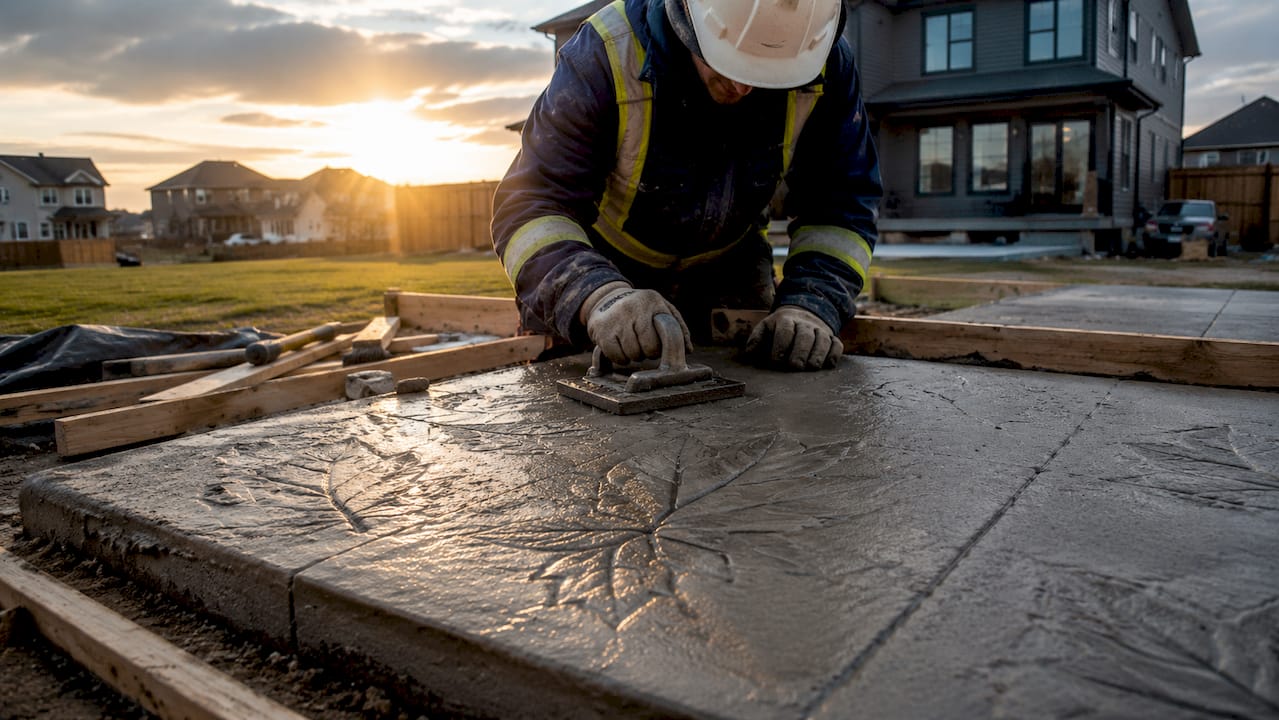
The seamless surface removes the gaps that allow weed growth and ant colonisation between pavers. That is a meaningful maintenance reduction for any Alberta property, where summer weeds push through aggressively. The monolithic slab also resists shifting caused by frost heave better than individual paver units.
2. What are the cost benefits compared to other materials?
Stamped concrete costs $8–$18 per square foot installed. Natural stone and quality pavers typically run 40–60% more for the same coverage area. That gap is significant on any project larger than a residential patio.
The cost advantage extends beyond materials. Installation takes 3–4 days, compared to 4–7 days for paver installations. Faster completion reduces labour costs and minimises disruption to commercial or municipal sites. For developers managing multiple outdoor spaces, that time saving compounds quickly across a project portfolio.
Long-term value is equally strong. Compared to plain concrete, stamped concrete costs 2–3 times more upfront, but it adds 10–15% to home value. The National Association of Realtors ranks outdoor living upgrades among the top return-on-investment investments for residential properties. For developers in Edmonton’s competitive real estate market, that is a direct argument for specifying stamped concrete on patios, driveways, and walkways.
Key cost facts at a glance:
- Material cost: $8–$18 per square foot installed
- Savings vs. natural stone or pavers: 40–60%
- Resealing cost: $0.50–$2.00 per square foot every 2–3 years
- Home value increase: 10–15% with well-designed outdoor upgrades
Maintenance costs are predictable. Resealing every 2–3 years at $0.50–$2.00 per square foot is the primary recurring expense. There are no individual units to replace, no sand to replenish between joints, and no specialist equipment required for routine upkeep.
3. How does stamped concrete perform in Alberta’s freeze-thaw climate?
Alberta’s climate is one of the most demanding in Canada for outdoor surfaces. Edmonton regularly cycles through freeze and thaw events from october through april, which expand and contract the ground beneath any paved surface. Stamped concrete handles this well when installed correctly.
Longevity in cold climates depends on two non-negotiable installation requirements: air-entrained concrete and a properly prepared base. Air entrainment introduces microscopic air bubbles into the mix. Those bubbles give water room to expand when it freezes, preventing the internal cracking that destroys non-entrained slabs. The base typically requires 6 inches of compacted crushed stone to provide stable drainage and prevent frost heave from lifting the slab.
Control joints are the third critical element. Placed every 8–10 feet, they guide any cracking that does occur into planned, less visible lines rather than random fractures across the surface. Skipping control joints is one of the most common errors made by contractors unfamiliar with Alberta conditions.
Maintenance requirements to preserve longevity:
- Reseal every 2–3 years with a quality penetrating or film-forming sealer
- Clean the surface annually to remove debris, road salt residue, and organic staining
- Inspect control joints each spring after the freeze-thaw season
- Address any surface spalling or sealer failure promptly before moisture penetrates deeper
Pro Tip: Skipping resealing is the single fastest way to shorten the life of stamped concrete. Without a sealer, UV exposure fades colour, surface erosion begins, and slip resistance drops. A concrete maintenance checklist helps property managers track resealing cycles and catch problems early.
4. What design advantages does stamped concrete offer?
Stamped concrete replicates the appearance of natural stone, brick, wood, and cobblestone at a cost that makes high-end aesthetics accessible on standard project budgets. The pattern range is wide. Popular options include Ashlar Slate, Random Flagstone, Herringbone Brick, Wood Plank, and Cobblestone. Each pattern is available in multiple colour combinations, allowing precise matching to a building’s exterior or a landscape design scheme.
The monolithic nature of stamped concrete creates a visual continuity that individual pavers cannot replicate. A large patio or driveway reads as a single designed surface rather than a collection of units. That cohesion improves curb appeal and supports the architectural character of both residential and commercial properties. For Edmonton outdoor spaces, where landscaping must work hard through a short outdoor season, a well-designed stamped surface extends the visual impact of the property year-round.
“The value of stamped concrete is directly tied to design harmony with home architecture. Contractor skill in timing and stamping is vital to achieving a result that looks intentional rather than generic.”
Colour integration is another advantage over plain concrete. Integral pigments are mixed into the concrete before pouring, while release agents and surface stains add depth and variation. The result is a surface that does not look painted. Colour is embedded in the material itself, which means surface wear does not expose a different colour underneath.
Choosing an experienced contractor is not optional for design quality. The stamping process must happen within a precise window as the concrete sets. A contractor who misjudges timing produces blurred patterns, uneven texture, or surface tears that cannot be corrected after the fact.
5. How does stamped concrete compare to pavers and natural stone?
The comparison between stamped concrete, pavers, and natural stone comes down to four factors: cost, installation time, maintenance burden, and repairability.
| Factor | Stamped concrete | Pavers | Natural stone |
|---|---|---|---|
| Installed cost | $8–$18/sq ft | 40–60% higher | Highest |
| Installation time | 3–4 days | 4–7 days | 5–10 days |
| Weed and ant control | Excellent (seamless) | Poor (jointed) | Poor (jointed) |
| Repairability | Difficult | Easy (replace units) | Moderate |
| Freeze-thaw performance | Strong (with proper base) | Moderate | Variable |
| Long-term maintenance | Reseal every 2–3 years | Re-sand joints annually | Seal and repoint |
Stamped concrete wins on cost and installation speed. It also wins on weed and pest control, since the seamless surface eliminates the joints that pavers depend on. That is a practical advantage for commercial properties and municipal spaces where maintenance labour is a budget line item.
The one area where pavers hold a clear advantage is repairability. A cracked paver is replaced individually. A cracked stamped concrete slab requires patching, and colour matching a repair is difficult. The patch is often visible. This is why control joint placement during installation is so important. It does not prevent cracking entirely, but it controls where cracks occur and reduces their visual impact.
Safety is a consideration that applies to both materials. Stamped concrete can become slippery when wet, particularly on pool decks and shaded walkways. Anti-slip additives mixed into the sealer, or textured finish options, address this directly. For public spaces and commercial properties in Alberta, specifying anti-slip treatment is a standard requirement, not an optional upgrade. You can find more detail on paving stones vs. concrete costs to support your material decision.
Pro Tip: For pool decks, shaded entrances, and any surface that stays wet for extended periods, always specify an anti-slip additive in the sealer. This is a low-cost specification change that directly reduces liability for commercial and municipal property owners.
ProZone’s perspective on stamped concrete in Alberta
Working on outdoor construction projects across Edmonton and the surrounding region, the pattern is consistent: the stamped concrete installations that fail are almost always the result of inadequate base preparation or a contractor who underestimated Alberta’s freeze-thaw severity. The concrete mix and the stamping technique matter, but the base is where the project is won or lost.
Property owners often focus on pattern and colour selection, which is understandable. Those choices are visible. What is not visible is the 6 inches of compacted crushed stone beneath the slab, the air entrainment in the mix, and the control joint layout. Those invisible decisions determine whether the surface looks the same in year ten as it did in year one.
The maintenance commitment is also frequently underestimated. Resealing every 2–3 years is not a major expense, but it requires scheduling and follow-through. Properties that skip resealing for five or six years face colour fading, surface erosion, and reduced slip resistance. Restoring a neglected surface costs significantly more than maintaining it on schedule.
For commercial and municipal clients, the safety specification deserves explicit attention at the design stage. Anti-slip additives and textured finishes are not afterthoughts. They belong in the project specification from the start, particularly for concrete sidewalk safety in high-traffic areas. Selecting a contractor with direct experience in Alberta conditions, and with a clear process for base prep and joint placement, is the most reliable way to get a surface that performs for 25 years or more.
— ProZone
Stamped concrete services from Prozoneltd in Alberta
Prozoneltd installs stamped concrete for residential, commercial, and municipal clients across Edmonton and the surrounding region. Every project follows Alberta Safety Codes, uses air-entrained concrete mixes suited to freeze-thaw conditions, and includes proper base preparation with compacted crushed stone. Prozoneltd’s crews are experienced with the full range of concrete finishes for Alberta projects, from decorative patios to high-traffic commercial surfaces. For property managers and developers planning outdoor upgrades, Prozoneltd also provides guidance on construction services for Edmonton managers to help scope and budget projects accurately. Contact Prozoneltd through the online form or by phone to receive a free estimate for your stamped concrete project.
FAQ
What is the lifespan of stamped concrete in Alberta?
Stamped concrete lasts 25 years or more with proper installation and resealing every 2–3 years. In Alberta’s freeze-thaw climate, air-entrained concrete and a 6-inch crushed stone base are required to achieve that lifespan.
How much does stamped concrete cost per square foot in Canada?
Stamped concrete costs $8–$18 per square foot installed, which is 40–60% less than natural stone or quality pavers. Resealing adds $0.50–$2.00 per square foot every 2–3 years as an ongoing maintenance cost.
Is stamped concrete slippery when wet?
Stamped concrete can become slippery when wet, particularly on pool decks and shaded surfaces. Adding anti-slip additives to the sealer or choosing a textured finish pattern resolves this and is standard practice for commercial and public spaces.
Can stamped concrete be repaired if it cracks?
Cracked stamped concrete can be patched, but colour matching is difficult and repairs are often visible. Proper control joint placement every 8–10 feet during installation minimises cracking and reduces the need for repairs.
How does stamped concrete compare to pavers for Alberta properties?
Stamped concrete installs 30–50% faster than pavers, costs less, and eliminates the weed and ant problems that come with jointed paver surfaces. Pavers have the advantage of easier individual unit replacement if damage occurs.