
Lot clearing is the process of removing trees, shrubs, brush, rocks, and surface debris from a parcel of land to prepare it for construction or development. It typically includes two distinct operations: clearing (removing above-ground vegetation) and grubbing (extracting stumps and roots below the soil surface to at least 300 mm below finished grade). That root-removal depth matters because organic material left in the ground decays over time, creating voids that can destabilise slabs, pavements, and foundations.
You likely need lot clearing if any of the following apply to your property:
- Trees, stumps, or dense brush occupy the building footprint or driveway corridor
- The site has never been developed and retains native vegetation
- A demolition has left debris, old fill, or buried organic material
- Your building permit requires a grading plan and the current surface is uneven or poorly drained
- A municipal development permit or environmental assessment flags vegetation removal as a prerequisite
Table of Contents
- What does lot clearing aim to accomplish?
- How does the lot clearing process work, step by step?
- What permits and regulations apply in Alberta?
- What equipment and methods are used for lot clearing?
- How is cleared debris handled and disposed of?
- How long does lot clearing take, and what drives the cost?
- What are the main risks, and how do professionals mitigate them?
- ProZone’s practical guidance for Edmonton and Alberta sites
- How do you choose a lot clearing contractor in Canada?
- Why professional lot clearing standards matter more than most owners realise
- ProZone site preparation services for Edmonton and Alberta
- FAQ
What does lot clearing aim to accomplish?
The primary goal is a construction-ready site: safe access for equipment, a stable and uniform subgrade, controlled stormwater drainage, and documented compliance with local bylaws. Each of those outcomes depends on the others. A site that drains poorly will heave and settle under frost pressure; a subgrade with buried organics will shift under load regardless of how well it drains.
Clearing addresses surface vegetation, including trees, shrubs, and ground cover. Grubbing goes further, removing root systems and stumps that clearing equipment leaves behind. For a new house, a contractor typically clears the building pad and a working perimeter, then grubs the footprint area to the required depth. A commercial pad or municipal road project extends that scope across the entire disturbed area. Residential land clearing focuses on precision, clearing only what is necessary, and protecting surrounding landscape features that are intended to remain.
How does the lot clearing process work, step by step?
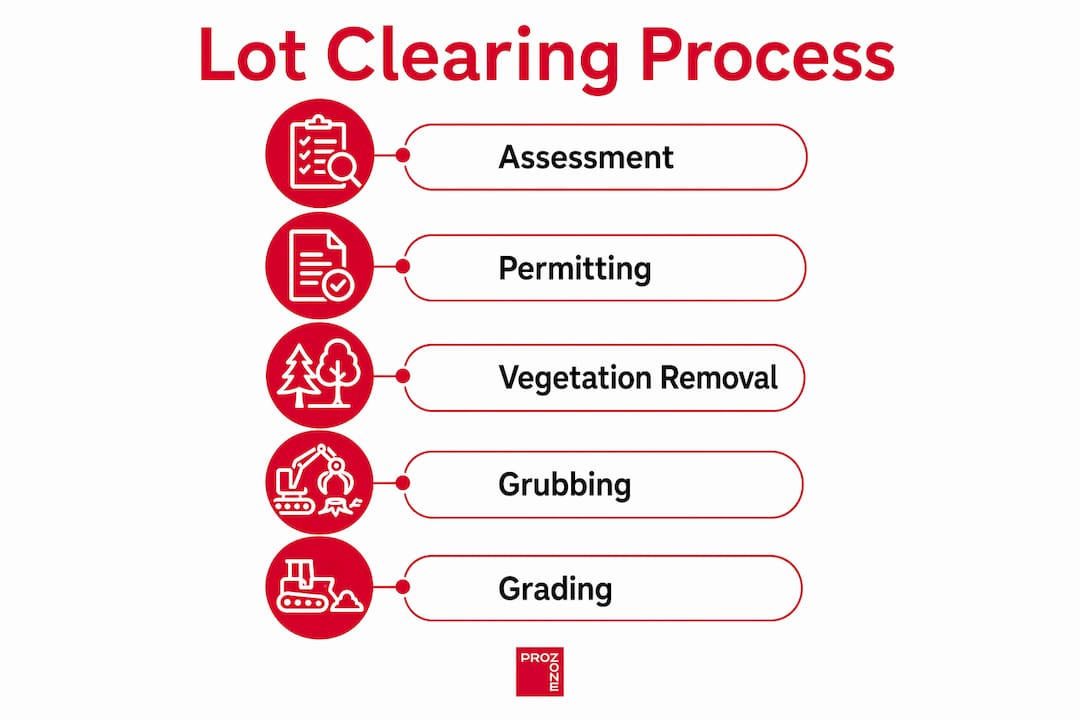
A well-managed lot clearing project follows a defined sequence. Skipping steps, particularly early assessment and erosion controls, creates compliance problems and rework costs later.
- Site assessment and utility markouts. Walk the site with your contractor to identify survey monuments, property pins, utility corridors, protected trees, and any watercourses or wetlands within the setback zone. Confirm that Alberta One-Call (now Utility Safety Partners) has been notified and all underground utilities are marked before any equipment moves.
- Install erosion and sediment controls. Standard practice requires silt fencing, sediment traps, or equivalent controls to be in place before clearing begins, not after. This protects adjacent properties and satisfies municipal inspection requirements.
- Tree and vegetation removal. Trees are felled, limbed, and bucked in a sequence that maintains safe working clearances. Designated trees identified in the permit or bylaw must be protected with barrier fencing throughout the project.
- Grubbing and stump removal. Stumps and root masses are extracted or ground to the required depth. On engineered projects, roots must be removed to at least 300 mm below finished grade to prevent organic decay and future voids beneath structures.
- Debris consolidation and disposal. Material is sorted onsite: wood waste for chipping or hauling, rock for potential reuse, and contaminated fill for licensed disposal. Burn pits, where permitted, require continuous supervision and written authorisation.
- Rough grading. Excavators and graders shape the subgrade to the design elevations, directing stormwater away from the building footprint. In Edmonton, lot grading approval for residential premises must be obtained within 18 months of the building permit being issued.
- Finish grading and erosion protection. The surface is brought to final design grades, topsoil is redistributed or imported, and temporary seeding or mulch cover is applied to exposed areas. A site preparation guide from ProZone’s project managers notes that managing stockpiles, haul routes, and erosion controls at this stage reduces rework and protects neighbouring properties.
For small residential lots with moderate tree cover, this sequence typically takes a few days of active work, weather permitting. Mid-size lots with dense vegetation or substantial grubbing needs can require significantly longer durations.
What permits and regulations apply in Alberta?
Most lot clearing projects in Alberta require at least one approval before work begins, and often several. The specific permits depend on municipality, site conditions, and project scope.
Municipal development and clearing permits are the starting point. The Regional Municipality of Wood Buffalo, for example, requires a Clearing and Grading Permit when clearing exceeds 1,000 square metres, cut or fill volumes exceed 400 cubic metres, or the site is near a water body. Edmonton operates under similar thresholds. Confirm the current requirements directly with your local planning department before scheduling equipment.
Tree removal permits apply in many municipalities when removing trees above a specified diameter or within a protected zone. Edmonton’s urban forestry bylaws set specific criteria; check with the City before removing any mature trees on or near the property line.
Burn authorisations are required whenever debris burning is planned. Tender specifications confirm that burning requires permits and continuous supervision; when burning is prohibited or impractical, debris must be transported to authorised disposal facilities.
Environmental checks cover protected species, riparian setbacks, and conservation overlays. If the site is near a watercourse, wetland, or area flagged in an Environmental Site Assessment, additional approvals from Alberta Environment and Protected Areas may be required before clearing begins.
A practical pre-work compliance checklist:
- Confirm municipal development and clearing permit requirements
- Verify tree removal permit thresholds with the local municipality
- Obtain burn authorisation or confirm burning is prohibited in your area
- Check for riparian or conservation setbacks using the municipality’s GIS mapping
- Notify Utility Safety Partners and obtain utility locate confirmation
- Confirm lot grading approval requirements under the City of Edmonton Drainage Bylaw
What equipment and methods are used for lot clearing?
The right equipment depends on site size, vegetation density, access constraints, and the intended end use of the cleared land.
Excavator. The workhorse of most clearing projects. Excavators push and pull trees, extract stumps, and move large volumes of material efficiently. They are best suited to sites where speed and power matter more than surface preservation.

Skid steer with mulching head. Effective for brush, small trees, and dense undergrowth. A mulching attachment grinds vegetation in place, leaving a layer of wood chips that can serve as temporary erosion cover. Less effective on large-diameter stumps.
Stump grinder. Purpose-built for grinding stumps to below grade after tree removal. Faster and less disruptive than full excavation for isolated stumps, though it does not remove the root mass to the 300 mm depth required for engineered subgrades.
Bulldozer. Used for bulk clearing on larger sites where topsoil stripping and rough grading happen simultaneously. Higher mobilisation cost makes it less economical for small residential lots.
Grader. Brings the cleared surface to design grades after bulk material has been moved. Graders are precision instruments; their role in earthworks for residential sites is to achieve the drainage slopes and elevation tolerances that downstream construction depends on.
Chipper. Processes branches and brush into wood chips onsite, reducing haul volumes significantly. Chips can be stockpiled for mulch reuse or spread as temporary ground cover.
Common clearing methods and their trade-offs:
- Mechanical clearing (excavator, bulldozer): fastest, highest production rate, best for large or heavily vegetated sites; higher fuel and mobilisation cost
- Selective tree removal: preserves soil structure and adjacent vegetation; preferred for residential lots where only specific trees are being removed
- Mulching: low disturbance, good for erosion control; not suitable where full grubbing is required
- Controlled burning (permit-dependent): reduces haul volumes; restricted or prohibited in many Alberta municipalities and during fire weather advisories
How is cleared debris handled and disposed of?
Debris management is a logistics problem as much as an environmental one. Material volumes from even a modest residential lot can be substantial, and poor planning leads to illegal dumping, bylaw violations, and unexpected hauling costs.
Onsite options include chipping branches and brush into wood chips for reuse as mulch or temporary erosion cover, and consolidating larger wood waste into designated burn pits where burning is authorised. Burn pits must be constructed, supervised, and rehabilitated according to permit conditions.
Offsite disposal routes cleared material to municipal transfer stations, licensed landfills, or composting facilities. Hauling logistics, including load sizes, route permits for oversize loads, and tipping fees, should be confirmed before work begins to avoid surprises in the final invoice.
Salvage and reuse can offset disposal costs. Merchantable timber may have value to local mills or firewood suppliers. Rock and aggregate uncovered during clearing can often be reused in drainage layers, temporary access roads, or landscaping. A landscaping material installation guide for Alberta properties covers how cleared aggregates and rock can be incorporated into follow-on site work.
Pro Tip: Stockpile topsoil separately from subsoil and debris from the first day of clearing. Mixing topsoil with mineral fill or wood waste destroys its reuse value for finish grading and landscaping, and replacing it later adds significant cost.
How long does lot clearing take, and what drives the cost?
Timeline and cost vary considerably based on site-specific conditions. The table below summarises the primary drivers and their typical effect on project scope.
| Cost and schedule driver | Typical impact |
|---|---|
| Vegetation density and tree size | Higher density and larger trees increase equipment hours and debris volumes significantly |
| Stump and root depth (grubbing scope) | Full grubbing to 300 mm adds excavator time versus surface-only clearing |
| Site access and working room | Tight access limits equipment size and slows production |
| Hauling distance to disposal facility | Longer haul routes increase trucking cost per load |
| Erosion and sediment control requirements | Engineered controls add material and installation cost |
| Seasonal timing and freeze-thaw conditions | Frozen ground can aid or hinder work; spring thaw creates soft subgrade conditions |
| Permit and inspection fees | Municipal fees vary; budget for grading approval costs in Edmonton |
Seasonality has a direct effect in Alberta. Clearing during frozen ground conditions can improve equipment traction and reduce rutting, but spring thaw can render a cleared site temporarily unworkable if grading and drainage have not been addressed. Scheduling clearing for late summer or early fall, before freeze-up, allows grading and erosion controls to be completed while the ground is stable.
What are the main risks, and how do professionals mitigate them?
Lot clearing disturbs soil, removes root systems that hold it in place, and alters how water moves across a site. Without active mitigation, those changes cause problems that outlast the clearing work itself.
Key risks and mitigation measures:
- Erosion and sediment runoff: Exposed soil on a cleared lot is highly vulnerable to wind and water erosion. Clearing increases runoff of sediment and nutrients into adjacent waterways. Mitigation: install silt fencing and sediment traps before clearing begins; apply temporary seeding or mulch to exposed areas within 48 hours of grading.
- Drainage impairment: Removing vegetation and altering grades can redirect stormwater toward foundations or neighbouring properties. The City of Edmonton requires grading to direct water away from buildings under its drainage bylaw. Mitigation: design grades to the approved lot grading plan before finish grading is complete.
- Soil instability: Grubbing voids and disturbed subgrade create settlement risk if not properly backfilled and compacted. Mitigation: backfill grub holes with compacted mineral fill; confirm compaction meets the geotechnical specification for the project.
- Habitat disruption: Clearing during nesting season can affect protected bird species. Mitigation: schedule clearing outside the April to July nesting window where possible, or obtain a qualified biologist’s assessment before proceeding.
- Dust and air quality: Dry summer conditions in Alberta generate significant dust from cleared sites. Mitigation: apply water suppression during active work; maintain vehicle speed limits on unpaved haul routes.
Alberta Safety Codes set the baseline for site safety on construction projects, including clearing operations. Compliance with those codes, combined with adherence to City of Edmonton drainage requirements, forms the minimum standard for professionally managed lot clearing in the region.
ProZone’s practical guidance for Edmonton and Alberta sites
Edmonton’s freeze-thaw cycle is one of the most consequential variables in local site preparation, with frost penetration depths that vary seasonally. The spring thaw period creates a window where subgrade bearing capacity drops sharply. Grading decisions made during lot clearing directly affect how a site performs through that cycle. Slopes that drain poorly during thaw will saturate the subgrade, delaying subsequent construction and increasing the risk of differential settlement under foundations and pavements.
ProZone’s project managers approach clearing as a logistics and sequencing problem, not just a removal task. Haul routes are planned before equipment arrives to avoid tracking mud onto municipal roads. Topsoil is stripped and stockpiled separately in the first pass so it remains available for finish grading. Erosion controls go in before the first tree comes down. These practices reflect the site preparation standards that distinguish engineered site work from generic clearing.
Pro Tip: In Edmonton, schedule your rough grading completion before the fall freeze-up. The City’s drainage bylaw requires rough grading approval within 18 months of a building permit being issued, and a frozen or snow-covered site will delay that inspection, pushing your timeline into the following spring.
For a practical look at how these principles apply across different project types, ProZone’s outdoor construction project examples illustrate the range of site preparation outcomes achievable in the Edmonton region.
How do you choose a lot clearing contractor in Canada?
The contractor you select sets the quality baseline for every phase of construction that follows. A poorly cleared and graded site creates problems that are expensive to correct after the fact.
Credentials and documents to verify before signing a contract:
- Current WCB (Workers’ Compensation Board) clearance letter
- General liability insurance certificate with adequate coverage limits
- Municipal business licence for the jurisdiction where work is being performed
- Awareness of and compliance with Alberta Safety Codes for construction site operations
- References from comparable projects (residential or commercial, depending on your scope)
Questions to ask during the quoting process:
- What is your method for root removal, and to what depth do you grub?
- How do you handle erosion and sediment control during and after clearing?
- What is your debris disposal plan, and do you hold the necessary permits?
- How do you protect designated trees and survey monuments during work?
- Will you provide a written scope of work and a grading plan?
Red flags that warrant caution:
- Verbal-only scope with no written contract or site visit
- No proof of insurance or WCB clearance when requested
- A significantly lower bid with no explanation of how scope or disposal is being handled differently
- No mention of erosion controls or grading in the proposal
Checking a contractor’s compliance with Alberta construction regulations is straightforward: ask for documentation, and walk away from any contractor who cannot or will not provide it. Site safety on clearing projects also depends on equipment visibility; fleet lighting standards for work vehicles are covered in guidance from Strobe My Ride, which is worth reviewing if you are managing a multi-vehicle clearing operation.
Why professional lot clearing standards matter more than most owners realise
The gap between a cleared lot and a construction-ready lot is wider than it looks. Removing trees is straightforward; delivering a subgrade that performs through Edmonton’s freeze-thaw cycles, meets the City’s drainage bylaw, and passes grading inspection requires a different level of planning and execution.
ProZone applies engineered grubbing standards, removes roots to the required 300 mm depth, and grades to approved drainage plans on every site preparation project. That approach is not the default in the industry. Generic clearing contractors often stop at surface removal, leaving root masses in place and grading to visual approximation rather than design elevations. The difference shows up months or years later, in cracked slabs, heaving pavements, and drainage complaints from neighbours.
Alberta Safety Codes compliance is not optional on construction sites, and ProZone’s project managers treat it as a baseline, not a selling point. What actually differentiates premium site preparation is the sequencing: erosion controls before clearing, topsoil segregation from the first pass, grading completed to a plan rather than by eye, and documentation that supports permit inspections without delays.
Property owners who treat lot clearing as a commodity purchase often discover the real cost later, in remediation work that could have been avoided with a properly scoped contract from the start.
ProZone site preparation services for Edmonton and Alberta
ProZone delivers professional lot clearing and site preparation across Edmonton and the surrounding Alberta communities. The process starts with a site review, moves to a written scope and estimate, and proceeds to scheduled clearing, grubbing, grading, and erosion control, all managed to Alberta Safety Codes and City of Edmonton drainage requirements.
For property owners and project managers ready to move from raw land to a construction-ready site, ProZone’s site preparation services cover the full scope: clearing, grubbing, rough and finish grading, debris disposal, and permit-ready documentation. A full overview of ProZone’s construction services for Edmonton is available for larger or multi-phase projects.
Contact ProZone directly through the online form or by phone to request a free site estimate. A project manager will review your site conditions, confirm permit requirements, and provide a written scope before any work begins.
FAQ
What is lot clearing, exactly?
Lot clearing is the removal of trees, stumps, brush, rocks, and debris from a parcel of land to prepare it for construction or development. It combines surface clearing with grubbing, which removes root systems below grade to create a stable subgrade.
What are the main effects of land clearing on the environment?
Clearing exposes soil to wind and water erosion and increases sediment and nutrient runoff into nearby waterways, which can harm aquatic habitats. Proper erosion controls, staged clearing, and prompt revegetation of exposed areas reduce these impacts significantly.
What is the cheapest way to clear a lot?
Selective mechanical clearing using a skid steer with a mulching head is generally the lowest-cost approach for small to mid-size lots with moderate vegetation, as it reduces haul volumes by processing material onsite. Full grubbing and engineered grading add cost but are required for construction-grade site preparation.
What are the disadvantages of clearing land?
Without proper planning, clearing can cause erosion, drainage problems, soil instability, and habitat disruption. In Alberta, poorly graded cleared sites are also vulnerable to freeze-thaw damage, which can compromise foundations and pavements if subgrade preparation is inadequate.
Do I need a permit to clear my lot in Alberta?
Most municipalities in Alberta require a clearing and grading permit when the disturbed area exceeds a set threshold, typically 1,000 square metres, or when the site is near a water body. Check with your local planning department before scheduling any clearing work.