
The most reliable approaches for property owners and facility managers are targeted patching for isolated failures, rout-and-seal for active cracks, and surface treatments or overlays for network-level preservation. Choosing the wrong method wastes budget and accelerates deterioration, particularly in Edmonton’s freeze-thaw climate where water infiltration is the primary failure driver. The top asphalt repair solutions covered here are ranked by damage type and severity, so you can match the right technique to what you are actually seeing on site.
When to use each technique at a glance:
- Isolated pothole or failed patch: cold patch (temporary), hot-mix full-depth patch (permanent), or spray patching
- Active transverse or longitudinal crack: rout-and-seal with rubberised sealant
- Hairline or non-moving crack: crack filling with emulsion-based filler
- Widespread surface oxidation, minor cracking: sealcoating, micro-surfacing, or slurry seal
- Structurally sound base with surface fatigue: mill and fill or thin overlay
- Alligator cracking, base failure, or drainage issues: full-depth reclamation or rehabilitation
TL;DR: Inspect your pavement in May and September, prioritise active cracks and drainage failures first, schedule sealcoating and crack treatments between late May and early September, and contact ProZone for an on-site estimate before committing to any repair programme.
Pro Tip: Take photos and note crack widths during your inspection. A crack wider than 6 mm that moves seasonally is an active crack requiring rout-and-seal, not a simple filler application.
Table of Contents
- 1. Pothole repair: which method holds up in freeze-thaw conditions
- 2. Crack sealing versus crack filling: what facility managers must know
- 3. Seal coating and surface treatments: when they extend pavement life
- 4. Milling, overlay, and full-depth rehabilitation: choosing larger interventions
- 6. Cost drivers and lifecycle tradeoffs: budgeting repairs for best value
- 8. DIY versus hiring a certified contractor: when professional work is required
- How ProZone inspects and specifies asphalt repairs
- A contractor’s perspective: prioritising long-term asset value over cheap quick fixes
- ProZone’s free on-site estimate for Edmonton property managers
- Sources and further reading
- FAQ
1. Pothole repair: which method holds up in freeze-thaw conditions
Potholes in Edmonton form when water infiltrates cracks, freezes, expands, and fractures the surface layer. The repair method you choose determines whether the fix lasts one winter or ten.
Cold patch is a pre-mixed, bag-applied material suited for emergency repairs when hot-mix is unavailable. It bonds adequately in cool weather but remains susceptible to displacement under traffic and freeze-thaw cycling. Expect a service life of one season under normal conditions; treat it as a placeholder, not a permanent fix.
Hot-mix full-depth patching is the standard for durable pothole repair. The failed material is saw-cut to a clean edge, excavated to the base, and replaced with compacted hot-mix asphalt in lifts. Proper edge preparation and a tack coat between lifts are non-negotiable for long-term adhesion. This method, executed correctly, matches the surrounding pavement’s service life.
Spray patching (also called spray-in-place patching) uses an emulsion and aggregate blown into the void under pressure. It is faster than hand-patching and works well for moderate-depth failures where mobilising a paving crew is not cost-effective. Infrared patching heats the existing asphalt, allows reworking and compaction, and is effective for shallow depressions and edge failures where the base is still sound.
- Drainage correction before patching is mandatory; a pothole that refills with water will fail again regardless of material quality
- Compaction to at least 95% of the mix’s maximum density is the single largest predictor of patch longevity
- Skin patches over soft or wet bases always fail; excavate to firm material
Pro Tip: Saw-cut edges at 90 degrees rather than feathering them. A vertical edge gives the new material a mechanical lock against the existing pavement and dramatically reduces edge cracking.
2. Crack sealing versus crack filling: what facility managers must know
These two treatments are often confused, but applying the wrong one to the wrong crack type wastes money and accelerates deterioration.
Crack sealing (rout-and-seal) is the correct treatment for active cracks, meaning cracks that open and close with temperature. The crack is routed to a defined reservoir, cleaned, dried, and filled with a flexible rubberised sealant. The reservoir geometry and sealant elasticity allow the material to accommodate movement without debonding. According to FCM’s crack sealing guidelines, sealant durability varies depending on material and installation quality, with realistic targets set according to product type and conditions.
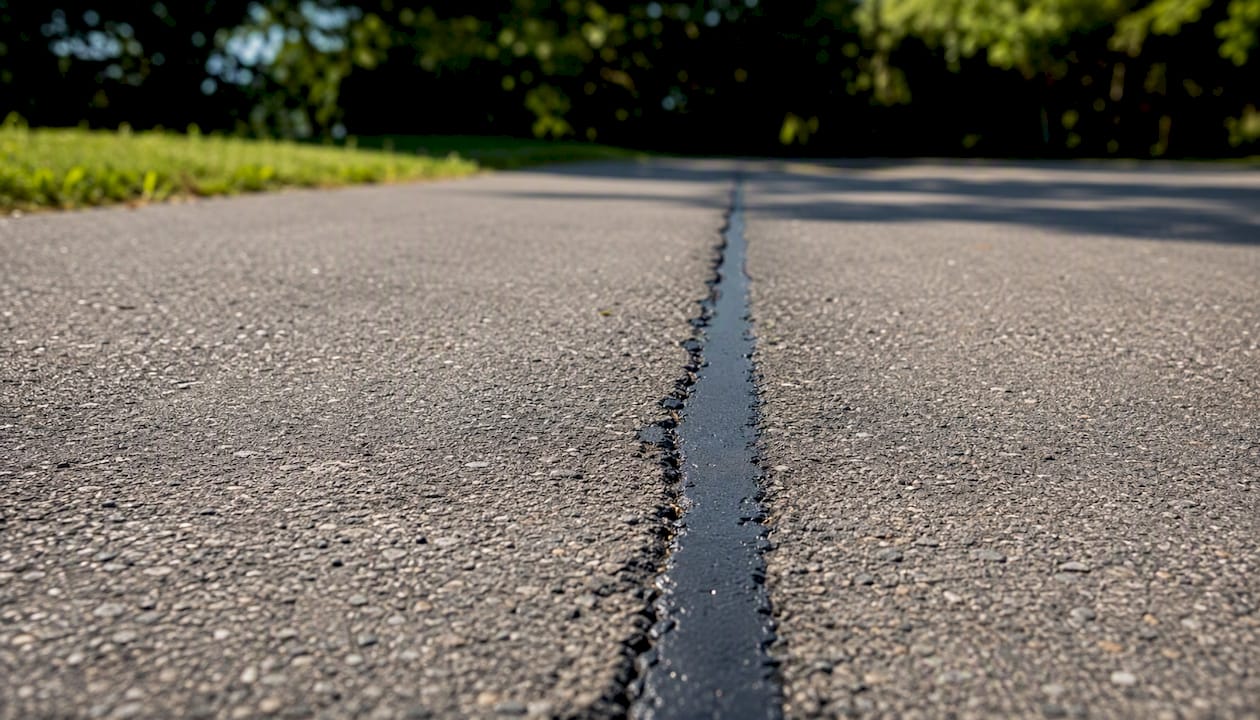
Crack filling uses an emulsion-based or asphalt-based filler applied directly into non-moving cracks. It is faster and less expensive, but it does not accommodate movement and will debond if applied to an active crack. Use it on hairline cracks and low-severity surface cracking in pavements with a condition rating above 75.
| Treatment | Best for | Expected service life | Traffic suitability |
|---|---|---|---|
| Rout-and-seal | Active cracks, seasonal movement | Medium to long-term performance (typically 2 to 12 years, depending on material and installation) | All traffic levels |
| Crack filling | Non-active, hairline cracks | Short to medium-term performance (varies with product and prep) | Low to medium traffic |
| Flush fill | Very fine surface cracks | Short-term performance | Low traffic only |
Preparation quality determines real-world durability more than product selection. The crack must be dry, free of debris, and routed to the correct reservoir depth before any sealant is applied. Wet or contaminated cracks cause adhesion failure within one freeze-thaw cycle.
According to Alberta Transportation’s crack maintenance guidelines, reservoir size, overband configuration, and the use of modified low-modulus sealants all materially increase service life. For active transverse cracks with noticeable annual movement, a low-modulus rubberised sealant in a routed reservoir with an overband is the specification that delivers the best long-term performance.
Pro Tip: For asphalt crack filling programmes, plan treatments as a recurring cycle, not a one-time activity. FCM guidelines recommend an initial treatment at 3 to 5 years and repeat cycles every 5 to 8 years for pavements in good condition.
3. Seal coating and surface treatments: when they extend pavement life
Surface treatments protect the binder layer from oxidation, reduce water infiltration, and extend pavement life at a fraction of the cost of an overlay. Their effectiveness depends entirely on applying them to the right pavement at the right time.
What each treatment does:
- Sealcoating applies a thin emulsion layer that restores surface flexibility, fills micro-cracks, and protects against UV oxidation and fuel spills
- Micro-surfacing is a polymer-modified slurry that corrects minor rutting and surface irregularities while sealing the surface; it performs well under higher traffic volumes than standard sealcoat
- Slurry seal is similar to micro-surfacing but without polymer modification; it suits lower-traffic surfaces and parking areas
- Fog seal is a diluted emulsion spray applied to slightly deteriorated surfaces to arrest ravelling and slow oxidation
When surface treatments are appropriate:
- Pavement condition rating is above 70 and the base is structurally sound
- Surface oxidation and minor cracking are present but no alligator cracking or base distress
- The surface has been crack-sealed first; sealcoating over open active cracks traps moisture
When they are not appropriate: over alligator cracking, over soft or failed base areas, or as a substitute for patching. Applying sealcoat to a failing surface delays the visible signal of distress without addressing the cause.
In Edmonton, apply sealcoating between late May and early September when surface temperatures are consistently above 10°C and no rain is forecast for at least 24 hours. Alberta Transportation’s guidelines confirm that seal coating, micro-surfacing, and slurry sealing can deliver cost-effective long-term performance when applied to appropriate pavements. For commercial sealcoating specifications, TrueSealCoating’s commercial programme outlines application standards relevant to high-traffic parking and drive-lane surfaces.
4. Milling, overlay, and full-depth rehabilitation: choosing larger interventions
When patching and surface treatments are no longer sufficient, the decision shifts to whether the base can support a new wearing course or whether structural rehabilitation is required.
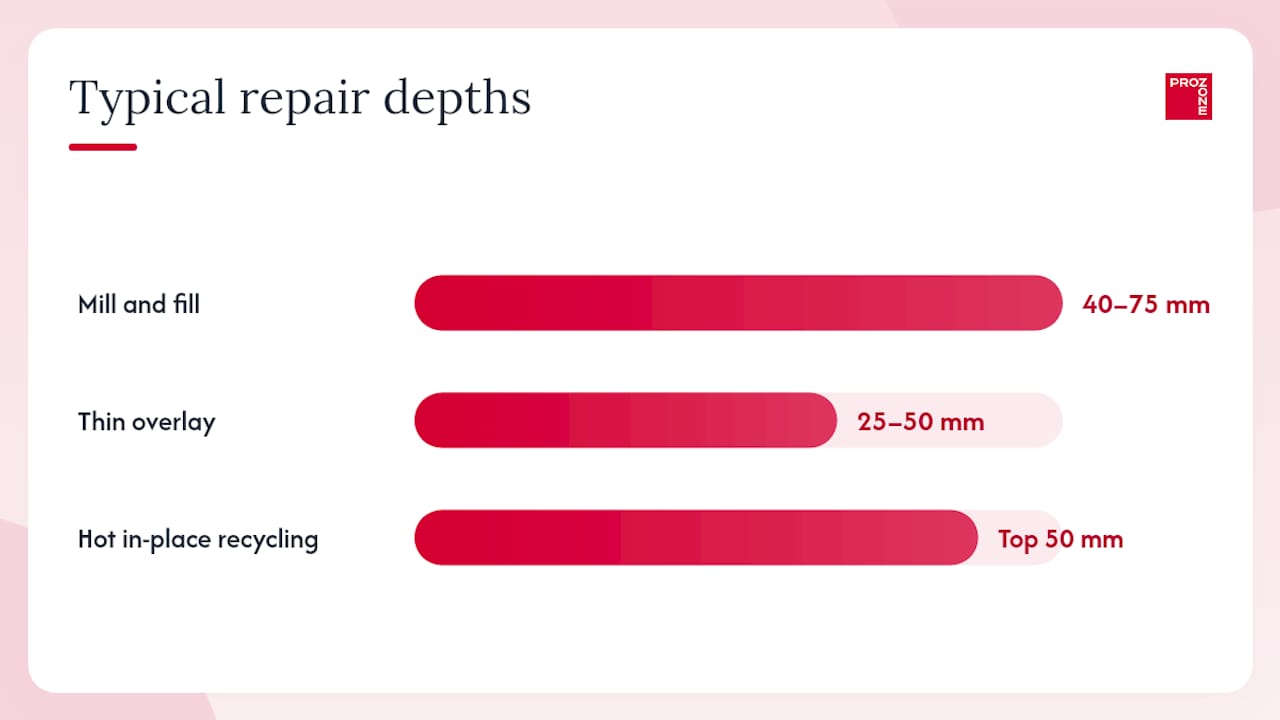
Mill and fill removes the deteriorated asphalt layer (typically 40–75 mm) and replaces it with new hot-mix. It is the preferred option when the base is sound but the surface has widespread cracking, rutting, or surface fatigue. According to Alberta Transportation’s crack maintenance guidelines, mill and fill improves ride quality and restores structural integrity when base conditions permit. ProZone’s concrete repair and asphalt pulverisation services cover this scope for parking lots and commercial drives.
Thin overlay bonds a new 25–50 mm asphalt layer over the existing surface without milling. It suits pavements with sound structure and minor surface distress, but it raises grade elevation, which can affect drainage and curb heights.
Hot in-place recycling (HIR) heats and scarifies the existing surface, blends in rejuvenators and virgin material, and repaves in a single pass. It reuses the top 50 mm of existing material, reducing hauling costs and material waste.
Full-depth reclamation (FDR) pulverises the entire asphalt layer and a portion of the base, stabilises the material with a binding agent, and compacts it as a new base course. It is the most cost-effective option when both the surface and base have failed.
| Intervention | Base condition required | Typical depth | Best suited for |
|---|---|---|---|
| Patching | Sound base under patch area | Varies | Isolated failures |
| Mill and fill | Sound base throughout | 40–75 mm | Widespread surface fatigue |
| Thin overlay | Sound structure | 25–50 mm | Minor surface distress |
| Hot in-place recycling | Sound base | Top 50 mm | Surface fatigue, moderate cracking |
| Full-depth reclamation | Failed base acceptable | Full depth | Structural failure, base failure |
- Alligator cracking covering more than 25% of the surface is a strong indicator that overlay alone will not provide lasting results
- Always verify base integrity with core samples before specifying an overlay; overlaying a failed base is one of the most common causes of premature pavement failure
6. Cost drivers and lifecycle tradeoffs: budgeting repairs for best value
Upfront repair cost is rarely the right metric. The correct question is: what does this repair cost per year of service life?
Primary cost drivers:
- Area and depth of repair (larger, deeper repairs cost more per unit but often less per year of service)
- Access and traffic control requirements, particularly on commercial properties with active operations
- Material selection, including binder grade and sealant type
- Seasonality: mobilising a paving crew outside the May to September window in Edmonton carries premium costs
- Base preparation and drainage correction, which are often excluded from low-bid quotes
Preventive maintenance payback logic: FCM’s preventive maintenance guide confirms that applying low-cost preventive treatments at the right time extends service life and is more cost-effective than delayed rehabilitation. Addressing thin cracks early reduces the need for expensive corrective actions later.
Budgeting checklist for comparing contractor quotes:
- Confirm the scope includes drainage assessment and base preparation, not surface repair only
- Require a materials specification sheet with binder grade and sealant product name
- Ask for compaction standards and testing methodology
- Confirm warranty terms in writing, including what voids the warranty
- Verify Alberta Safety Codes compliance and trade certifications
- Request references or a project gallery for comparable work in Edmonton
For a broader view of cost factors in Canadian paving, asphalt paving costs and key facts covers typical material and labour considerations for Alberta projects.
8. DIY versus hiring a certified contractor: when professional work is required
Some repairs are within reach of a capable property manager with the right materials. Most are not, and the cost of a failed DIY repair in Edmonton’s climate is always higher than the cost of doing it right the first time.
When DIY is reasonable:
- Filling hairline cracks (under 3 mm, non-active) with a quality emulsion filler
- Applying cold patch to a pothole as a temporary safety measure pending a contractor visit
- Applying a residential-grade sealcoat to a low-traffic private driveway
When a certified contractor is required:
- Any repair on a commercial or municipal property where safety liability applies
- Full-depth patching, mill and fill, overlays, or rehabilitation work
- Crack sealing with routed reservoirs and rubberised sealant (requires specialised equipment)
- Any work subject to Alberta Safety Codes or requiring compaction testing documentation
- Repairs where a warranty is needed for insurance or lease purposes
Risks of under-spec DIY in freeze-thaw climates:
- Cold patch without proper compaction displaces under traffic within weeks
- Sealant applied to wet or dirty cracks debonds in the first freeze cycle
- Surface repairs over failed bases create a false sense of security while the base continues to deteriorate
What to require from any contractor bid:
- Written scope including drainage and base assessment
- Materials specification with product names and binder grades
- Compaction standards and testing plan
- Proof of Alberta Safety Codes compliance and trade certifications
- Warranty terms in writing, with clear exclusions stated
For context on what a well-specified repair programme looks like in practice, ProZone’s road maintenance strategies for Alberta managers outlines the decision framework used on commercial and municipal projects.
How ProZone inspects and specifies asphalt repairs
ProZone’s repair process starts with a structured site assessment, not a quote. Understanding what is actually failing, and why, determines whether a repair will hold or simply delay the next failure.
Inspection checklist used on site:
- Visual distress mapping: pothole locations, crack patterns, alligator cracking extent, and surface ravelling
- Crack measurement: width, length, and seasonal movement assessment
- Drainage review: identifying ponding areas, blocked inlets, and grade deficiencies
- Core sampling recommendation where base integrity is uncertain
- Load and traffic assessment: heavy vehicle routes and turning movements that concentrate stress
ProZone specifies repairs to Alberta Safety Codes standards, uses binder grades suited to Edmonton’s temperature range, and provides written warranty terms covering both materials and workmanship. Every project close-out includes compaction test results and material delivery documentation so facility managers have a complete record for their asset management files.
ProZone holds trade certifications and project insurance appropriate for commercial and municipal work in Alberta. Project galleries and client references are available on request, giving facility managers the verification they need before committing to a contract.
Pro Tip: Request a written specification, not just a price. A specification that names the binder grade, compaction standard, and warranty terms is the only document that protects you if the repair fails prematurely.
A contractor’s perspective: prioritising long-term asset value over cheap quick fixes
The most expensive repairs ProZone encounters are the ones that were done cheaply the first time. A cold patch applied over a wet base, a sealcoat brushed over open alligator cracking, or an overlay placed without milling a failed surface layer: each one looks like a cost saving on the day it is done and becomes a rehabilitation project within two winters.
Edmonton’s freeze-thaw cycles are unforgiving to shortcuts. Water finds every gap, freezes, expands, and widens cracks that were not properly sealed. A repair that skips drainage correction or base preparation is not a repair; it is a delay. The correct specification for a full-depth pothole repair in this climate costs more than a cold patch, but it costs less than replacing the same area three times over five years.
The right approach is inspection-led prioritisation. Spend the maintenance budget on pavements that are still in good condition and will respond to preventive treatment. Pavements that have already failed structurally need rehabilitation, not another layer of sealcoat. That distinction, applied consistently across a property portfolio, is what separates a managed asset from a recurring liability.
ProZone’s free on-site estimate for Edmonton property managers
ProZone provides on-site assessments for property owners and facility managers across Edmonton and the surrounding Alberta communities. The assessment covers distress mapping, drainage review, and a written repair specification with materials, compaction standards, and warranty terms. You get a clear scope of work, not just a number.
ProZone’s team holds Alberta Safety Codes compliance and trade certifications for commercial and municipal asphalt work. For larger projects, the road construction services page outlines ProZone’s capabilities for municipal and commercial property managers. To see the range of construction services available in Edmonton, the construction services overview covers the full scope.
Contact ProZone through the online form at prozoneltd.ca/contact or call directly to schedule your free estimate. Repairs are best planned before freeze-up; booking early in the season secures your place in the schedule.
Sources and further reading
| Resource | Publisher | Use |
|---|---|---|
| Guidelines for sealing and filling cracks in asphalt and concrete pavements | Federation of Canadian Municipalities | Crack sealing and filling methods, timing, and material guidance |
| Timely preventive maintenance for municipal roads | Federation of Canadian Municipalities | Lifecycle planning and preventive maintenance timing |
| Crack maintenance guidelines | Alberta Transportation | Alberta-specific crack repair methods and material specifications |
| Asphalt pavement maintenance guide | Transports Québec | Rehabilitation options including hot in-place recycling and mill and fill |
| Top road repair methods for Edmonton property managers | ProZone | Local repair method selection for Edmonton and nearby municipalities |
| Top asphalt maintenance tips to extend lifespan in Edmonton | ProZone | Seasonal maintenance checklists and Edmonton climate guidance |
FAQ
What is the best asphalt repair method for Edmonton’s climate?
Hot-mix full-depth patching is the most durable option for potholes and structural failures in Edmonton’s freeze-thaw climate. For surface-level cracking, rout-and-seal with a low-modulus rubberised sealant delivers the best long-term performance on active cracks.
What is the difference between crack sealing and crack filling?
Crack sealing uses a routed reservoir and flexible rubberised sealant to accommodate crack movement; it suits active cracks that open and close seasonally. Crack filling applies a filler directly into non-moving hairline cracks and is not suitable for cracks with seasonal movement.
Will new asphalt bond properly to old asphalt?
Yes, provided the old surface is clean, dry, and structurally sound, and a tack coat is applied before the new layer. Bonding fails when the existing surface is contaminated, wet, or structurally compromised, which is why base assessment before any overlay is non-negotiable.
Is sealing a driveway or parking lot worth the cost?
Sealcoating is cost-effective when applied to pavements in good condition with a rating above 70 and no alligator cracking. Applied to a failing surface, it delays visible distress without addressing the underlying problem and is not a substitute for structural repair.
When should you hire a professional instead of doing it yourself?
Any repair on a commercial or municipal property, full-depth patching, crack sealing with routed reservoirs, overlays, or work requiring Alberta Safety Codes compliance should be done by a certified contractor. DIY cold patch is acceptable only as a temporary safety measure pending a professional repair.