
TL;DR:
- SCM-blended mixes using slag or fly ash are the most practical, available, and code-compliant low-carbon options for concrete in Canada. Carbon-negative wall blocks and insulation materials like hempcrete provide additional sustainable choices for non-structural applications, while geopolymer concrete and other emerging materials require specialized control and approval. Proper testing, certification, and engineering review are essential for safe, durable, and compliant use of these alternatives in Alberta projects.
For structural slabs and paving in Canada, SCM-blended mixes using slag or fly ash are the most practical starting point. For wall blocks and masonry units, CarbiCrete-style carbon-negative block technology is the leading option with Canadian production. For insulation and non-structural infill, hempcrete and prefabricated hemp SIPs deliver the best thermal performance in Alberta’s cold climate. These are the four categories worth evaluating as c-ment.ca alternatives for any project where Portland cement is the current default.
The Government of Canada’s net-zero concrete roadmap confirms that SCMs can replace an average of 30% or more of the Portland cement in a concrete mix without sacrificing structural performance. That single substitution is the most widely available, code-compliant, and cost-effective carbon reduction available to Canadian builders today.
Quick pros by category:
- SCM-blended mixes (slag, fly ash): Widely available nationally, code-compliant, lower embodied carbon, proven freeze-thaw performance
- Geopolymer concrete: Significant CO2 reduction, strong compressive strength, requires specialist mix control and heated curing in cold climates
- CarbiCrete-style carbon-negative blocks: Net-negative carbon, produced in Canada (Quebec), suited to wall and block applications
- Hempcrete / hemp SIPs: Excellent insulation, carbon-storing, non-structural only, prefabricated panels available for Alberta residential projects
- Ferrock: Steel-waste binder, higher compressive strength than Portland cement, limited Canadian supply
- Compressed earth blocks (CEBs): Low embodied energy, load-bearing potential, requires moisture management in Alberta conditions
For environmental considerations in construction and Alberta Safety Codes compliance, engineered and tested alternatives consistently outperform ad hoc substitutions.
Table of Contents
- How do these alternatives compare side by side?
- What you need to know about each alternative material
- How do you pick the right alternative for your Alberta project?
- Where can you source these alternatives in Canada?
- What do regulations and evidence say about these materials in Canada?
- ProZone’s perspective on alternative materials in Alberta
- ProZone can help you source, test, and install alternative materials
- Useful sources and further reading
- FAQ
How do these alternatives compare side by side?
| Material | Best for | Carbon reduction | Canadian availability | Cost vs Portland cement | Structural suitability | Alberta freeze-thaw | Installation complexity | Code / regulatory status |
|---|---|---|---|---|---|---|---|---|
| SCM-blended mixes (slag, fly ash) | Structural slabs, paving, flatwork | High (average 30% or more cement replacement) | Widely available nationally | Similar or lower | Load-bearing with engineered mix design | Excellent with proper mix design | Low, standard ready-mix process | Accepted under NBC and Alberta Safety Codes |
| Geopolymer concrete | Structural elements, precast | Very high CO2 reduction vs OPC | Limited, regional suppliers | Higher upfront | Load-bearing with engineering stamp | Good, requires careful curing | High, specialist mix protocols required | Requires engineering approval for structural use |
| CarbiCrete-style carbon-negative blocks | Wall blocks, masonry units | Net negative (CO2 cured into block) | Regional (Quebec production, national shipping) | Comparable to standard block | Non-structural to light load-bearing | Good for above-grade masonry | Moderate, standard block-laying | Emerging; verify local acceptance |
| Ferrock | Specialty structural, marine | Very high (carbon-absorbing cure) | Very limited in Canada | Higher | Structural potential, limited data | Limited cold-climate data | High, specialist only | Experimental; no standard code path |
| Hempcrete | Insulation, non-structural walls | High (carbon-storing material) | Growing, prefab panels available in Alberta | Moderate to high | Non-structural only | Good with vapour management | Moderate, prefab panels reduce risk | Non-structural; accepted in residential with design review |
| Mycelium-based materials | Insulation blocks, packaging | Very high | Very limited | Higher | Non-structural only | Not rated for exterior Alberta use | Low for interior use | Non-structural, no structural code path |
| Compressed earth blocks (CEBs) | Low-rise walls, landscape walls | High (minimal processing) | Limited, regional producers | Low | Load-bearing potential in low-rise | Requires waterproofing and drainage | Moderate | Requires engineering review in Alberta |
| EcoPact / low-carbon proprietary mixes | Structural slabs, paving | Moderate to high | National (major ready-mix suppliers) | Similar to standard mix | Load-bearing with standard mix design | Proven with proper specification | Low, standard ready-mix process | Accepted under NBC and Alberta Safety Codes |
Pros and cons at a glance:
- SCM-blended mixes: Proven track record and easy procurement; slower early strength gain with high fly ash content
- Geopolymer: Major carbon savings; needs heated curing in winter and specialist installers
- CarbiCrete-style blocks: Genuinely carbon-negative; currently limited to block format, not poured concrete
- Ferrock: Impressive strength and carbon absorption; supply chain in Canada is not yet established
- Hempcrete: Excellent insulation and carbon storage; not suitable for structural loads or below-grade applications
- Mycelium: Promising for interior insulation; not rated for Alberta exterior conditions
- CEBs: Very low embodied energy; moisture management is critical in Alberta’s climate
- EcoPact / low-carbon mixes: Drop-in replacement for standard mixes; carbon savings vary by supplier formulation
What you need to know about each alternative material
SCM-blended mixes: slag and fly ash
Slag (ground granulated blast-furnace slag, or GGBFS) and fly ash are industrial by-products added to concrete to partially replace Portland cement clinker. Slag and fly ash can replace an average of 30% or more of the Portland cement in a concrete mix, improving durability and reducing embodied carbon. Both are available through national ready-mix suppliers and are the most straightforward path to lower-carbon concrete for Alberta projects.
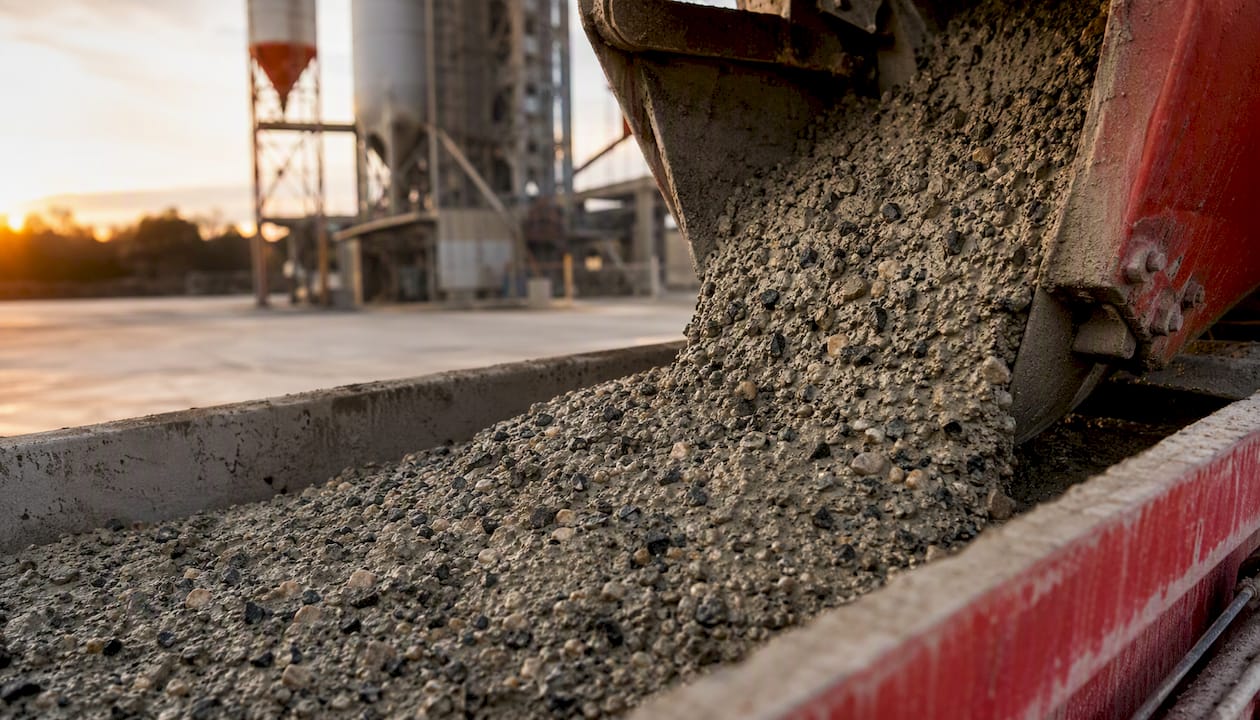
The freeze-thaw caveat: high fly ash content can slow early strength gain, which matters in Edmonton where cold snaps can arrive before a pour has cured. Specifying air entrainment and a minimum 28-day strength target mitigates this risk.
Geopolymer concrete
Geopolymer concrete replaces Portland cement with an alkaline-activated binder, typically derived from fly ash or slag. The chemistry produces a dense, low-permeability matrix with compressive strengths comparable to standard concrete. CO2 savings relative to ordinary Portland cement (OPC) mixes can be substantial, though exact figures depend on the source material and activator chemistry.
Geopolymer mixes require alkaline activators (sodium silicate and sodium hydroxide) and careful control of mix ratios. In cold climates, heated curing or insulated formwork is often necessary to achieve published strengths. Installers must follow supplier protocols precisely; this is not a product for general contractors without specific training.
CarbiCrete-style carbon-negative block technology
CarbiCrete, a Montreal-based company, produces concrete blocks cured with CO2 rather than steam, permanently mineralising carbon into the block matrix. The process eliminates Portland cement entirely from the block and results in a net-negative carbon product. Blocks are available for wall and masonry applications and can be shipped nationally, though production is currently centred in Quebec.
For Alberta projects, the practical path is to specify CarbiCrete-type blocks for above-grade masonry walls where standard CMU blocks would otherwise be used. Structural suitability for load-bearing applications should be confirmed with the supplier’s technical data and an engineering review.
Ferrock and steel-waste binders
Ferrock is a binder made primarily from steel dust (a recycled industrial waste) that cures by absorbing CO2 from the air. Its compressive strength exceeds that of Portland cement in controlled conditions, and the curing process is carbon-absorbing rather than carbon-emitting. Canadian supply is not yet established at commercial scale, making Ferrock a material to watch rather than specify today.
Hempcrete and mycelium-based materials
Hempcrete is a mixture of hemp hurd (the woody core of the hemp stalk), lime binder, and water. It is non-structural but provides excellent thermal mass, vapour permeability, and carbon storage. Prefabricated hempcrete panels and hemp SIPs are available for residential projects in Alberta, and a new Indigenous-owned processing plant in Elk Point, northeast of Edmonton, is producing hemp-blended building blocks, expanding local supply.
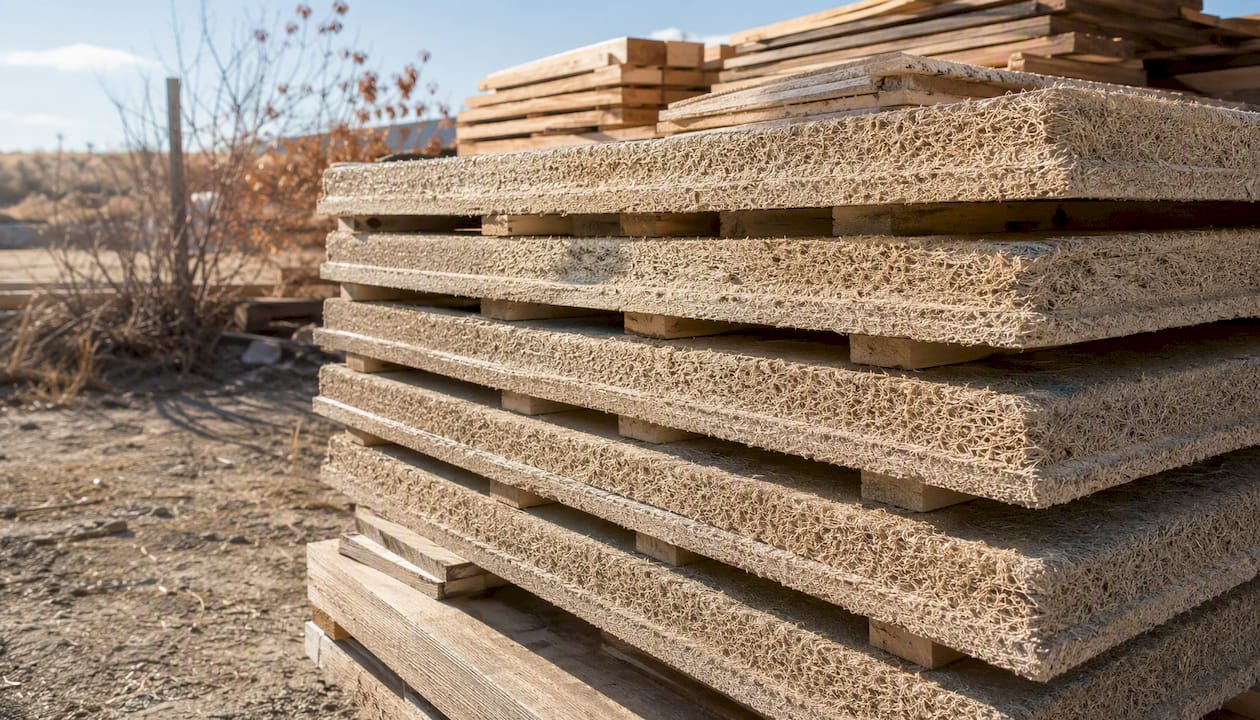
Mycelium-based insulation blocks (grown from fungal mycelium and agricultural waste) are suited to interior insulation applications. They are not rated for exterior use in Alberta’s climate and should not be considered for any application exposed to freeze-thaw cycling.
Pro Tip: For Alberta wall assemblies, prefabricated hemp SIPs or straw-bale panels from suppliers like Savick reduce on-site variability and provide documented R-values, which simplifies energy-code compliance submissions.
Compressed earth blocks (CEBs)
CEBs are compressed from stabilised soil, sometimes with a small cement or lime addition. They have very low embodied energy and can be load-bearing in low-rise construction when properly engineered. In Alberta, moisture management is the critical design challenge: CEBs must be protected from ground moisture and freeze-thaw cycling at the base of walls. Waterproof footings, capillary breaks, and roof overhangs are non-negotiable details.
Self-levelling overlays and patched pours
For non-structural repairs, self-levelling overlays poured over existing slabs offer a durable, code-acceptable middle ground. They are more reliable than dry-pack or “poor man’s concrete” mixes but will not correct underlying subgrade settlement. In Edmonton’s freeze-thaw climate, addressing drainage and subgrade compaction before applying any overlay is the prerequisite step.
How do you pick the right alternative for your Alberta project?
Start by defining the structural role of the material. That single question eliminates most of the list immediately.
Decision process:
- Define the structural requirement. Load-bearing slab or pavement: use SCM-blended mixes or EcoPact-type low-carbon mixes. Masonry wall blocks: consider CarbiCrete-style carbon-negative blocks. Insulation or non-structural infill: hempcrete or prefabricated straw panels. Decorative or non-structural finish: self-levelling overlays or stamped concrete with SCM content.
- Set your carbon target. Request an Environmental Product Declaration (EPD) from every supplier. An EPD is a third-party-verified document stating the material’s embodied carbon per unit. Without one, carbon claims are marketing, not data.
- Assess lifecycle cost, not just unit price. A lower-cost experimental mix that requires replacement in 10 years costs more than a proven engineered mix with a 30-year service life. Lifecycle optimisation matters more than lowest upfront cost, particularly in Alberta where premature failure means winter disruption and expensive mobilisation.
- Verify local testing and supplier references. Ask for freeze-thaw test data (ASTM C666 or equivalent) and at least two Canadian project references. A supplier who cannot provide both is not ready for Alberta conditions.
- Confirm Alberta Safety Codes compliance. For any load-bearing application, the material must be accepted under the Alberta Building Code, and an engineer of record must stamp the design. Experimental or uncertified mixtures often lack approval for structural use and will not pass a municipal inspection.
Red flags to watch for:
- No published EPD or third-party lab test results
- No Canadian project references or local freeze-thaw data
- Supplier cannot confirm Alberta Safety Codes compliance for structural applications
- Mix design described as “proprietary” with no technical data sheet available
- No installer training programme or certified applicator network
Where can you source these alternatives in Canada?
SCM-blended mixes and EcoPact-type low-carbon mixes are available through major national ready-mix suppliers operating in Alberta. These are the easiest to procure because they fit into standard ordering and delivery workflows. Fly ash supply in Alberta is tied to coal-fired power generation, so availability can vary; slag is imported and more consistently available.
Geopolymer concrete suppliers are concentrated in Ontario and British Columbia, with limited representation in Alberta. Freight costs and lead times for pre-batched geopolymer products can be significant; confirm these before specifying. CarbiCrete-style blocks ship nationally from Quebec, and lead times for large orders should be built into the project schedule.
For bio-based materials, Hempcrete Homes offers prefabricated panels and interlocking block systems suited to Alberta residential projects. The Elk Point plant northeast of Edmonton represents a growing regional supply source for hemp-blended blocks. Prefabricated straw building components from Savick are produced in Alberta and offer very high insulation values with documented performance.
Supplier questionnaire: questions to ask before procurement
When contacting any supplier of alternative materials, ask these questions directly:
- Can you provide a current Environmental Product Declaration (EPD) for this product?
- Do you have freeze-thaw test data (ASTM C666 or equivalent) for Alberta conditions?
- Can you provide references for two or more completed Canadian projects using this material?
- What is the lead time and delivered cost to Edmonton or your project site?
- Does your product comply with the Alberta Building Code for the intended application, and can you provide documentation?
- What installer training or certification is required, and do you have certified installers in Alberta?
Before committing to any alternative material at scale, run a pilot batch or small test pour. Successful adoption on Alberta projects typically follows a three-stage process: small pilot pours with local lab testing, a limited trial installation under local climate conditions, then phased scale-up with written acceptance criteria agreed in advance with the municipality or owner.
What do regulations and evidence say about these materials in Canada?
The Government of Canada’s net-zero concrete roadmap sets out a clear direction: SCMs replacing 30% or more of Portland cement are the near-term standard, with geopolymer and carbon-negative technologies scaling through the 2030s. The roadmap explicitly supports engineered, high-performance low-carbon materials as the industry norm, moving away from site-mixed or ad hoc substitutions.
The Government of Canada’s roadmap to net-zero carbon concrete identifies supplementary cementitious materials as the most immediately scalable path to reducing embodied carbon in Canadian construction, with SCMs capable of replacing 30% or more of Portland cement in standard mixes while maintaining structural performance under the National Building Code.
Alberta Safety Codes require that any load-bearing material used in a permitted structure be accepted under the Alberta Building Code, either through a listed product standard or through an engineer of record providing a site-specific design. Alternative materials without a recognised product standard, such as geopolymer concrete or CEBs, require an engineering stamp and, in some cases, a Special Inspection programme. Municipal clients and property managers should budget for this additional design and documentation cost when evaluating alternatives.
Lifecycle cost data supports the engineered approach. Research from UBC confirms that cheap, unproven patches consume more resources over time through premature replacement. For Edmonton projects, where a failed slab or wall requires winter mobilisation and traffic management, the cost of a premature failure far exceeds the upfront premium for a properly engineered mix. For structural concrete guidance specific to Alberta managers, the principle is consistent: specify to the service life, not the lowest unit price.
Common documentation requirements for municipal or institutional clients include: EPDs, mix design reports, compressive strength test results (28-day minimum), freeze-thaw durability data, and installer qualifications. Prepare this package before tendering, not after award.
ProZone’s perspective on alternative materials in Alberta
The conversation about c-ment.ca alternatives and low-carbon concrete is moving faster than most project managers realise. SCM-blended mixes are no longer a niche specification; they are the standard for any project where embodied carbon is a procurement criterion, and that includes most municipal and institutional work in Alberta today.
ProZone’s position is straightforward: for structural slabs, paving, and flatwork in Edmonton, SCM-blended mixes and EcoPact-type low-carbon mixes are the right starting point. They are code-compliant, available through established supply chains, and perform reliably through Alberta’s freeze-thaw cycles when properly specified with air entrainment and adequate curing protection. For wall block applications where a carbon-negative product is required, CarbiCrete-style blocks are worth the additional procurement effort.
Where prefabricated systems such as hemp SIPs or engineered straw panels make sense is in residential envelope applications where on-site variability is a risk. A prefabricated panel with a documented R-value and a factory quality-control record is a lower-risk choice than a site-mixed hempcrete application in an Edmonton winter. ProZone’s experience with site preparation and subgrade work across Edmonton-area projects confirms that the foundation and drainage details matter as much as the wall or slab material above them.
The one consistent mistake ProZone sees in alternative material projects is skipping the pilot phase. A small test pour or a single trial wall section, with lab testing and a written acceptance criterion, costs a fraction of a failed full-scale installation. Alberta Safety Codes compliance and long-term durability both depend on that documented process.
ProZone can help you source, test, and install alternative materials
ProZone works with property managers, facility managers, and municipal clients across Edmonton and the surrounding region on concrete, paving, and infrastructure projects. For clients evaluating low-carbon or alternative materials, ProZone offers site assessment, mix specification support, subgrade and drainage preparation, and certified installation crews familiar with Alberta Safety Codes requirements.
ProZone follows Alberta Safety Codes on every project and provides the documentation municipal clients need for approvals, including mix design records, compressive strength test results, and installation reports. For projects where a pilot pour or trial installation is the right first step, ProZone can coordinate the logistics, lab testing, and written acceptance criteria.
To get a free estimate for your project or to discuss which alternative material is the right fit for your site conditions, contact ProZone directly or use the online form at prozoneltd.ca. ProZone’s team is available to review your project scope and provide a clear, costed recommendation.
Useful sources and further reading
Primary sources for procurement and technical verification:
- Government of Canada: Cement and Concrete Roadmap to Net-Zero Carbon Concrete 2050 — the authoritative Canadian policy and technical reference for SCMs and low-carbon concrete
- Hempcrete Homes product pages — prefabricated hempcrete panels and hemp SIPs available for Alberta residential projects
- Savick prefabricated straw building components — Alberta-produced straw panels with documented insulation values
- PLAEX-crete recycled composite product information — thermoplastic composite blocks with over 90% recycled content for non-standard block applications
- What Is Poor Man’s Concrete? (Golden Bay Foundation Builders) — practical overview of non-standard mixes and their limitations in freeze-thaw climates
- UBC analysis of performance and emissions for green concrete — academic lifecycle and emissions data for low-carbon concrete mixes
- CBC News: Indigenous-owned Alberta company making hemp building blocks — regional supply context for hemp-blended blocks in northeast Alberta
Suggested search terms for finding Canadian suppliers and EPDs:
- “SCM blended concrete EPD Canada”
- “geopolymer concrete supplier Alberta”
- “CarbiCrete carbon-negative block Canada”
- “hempcrete prefab panels Alberta”
- “low-carbon ready-mix Edmonton”
Before procuring any alternative material, request the EPD, lab test reports (including freeze-thaw data), and at least two local project references from the supplier. These three documents are the minimum due-diligence package for any Alberta project.
FAQ
What is the best substitute for cement in Canada?
SCM-blended mixes using slag or fly ash are the most practical and widely available substitute for Portland cement in Canada, replacing 30% or more of cement content while meeting National Building Code requirements. For wall blocks, CarbiCrete-style carbon-negative blocks are the leading option with Canadian production.
What is poor man’s concrete, and does it work in Alberta?
“Poor man’s concrete” refers to non-standardised mixes such as dry-pack mortar, soil-cement, or lean mixes used as low-cost substitutes. These mixes typically lack the engineered aggregate structure and drainage needed to survive Edmonton’s freeze-thaw cycles and are not suitable for structural or high-traffic applications.
What is a cheap alternative to concrete slabs?
Self-levelling overlays poured over existing slabs are a cost-effective option for non-structural repairs, and SCM-blended mixes offer comparable or lower unit costs to standard Portland cement concrete for new pours. Neither option replaces proper subgrade preparation and drainage, which are the primary factors in slab longevity in Alberta.
What is the cheapest way to concrete a backyard in Canada?
Using a fly ash or slag blended ready-mix from a national supplier is typically the most cost-effective approach, as it fits standard delivery and placement workflows with no specialist equipment. Cutting costs by using unengineered or DIY mixes risks premature cracking and heaving in Alberta’s climate, which costs more to repair than the original saving.
Do alternative cement materials meet Alberta Safety Codes?
SCM-blended mixes and EcoPact-type low-carbon mixes are accepted under the Alberta Building Code for structural applications when properly specified. Geopolymer concrete, CEBs, and other emerging materials require an engineering stamp and, in some cases, a Special Inspection programme before a municipal building permit will be issued.