
For most landscaping uses, the correct mulch depth falls between 5 and 10 cm (2 to 4 inches). That single range covers the majority of flower beds, shrub borders, and tree rings across Canadian gardens. Narrowing it further by use gives you:
- Flower beds and perennials: 5–8 cm (2–3 in)
- Trees and shrubs (established): 5–10 cm (2–4 in), spread in a ring
- New tree rings: 5–7 cm (2–3 in) per City of Edmonton guidance
- Vegetable gardens: 5–8 cm (2–3 in)
- Garden pathways: 8–10 cm (3–4 in)
- Winter insulation (perennials, garlic): a thicker mulch layer applied after the ground freezes for insulation
Two rules apply everywhere: never pile mulch against trunks or stems, and never exceed roughly 10 cm in planting beds. Excessively deep mulch layers can restrict oxygen and water infiltration, potentially harming roots and promoting rot near plant crowns.
Table of Contents
- What mulch depth for landscaping works best by plant type?
- How does mulch material change the depth you should use?
- When should you apply more or less mulch than the standard range?
- Common mulching mistakes and how to fix them
- How to calculate how much mulch you need
- When should you apply mulch in Edmonton and Alberta?
- How to prepare your beds and apply mulch correctly
- ProZone product recommendations for Edmonton and Alberta
- A project manager’s perspective on mulch depth
- Ready to order mulch or book a professional installation?
- Sources
- FAQ
What mulch depth for landscaping works best by plant type?
Different plants have different needs, and the right depth depends on what you are growing, your soil type, and how coarse the mulch material is.
| Use case | Recommended depth | Why | Key notes |
|---|---|---|---|
| Established trees | 5–10 cm (2–4 in) | Retains moisture, moderates soil temp | Keep 10 cm clear of trunk; spread to drip line |
| New trees | 5–7 cm (2–3 in) | Prevents heaving without smothering roots | Wider ring is better than deeper layer |
| Shrubs | 5–8 cm (2–3 in) | Suppresses weeds, holds moisture | Clear 5 cm from base of stems |
| Flower beds / perennials | 5–8 cm (2–3 in) | Balances moisture retention and air flow | Finer mulch at lower end of range |
| Vegetable gardens | 5–8 cm (2–3 in) | Warms soil, reduces splash-back disease | Use compost or straw; avoid wood chips near roots |
| Lawns (top-dress) | 2–3 cm (max) | Light amendment only | Compost only; do not smother grass |
| Garden pathways | 8–10 cm (3–4 in) | Suppresses weeds, cushions foot traffic | Coarse wood chips preferred |
| Winter insulation | 10–15 cm (4–6 in) | Protects roots from freeze-thaw heaving | Apply after ground freezes; remove in early spring |
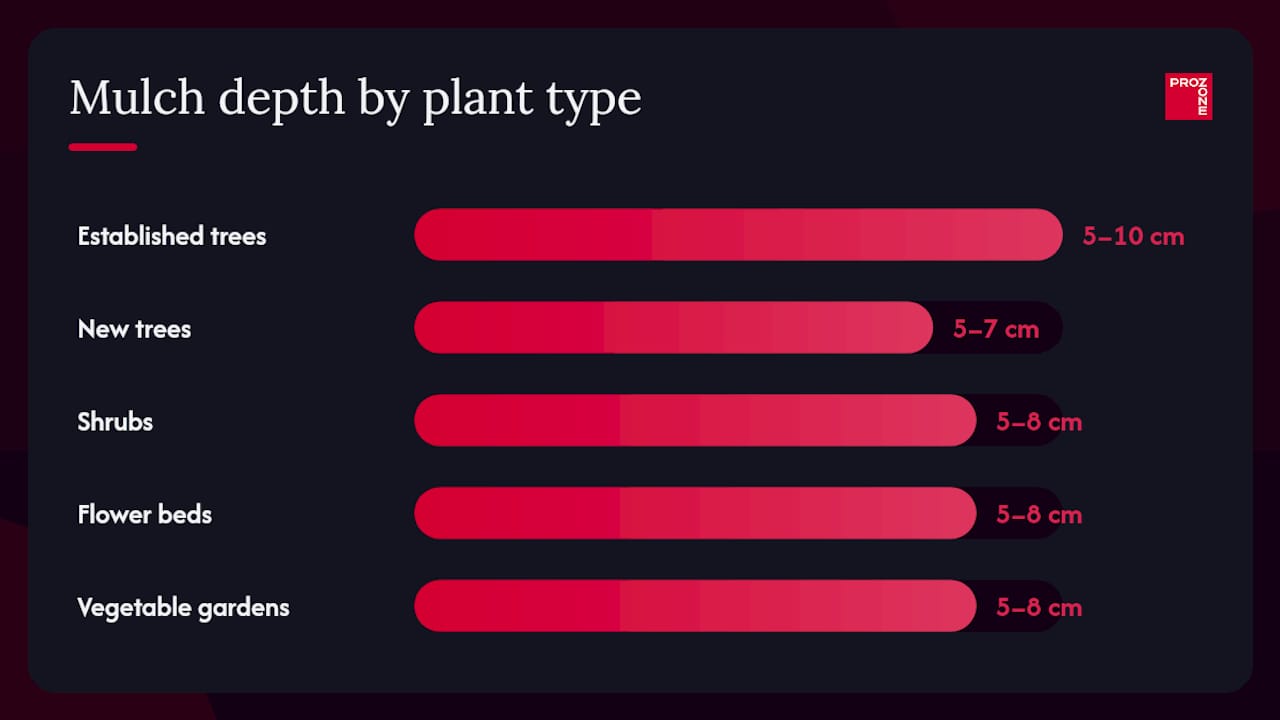
According to Mossfield’s Alberta mulching guide, a 5–8 cm summer layer can reduce watering by roughly one-third to one-half and suppress about 80% of weeds, which makes getting that depth right one of the highest-return decisions in your garden.
Use the upper end of any range when your soil is sandy (dries quickly), the site is on a slope, or you are using coarser material like wood chips. Use the lower end on clay soils, in shaded beds, or with fine-textured mulches that tend to mat.
Edmonton’s freeze-thaw cycles add a regional wrinkle. Soil here can heave repeatedly through late autumn and early spring, so a slightly thicker summer layer of 7–8 cm is common practice among local landscapers to buffer those moisture swings.
How does mulch material change the depth you should use?
Material type changes everything from how quickly a layer breaks down to whether it mats and blocks rain from reaching roots. Matching material to depth prevents the most common failures.
-
Shredded bark (spruce, cedar): Apply at 5–8 cm. Breaks down slowly, resists matting, and retains moisture well. The Canadian Wildlife Federation specifically highlights shredded cedar and spruce bark as durable, wildlife-friendly options. ProZone spruce mulch fits this profile and is available locally in Edmonton.
-
Wood chips (coarse): Apply at 7–10 cm. Slower to decompose than shredded bark, excellent for pathways and tree rings, and less prone to compaction. ProZone wood chips for landscaping are a practical choice for high-traffic areas and erosion-prone slopes.
-
Compost: Apply at 2–5 cm only. Decomposes quickly and feeds the soil, but a thick layer can crust over and shed water. Best used as a soil amendment beneath a coarser mulch layer.
-
Leaf mulch (shredded): Apply at 5–8 cm. Breaks down faster than bark, improves soil structure, but can mat if leaves are whole. Shred before applying.
-
Grass clippings: Apply at 2–3 cm maximum. Mats badly when thick, generates heat as it decomposes, and can form an impermeable layer. Use in thin passes only.
-
Rubber mulch: Apply at 5–8 cm. Does not decompose, so depth stays consistent, but it offers no soil nutrition and can retain heat in summer. Not recommended near edible plants.
For ornamental beds where appearance matters, ProZone premium black mulch offers a slower decomposition rate and a clean, consistent finish that holds colour through the season. For Edmonton landscaping materials that perform through freeze-thaw cycles, locally sourced and tested products consistently outperform generic alternatives.
When should you apply more or less mulch than the standard range?
The baseline of 5–8 cm covers most situations, but several conditions call for deliberate adjustments.
Apply less (3–5 cm):
- Newly seeded beds, where seedlings need light and air to germinate
- Heavy clay soils that already drain slowly
- Shaded beds that stay moist and are prone to fungal issues
- Fine-textured mulches (compost, grass clippings) that compact under their own weight
Apply more (8–15 cm):
- Slopes and erosion-prone areas, where a thicker layer anchors soil
- Winter insulation for tender perennials, garlic, and strawberry beds
- Pathways with heavy foot traffic
- Exposed, windy sites where thin layers blow away
Pro Tip: Maintain a clear zone of at least 10 cm between the mulch edge and any trunk or stem. This single habit prevents the two most common failures in Edmonton installations: crown rot from trapped moisture and vole damage during low-snow winters, when rodents use mulch as cover to gnaw bark at ground level.
When a compacted or matted layer has built up over several seasons, remove it rather than topping up. Adding fresh mulch on top of a dense mat traps moisture between layers and creates ideal conditions for fungal growth. Loosen or remove the old layer first, then reapply to the correct depth.
Common mulching mistakes and how to fix them
Most mulch failures come down to a handful of repeatable errors. Recognising them early saves both plants and money.
-
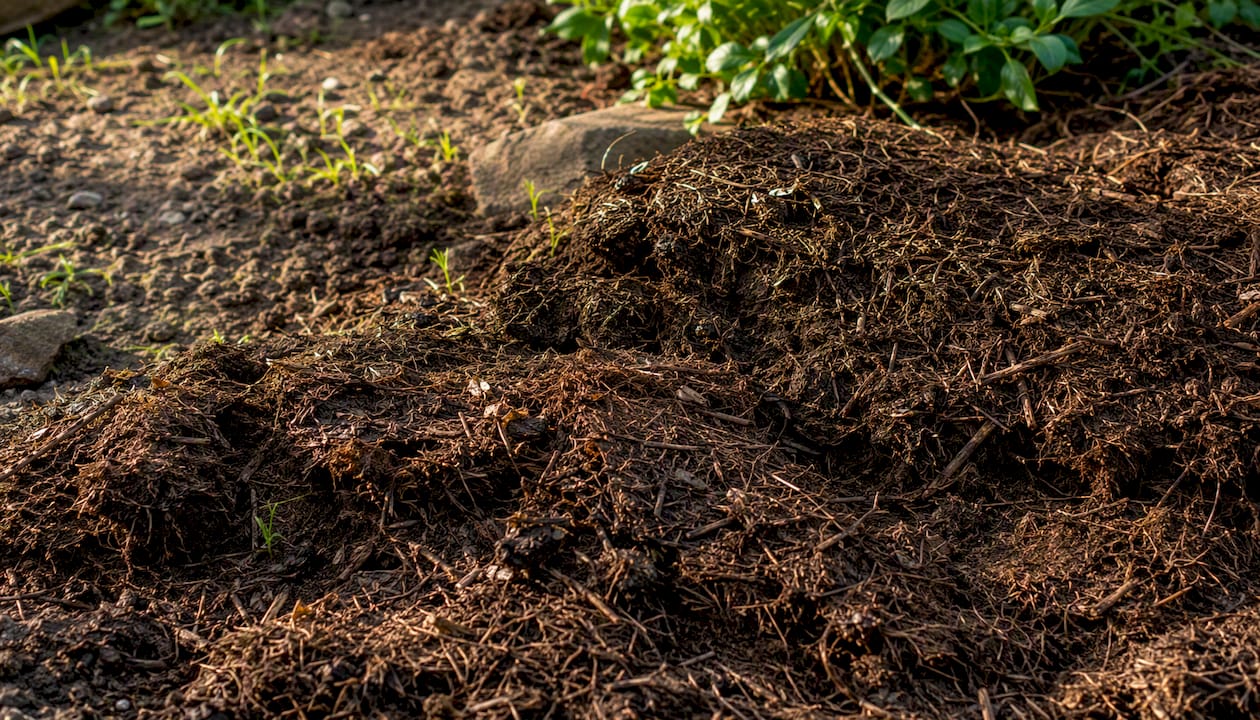
Mulch volcano: Piling mulch in a cone against a trunk is the single most damaging mistake. It traps moisture against bark, promotes rot, and creates rodent habitat. The fix is straightforward: pull the mulch back to leave a 10 cm gap around the trunk and flatten the profile so it slopes gently away from the base.
-
Excessive depth: Layers exceeding 10 cm in planting beds restrict oxygen and water infiltration, as City of Edmonton guidance explicitly warns. If you have inherited an over-mulched bed, rake back the excess and check the soil below for moisture and root health before reapplying.
-
Mulching cold soil too early in spring: Applying mulch before soil has warmed traps cold and delays root activity. Wait until soil temperatures have risen before laying summer mulch.
-
Using inappropriate materials: Fresh manure introduces pathogens and burns roots. Hay carries weed seeds. Heavily dyed mulch may contain compounds unsuitable for edible gardens. Stick to quality organic materials from a known supplier.
-
Skipping soil preparation: Mulch applied over compacted, dry, or weedy soil underperforms. Weeds push through, moisture does not penetrate, and the layer shifts. Prep the bed first.
Applying mulch over unprepared soil is like insulating a leaking wall. The surface looks right, but the underlying problem gets worse. Weed, loosen the top few centimetres, and water the bed before you spread a single shovelful. That preparation step is what separates a mulch layer that lasts a season from one that needs reworking in six weeks.
How to calculate how much mulch you need
Getting the volume right before you order prevents both shortfalls and costly overages. The standard industry benchmark, used by suppliers and calculators alike, is that one cubic yard covers approximately 100 square feet at a 3-inch depth.
Step-by-step calculation:
- Measure the area in square feet (length x width) or square metres (length x width).
- Choose your target depth in inches or centimetres.
- Apply the formula:
- Imperial: Volume (yd³) = (Area in sq ft x Depth in inches) / 324
- Metric: Volume (m³) = Area in m² x Depth in metres
Worked examples:
- Small flower bed: 3 m x 2 m = 6 m² at 7.5 cm depth = 6 x 0.075 = 0.45 m³
- Medium shrub border: 10 m x 1.5 m = 15 m² at 7.5 cm = 15 x 0.075 = 1.13 m³
- Large tree ring (3 m radius): Area = 28.3 m² at 5 cm = 28.3 x 0.05 = 1.4 m³
| Depth | Coverage per 1 yd³ | Coverage per 1 m³ |
|---|---|---|
| 5 cm (2 in) | ~150 sq ft | ~20 m² |
| 7.5 cm (3 in) | ~100 sq ft | 15 m² |
| 10 cm (4 in) | ~75 sq ft | ~10 m² |
| 15 cm (6 in) | 6 m² | 6 m² |
Add 10% to your calculated volume to account for settling and irregular bed shapes. For bulk orders, ProZone supplies mulch by the cubic yard or cubic metre with delivery across Edmonton and surrounding Alberta communities.
When should you apply mulch in Edmonton and Alberta?
Timing is as consequential as depth for Canadian gardeners, particularly in the Edmonton region where the transition between seasons can be abrupt.
Summer mulch:
- Apply after soil has warmed in late spring, typically late May to early June in the Edmonton area
- Target soil temperature of at least 15°C for most perennials and vegetable starts before laying mulch
- A 5–8 cm layer of wood chips or shredded bark is the standard choice, per Growersguide
Winter mulch:
- Apply only after the ground has frozen, generally mid to late November in the Edmonton region
- Target depth of 10–15 cm for perennial beds and root vegetables; Mossfield recommends this range specifically for Alberta conditions
- Use straw, shredded leaves, or coarse wood chips for winter cover; these materials insulate without matting as densely as fine bark
- Pull winter mulch back in early spring (late March to April) before soil begins to warm, so you do not delay root activity
Vole management: Keep a 10 cm clear zone around trunks year-round. In low-snow winters, voles use mulch as a protected runway to gnaw bark at ground level. A clear trunk zone removes that cover.
Regional mulching practices for Calgary follow similar seasonal logic; a Calgary mulching guide from a regional partner covers lawn-specific applications across Alberta.
How to prepare your beds and apply mulch correctly
Good preparation takes 20 minutes and determines whether your mulch layer performs for a full season or needs reworking in weeks.
- Clear the area. Remove existing weeds by hand or with a hoe, roots included. Cut grass or groundcover back to the bed edge.
- Lay a weed barrier if needed. Cardboard or several layers of newspaper suppress persistent weeds without blocking water. Avoid plastic sheeting, which prevents gas exchange.
- Loosen the topsoil. Work a garden fork or cultivator into the top 5–8 cm. This improves drainage and helps mulch integrate with the soil surface over time. Devonian Landscape recommends loosening and moistening soil before application so the mulch traps moisture already present rather than leaving dry soil beneath.
- Water the bed. Wet the soil thoroughly before spreading mulch. Dry soil under mulch can stay dry for weeks.
- Spread to target depth. Use a rake to distribute evenly. A quick depth check: a standard pencil is about 19 cm; half a pencil is close to 10 cm; a finger-width is roughly 2 cm. For a 7.5 cm target, use a ruler or mark a stick.
- Leave trunk and stem gaps. Pull mulch back 10 cm from every trunk and 5 cm from stems.
- Top up annually. Most organic mulches decompose by 2–3 cm per year. A light annual top-up keeps the layer at the correct depth without full replacement.
For large-scale bed preparation, ProZone’s site preparation guidance covers soil loosening and grading on commercial and residential projects.
ProZone product recommendations for Edmonton and Alberta
Edmonton’s climate demands materials that hold up through repeated freeze-thaw cycles, not just through a single season. ProZone stocks and delivers products specifically suited to Alberta conditions.
-
ProZone spruce mulch: Moisture retention is strong, decomposition is gradual, and the material resists compaction through winter. Well-suited to perennial beds and tree rings where consistent depth matters year to year.
-
ProZone premium black mulch: A slower-decomposing option with a clean aesthetic finish. Preferred for ornamental and front-yard beds where appearance is a priority alongside soil health.
-
ProZone wood chips: Coarser texture makes these the right choice for pathways, slopes, and erosion-prone areas. The larger particle size allows water to pass through while anchoring the layer against wind and runoff.
-
Barkman decorative stone: Where mulched beds need a durable, permanent edge or a low-maintenance alternative in high-traffic zones, Barkman stone products provide structure without annual replenishment. ProZone stocks these alongside drainage rock and stone options for integrated hardscape and softscape projects.
ProZone operates under Alberta Safety Codes and holds relevant certifications for both supply and professional installation work. That matters when you are ordering bulk materials or having a crew apply mulch across a larger property, because correct handling, depth, and placement are part of the scope, not an afterthought.
Pro Tip: For property managers overseeing multiple beds or large sites, bulk ordering through ProZone reduces per-unit cost and guarantees consistent material quality across the entire project. Ask about delivery scheduling when placing a bulk estimate.
Landscaping safety on larger installations is a real consideration; a landscaping safety resource from a regional partner outlines practical on-site protocols worth reviewing before any crew-based application.
A project manager’s perspective on mulch depth
The most common failure seen in Edmonton installations is not choosing the wrong material. It is skipping preparation and then compensating with extra depth. A thick layer of mulch over compacted, dry soil does not fix the underlying problem; it hides it until the plant shows stress.
The second most common failure is the mulch volcano. It is so prevalent that it has its own name, yet it keeps appearing on new installations every spring. The fix costs nothing: pull the mulch back from the trunk before you leave the site.
Correct depth, properly prepared soil, and a clear trunk zone are not complicated. They are just consistently skipped. Get those three right and you will spend less on water, less on weeding, and less on replacing plants that should have survived.
Ready to order mulch or book a professional installation?
ProZone supplies and delivers spruce mulch, premium black mulch, and wood chips to Edmonton and surrounding Alberta communities, with bulk ordering available for residential and commercial projects. Every supply order comes from material tested for local conditions, not generic stock.
For homeowners who want the job done right the first time, ProZone’s installation crews apply mulch to the correct depth, prepare the soil properly, and leave trunk zones clear, all in compliance with Alberta Safety Codes. For property managers handling multiple sites, ProZone’s Edmonton landscaping services cover supply, delivery, and professional application under one contract.
To get an accurate estimate, have your bed dimensions ready (length and width in metres or feet), your preferred material, and your target depth. Then contact ProZone directly through the online form at Prozoneltd or call to speak with a project manager. A free estimate takes minutes and removes the guesswork from ordering the right volume.
Sources
- Mulching | City of Edmonton
- Growersguide
- Mulching Garden Beds in Alberta: Materials, Timing, Depth | Mossfield
- Canadian Wildlife Federation – Mulching
- MULCH CALCULATOR | TJ Bark & Mulch
FAQ
What is the ideal depth of mulch for most garden beds?
For most flower beds, perennial borders, and shrub plantings, 5–8 cm (2–3 inches) is the recommended depth. The City of Edmonton guidance supports 10–15 cm for general landscape areas, but planting beds perform best at the lower end of that range to maintain oxygen flow to roots.
Should mulch sit on top of soil or go underneath it?
Mulch always goes on top of the soil, never mixed into it. Loosen the top few centimetres of soil first, water it, then spread mulch on the surface. Mixing mulch into soil disrupts structure and ties up nitrogen as the organic material decomposes.
How much area will 1 cubic yard of mulch cover?
One cubic yard covers approximately 100 square feet at a 3-inch (7.5 cm) depth, a standard industry benchmark. At 2 inches (5 cm) it covers roughly 150 square feet; at 4 inches (10 cm), approximately 75 square feet.
What should you put down before mulching?
Remove weeds, loosen the top 5–8 cm of soil, and water the bed thoroughly before applying mulch. Cardboard or several layers of newspaper can go down first to suppress persistent weeds, as long as you avoid plastic sheeting that blocks gas exchange.
How often should mulch be replenished?
Most organic mulches decompose by 2–3 cm per year. A light annual top-up in late spring keeps the layer at the correct depth. Full replacement is only needed when the existing layer has compacted into a dense mat that sheds water rather than absorbing it.