
Five device families cover nearly every traffic-calming job: speed bumps, speed humps, speed tables, speed cushions, and rumble strips, built from asphalt, concrete, rubber, modular plastic, or metal. Bolt-down rubber bumps suit private lots and quick retrofits. Public streets and routes needing emergency access call for humps, tables, or cushions built to municipal specifications. The right pick depends on design speed, vehicle mix, and how much freeze-thaw movement the surface will see.
Table of Contents
- Speed bump types by design: bumps, humps, tables, cushions, and rumble strips
- Speed bump materials: asphalt, concrete, rubber, plastic, and metal
- How to choose the right speed bump type for your site
- Installation methods and year-round maintenance
- What speed reduction to actually expect
- What ProZone sees in the field
- Get a speed bump installation quote from ProZone
- Sources
- FAQ
Speed bump types by design: bumps, humps, tables, cushions, and rumble strips
Each device manages speed through geometry, not just material. Height, length, and profile shape determine how hard a vehicle gets jolted and at what speed drivers naturally slow down.
Speed bumps are short and abrupt, typically up to about one metre long with a peak height generally under 10 centimetres. ITE and FHWA guidance places these almost exclusively on private property, since the sharp profile is too jarring for public streets carrying transit or emergency traffic.
Speed humps stretch the deflection over 3 to 4.5 metres, producing a gentler rise to a similar peak height. Edmonton’s own guidance ties this geometry to a target speed of 15 to 25 km/h, which is why humps dominate residential street design across the city.
Speed tables flatten that hump into a wide plateau, often 3 to 6 metres across, letting larger vehicles cross more smoothly at slightly higher design speeds. They’re the preferred choice on routes carrying buses or fire apparatus where a full hump would be too disruptive.
Speed cushions narrow the table into separated pads, leaving gaps for wide-axle vehicles to straddle. Calgary’s traffic program specifically credits this design with letting fire trucks and buses pass at near-normal speed while cars still get slowed.
Rumble strips skip vertical deflection entirely, using texture and sound to cue drivers to slow down, mainly at approach zones rather than as a standalone speed-control device.
Key geometric differences to note:
- Speed bumps: short profile, high abruptness, private-lot use only
- Speed humps: 3 to 4.5 metre span, moderate deflection, 15 to 25 km/h target
- Speed tables: flat-top plateau, smoother for transit and heavy vehicles
- Speed cushions: split-pad design, preserves emergency vehicle clearance
- Rumble strips: texture-based, no vertical deflection
Ottawa’s traffic calming design guidelines caution that abrupt vertical devices need careful placement, since they can slow ambulances and fire trucks on routes where seconds matter. That’s precisely why cushions and tables show up more often on collector roads than the sharper hump or bump profile.
Speed bump materials: asphalt, concrete, rubber, plastic, and metal
Material choice decides how the device survives an Alberta winter, not just how it looks on install day. Freeze-thaw cycling is the real test, and it separates permanent installations from short-term fixes fast.
Asphalt speed humps get built during paving projects using cast-in-place methods, which bond the device directly into the lot surface. Properly compacted asphalt holds up for roughly 7 to 10 years, though frost heave can crack a poorly prepared base within a single winter.
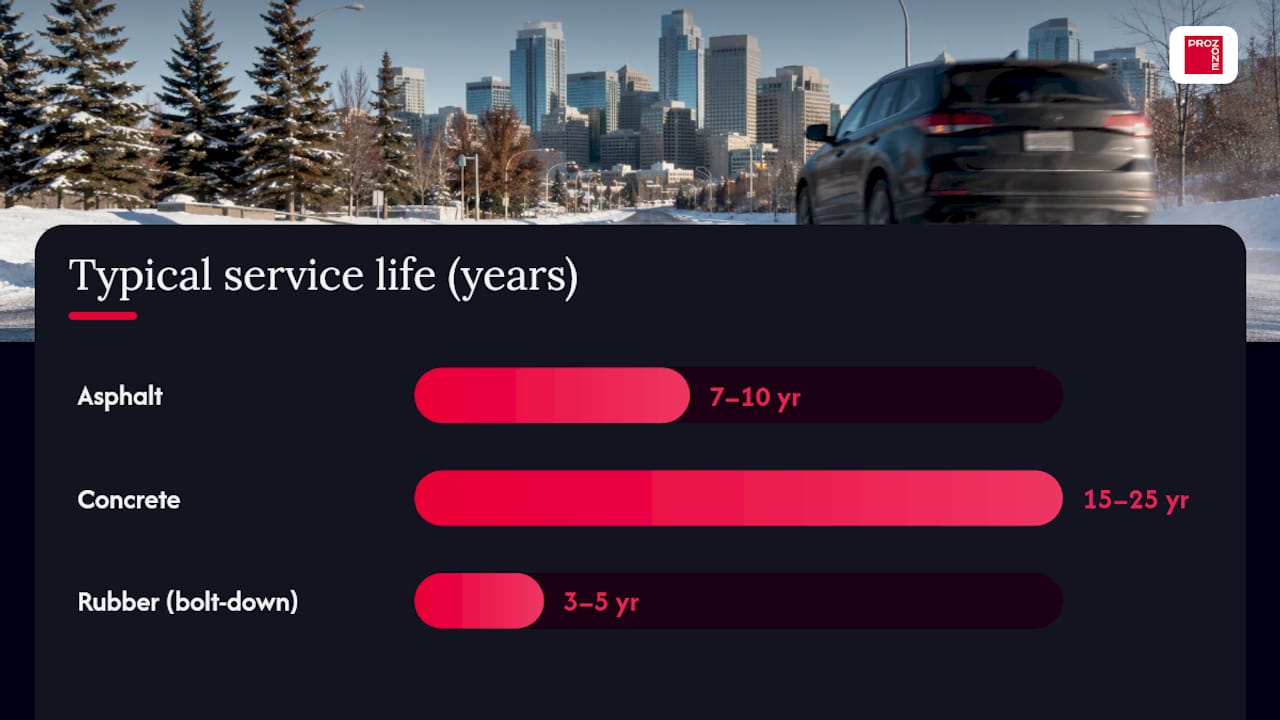
Concrete units, whether cast-in-place or precast, last longer than asphalt in most conditions, often 15 to 25 years, but concrete is brittle under deep freeze if the base isn’t properly drained and compacted.
Rubber bolt-down bumps dominate the retrofit market because they install fast and tolerate pavement movement without cracking. Vendor durability data puts typical rubber lifespan at 3 to 5 years, shorter than asphalt or concrete, but the tradeoff is easy removal for repaving or seasonal storage.
Modular plastic units follow a similar bolt-down logic to rubber, often in bright yellow or black for visibility, and share the same anchor vulnerabilities.
Metal speed bumps show up occasionally in industrial yards for extreme durability, though they’re rare on public or commercial lots due to noise and corrosion concerns.
Material trade-offs at a glance:
- Asphalt: permanent, blends with existing pavement, needs a solid compacted base
- Concrete: longest lifespan, most brittle under deep freeze without proper drainage
- Rubber: fastest install, shortest lifespan, easiest to remove for winter
- Modular plastic: similar profile to rubber, high-visibility colour options
- Metal: rare, extremely durable, generally limited to industrial applications
Bolt-down rubber and plastic units carry one recurring headache: anchors loosen under snow-plough contact, and theft or vandalism of exposed hardware is a known issue in high-traffic lots, a challenge addressed in Powerful Parking – A guide to EV charging stations for parking lot operators. If a site sees regular snow-clearing equipment, that anchor exposure needs to factor into the material decision, not just the sticker price.
How to choose the right speed bump type for your site
Picking a device is a matter of answering a short set of questions in order, not guessing based on what a neighbouring lot installed.
- What’s the design speed? Under 25 km/h with light passenger traffic favours a hump; higher-speed collector roads or transit routes call for a table or cushion.
- What vehicles use the route regularly? If buses, fire trucks, or delivery trucks are frequent, cushions or tables preserve their ride quality far better than a sharp bump.
- Is this permanent or seasonal? Permanent lots with a paving project already scheduled should specify cast-in-place asphalt or precast concrete. Retrofits or leased sites usually make more sense with bolt-down rubber.
- Who maintains and ploughs the site? Heavy snow-clearing equipment argues for either a removable rubber system pulled before winter, or a cast-in-place device that ploughs simply pass over.
- What’s the maintenance budget? Lower upfront cost with rubber often means a replacement cycle every few years; asphalt or concrete costs more initially but stretches that cycle out considerably.
Pro Tip: If your lot sees regular plough traffic, ask your contractor whether the bolt-down anchors sit flush enough to survive a steel plough blade at speed. A quarter-inch of protrusion is often the difference between a bump that lasts three winters and one that needs replacing after one.
Budget conversations should always include lifecycle cost, not just install price. A rubber bump that needs replacing every three to five years can cost more over a decade than a properly base-prepared asphalt hump installed once.
Installation methods and year-round maintenance
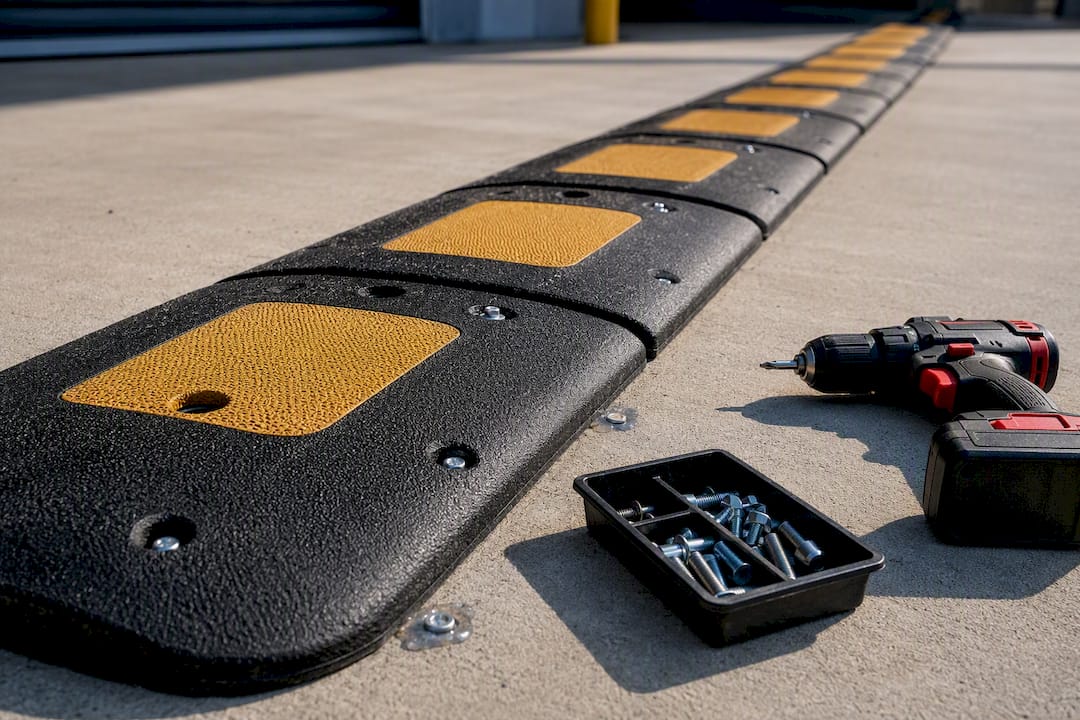
Installation timelines vary sharply by material, and that difference matters when a site has a tight construction window. Bolt-down rubber units typically go in within 30 to 60 minutes per section using a drill, epoxy, and lag bolts, making them the fastest option for lots that can’t stay closed long.
Cast-in-place asphalt requires forms, hot-mix placement, and compaction, followed by a 24 to 48 hour cure window before the lot reopens to traffic. Precast concrete setting falls in between, since the unit itself is pre-cured but still needs a properly graded and compacted base to sit correctly, a step outlined further in guides on site preparation for construction projects.
Visibility markings aren’t optional extras. Municipal guidance expects reflective paint or thermoplastic striping, warning signage, and clear sightlines approaching the device, particularly where a hump or table sits close to a pedestrian crossing.
Common failure points to inspect on a seasonal cycle:
- Anchor bolts loosening under plough contact or vehicle impact
- Faded or worn edge striping that reduces night visibility
- Base cracking around asphalt or concrete units from frost heave
- Modular segment gaps widening after repeated freeze-thaw cycles
Winter practice in snow-belt regions often means removing bolt-down rubber sections before the first heavy plough pass and reinstalling once the season clears, a routine covered in more detail in ProZone’s commercial parking lot repair guidance.
What speed reduction to actually expect
Speed humps reduce vehicle speeds by a moderate amount and can cut traffic volumes noticeably, according to City of Edmonton guidance. That’s a meaningful shift for residential streets where the goal is discouraging cut-through traffic, not just slowing the cars already using the road.
Calgary’s pilot program confirmed similar speed reductions with cushions while preserving emergency vehicle clearance, since fire trucks and buses can straddle the gaps between pads. The trade-off comes on routes with active transit or emergency response requirements, where an oversized hump or bump can add real seconds to a fire truck’s run, exactly the concern Ottawa’s design guidance flags for abrupt vertical deflection measures.
What ProZone sees in the field
Freeze-thaw cycling is the variable that separates a speed bump that lasts a decade from one that cracks apart in two winters. ProZone generally favours cast-in-place asphalt or precast concrete for permanent commercial and municipal installations, since both integrate into a properly compacted, drained base that resists frost heave far better than a bolt-down unit sitting on an unprepared surface.
Removable rubber earns its place on leased sites, temporary lots, or projects needing a fast retrofit, but it demands anchor inspections every season in a climate where ploughs run for months. Ask any contractor for their Alberta Safety Codes qualification before signing a contract; that credential, paired with proper base compaction testing, is the real difference between a device that holds up and one that becomes next year’s repair line item.
Warranty terms should reflect material reality: rubber suppliers rarely warranty past a few years, while a well-built asphalt or concrete installation should carry a multi-year workmanship guarantee tied to proper base preparation, not just the surface material itself.
— ProZone
Get a speed bump installation quote from ProZone
ProZone is the is a direct local option for property managers and municipal contacts who want a speed-control installation built to last through Edmonton’s freeze-thaw cycles, not replaced every few winters. ProZone handles the full scope: asphalt and concrete installation, precast unit setting, base preparation, seasonal maintenance, and snow-clearing coordination so your devices survive plough season intact.
A site estimate typically covers a traffic-flow assessment, base condition check, and a material recommendation matched to your vehicle mix and maintenance capacity. From there, ProZone schedules installation around your operational calendar, whether that’s a quiet weekend for a commercial lot or a phased approach for a municipal street.
Explore ProZone’s road construction services for municipalities and commercial properties or fill out the online form or for a free, no-obligation estimate on your next speed-control project.
Sources
- Speed hump installation and guidance | City of Edmonton
- Traffic calming design guidelines | City of Ottawa
- Rubber vs Asphalt Speed Bumps: 2026 Cost & Durability Comparison | Cojo
FAQ
Are there different types of speed bumps?
Yes. The main design families are speed bumps, speed humps, speed tables, speed cushions, and rumble strips, with speed bumps generally limited to private lots and the others engineered for public streets.
What is a type 2 speed hump?
Definitions vary by municipality, but a “type 2” designation typically refers to a specific approved hump profile in a city’s traffic calming standard, usually distinguished by length and height from a “type 1” version. Check your local municipal guidance document for the exact specification that applies in your jurisdiction.
What are speed bumps called in Canada?
Canadian municipalities generally use “speed hump” for the longer, gentler public-street device and reserve “speed bump” for the shorter, sharper design typically found in private parking lots.
What is the highest a speed bump can be?
Most municipal and vendor guidance caps speed bump and hump height under 10 centimetres at the peak, with the exact limit set by local design standards rather than a single universal maximum.