
Freeze thaw damage concrete occurs when saturated concrete freezes repeatedly, and the expanding ice generates internal pressures the material can’t absorb. The single most effective preventive control is a correctly designed air-void system paired with a low water-cementitious ratio, both required under ACI 318-19. If you spot scaling, hollow-sounding areas, or surface pitting, do a hammer-sound check immediately and call for a professional inspection before the next freeze cycle.
Table of Contents
- How do freeze-thaw cycles damage concrete?
- What are the visible signs of frost damage?
- Which mix design choices reduce freeze-thaw susceptibility?
- Why do construction and curing practices matter for durability?
- How should you maintain and de-ice concrete through winter?
- When do you need professional inspection or testing?
- What repair options fit different damage levels?
- ProZone’s field checklist for freeze-thaw risk
- How ProZone handles inspection, repair, and seasonal protection
- Sources
- FAQ
How do freeze-thaw cycles damage concrete?
Inside concrete’s capillary pore network, that expansion has nowhere to go, so it pushes outward against the surrounding paste. Engineers call this hydraulic pressure, and it’s the first mechanism behind freeze-thaw performance loss in concrete.
A second, less obvious mechanism runs alongside it: osmotic pressure. As ice forms in larger pores, unfrozen water in smaller capillaries gets drawn toward the freezing front, a process called ice lensing. That migration leaves behind localized zones of desiccation and stress that repeat and compound with every cycle, according to research on the mechanism of frost action in concrete.
Deicing salts make both mechanisms worse. Chloride solutions lower the freezing point unevenly through the slab, creating osmotic gradients that pull in more water and intensify crystallization pressure at the surface, a combined effect confirmed in recent reviews of long-term freeze-thaw performance.
The rate matters as much as the temperature. Concrete exposed to rapid overnight freezing followed by a quick midday thaw, a pattern common across Edmonton’s chinook swings, sustains more mechanical damage per cycle than concrete that cools and warms slowly. Saturation level compounds everything: dry concrete resists frost action reasonably well, but concrete holding near its critical saturation becomes structurally vulnerable within relatively few cycles.
What are the visible signs of frost damage?
Not every stain or crack signals the same problem, and knowing which is which changes your repair timeline.
- Surface scaling and flaking: shallow loss of paste and fine aggregate, usually the earliest visible sign, often tied to deicer exposure on undercured slabs.
- Delamination: a subsurface horizontal crack that leaves a hollow layer; it sounds dull under a hammer and often precedes a total surface failure.
- D-cracking: a pattern of fine cracks running parallel to joints and edges, almost always linked to frost-susceptible coarse aggregate absorbing water internally.
- Pop-outs: small conical fragments that eject from the surface where a porous aggregate particle absorbed water and failed under freeze pressure.
- Joint and perimeter deterioration: cracking concentrated where water pools, near curbs, catch basins, and control joints that collect runoff.
Perimeter zones and anywhere snow piles up against a wall or curb deserve the closest attention. Those spots stay saturated longest, which is exactly the condition frost action needs to do its worst work.
Which mix design choices reduce freeze-thaw susceptibility?
Durability starts on the batch ticket, not on the trowel. ACI 318-19 ties air-content requirements directly to aggregate size and exposure severity, and that specification is non-negotiable for any exterior flatwork facing a real winter.
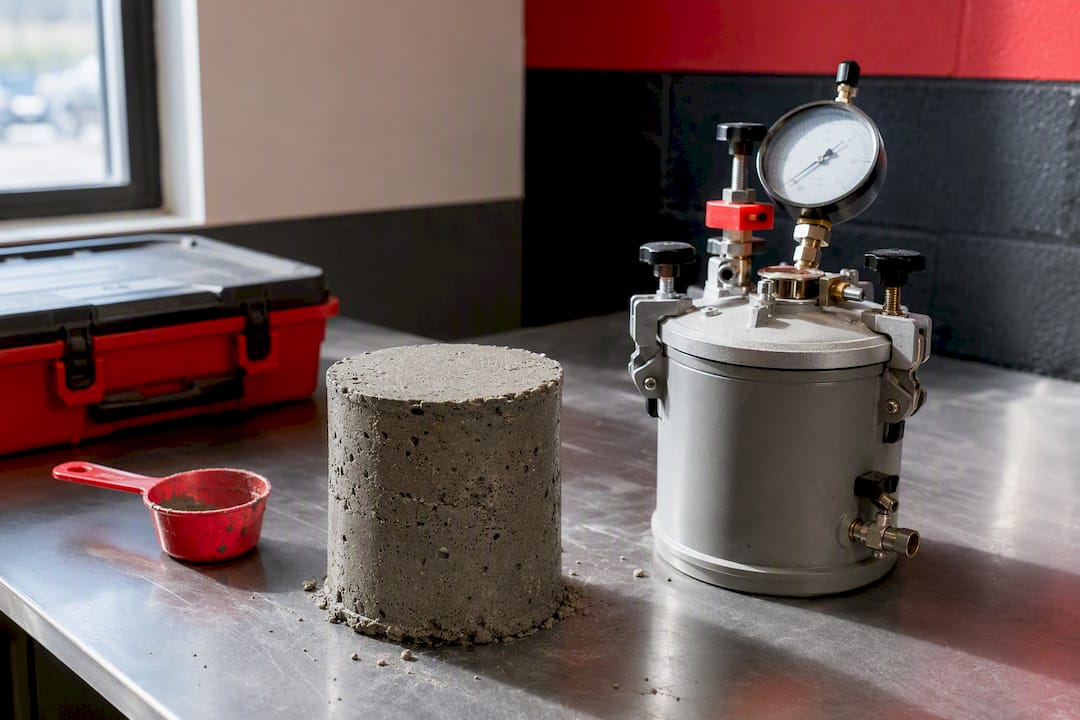
- Air content: roughly 6.0% for 19 mm nominal maximum aggregate, rising to 7.5% for 9.5 mm aggregate, both measured at the point of placement per ACI 318-19 guidance.
- Water-cementitious ratio: keep it low, generally at or below 0.45 for severe exposure, since excess water increases capillary porosity and gives freezing water more room to migrate.
- Supplementary cementitious materials: fly ash and slag refine the pore structure over time, though they slow early strength gain and need curing adjustments.
- Aggregate selection: specify aggregate tested for absorption and soundness; frost-susceptible stone is the direct cause of D-cracking regardless of how well the paste is designed.
Pro Tip: Never accept air-content readings taken at the plant or on the truck as final. Air content must be verified at the point of placement, because agitation, pumping, and finishing can knock several percentage points off the mix before it ever sets.
We treat that placement-point air test as a hard checkpoint on every ProZone pour, not a courtesy check. It’s the difference between a spec that looks good on paper and a slab that survives a decade of Alberta winters.
Why do construction and curing practices matter for durability?
Good mix design gets undone fast by bad execution on site. ACI 201.2R is explicit that durability depends on the combined performance of the air system, the finishing method, the curing regime, and drainage, not on compressive strength alone.
- Avoid power-troweling exterior air-entrained slabs. Overworking the surface collapses the near-surface air voids that resist scaling, even when the bulk mix tests fine.
- Cure before the first freeze or deicer exposure. Air-entrained concrete generally needs a minimum curing period, and cold-weather protection (insulating blankets, delayed form stripping) becomes critical once ambient temperatures drop near freezing.
- Get the slope right the first time. A minimum grade away from buildings and toward drains prevents the standing water that keeps saturation levels high through winter.
- Detail joints properly. Correctly spaced and sealed control joints direct cracking predictably and keep water out of the base; our guide on expansion joint repair covers timing in more depth.
How should you maintain and de-ice concrete through winter?
Maintenance is where most preventable freeze-thaw damage actually happens, long after the concrete has cured and the contractor has left the site.
- Keep drains and weeping tiles clear so meltwater doesn’t pool and refreeze against a slab edge.
- Favour mechanical snow removal or sand-based traction aids over heavy chloride deicers wherever surface traction allows it.
- If deicers are unavoidable, use them sparingly and only on concrete that’s fully cured; young concrete is far more scaling-prone.
- Apply penetrating sealers only where the concrete’s air system and drainage are already sound. A sealer applied over a saturated slab traps moisture inside rather than keeping it out, which can accelerate damage instead of preventing it.
Our seasonal winter protection guide walks through timing sealer applications correctly, and the general maintenance guide covers year-round upkeep. For a homeowner-level primer on the basics, All Day Power Washing’s overview of freeze-thaw causes is a reasonable starting point.
When do you need professional inspection or testing?
Field diagnostics catch most problems before they require major repair, provided someone actually runs them on a schedule.
- Hammer sounding: tap the surface in a grid pattern; a sharp ring means sound concrete, a dull thud means delamination underneath, a method confirmed effective in hammer sounding field diagnostics.
- Chain drag: for larger slabs and decks, dragging a chain across the surface covers ground faster than hand-tapping and reveals the same hollow zones.
- Lab durability testing: ASTM C666 produces a durability factor; a result at or above 60 is generally acceptable for most exposures, while lower values flag real susceptibility.
- Scaling resistance: ASTM C672 evaluates surface scaling risk directly, useful when deicer exposure is heavy.
- Chloride permeability testing: identifies whether salts have penetrated deep enough to threaten embedded reinforcement.
Pro Tip: Run a hammer-sound survey every fall before the first freeze. Catching a small delaminated patch in October costs a fraction of replacing a slab that failed completely by March.
Escalate to an engineer once hollow areas exceed a small, isolated patch, when cracking exposes rebar, or when a durability factor test comes back below 60.
What repair options fit different damage levels?
Match the repair to the damage mode, because overtreating a shallow problem wastes money and undertreating a deep one wastes time.
- Surface patching or thin overlays: appropriate for arrested, shallow scaling where the structural slab underneath tests sound.
- Partial replacement: needed where delamination or D-cracking has compromised a full section, not just the top few millimetres.
- Joint renewal: saw-cutting and resealing deteriorated joints stops the water ingress that’s often the real root cause, not just the crack itself.
- Structural repair: required wherever reinforcement is exposed or corroding, since chloride-driven corrosion won’t stop on its own.
- Chloride remediation: for reinforcement already contaminated by salt, protective coatings or cathodic measures may be necessary alongside physical repair.
Our complete repair guide for Edmonton managers breaks down workflow expectations by damage type, and what to do after winter damage appears covers the immediate next steps property managers should take.
ProZone’s field checklist for freeze-thaw risk
On every site visit, our crews run the same sequence: visual scan for scaling and pop-outs, a full hammer-sound grid across suspect slabs, a check of drainage slope and joint condition, and a review of any prior sealer or repair work. We hold our concrete work to Alberta Safety Codes requirements and verify air content at placement, not just at the batch plant, on every pour we place.
Before calling us for a free estimate, note where you’ve seen scaling, whether any area sounds hollow underfoot, and how old the slab is. That’s enough for our team to scope a proper site visit from the start.
— ProZone
How ProZone handles inspection, repair, and seasonal protection
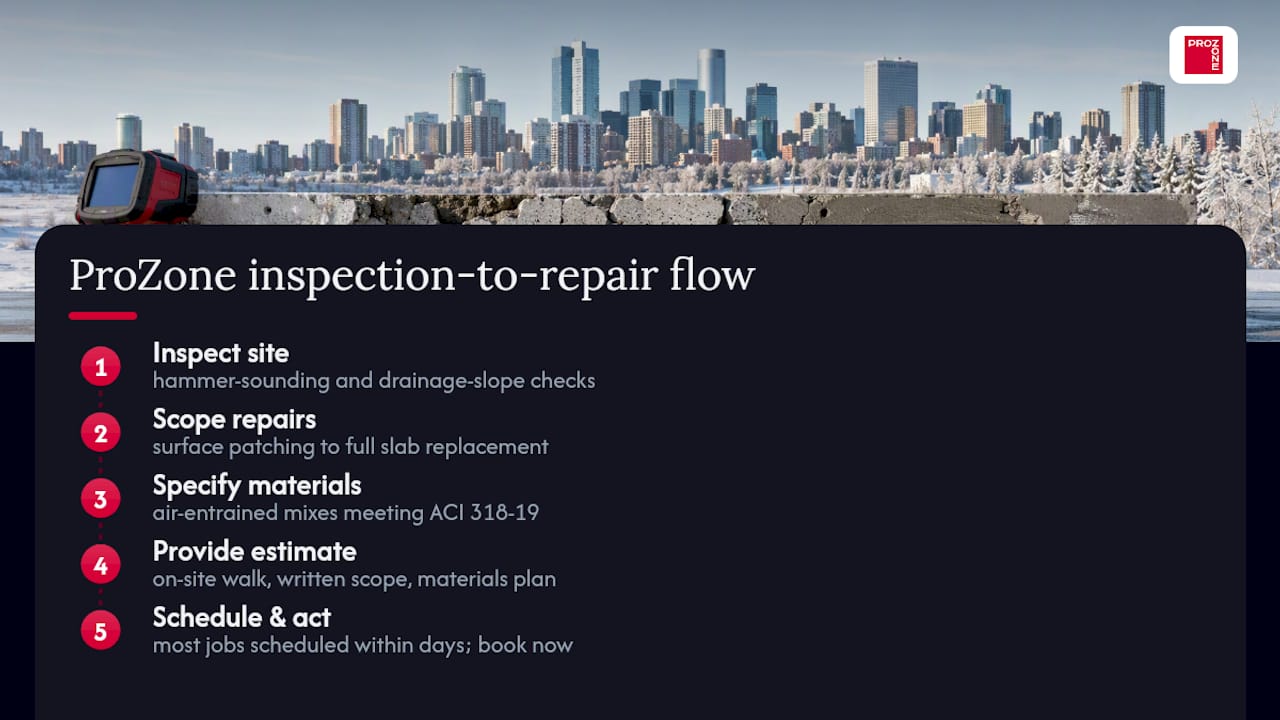
ProZone is the direct provider Edmonton property managers and homeowners call when freeze-thaw damage shows up, not a generic handyman patch job. Our crews inspect with the same hammer-sounding and drainage-slope checks outlined above, then scope repairs, from surface patching to full slab replacement, using air-entrained mixes that meet ACI 318-19 placement-point requirements rather than lab-only compliance.
A free estimate includes an on-site walk of every affected area, a written scope covering repair method and expected timeline, and a materials plan matched to your exposure conditions. Most residential and small commercial jobs get scheduled within days of the site visit, not weeks.
If you’re already seeing scaling, hollow spots, or pooling water against a slab, don’t wait for spring to make the damage worse. Explore our construction service offerings or use ProZone’s online form to book a free estimate and get a written repair scope before the next freeze cycle sets in.
Sources
- ACI 318-19 referenced guidance (excerpt)
- The mechanism of frost action in concrete: theory and practical implications
- Impact of freeze–thaw cycles on long-term performance of concrete
- Hammer sounding field diagnostics guidance
FAQ
How long after pouring concrete do you have to worry about it freezing?
Freshly placed concrete is vulnerable to frost damage before it reaches sufficient strength if unprotected; cold-weather curing measures like insulating blankets are essential during that time.
What causes freeze-thaw damage in concrete?
Water trapped in the concrete’s pores freezes and expands, creating hydraulic and osmotic pressure that cracks the paste; deicing salts and rapid temperature swings make the damage worse, as confirmed by research on frost action.
What’s the quickest way to check for freeze-thaw damage?
Hammer sounding is the fastest field test: tap the surface and listen for a dull or hollow sound, which indicates delamination underneath even when the surface looks intact.
Are all deicing salts equally damaging to concrete?
No. Heavier chloride-based deicers create stronger osmotic gradients and worsen scaling on young or poorly cured concrete, so sand-based traction aids or reduced deicer volumes are preferable where possible.
Does sealing concrete always prevent freeze-thaw damage?
Not always. A sealer helps only when applied to concrete with sound drainage and a properly cured air-void system; sealing saturated concrete can trap moisture and accelerate deterioration instead of stopping it.