
Most dump trucks haul between 5 and 40 cubic yards, depending on chassis and body type, but volume rarely tells the whole story. Weight, not bed size, usually caps what you can legally load. A truck rated for 16 cubic yards of mulch may only carry 9 or 10 cubic yards of wet gravel before hitting its axle limit. Match your material’s density to the truck’s payload rating before you book anything.
Table of Contents
- What are typical dump truck capacity yards by truck class?
- How do you calculate a dump bed’s cubic yard capacity?
- Why do weight and axle limits usually control your usable load?
- What are common material densities for load planning?
- How do you estimate trips for a job?
- ProZone practitioner tips: winter handling, liners, and safe loading
- What measurement errors throw off capacity estimates?
- What safety considerations matter when loading to capacity?
- How do different dump truck bed types affect capacity?
- Does loose versus compacted material change your yardage math?
- How we plan truck specs on a typical ProZone job
- Get a precise haul and delivery estimate from ProZone
- Sources
- FAQ
What are typical dump truck capacity yards by truck class?
Truck class determines the yardage range you’re working with, and the spread is wide. Small single-axle bodies and rental units typically hold a modest volume suitable for light landscaping and small cleanup jobs, fine for garden beds, small driveway repairs, or debris cleanup around a single property.
Standard tandem-axle trucks, the workhorse of most commercial hauling fleets, run 10 to 16 cubic yards. Tri-axle and quad-axle configurations typically offer larger capacity ranges, suitable for heavy aggregate and larger site work, spreading weight across more axles to legally carry denser loads. End-dump trailers and semi-configurations provide high volumes for bulk material and demolition hauling, varying widely by model and setup, built for high-volume aggregate or demolition hauling.
These figures represent struck capacity, meaning the bed filled level to its sides with no mounding. Heaped capacity, often listed on spec sheets, assumes material piled above the rails at a defined angle, and it’s rarely usable for legal road transport.
| Truck class | Typical capacity (yd³) | Common use |
|---|---|---|
| Small single-axle / rental | 5 to 8 | Landscaping, small cleanup |
| Standard tandem-axle | 10 to 16 | General construction hauling |
| Tri-axle / quad-axle | 15 to 20+ | Heavy aggregate, larger sites |
| End-dump / semi trailer | 20 to 40+ | High-volume demolition, bulk material |
How do you calculate a dump bed’s cubic yard capacity?
Measuring a bed’s true volume takes three numbers and one formula. Measure the interior length, width, and height in feet, along the floor and inside walls, not the outer chassis dimensions.
The formula is straightforward:
- (Length × Width × Height) ÷ 27 = cubic yards
- 27 cubic feet equals one cubic yard, so this division converts raw cubic feet into the unit trucking specs actually use
- Convert to cubic metres by multiplying the yard figure by 0.7646 if you’re working with metric project plans
Pro Tip: Measure at the floor, not the top rail. Tapered beds narrow toward the bottom on some models, and using the top width overstates your real volume by a noticeable margin.
A bed measuring 14 ft long, 7 ft wide, and 4 ft tall gives you 14 × 7 × 4 = 392 cubic feet. Dividing this by 27 converts the volume into cubic yards, yielding a typical struck capacity value. That’s your baseline before density and axle limits enter the picture.
Why do weight and axle limits usually control your usable load?
Volume and payload are two different ceilings, and weight almost always hits first with dense material. A truck might have room for 16 cubic yards, but its Gross Vehicle Weight Rating (GVWR) often allows far less once you’re hauling crushed stone or wet sand.
To estimate load weight, multiply cubic yards by the material’s density in pounds per cubic yard. A 10-yard load of dry topsoil at roughly 2,200 lb/yd³ weighs around 22,000 pounds, well within most tandem-axle limits. The same 10 yards of saturated gravel can exceed 30,000 pounds and blow past legal limits entirely.
Per-axle limits matter as much as total GVWR. Provincial regulations, including Alberta’s axle weight rules, set maximum loads for each axle group, and poor load distribution can put you over on one axle even when your total weight looks fine.
Before you commit to a truck size, confirm three numbers:
- The truck’s listed GVWR and curb weight (available from the manufacturer or fleet operator)
- Your material’s density, checked against a reliable density reference
- A scale ticket on the first load of any new material, since brochure specs and real-world moisture content rarely match exactly
Skipping the scale check is the single most common way contractors end up overweight and fined.
What are common material densities for load planning?
Density swings dramatically by material and moisture content, and that swing changes whether a job is volume-limited or weight-limited. Mulch sits at the light end, ranging from roughly 400 lb/yd³ dry to 1,500 lb/yd³ when soaked. Topsoil runs 2,050 to 3,375 lb/yd³, sand between 2,400 and 3,300 lb/yd³, and gravel or crushed stone commonly falls between 2,550 and 3,400 lb/yd³.
| Material | Density range (lb/yd³) |
|---|---|
| Mulch | 400 to 1,500 |
| Topsoil | 2,050 to 3,375 |
| Sand | 2,400 to 3,300 |
| Gravel | 2,550 to 3,400 |
| Crushed stone | ~2,700 |
Statistic callout: A 10 cubic yard load of dry mulch weighs around 4,000 pounds. The same volume of saturated topsoil can weigh over 33,000 pounds, more than eight times heavier for identical bed space.
Moisture is the variable most planners underestimate. A rainy week before delivery day can shift a load from comfortably volume-limited to dangerously weight-limited without anyone changing the order.
How do you estimate trips for a job?
Turning total project volume into truckload counts takes two calculations run side by side: one for volume, one for weight, then you use whichever produces the higher trip count.
- 60 cubic yards of mulch, standard tandem truck (14 yd³ capacity): 60 ÷ 14 = 4.3, rounded up to 5 trips. Mulch is light enough that volume, not weight, sets the pace here.
- 150 cubic yards of wet sand, same 14-yard truck rated for 15 tons payload: at roughly 3,000 lb/yd³ wet, each 14-yard load would weigh 42,000 pounds, well over the truck’s rating. The real per-trip capacity drops to about 10 yards, so 150 ÷ 10 = 15 trips, not the 11 you’d expect from volume alone.
- Always round trip counts up, never down, and add a buffer trip when material will be heaped rather than struck level.
A load calculator speeds this up considerably when you’re quoting several materials across one site.
ProZone practitioner tips: winter handling, liners, and safe loading
Edmonton’s freeze-thaw cycles create a hauling problem most calculators don’t account for: frozen material sticking to the bed. A load that weighed 9 tons at pickup can arrive at the dump site carrying an extra half-ton of frozen buildup clinging to the walls and floor.
- We spec poly liners or heated bed options on trucks assigned to winter aggregate hauls to cut adhesion
- Load distribution gets checked against per-axle limits on every commercial job, not just total GVWR
- For heavy crushed stone or wet aggregate runs, ProZone routes to tri-axle or trailer configurations rather than pushing a tandem-axle past its rated capacity
- We track Moffett delivery options for palletized materials when a full dump load isn’t the right fit for a site
Pro Tip: If you’re ordering aggregate in January or February, ask your supplier how they mitigate frozen adhesion. A bed with no liner and no scraping plan can quietly cost you a full extra trip’s worth of dead weight.
What measurement errors throw off capacity estimates?
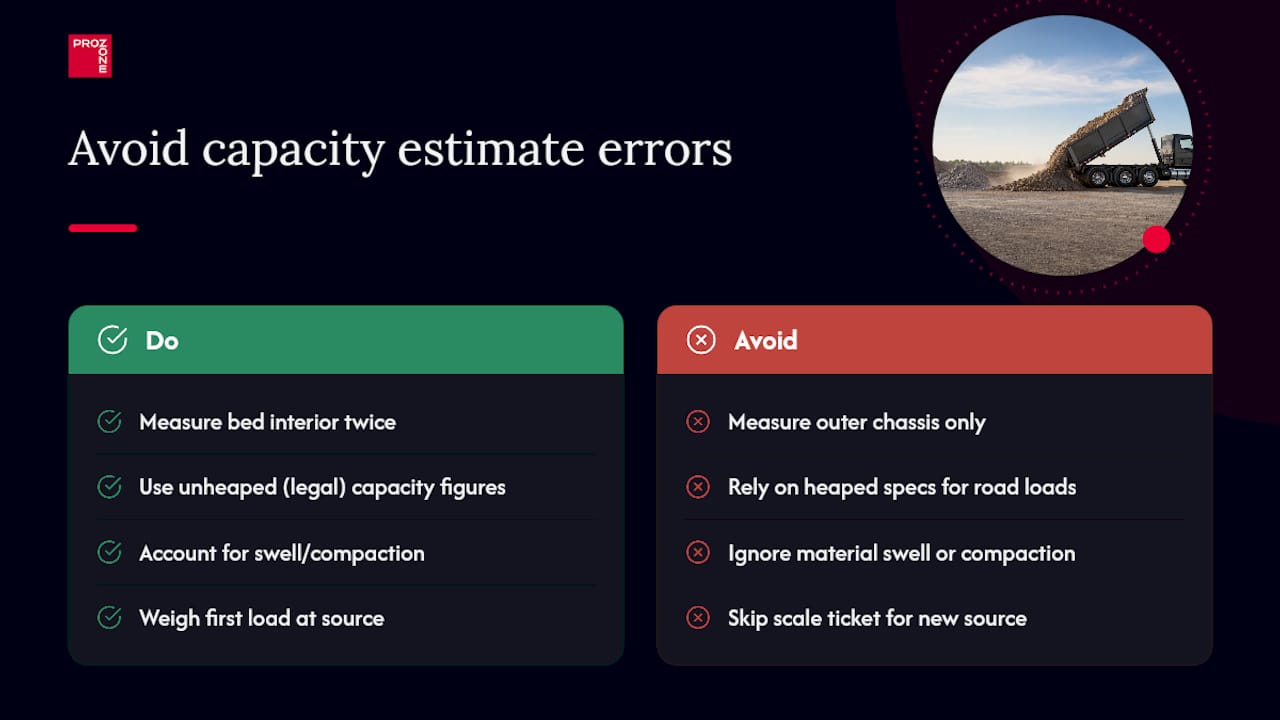
The most common mistake is measuring outer chassis dimensions instead of the interior bed walls. Bed rails, tapered sides, and wheel wells all eat into usable space, and a truck that looks 8 feet wide on the outside might only be 7 feet 4 inches inside.
A second frequent error is using heaped capacity figures for legal road transport calculations. Manufacturer spec sheets often advertise heaped numbers because they look more impressive, but heaped loads assume a specific mound angle that most jurisdictions don’t permit on public roads without a load higher than the sideboards, and covering requirements.
Third, contractors frequently forget to account for material swell or compaction when converting a hole’s volume into truckload count. A cubic yard of undisturbed clay soil can swell to 1.2 or more cubic yards once excavated and loosened, meaning your truck count based on in-ground volume will run short.
Finally, skipping the scale ticket on a new material source is a costly shortcut. Density estimates from a table are useful for planning, but actual material varies by moisture, source quarry, and even by the week. Weigh the first load of any unfamiliar material before committing to a trip count for the whole job.
Measure twice at the bed, confirm your density assumption against a real scale reading, and build in one buffer trip for heaped or swollen material. Those three habits catch the errors that spreadsheets alone miss.
What safety considerations matter when loading to capacity?
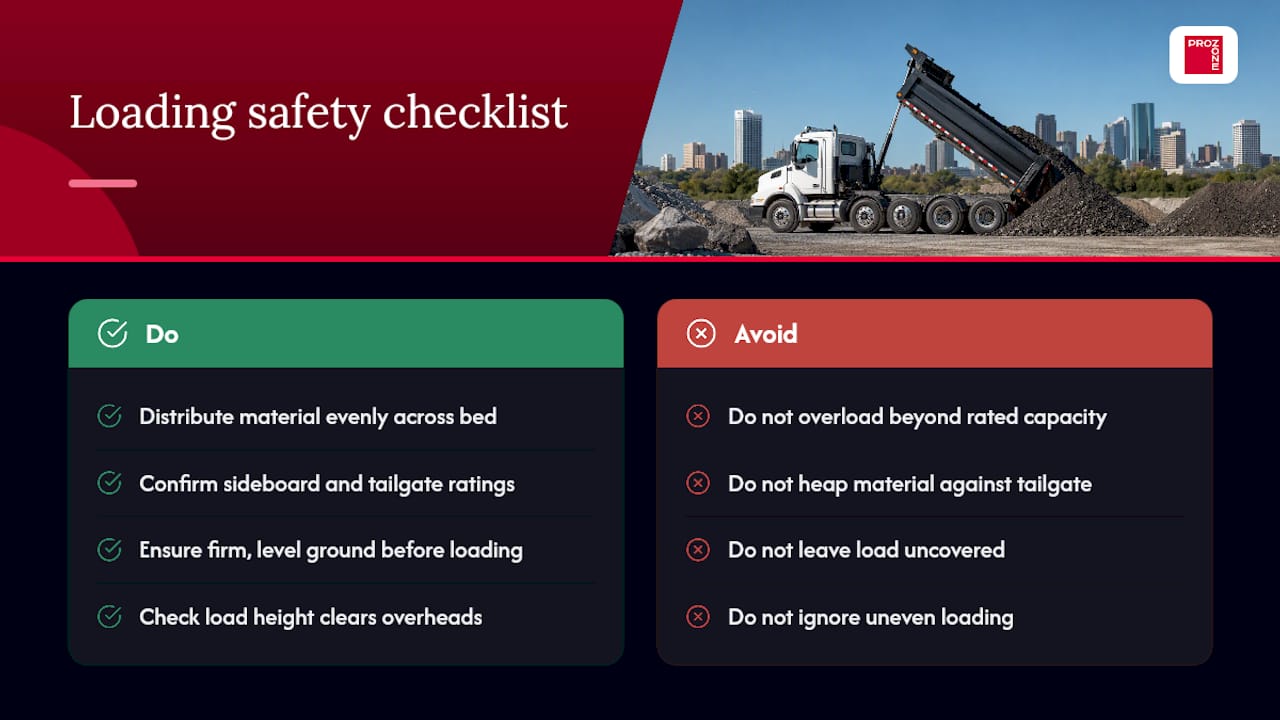
Loading a dump truck to its stated maximum introduces risks that go beyond a fine for being overweight. An overloaded bed shifts the vehicle’s centre of gravity higher and further back, increasing rollover risk on uneven site terrain or during tight turns.
Uneven loading, where material piles heavier on one side or concentrates over the rear axle, creates handling instability that a driver may not notice until braking hard or hitting a rut. Distribute material evenly across the bed floor before adding height, rather than dumping from one loader pass and hoping it settles.
Sideboards and tailgates have rated limits too. Pushing heaped material against a tailgate not designed for that pressure risks a gate failure during transport, spilling material onto the roadway. Cover requirements exist in most jurisdictions specifically because loose material bouncing off an uncovered load is a documented hazard to following vehicles.
Ground conditions at the loading site matter as much as the truck itself. Soft or frozen, rutted ground can cause a fully loaded truck to sink or tip while stationary, well before it ever reaches the road. Crews should confirm firm, level footing before loading proceeds, particularly during Edmonton’s spring thaw when surface conditions can shift within a single day.
Finally, always confirm the load height clears overhead obstructions, wires, and bridge clearances on the planned route. A truck loaded correctly by weight can still create a clearance hazard if height wasn’t checked against the route’s lowest overpass.
How do different dump truck bed types affect capacity?
Bed design changes usable capacity even when two trucks share the same rated tonnage. A straight rectangular box maximizes struck volume for its footprint, common on standard tandem-axle trucks built for general construction debris and aggregate.
Tapered beds, narrower at the bottom than the top, are common on some specialized units and reduce actual struck volume compared to a straight box of the same outer dimensions. This is precisely why measuring at the floor, rather than the top rail, matters so much for accurate quoting.
Tailgate design also affects practical capacity. A spreader gate allows controlled material release for road base or gravel spreading but can restrict how high material can safely mound near the rear without spilling during transit. Standard swing gates offer simpler full-dump unloading but less control over placement.
Dump trailers, pulled behind a separate tow vehicle, suit intermittent landscaping or lighter debris work rather than continuous high-volume hauling, since dedicated dump trucks with integrated hydraulic lift systems handle sustained daily loads more efficiently. Choosing between a trailer and a dedicated truck often comes down to how many loads per day the job actually needs, not just total volume required.
Does loose versus compacted material change your yardage math?
Material volume isn’t fixed once it leaves the ground, and that shift throws off estimates built on excavation measurements alone. Soil, gravel, and most granular material expand when excavated because the compaction that held particles tightly together in-ground is gone.
Clay and heavy soils can swell 20% to 30% once loosened, meaning a hole measuring 10 cubic yards in place may produce 12 to 13 cubic yards of loose material to haul away. Sand and gravel swell less dramatically, often in the 10% to 15% range, but the effect is never zero.
The reverse happens at the destination. Material dumped and later compacted for a road base or fill project settles back down, sometimes below its original in-ground volume once proper compaction equipment finishes the job. This is why civil engineers distinguish between bank measure (in-ground), loose measure (excavated, in the truck), and compacted measure (final installed volume), and quoting off the wrong one under counts or over counts your truck requirement.
For practical planning, always base your truckload count on loose measure, since that’s the volume actually occupying space in the bed, not the bank measure of the original excavation or the compacted measure of the finished job.
How we plan truck specs on a typical ProZone job
Every ProZone haul estimate starts with a site assessment: material type, moisture condition, and access route, including axle-sensitive turns or soft ground. We check density against our own reference data rather than relying on generic averages, since regional aggregate can vary from standard tables.
Scale tickets confirm the actual load weight against our quoted trip count, and any variance gets documented and adjusted before the next load. That discipline keeps quotes accurate instead of optimistic.
If you want a truck size and trip count built around your actual site conditions rather than a rough online estimate, request an itemized haul estimate from ProZone.
— ProZone
Get a precise haul and delivery estimate from ProZone
Guessing at truck size costs you either wasted trips or an overweight fine, and neither shows up on a rough online estimate. ProZone builds every haul quote from real numbers: measured yards per load, a weight check against your specific material’s density, an accurate trip count, and the recommended truck class for your site’s axle and access conditions.
Our crews work to Alberta Safety Codes standards. Our fleet options include tandem, tri-axle, and Moffett-based delivery for palletized loads and yard bags where a full dump run isn’t the right fit. We also supply the material itself, from crushed gravel to washed sand, so your density numbers come from the same source hauling the load.
If you’re planning a hauling job anywhere from Edmonton to the surrounding region, review our full range of construction services or contact ProZone directly through the online form or by phone for a free, itemized estimate before you commit to a truck size.
Sources
Verify your own numbers using a dedicated load calculator alongside published density references. Alberta’s own axle weight limits guide covers the regulatory side, while manufacturer body-size guides confirm chassis-specific struck volumes before you finalize a trip count.
- Free dump truck load calculator online
- Dump Truck Capacity: How Many Cubic Yards Can a Dump Truck Hold?
- How many cubic yards are really in a truck?
FAQ
How many yards are in a 20 ton dump truck?
It depends on material density: at roughly 2,700 lb/yd³ for crushed stone, a 20 ton capacity corresponds with a load of about 14 cubic yards, but lighter material like dry mulch would fill far more volume before hitting that weight.
How many yards do most dump trucks hold?
Standard tandem-axle trucks, the most common configuration for general construction and landscaping hauling, typically hold 10 to 16 cubic yards of struck capacity.
How many yards is a 16 foot dump truck?
A 16 foot bed length typically falls into the tandem-axle or tri-axle class, generally offering 12 to 16 cubic yards depending on width and wall height; use the (Length × Width × Height) ÷ 27 formula on the specific unit for an exact figure.
How many yards is a 7×12 dump trailer?
A 7 foot by 12 foot dump trailer with roughly 2 foot high walls holds about 6 cubic yards struck (7 × 12 × 2 ÷ 27), making it suitable for landscaping or small debris jobs rather than high-volume commercial hauling.