
Use laser screed concrete when a project demands consistent high FF/FL numbers over a large slab; it buys flatness, speed, and lower labour costs on pours where hand methods fall short. It struggles on tightly contoured or multi-slope surfaces unless paired with 3D total-station guidance, and no machine can fix a poorly compacted subgrade. For warehouse floors, industrial pads, and most commercial slabs over a few thousand square feet, laser screeding is the standard a contractor should specify.
Table of Contents
- How laser screed concrete works and the grade-control fundamentals
- Machine classes and access constraints: choosing the right platform
- Performance and specs contractors care about: FF/FL, production, and tolerances
- Site and mix considerations that determine success and common failure modes
- Choosing a contractor or service and what to specify in the contract
- Maintenance and calibration of laser screed equipment to ensure accuracy and longevity
- Safety protocols and operator training requirements for effective laser screed operation
- ProZone perspective: how we deploy laser screed technology for Alberta conditions
- Get a laser screed concrete quote built around your slab, not a generic rate sheet
- Sources
- FAQ
How laser screed concrete works and the grade-control fundamentals
A laser screed levels and vibrates freshly placed concrete using a closed-loop control system, not a hand-pulled bull float and a lot of guesswork. The laser screed encyclopedia entry breaks the system into four working parts:
- Laser transmitter, mounted on a tripod, projects a reference plane or is replaced by a robotic total station for variable grades
- Receiver, fixed to the screed head, reads the reference signal continuously as the machine moves
- Controller, the onboard computer that compares the receiver’s reading against target elevation
- Hydraulic head with vibrators, which raises, lowers, and vibrates the screed pan to strike concrete to grade in real time
A rotating laser plane works well for flat slabs or single-direction slopes, and it sets up faster than a total-station rig. The moment a design calls for multiple slopes, crowns, or contoured drainage, that plane can’t follow the geometry. That’s where 3D total-station guidance becomes mandatory, tracking a digital terrain model instead of a single fixed reference. Get the control choice wrong and the error doesn’t stay small: a rotating laser forced onto a variable-slope pour will telegraph every grade change straight into the finished floor as a flatness defect.
Machine classes and access constraints: choosing the right platform
Slab size and site access decide which laser screed class actually fits the job, not preference. Four platform categories cover most commercial and industrial work:
- Ride-on boom screeds handle the largest pours, often 10,000 square feet or more, with a telescoping boom that reaches wide bays without repositioning constantly.
- Compact boom screeds trade some reach for a smaller footprint, suited to mid-size warehouse bays or sites with tighter column spacing.
- Drive-in/ride-in screeds work well on slabs poured in sections, moving between bays through standard door openings.
- Walk-behind screeds fit tight interior spaces, low headroom, or slabs accessed only through narrow openings where a ride-on rig can’t manoeuvre.
Headroom, slab openings, and boom reach act as hard filters before production numbers even matter. According to the productivity data from manufacturer sources, modern laser screeds routinely cover 300 to 500 square metres per hour on open slabs, a range planners can use to budget pour schedules against a placing crew’s capacity. Electric and low-emission models are also entering the market, and battery-powered screeds reduce ventilation and noise concerns on enclosed or urban pours where fumes and decibel limits matter.
Performance and specs contractors care about: FF/FL, production, and tolerances
Flatness and levelness in North America are measured using the F-number system defined by ASTM E1155 and referenced against ACI 117 tolerances. FF measures floor flatness; FL measures levelness. Both come from a statistical sampling of elevation differences along a grid, not a single straightedge check.
Statistic callout: Standard warehouse floors commonly specify FF 35 / FL 25, a target most laser screeds achieve as a routine outcome on a well-prepared subgrade. Defined-traffic superflat floors pushing toward FF 100 / FL 50 require 3D guidance plus restrained finishing and tight mix control, not just a bigger machine.
Production and labour gains are where the case for laser screeding gets concrete, literally:
- a moderate to high coverage rate on open floor plans
- significantly fewer labourers compared with a manual truss screed crew on large pours
- Fewer corrective actions and higher initial compliance with FF/FL requirements, which trims rework days off the schedule
Those numbers only hold when the rest of the system, the subgrade, mix, and finishing crew, cooperates. A screed head can’t out-perform bad concrete.
Site and mix considerations that determine success and common failure modes
Flatness is a system outcome, not a machine spec. The screed head gives you capability; subgrade, mix design, and finishing crew timing decide whether that capability shows up in the finished floor.
Subgrade compaction and proof rolling come first, before concrete ever touches the ground. A soft or unevenly compacted base will telegraph through the slab regardless of how well the screed tracks its reference plane, and it’s the single most common field error that spoils an otherwise well-run pour.
Concrete mix behaviour matters just as much. Slump, bleed rate, and set timing all need to match screed speed, because a screed moving faster than the concrete can support will drag or tear the surface.
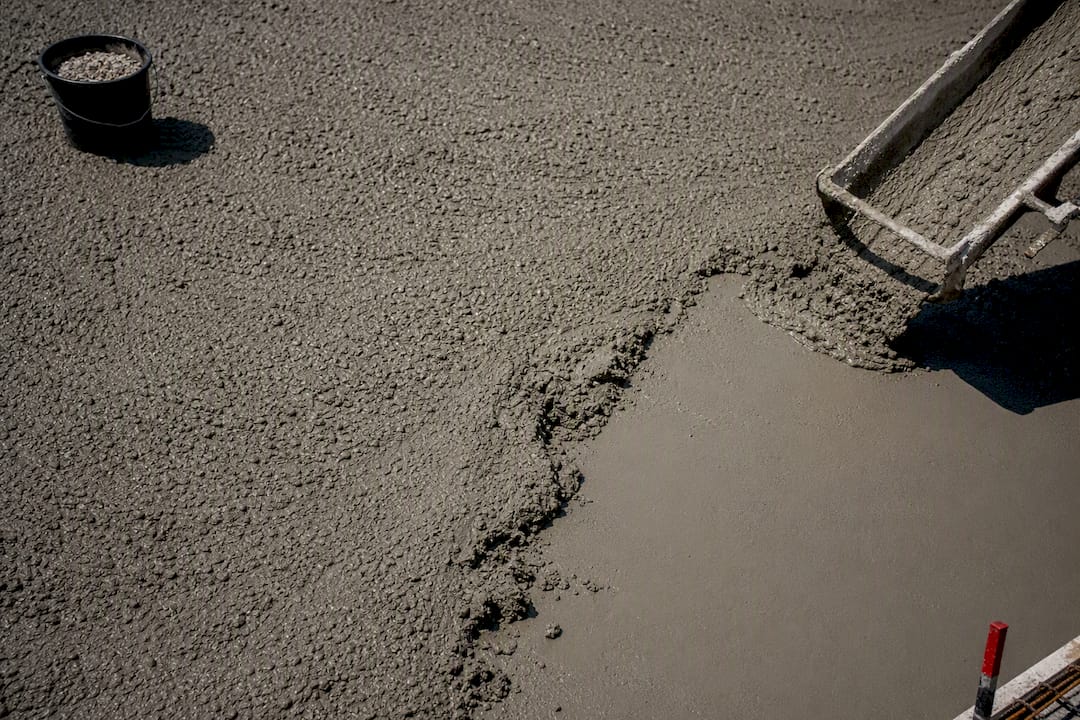
Pro Tip: Synchronise placing rate, screed speed, and the finishing crew’s arrival before the pour starts. Variable bleed water or uneven set times across a bay create local hollow defects that no amount of post-pour troweling can fully correct.
Common failure points on real jobs include:
- Soft or inconsistently compacted subgrade causing dips under load
- Screeding ahead of the placing crew, leaving concrete to set before the head reaches it
- Premature troweling before bleed water has escaped, trapping moisture under a sealed surface
- Skipping proper edge, float, and cure sequencing, which must start promptly after screeding to lock in surface texture and strength
Every one of these is a scheduling or preparation failure, not an equipment limitation. That distinction matters when a contractor tries to blame the machine for a floor that failed because the base was never proof-rolled.
Choosing a contractor or service and what to specify in the contract
The contract, not the sales pitch, is where a laser screed project actually gets protected. Specify these items before a crew shows up on site:
- Grade-control method, rotating laser or 3D total station, tied explicitly to the slab’s geometry and slope requirements.
- Target FF/FL numbers, stated per ASTM E1155 with the test method and acceptance criteria named, not left as a vague “flat floor” promise.
- Remedial allowance, spelling out who pays for corrective grinding or patching if measured FF/FL falls short.
- Equipment class and operator experience, matched against the slab size and access constraints covered above.
- Site-prep responsibilities, naming who compacts and proof-rolls the subgrade before the pour, and to what standard.
- Schedule impact, including how placing rate and finishing crew size will be coordinated with screed production.
When a project uses 3D total-station guidance, add one more layer: who supplies the digital terrain model, who controls survey benchmarks, and what verification data gets handed over after the pour. A model built from stale survey points produces a screed pass that’s precisely wrong. Contractors specifying complex grade work should also review 3D site planning workflows to understand how model accuracy carries through to finished grade. Owners can cross-reference flatness expectations against what concrete flatwork actually requires before signing off on any acceptance clause.
Maintenance and calibration of laser screed equipment to ensure accuracy and longevity
A laser screed is only as accurate as its last calibration. Transmitter and receiver alignment drifts over time from vibration, transport, and temperature swings, and an uncalibrated unit will produce a slab that reads flat on the operator’s display while sitting outside spec in the field.
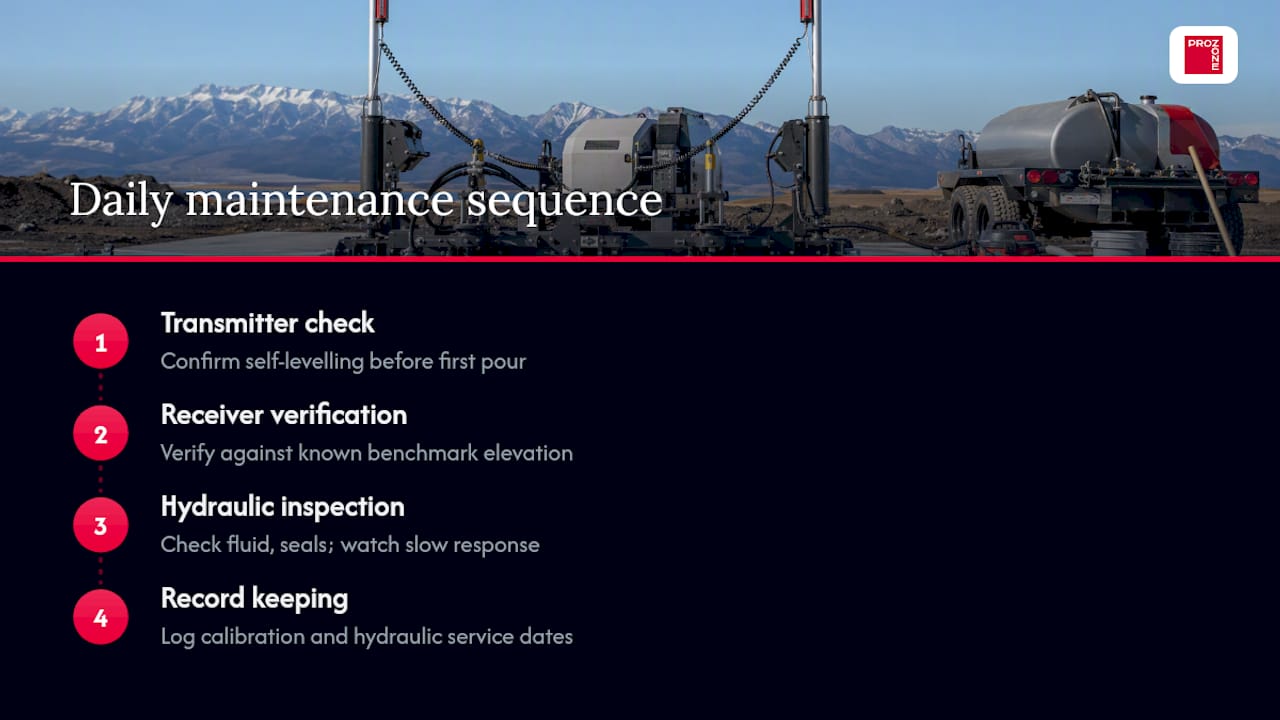
Daily calibration checks should confirm the transmitter’s self-levelling function and verify the receiver against a known benchmark elevation before the first pour of the day. Hydraulic systems on the screed head need routine fluid checks and seal inspection; a slow hydraulic response translates directly into lag between the sensed grade and the actual strike, which shows up as waviness on a floor that should read dead flat.
Edmonton’s freeze-thaw cycles add a wrinkle most manufacturers don’t address in their manuals. Equipment stored or transported through temperature swings near freezing needs extra attention to hydraulic fluid viscosity and seal integrity, since cold-weather contraction can loosen fittings that held tight through summer. A screed that performed to spec in August can drift out of calibration by November without a mid-season check.
Track calibration dates and hydraulic service intervals the same way a contractor tracks concrete batch tickets. It’s boring paperwork until an owner disputes a flatness reading and there’s no record proving the equipment was in spec on pour day.
Safety protocols and operator training requirements for effective laser screed operation
Operating a laser screed safely starts with recognizing it as heavy equipment working in close proximity to a placing crew, pump operators, and finishing workers, all on a wet, uneven surface. Alberta Safety Codes require documented equipment-specific training before an operator runs a boom or ride-on unit unsupervised, and that training needs to cover hydraulic system lockout, boom swing radius, and emergency stop procedures specific to the machine class in use.
Ground crew positioning matters as much as operator skill. A boom screed’s reach means workers placing concrete ahead of the head need clear communication protocols, hand signals or radio contact, to avoid being caught in the swing path during a pour.
Pre-shift checks should confirm hydraulic hose integrity, vibrator function, and laser or total-station calibration before concrete hits the ground, since a mid-pour equipment failure is far more costly than a five-minute inspection. Contractors running a genuine safety program document this inspection every shift, not just when an inspector is on site.
ProZone perspective: how we deploy laser screed technology for Alberta conditions
The grade-control method and target FF/FL are specified on commercial flatwork projects before a crew mobilizes, because a verbal promise of “flat” means nothing on a warehouse floor carrying rack loads. Our crews are trained to Alberta Safety Codes standards and we build subgrade compaction into the schedule as a checked, sign-off step, not an assumption.
Edmonton’s freeze-thaw cycles punish shortcuts that other markets tolerate. A slab poured over a soft base or finished on a rushed schedule shows its weakness within a season, and we plan mix design, screed speed, and finishing sequence around that reality rather than around minimum spec.
Reference our concrete maintenance checklist for what keeps a laser-screeded floor performing through Alberta winters. If you’re planning a slab that needs documented FF/FL compliance, request a site review through our contact form or call ProZone directly for a free estimate.
— ProZone
Get a laser screed concrete quote built around your slab, not a generic rate sheet
This company offers laser screed concrete work specified and delivered against documented FF/FL targets, not a rough promise of “it’ll be flat enough.” Some contractors skip proof rolling or run a rotating laser on a sloped pad it was never built for, but grade control, subgrade verification, and finish sequencing are built into the contract before the first truck arrives. That matters most on industrial floors, commercial pads, and municipal slabs where a failed FF/FL test means grinding, patching, and a delayed handover.
Review our full range of construction services to see how concrete flatwork fits alongside site preparation and finishing, then request a free estimate through our online form or call ProZone directly to talk through your slab’s geometry, access constraints, and target flatness spec before you commit to a pour date.
Sources
- Laser screed encyclopedia entry
- What is a concrete laser screed and how does it work
- How laser screeding supports ACI flatness
- Laser guided screeding for flat concrete floors
FAQ
How does a laser screed work?
A laser screed uses a rotating laser transmitter or robotic total station to send a reference signal to a receiver mounted on the machine’s hydraulic screed head, which raises, lowers, and vibrates in real time to strike concrete to the target elevation as the machine moves across the slab.
What are common problems with laser screeds?
The most common failures trace back to a poorly compacted subgrade, screeding ahead of the placing crew before concrete is ready, premature troweling before bleed water escapes, and using a rotating laser plane on a slab that actually needs 3D total-station guidance for multi-slope geometry.
How long does it take to screed with a laser screed?
Production commonly runs 300 to 500 square metres per hour on open floor plans, a pace that lets a laser screed cover a large warehouse bay in a fraction of the time a manual truss screed crew would need for the same area.
Is screed as strong as concrete?
Screeding doesn’t add or subtract strength; it levels and finishes the concrete that’s already been placed, so the slab’s structural strength comes entirely from the mix design and curing, not from the screeding method used to achieve flatness.
What FF/FL numbers should I specify for a warehouse floor?
Most standard warehouse floors specify FF 35 / FL 25 under ASTM E1155 and ACI 117, a target laser screeds achieve routinely on a properly compacted subgrade, while superflat floors for defined-traffic racking often push toward FF 100 / FL 50 and require 3D guidance plus tighter mix and finishing control.