
Infrared asphalt repair is a surface-level thermal recycling method that heats existing pavement until it becomes workable again, then blends it with fresh hot mix to form a seamless, thermally bonded patch. It only performs as advertised when the base underneath is sound. Choose it when you need minimal downtime, want to reuse existing material instead of hauling it to landfill, and care about seam performance during freeze-thaw cycles. Choose something else when the failure runs deeper than the surface.
Table of Contents
- What is infrared asphalt repair and when should you use it?
- How do you perform an infrared asphalt repair step by step?
- What equipment and temperatures does infrared repair require?
- Infrared repair versus saw-cut patching: what changes
- When infrared asphalt repair is the wrong call
- What does infrared asphalt repair cost and how long does it take?
- Where ProZone’s field practices fit into the picture
- Get a free infrared repair estimate from ProZone
- Sources
- FAQ
What is infrared asphalt repair and when should you use it?
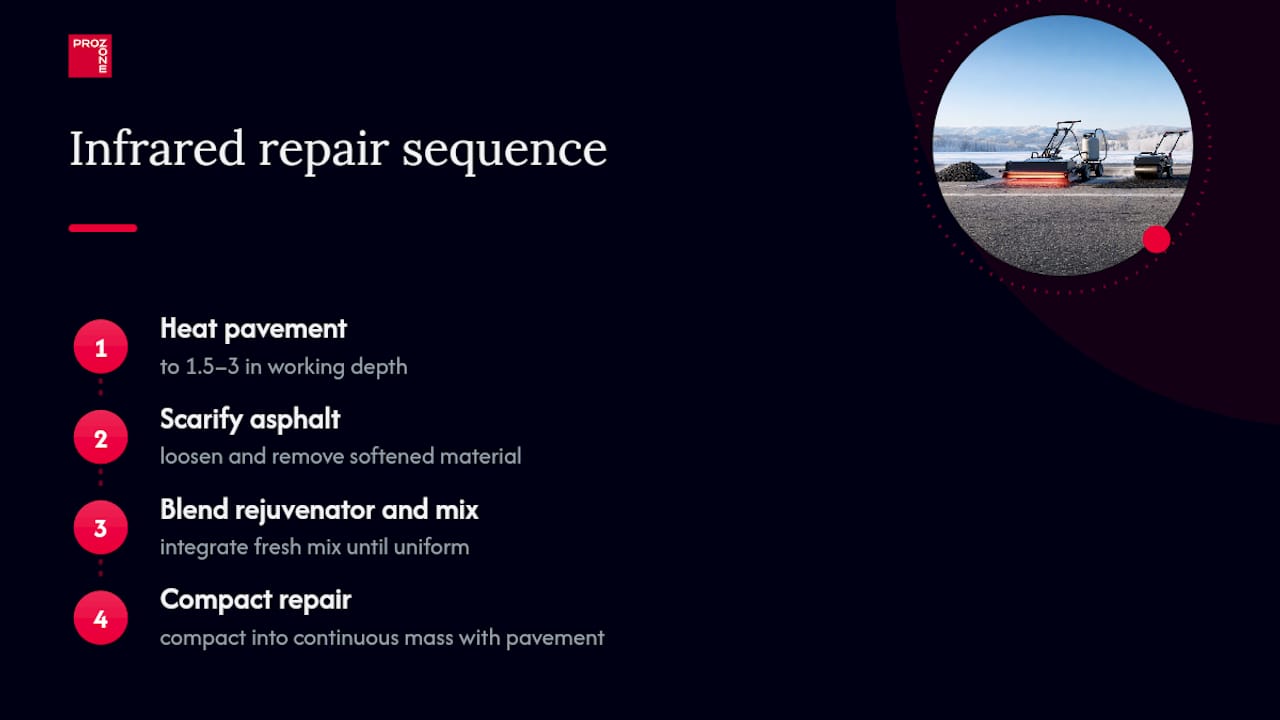
Infrared repair works by radiating heat into the pavement surface until the asphalt softens enough to rework, typically to a depth of 1.5 to 3 inches. That depth matters: it is enough to fix surface distress but not enough to correct a failed subgrade. The technician then scarifies the softened material, blends in rejuvenator and fresh mix, and compacts it into one continuous mass with the surrounding pavement, rather than dropping new material into a cut trench.
The method suits potholes with a sound base, seam failures along old patch lines, utility cut blending, raveling, and the cracked collars around catch basins where standard patching tends to fail first. It is not a fix for structural problems.
Before you approve the approach, run a short checklist. Inspect the base by probing the defect edges for softness or pumping under load. Check drainage, since water trapped below the surface defeats any surface repair. Ask about the site’s patch history: a location that has failed three times in two years usually has a base problem infrared cannot solve, no matter how good the technician is.
How do you perform an infrared asphalt repair step by step?
A properly run infrared repair follows a disciplined sequence, and shortcuts at any stage show up as premature seam failure within a season or two.
- Prepare the site. Clear debris, dry the surface (infrared heaters do not work efficiently over standing water), and mark a perimeter roughly a foot beyond the visible defect.
- Heat the pavement. Position the heater over the defect and hold it in place for 7 to 15 minutes per layer, depending on ambient temperature and asphalt thickness. Contractor field data shows total repair cycles usually run 20 to 45 minutes. Target a working range of roughly 140 to 190 degrees Celsius at the surface, hot enough to soften the binder without scorching it.
- Scarify while preserving the bond edge. Rake the softened asphalt to break it up, but leave the outer 6 inches of the heated zone untouched. That undisturbed ring acts as a thermal transition zone and is what prevents the classic ring-shaped seam crack you see on badly executed infrared patches, a technique detailed in Ray-Tech Infrared’s field procedure.
- Apply rejuvenator oil. Older asphalt loses maltenes, the light oils that keep it flexible, as it oxidizes. Reintroducing rejuvenator oil during raking restores flexibility and materially reduces the odds of cracking through Edmonton’s freeze-thaw cycles.
- Add hot mix and compact. Blend in fresh material, then compact from the edge inward toward the centre, checking density with a plate or roller pass pattern rather than eyeballing it.
If the reclaimed asphalt cools below workable temperature before compaction, a brief reheat pass restores it. Press a boot heel into the mix; if it springs back cleanly rather than smearing, it is ready to compact.
Pro Tip: Ask any bidder how they verify compaction on an infrared patch. “We roll it a few times” is not an answer. A crew that references density checks or edge-to-centre passes is one that treats the process as engineering, not guesswork.
What equipment and temperatures does infrared repair require?
Equipment scales with the job. Portable infrared units handle single potholes and small utility cuts. Tow-behind units cover larger surface areas in fewer passes, and truck-mounted systems are built for continuous production work across parking lots or lane sections.
Temperature control separates a durable patch from a repeat call-back. Controlled studies point to a working band of roughly 140 to 190 degrees Celsius for proper softening without burning the binder, and dynamic heating (moving the heater rather than leaving it static) produces a more even temperature profile through the patch depth. Cold ambient air extends heating time; a January repair in Edmonton will always take longer than the same defect in July.
Hot-box storage matters more than most property managers assume. Field evaluations found that improper storage and ignition problems with heating equipment lengthen patch durations and cut productivity when crews mishandle hot mix between stops.
- Rejuvenator selection depends on how oxidized the existing asphalt is; heavily weathered pavement needs a higher application rate than a patch on a five-year-old lot.
- Preheating the reclaimed material also allows higher recycled content in the fill mix, and NJDOT testing found preheated mixes with 30% reclaimed asphalt pavement performed satisfactorily against conventional hot mix.
Infrared repair versus saw-cut patching: what changes
The core advantage of infrared is the absence of a cold joint. Saw-cut patching always leaves a seam where new mix meets old pavement, and that seam is where water finds its way in every spring thaw. Thermal bonding fuses old and new material into one mass, which is why a field evaluation found infrared patches outperformed throw-and-roll and spray-injection methods on longevity when installed correctly.
- No cold joint means measurably lower water infiltration risk at the patch edge.
- Reusing existing asphalt on site cuts hauling and landfill costs, and contractor data suggests lifecycle savings of 20 to 30 percent versus saw-cut patching for surface-level defects.
- Saw-cut patching still wins on very large areas or where the base itself needs replacement, since infrared cannot correct what lies beneath the surface layer.
Productivity varies too. Infrared crews move faster on small, scattered defects; saw-cut crews with full-depth equipment are more efficient once you are removing and replacing entire sections.
When infrared asphalt repair is the wrong call
Infrared cannot fix a base that has already failed. If probing reveals pumping, deflection, or a soft, spongy feel underfoot at the defect edges, the subgrade is compromised and needs full-depth excavation, not surface heating.
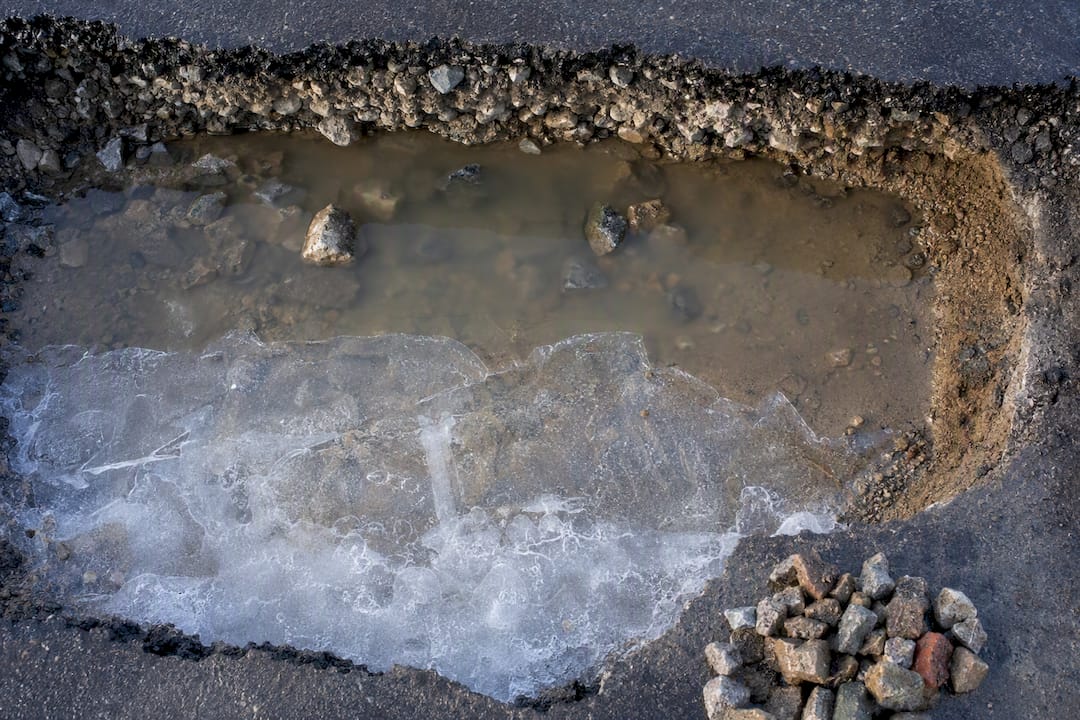
Saturated subbase, standing water in the excavation, or frozen ground under the defect are all reasons to stop and reschedule. Heating over a wet base traps moisture that will re-emerge as a blister or crack within a season.
Watch installer technique closely. Common errors include raking into the undisturbed bond edge, skipping compaction verification, and overheating the surface until the binder scorches and loses its adhesive properties. If a bid does not mention core samples or an engineering review for a defect with unclear depth, ask why before signing off. For anything touching structural pavement layers, a full asphalt pulverization and repair approach is the more defensible investment.
What does infrared asphalt repair cost and how long does it take?
Ballpark pricing for infrared work runs roughly $2 to $6 per square foot, with the range driven by patch size, defect depth, ambient temperature, and how far the crew has to truck hot mix. Small, scattered pothole work costs more per square foot than continuous runs along a seam or curb line.
Most infrared repairs reopen to traffic within 30 to 60 minutes of compaction, a fraction of the cure time full-depth replacement demands. Under sound base conditions, expect a service life of several years before the patch needs attention again.
Plan for a crew of two to four, an infrared unit sized to your typical defect count, a hot-box for standby mix, and basic traffic control for lot or lane closures. When you compare quotes, ask for:
- A written scope defining exact repair locations and dimensions
- Compaction verification method, not just a promise of “proper compaction”
- Warranty terms tied to workmanship, not just material supply
Where ProZone’s field practices fit into the picture
ProZone approaches every infrared repair the same way a structural engineer approaches a foundation crack: verify the cause before treating the symptom. That starts with a base inspection, because no amount of skilled heating rescues a patch sitting on failed subgrade in an Edmonton freeze-thaw cycle.
Crews assess oxidation levels on site and calibrate rejuvenator strategy accordingly, since a ten-year-old lot needs a different oil application rate than a recent overlay. Compaction is verified, not assumed, before a crew leaves the site.
ProZone’s project gallery documents completed lots and municipal sections repaired under Alberta Safety Codes standards. This is work you can review before requesting a quote. Bring photos of the defect, its approximate dimensions, and how traffic moves across it, and an on-site evaluation moves faster.
— ProZone
Get a free infrared repair estimate from ProZone
Requesting a quote is straightforward once you have the basics ready: photos of each defect, rough dimensions, and a note on how heavy or frequent traffic is across that section of pavement. That information lets ProZone scope an infrared repair, or recommend full-depth work instead, without a wasted site visit.
A ProZone quote lays out the repair scope, expected timeline, and warranty terms in writing, so there is no ambiguity about what “compaction verified” or “seam sealed” actually covers. For lots where the damage runs deeper than the surface, ProZone’s asphalt paving services cover the full range from patch repair to complete resurfacing.
If your parking lot, access road, or utility cut needs an honest assessment rather than a quick patch that fails by spring, use the online form or call ProZone directly, arrange a free on-site estimate.
Sources
- Field evaluation of the infrared asphalt heater/reclaimer patching method (ODOT interim report)
- Experimental studies on infrared heating for pothole repair (scientific article)
- Infrared patching: how it works, equipment, and when to use it
- NJDOT technical brief on pothole repair and preheating methods
- How to: an average asphalt repair (Ray-Tech Infrared)
FAQ
Does infrared asphalt repair actually work?
Yes, when the base is sound. Field evaluations found infrared patches outperformed throw-and-roll and spray-injection methods on longevity, but the method cannot correct a failed subgrade underneath the defect.
What are the downsides of cold patch asphalt?
Cold patch is a temporary fix, not a bonded repair. It lacks the thermal bond that fuses old and new material, so it tends to loosen, ravel, and pop out under traffic within a season, especially through freeze-thaw cycles.
What is the best product for repairing an asphalt driveway crack?
For hairline surface cracks on a driveway, a rubberized crack filler applied to a clean, dry crack works well as a short-term seal. For anything wider than a hairline crack or showing edge deterioration, infrared or hot mix patching gives a longer-lasting repair than filler alone.
How does infrared asphalt repair compare to traditional patching for cost?
Infrared runs roughly $2 to $6 per square foot and reopens to traffic in 30 to 60 minutes, while saw-cut patching often costs more per square foot once you factor in material removal, hauling, and longer cure times before the site reopens.
How long does an infrared asphalt patch typically last?
Under sound base conditions, expect a service life of three to ten years, depending on traffic loads and how well the rejuvenator and compaction steps were executed during the repair.