
A commercial utility locate in Edmonton always has two parts. You need a Utility Safety Partners ticket for member-owned assets, and a separate private locate for lines that USP does not cover. Alberta OHS rules make this a contractor duty, not a courtesy, so the immediate move on any project is to open a USP ticket and line up a private locator or Alternate Locate Provider at the same time.
Table of Contents
- What are Alberta’s utility locate requirements before excavation?
- What private utilities does a public locate miss?
- Should you use electromagnetic locating, GPR, or both?
- How far ahead should you schedule an Edmonton utility locate?
- What documents should a locator hand over before you dig?
- How does ProZone coordinate locates on Edmonton projects?
- Pre-mobilization checklist: getting locates done before you break ground
- Field manager perspective: locating is a project phase, not a delay
- Get a coordinated locate and site-prep plan from ProZone
- Sources
- FAQ
What are Alberta’s utility locate requirements before excavation?
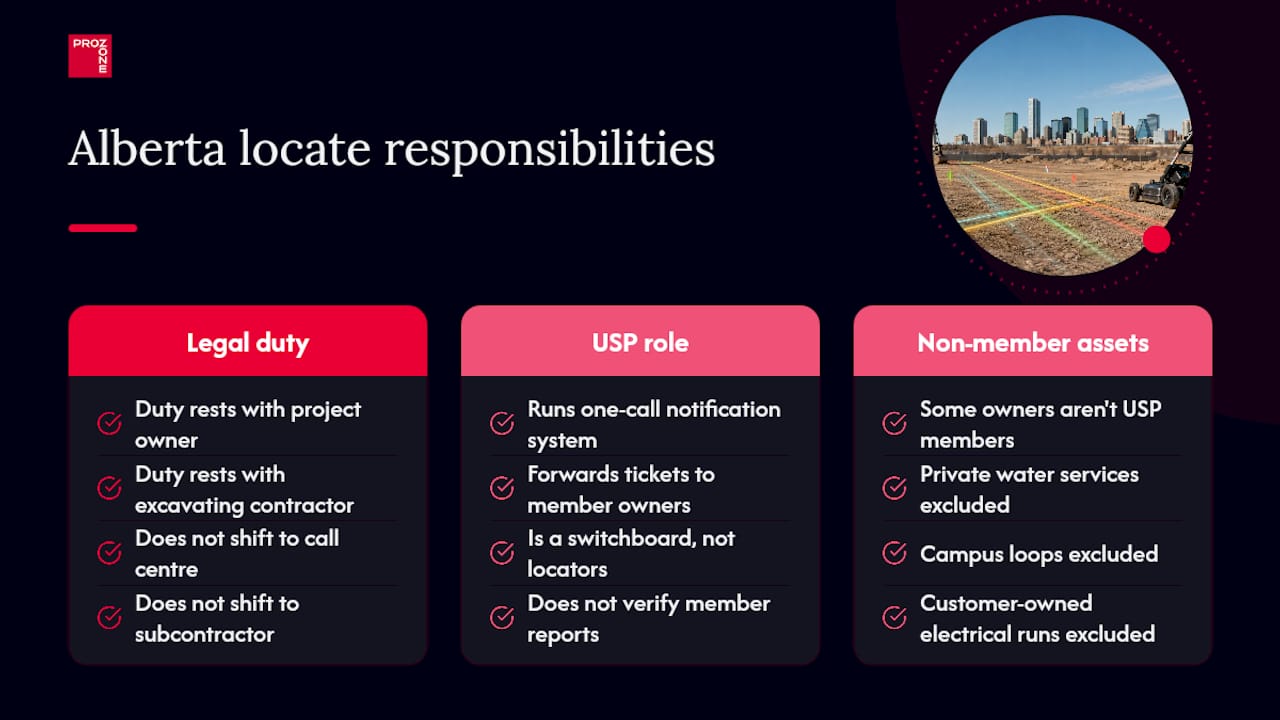
Alberta’s Occupational Health and Safety Code puts the duty to locate squarely on whoever disturbs the ground. That obligation does not shift to a call centre or a subcontractor. It sits with the project owner and the excavating contractor, full stop.
Utility Safety Partners runs the province’s one-call notification system. When you submit a ticket, USP forwards the request to its member utility owners, who then send crews or provide records to mark their lines. USP is a switchboard, not a locate crew. It does not walk your site with a wand or a radar unit, and it does not verify anything beyond what its members choose to report through the Damage Prevention Process.
Here is where projects get exposed. Plenty of asset owners in Edmonton and the surrounding municipalities are not USP members, so understanding how commercial water metering works can help clarify ownership boundaries and locating responsibilities. Private water services, campus loops, and customer-owned electrical runs fall outside the notification net entirely, which means locating them stays your responsibility.
What private utilities does a public locate miss?
Public locates from USP member utilities typically stop at the meter or the property line. Everything past that point, and every asset owned by a non-member, is on the ground-disturber’s ledger, according to USP’s own FAQ.
On commercial and municipal parcels, that gap covers a surprising amount of infrastructure: secondary electrical feeds between buildings, irrigation mains, site lighting circuits, fuel lines at loading docks, and abandoned services nobody bothered to record. Edmonton’s older industrial parks and institutional campuses are particularly prone to this, since decades of piecemeal additions rarely left behind a clean as-built drawing.
Hit one of these lines and the fallout is not just a repair bill. You are looking at outages for tenants, a safety incident report, and possibly disqualification from future tender bids if you cannot produce locate records afterward, a real consequence under Alberta procurement practice for civil and underground utility public work.
Should you use electromagnetic locating, GPR, or both?
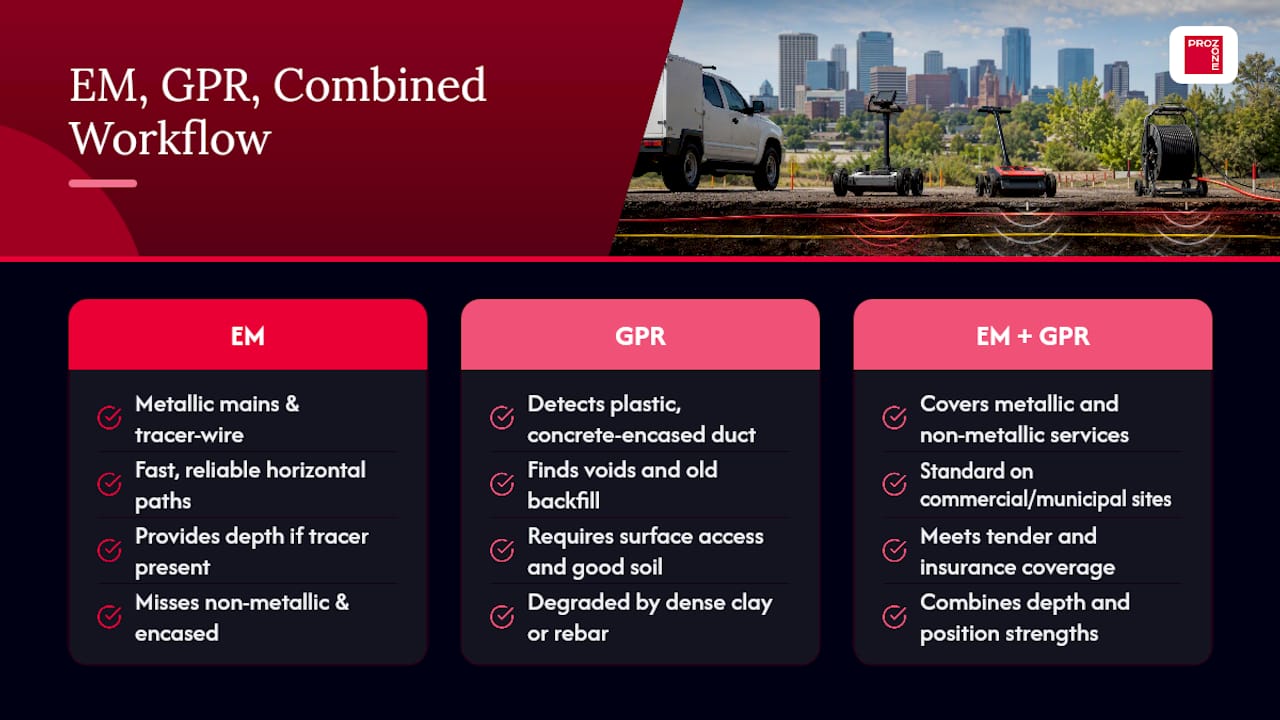
Electromagnetic (EM) locating stays the workhorse for metallic mains and any service with a tracer wire. It reads induced signal along conductive pipe or cable, giving fast, reliable horizontal paths and, where a tracer exists, a workable depth estimate. For steel gas lines, copper water services, and most electrical conduit, EM is the first tool out of the truck.
Ground-penetrating radar (GPR) covers what EM cannot see. It detects non-metallic pipe, plastic conduit, concrete-encased duct, and even voids or old excavation backfill, though it depends on surface access and soil conditions cooperating. Dense clay or a paved lot with heavy rebar can degrade a GPR return, so a skilled operator matters as much as the equipment.
For anything beyond a routine residential locate, a combined EM plus GPR workflow is the standard on Edmonton commercial and municipal sites. Running both methods catches the non-metallic services EM misses and the metallic ones GPR alone would underrepresent, which is exactly the coverage a tender package or an insurance file needs to hold up.
How far ahead should you schedule an Edmonton utility locate?
Plan for several business days on a USP public locate during Edmonton’s peak construction season, and treat that as a floor, not a target. Line-locating timelines in Alberta and Saskatchewan routinely stretch past that window between May and September, so submitting your ticket earlier buys real margin.
The Alternate Locate Provider program gives you a second lever. Through USP’s ALP program, a ticket requester can select an approved private locator to perform locates on behalf of participating member utilities, which compresses the wait when those members are enrolled. It is not universal, since not every owner participates, but where it applies it removes one of the biggest scheduling bottlenecks on a tight build.
The practical move is to run private-locator procurement in parallel with your USP ticket from day one, capturing the ticket number and response confirmations as they come in rather than waiting to see what USP returns before acting.
What documents should a locator hand over before you dig?
Treat these as non-negotiable acceptance criteria, not nice-to-haves:
- A ticket number tied to every USP submission, with response records for each member contacted.
- Field markings using a clear, consistent legend, so different utility types are never ambiguous on the ground.
- A locate sketch or CAD plan showing horizontal position and, where the method allows, depth estimates.
- Written confirmation of the locate’s scope and its expiry date.
- Confirmation the locator or utility owner attended any prearranged meeting point, with hand-expose procedures noted before mechanical excavation starts.
These documents are not paperwork for its own sake. Missing locate records can bar a bid from consideration on public work, and a complete file is often the difference between a defensible position and an uninsured loss if a strike happens anyway, per the Cornerstone Contracts guidance on Alberta procurement.
How does ProZone coordinate locates on Edmonton projects?
The USP ticket is opened at project intake, then the utility list is reviewed to flag any owner outside the USP membership roster. Those non-member assets, and any customer-owned lines on the site plan, get routed to a registered private locator or an approved ALSP running in parallel with the public ticket.
Every deliverable gets archived the same way: ticket numbers logged, locate sketches attached to the site package, and the full record kept for tender submissions and insurance defence. That documentation trail is built into ProZone’s site-prep process, not bolted on afterward.
Edmonton’s freeze-thaw cycle adds another layer. Frost heave shifts shallow lines and can crack old concrete encasements over a winter, so locate timing is factored into the excavation window and restoration plan rather than treating locates as a separate task from the schedule.
Pre-mobilization checklist: getting locates done before you break ground
Work through this order on every project:
- Pre-mark the intended dig area so locators know exactly where to focus.
- Submit the USP ticket, ideally more than 5 business days ahead in peak season.
- Identify non-member owners and customer-owned lines from site records.
- Select an Alternate Locate Provider if participating members allow it.
- Schedule the private locator to run alongside the public ticket.
- Confirm the on-site meeting point and hand-expose plan with all parties.
- Collect every locate deliverable and file the ticket records before mobilization.
The site superintendent should sign off on the completed checklist, with records stored in the project file alongside contractor vetting documentation.
Pro Tip: Book your private locator the same week you submit the USP ticket, especially for anything scheduled between May and September. Waiting for the public response before starting private procurement is the single most common cause of Edmonton locate delays.
Field manager perspective: locating is a project phase, not a delay
Locating gets treated as an obstacle when it should be budgeted like formwork or grading, a fixed line item with its own schedule slot. Crews that skip that step end up paying for it twice, once in downtime and once in the claim that follows a strike. The documentation from a proper locate also does something quieter but valuable: it makes your bid file and your insurance position stronger on every project after this one.
— ProZone
Get a coordinated locate and site-prep plan from ProZone
Private utility locate coordination is managed as a standard part of Edmonton excavation and site-prep work, not as an outsourced afterthought. One point of contact handles the USP ticket, engages an ALSP or private locator for non-member assets, and folds every locate deliverable directly into the site package instead of requiring coordination among multiple vendors for paperwork before a bid deadline.
The company regularly supports:
- Municipal infrastructure and road reconstruction projects
- Commercial parking lot rehabilitation and expansion
- Institutional and industrial site redevelopment
If you have a project breaking ground in Edmonton, call ProZone or use the online contact form for a free estimate and a pre-mobilization plan that gets your locates scheduled before your excavation crew shows up. For projects involving road or lot reconstruction specifically, review ProZone’s road construction services to see how locate coordination fits into the broader build sequence.
Sources
- Damage Prevention Process in Alberta
- Bidding civil and underground utility public work in Alberta (2026) · Cornerstone Contracts
- Everything you need to know about line locating in Alberta and Saskatchewan
FAQ
Does a USP ticket cover private utilities in Edmonton?
No. USP only notifies member utility owners, and public locates typically stop at the property line or meter, leaving privately owned and customer-owned lines to a separate private locate.
How long does a locate take in Edmonton during peak season?
Budget 3 to 5 business days for a USP response in peak season, and submit earlier where possible since demand between May and September routinely extends that window.
What is the Alternate Locate Provider program?
The ALP program lets a ticket requester choose an approved private locator to perform locates on behalf of participating USP members, which can shorten wait times when those members are enrolled.
Do I need both GPR and electromagnetic locating?
Commercial and municipal sites generally need both, since electromagnetic locating finds metallic and tracer-wired lines while GPR detects non-metallic pipe, duct, and voids that EM cannot see.
Can ProZone manage the entire locate process for my project?
Yes, ProZone coordinates the USP ticket, engages private locators or ALSPs for non-member assets, and integrates every locate deliverable into the site-prep package for your Edmonton project.