
The Manual of Uniform Traffic Control Devices for Canada (MUTCDC) is the primary technical standard governing crosswalk marking standards in Canada, but it is never the whole answer. Every province and most municipalities publish supplements that fill in the exact dimensions contractors must follow, and Ontario Regulation 402/15 sets binding rules for pedestrian crossovers. Layered on top is the Transportation Association of Canada’s 2023 research into non-standard markings, which informs policy but has not been folded into formal MUTCDC guidance.
Table of Contents
- What governs crosswalk marking standards in Canada?
- Provincial and municipal supplements you need to check first
- Exact dimensions: stroke widths, spacing, and placement
- When should a crosswalk actually be marked?
- What TAC’s research on non-standard markings means for your policy
- Materials and maintenance for Edmonton’s freeze-thaw climate
- How to specify and accept a crosswalk marking project
- A field perspective on crosswalk installation quality
- How ProZone supports crosswalk marking projects across Alberta
- Key manuals and regulations to keep on file
- Sources
- FAQ
What governs crosswalk marking standards in Canada?
MUTCDC sets the national baseline for pavement markings and pedestrian crossing devices. Published by the Transportation Association of Canada, it functions as the reference document that provincial ministries and municipal engineering departments start from when they write their own standards. It does not, by itself, dictate every stroke width or spacing measurement a contractor needs on site.
That gap is intentional. MUTCDC establishes principles, retroreflectivity expectations, and device categories, while leaving dimensional specifics to be adapted for local traffic volumes, climate, and road classification. TAC’s research report on non-standard crosswalk pavement markings adds an evidence layer on top, examining decorative and artistic treatments that have grown popular in some communities. It is a policy input, not a revision to the manual.
Practitioners should treat the hierarchy this way:
- MUTCDC: national principles, device selection logic, and minimum performance expectations.
- Provincial manuals: binding dimensional and application guidance for that jurisdiction’s roads.
- Municipal standard drawings: the exact figures a contractor bids and builds to.
- TAC research reports: evidence and recommendations to weigh, not mandatory clauses.
Skipping the municipal drawing and specifying straight from MUTCDC is one of the most common tendering mistakes we see in Alberta procurement documents.
Provincial and municipal supplements you need to check first
Alberta’s own Highway Pavement Marking Guide aligns with MUTCDC principles while adding provincial interpretation for highway and municipal contexts, including application notes that matter for Alberta’s freeze-thaw cycle. Ontario runs a different model entirely: Regulation 402/15 legally specifies pedestrian crossover sign and marking diagrams, covering Level 1 and Level 2 crossovers, ladder crosswalks, and shark teeth yield markings, each with exact dimensions attached.
Edmonton’s Manual for Pavement Marking Design is the clearest example of how a municipal document overrides generic national guidance with city-specific numbers, including a downtown exception that widens spacing tolerances. British Columbia relies on its Ministry publications and a Pedestrian Crossing Control Manual to guide the same decisions provincially. The documents that matter most, in the order a project manager should pull them:
- The provincial traffic control manual for the road’s jurisdiction (Alberta, Ontario, BC, or others).
- The municipal standard drawing set, where one exists (Edmonton, Toronto, and other major cities publish their own).
- Any binding regulation specific to the crossing type, such as O. Reg. 402/15 for pedestrian crossovers.
- MUTCDC, consulted for anything the above documents do not address.
Toronto’s T-310 zebra pavement marking standard drawing is a good illustration of how granular these municipal documents get, right down to installation notes for the paint crew.
Exact dimensions: stroke widths, spacing, and placement
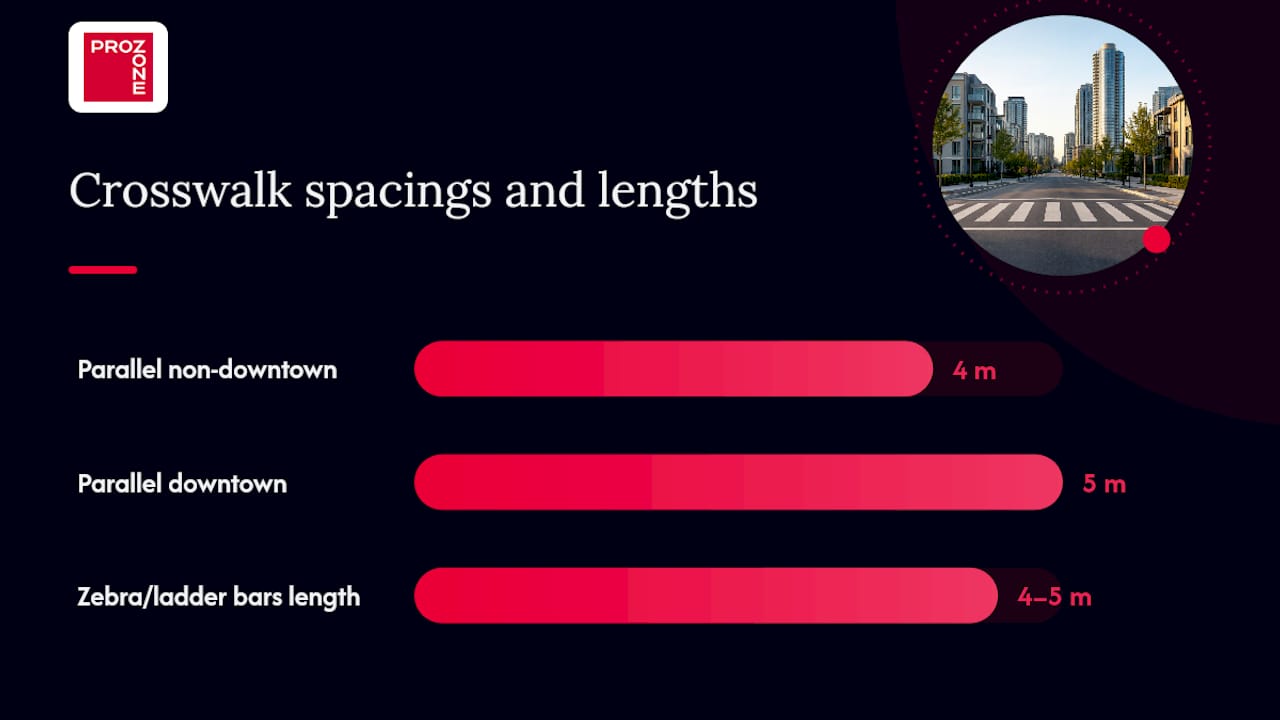
Numbers are where tendering documents go wrong most often, usually because a spec writer copies a figure from the wrong jurisdiction. Edmonton’s manual sets parallel (twin-line) crosswalk stroke widths at 20 cm, with centre spacing of 4 m outside the downtown core and 5 m within it, a distinction that trips up out-of-province contractors regularly.
Crosswalk marking dimensions by type (Canadian examples)
| Marking type | Stroke or bar width | Spacing / length | Governing source |
|---|---|---|---|
| Parallel (twin) lines, non-downtown | 20 cm | 4 m centre spacing | Edmonton Pavement Marking Manual |
| Parallel (twin) lines, downtown | 20 cm | 5 m centre spacing | Edmonton Pavement Marking Manual |
| Zebra/ladder bars | 20 cm | 4 to 5 m length, depending on approach speed | Edmonton Pavement Marking Manual |
| Pedestrian crossover (Level 1/2) | Per diagram | Fixed diagram dimensions | Ontario Reg. 402/15 |
Pro Tip: Never assume the Alberta highway figures apply inside city limits. Edmonton’s own manual takes precedence over the provincial guide for municipal roads, and the two documents do not always agree on stroke width tolerances.
Stop lines are placed relative to the crosswalk edge, not painted flush against it, and their width scales with approach speed under both MUTCDC and provincial guides. Ontario’s shark teeth yield markings and Level 1/2 crossover X markings carry fixed diagram dimensions under O. Reg. 402/15, so a designer working in Ontario should pull that regulation directly rather than estimate from Alberta figures.
When should a crosswalk actually be marked?
Painting a crosswalk is a decision, not a default. TAC’s Pedestrian Crossing Control Guide frames the choice around a mix of numeric warrants and engineering judgment rather than a simple checklist. High approach speeds without supporting signals or signage can actually discourage marking, since an unwarranted painted crossing can create a false sense of protection.
Key conditions that shift the analysis:
- School zones and mid-block locations generally warrant stronger consideration for marked crossings paired with signage.
- Roundabouts require special treatment since marking alone rarely resolves yielding conflicts.
- Where speeds or sightlines are poor, signals or additional signing are needed alongside any marking, not instead of it.
What TAC’s research on non-standard markings means for your policy
TAC’s 2023 review combined a literature scan, simulation work, and a municipal survey to assess decorative and artistic crosswalk treatments spreading across Canadian downtowns. The findings show there is not yet enough consensus to call these treatments uniformly safe or unsafe for pedestrian perception and driver behaviour.
Practical takeaways for a municipal engineering department:
- Treat non-standard markings as a pilot decision, not a default policy, with defined evaluation metrics before wider rollout.
- Retain required parallel or zebra lines under the standard wherever the regulation mandates them, decorative overlay or not.
- Document before/after conflict data if you do pilot a non-standard design, since TAC’s own report notes the evidence base is still thin.
Pro Tip: If council wants a decorative crosswalk, keep the compliant marking underneath or immediately adjacent. A visually striking design that fails to meet MUTCDC’s retroreflectivity or dimension standard creates liability exposure that outweighs the aesthetic benefit.
Materials and maintenance for Edmonton’s freeze-thaw climate
Material selection determines whether a crosswalk survives one Alberta winter or five. Thermoplastic, applied at the correct surface temperature and thickness, typically outlasts standard traffic paint and holds its retroreflectivity longer through repeated freeze-thaw cycles, but it demands proper surface preparation and carries a higher upfront cost. StreetBond offers an aesthetic, textured alternative, though its longevity varies with traffic volume and how aggressively the surface gets ploughed each winter.
- Install thermoplastic when pavement and ambient temperatures fall within the manufacturer’s application window, not on a rushed fall schedule.
- Inspect markings each spring after plow season to catch scraping damage before it becomes a visibility hazard.
- Set remarking thresholds based on retroreflectivity readings, not visual guesswork from a moving vehicle.
Pro Tip: Ask any contractor bidding on marking work for documented surface prep procedures. Thin material applied over a poorly cleaned or damp surface is the single most common cause of premature crosswalk failure we encounter in Alberta municipal work.
How to specify and accept a crosswalk marking project
A clean procurement process protects the municipality from exactly the kind of substandard installation that fails within one winter. Follow this sequence:
- Document the warrant analysis and site conditions before design, referencing the Pedestrian Crossing Control Guide framework.
- Confirm which manual governs the specific road, provincial, municipal, or regulatory, and pull dimensions from that source only.
- Write tender clauses specifying material type, minimum thickness, application temperature range, and required retroreflectivity values.
- Require a warranty period matched to local freeze-thaw exposure, not a generic national default.
- On acceptance, request documented mix data, application temperature logs, and post-install retroreflectivity test results before releasing final payment.
Municipalities that also handle curb ramp alignment as part of the same project should coordinate with Edmonton municipal sidewalk construction standards so ramp centring matches the marked crossing location precisely.
A field perspective on crosswalk installation quality
Most crosswalk failures we see trace back to two causes: inadequate surface preparation and material applied too thin for the temperature at hand. A quick scrape test after cure catches both before winter exposes them. Alberta Safety Codes and certified material sourcing are not paperwork exercises. They are what separates a marking that survives freeze-thaw cycling from one that flakes by March.
— ProZone
How ProZone supports crosswalk marking projects across Alberta
Municipalities and property managers working through crosswalk marking standards in Canada need a contractor who treats the manual, not the calendar, as the deadline. ProZone applies thermoplastic and StreetBond & Thermoplastic surfacing to municipal and commercial specifications, backed by base repair and asphalt work when the pavement underneath needs attention before any marking goes down. Our Parking Lot Maintenance and Commercial Property Maintenance programs keep retroreflectivity and stripe integrity on a documented inspection schedule rather than a reactive one.

Free on-site consultations within 100 km of Edmonton are available, serving municipal, commercial, and private clients across the surrounding region. If your department has a marking project moving through tender, or an existing crosswalk showing wear after this year’s freeze-thaw cycle, request a free estimate through our online contact form or call ProZone directly to talk through your specification before you finalize it.
Key manuals and regulations to keep on file
- MUTCDC, the national baseline for pavement markings and pedestrian devices.
- TAC’s non-standard markings report, for decorative treatment policy decisions.
- Edmonton’s Pavement Marking Design manual, for city-specific stroke and spacing figures.
- Alberta’s Highway Pavement Marking Guide, for provincial application guidance.
- Ontario Regulation 402/15, for pedestrian crossover legal dimensions.
Always confirm the final dimensions against your own municipality’s standard drawing before tendering. National and provincial documents set the framework, but the local figure is what a contractor is legally bound to build.
Sources
- TAC releases research report on non-standard crosswalk pavement markings
- Manual for pavement marking design (City of Edmonton)
- Alberta Highway Pavement Marking Guide 2003
- O. Reg. 402/15: Pedestrian crossover signs
FAQ
What are the rules for pedestrian crosswalks in Ontario?
Ontario governs pedestrian crossovers through Regulation 402/15, which specifies exact sign and marking diagrams for Level 1 and Level 2 crossovers, ladder crosswalks, and shark teeth yield markings. Municipalities must follow these dimensions exactly rather than substitute generic MUTCDC figures for a legally designated pedestrian crossover.
What are the minimum dimensions for crosswalk markings under MUTCDC?
MUTCDC sets national principles for pavement marking width and retroreflectivity but leaves precise stroke and spacing figures to provincial and municipal manuals. Edmonton’s own manual, for example, specifies 20 cm stroke widths with 4 m centre spacing outside downtown and 5 m within it.
What road markings are used for pedestrian crossings in Canada?
The two dominant styles are parallel (twin) lines, typically used at signalized intersections, and zebra or ladder bars, preferred for unsignalized and mid-block crossings because they improve driver visibility. The Alberta Pavement Marking Guide confirms this split in its application guidance.
What are the main categories of roadway markings?
Roadway markings generally fall into longitudinal lines (centrelines, lane lines), transverse markings (stop lines, crosswalks, yield teeth), word and symbol markings, curb markings, object markers, and delineators. Crosswalk markings sit within the transverse category and carry the strictest dimensional requirements because they govern pedestrian safety directly.
Does ProZone install crosswalk markings for municipal clients?
Yes. ProZone applies thermoplastic and StreetBond surfacing for municipal and commercial crosswalk projects across Edmonton and the surrounding Alberta region, with pricing available on request through the services page.