
Choose microsurfacing when rutting, waterproofing and extended service life matter most, since polymer-modified binders cure quickly and withstand heavier traffic loads. Choose slurry seal when the goal is low-cost surface renewal and better friction on a pavement that is otherwise structurally sound. The trade-offs come down to cost, cure time, equipment and sensitivity to moisture, all of which we break down below alongside mix design, application steps and a procurement checklist.
Table of Contents
- Slurry seal vs microsurfacing: a side-by-side technical comparison
- What goes into each mix and why it matters
- How each treatment is applied and what can go wrong on site
- How durable is each treatment, and where does it fall short?
- ProZone’s field checklist for choosing and specifying the right treatment
- Why the simplest choice usually wins
- Get a pavement assessment and free estimate from ProZone
- FAQ
- Sources
Slurry seal vs microsurfacing: a side-by-side technical comparison
Both treatments are thin, cold-applied surface systems built from emulsified asphalt and fine aggregate, but they diverge in binder chemistry, equipment demands and what each one can realistically fix.
Composition. Slurry seal relies on slow-setting emulsions, fine aggregate and mineral filler. Microsurfacing uses a polymer-modified emulsion with crushed aggregate, which gives it a faster break and stronger bond to the existing surface, as agency specifications for micro surfacing confirm.
Thickness and application rate. Slurry is typically placed at around 3 millimetres, roughly 1 tonne per 1,500 square metres, according to emulsified asphalt specifications from Saskatoon. Microsurfacing is applied in defined scratch and surface lifts to correct minor rutting, a thickness profile that standard slurry mixes cannot achieve.
Equipment and crew skill. Slurry works with continuous-flow mixers and calibrated spreader boxes. Microsurfacing plants need tighter polymer-dosing controls and operators trained to manage faster-setting material before it breaks on the paver box.
Curing and traffic reopening. Slurry seal generally needs a longer curing window under cool or humid conditions. Microsurfacing, because of its polymer content, often reopens to traffic faster, a practical advantage on active commercial lots.
Service life and best use. Slurry seal is best suited to friction renewal and sealing minor surface oxidation on pavement with no structural distress. Microsurfacing is the better fit for rut correction, as polymer-modified treatments have reduced rutting by 90 to 96% in some field studies and extended pavement service life by an estimated 4.9 to 8.8 years in some tested sections.
Cost drivers. Three factors move price on both treatments:
- Aggregate gradation and polymer content, which raise material cost for microsurfacing.
- Mobilization distance and lot size, since smaller lots cost more per square metre.
- Weather windows, as cold or wet conditions extend crew time and curing delays.
In short, the decision sequence is:
- Confirm whether the distress is cosmetic (oxidation, minor raveling) or structural (rutting, cracking through the base).
- Match cosmetic distress to slurry seal and rutting or moisture concerns to microsurfacing.
- Verify drainage and traffic volume before committing to either system.
What goes into each mix and why it matters
Mix design is where these two systems earn their different performance profiles. Slurry seal uses a slow-setting emulsion so the mixture stays workable long enough to spread evenly before it sets. Microsurfacing uses a polymer-modified emulsion specifically so it can “break” faster on the pavement, which is what allows early traffic reopening.
Typical mix figures:
- Microsurfacing mixes contain 82 to 90% aggregate, 1.5 to 3.0% mineral filler and 5.5 to 9.5% residual asphalt.
- Slurry seal uses a comparable fine aggregate and filler structure but without the added polymer, relying instead on the emulsion’s natural set characteristics, as the International Slurry Surfacing Association notes in distinguishing the two systems.
- Filler type and percentage directly affect how quickly the mix breaks and how resistant the cured surface is to raveling.
For spec writers: polymer content and aggregate gradation should be verified against the project’s agency manual before mix approval, not assumed from a supplier’s standard formula.
How each treatment is applied and what can go wrong on site
Surface prep is identical in principle for both treatments: sweep the pavement, rout and seal cracks, and apply a tack or scratch coat where the specification calls for one. Skipping this step is the single most common cause of early delamination.
- Calibrate the mixer or microsurfacing plant before production, confirming emulsion-to-aggregate ratio against the approved mix design.
- Control spreader speed. Agency manuals cap speeds (commonly around 55 metres per minute) to avoid streaking and pickup, as specified by Saskatoon’s construction guidelines.
- Run a trial batch and document the results, since most agency specifications require this step at the contractor’s expense.
- Monitor curing before reopening to traffic, adjusting for ambient temperature and humidity.
- Suspend application if rain is forecast within the curing window; moisture before the emulsion breaks ruins the bond.
Watch for drag marks, excess pickup on tires, or an uneven scratch coat. These are early warnings of a bad mix ratio or an operator moving the spreader too fast.
Pro Tip: Request the trial batch report in writing before production begins; it is your clearest evidence the mix design matches site conditions.
For a deeper look at timing expectations, our guide on asphalt curing time covers return-to-traffic variables that apply to both treatments.
How durable is each treatment, and where does it fall short?
Service life depends heavily on correct specification and traffic matching, not just material choice. Institutional testing gives a reasonable range to plan around, but neither treatment substitutes for structural repair where the base has failed.
- Microsurfacing has shown rutting reductions of 90 to 96% in some field studies, with service life extensions of roughly 4.9 to 8.8 years when specified for the correct traffic class.
- Slurry seal is primarily a friction and cosmetic renewal treatment; it restores surface texture and slows oxidation but does little to correct existing rutting.
- Both treatments carry moisture risk: microsurfacing can trap moisture in areas with shallow groundwater or heavy rainfall if drainage is not addressed first, a concern the LSU moisture damage study flags directly.
- In Edmonton’s freeze-thaw climate, trapped moisture that refreezes can accelerate cracking under either surface treatment.
- Where cracking extends through the base course or rutting exceeds a few centimetres, a full overlay or structural repair is the appropriate fix, not a thin surface treatment. See our breakdown of road repair methods for that threshold.
ProZone’s field checklist for choosing and specifying the right treatment
Crews experienced with both treatments note that freeze-thaw cycling is the dominant stress factor on any thin surface system in this region, so knowing how to choose contractor for waterproofing success can be critical to ensuring proper moisture control and durability.
Before you brief a contractor, confirm:
- Pavement condition: rutting depth, crack pattern and whether distress is surface-level or structural.
- Drainage: standing water or poor grade near the treatment area, especially ahead of microsurfacing.
- Traffic class: daily volume and vehicle weight, which determine mix design and polymer content.
- Existing asphalt thickness, since thin base layers may need structural repair before any surface treatment.
Contract items worth requesting: a lab-verified mix design, documented polymer content for microsurfacing, a pilot patch before full production, and a written protection-time and warranty period.
Pro Tip: In this climate, schedule either treatment for a window with stable temperatures above typical minimums and no rain forecast through the full cure period.
Why the simplest choice usually wins
The conventional advice treats slurry seal and microsurfacing as interchangeable “preventive maintenance” options, picked mainly on price. That framing undersells how different their failure modes are. Slurry seal on a rutted lot looks fine for a season and then telegraphs the same rutting back through the new surface, because it was never designed to correct structural deformation.
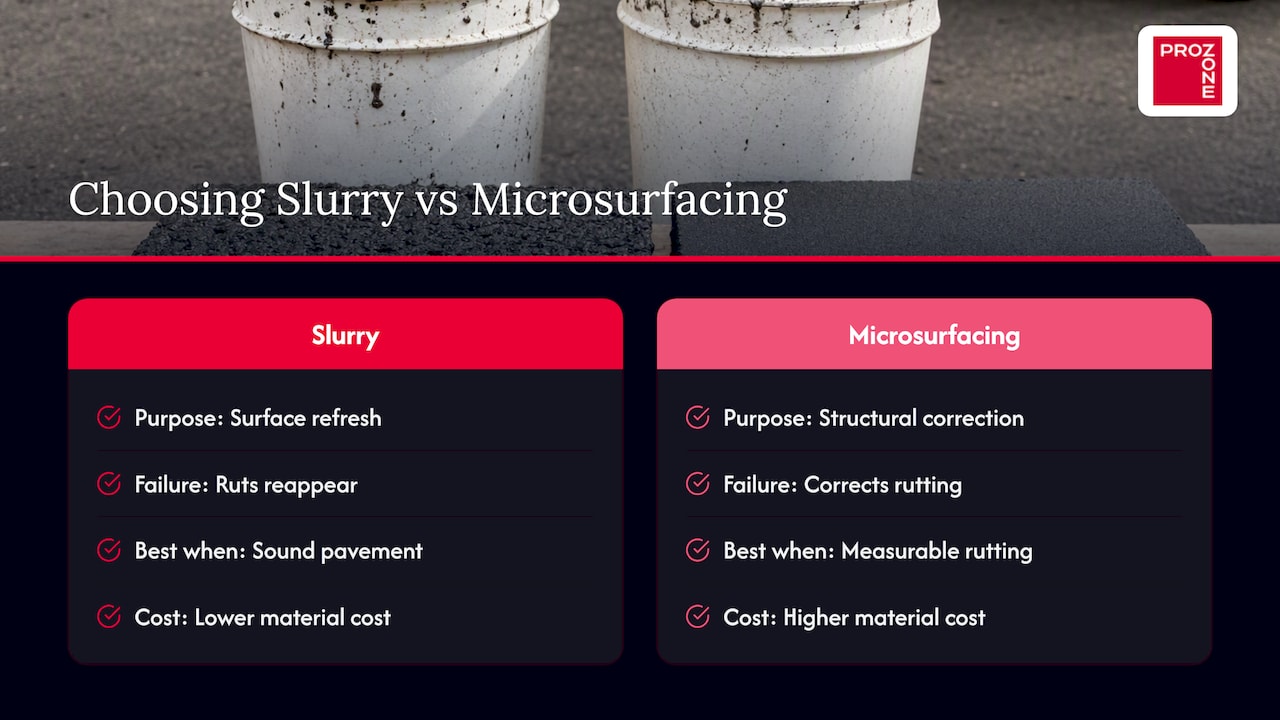
The judgment the evidence actually supports is narrower: match the treatment to the distress, not the budget line. If the pavement is structurally sound and the complaint is faded, slick or oxidized surface, slurry seal is the economical answer. If there is measurable rutting or a need to buy several years of life before a full overlay, microsurfacing is worth the added material cost.
What gets overlooked most often is drainage. A specification can get the mix design right and still fail if water sits against the treated surface through a freeze-thaw cycle. Readers should prioritize a drainage check before comparing material costs, not after.
— ProZone
Get a pavement assessment and free estimate from ProZone
Deciding between these two treatments is easier with a site visit than with a spec sheet alone. Our crews assess rutting, drainage and existing asphalt condition before recommending slurry seal, microsurfacing or a different approach from our asphalt services, which also cover crack sealing, patching and full-depth repair.
We work to Alberta Safety Codes standards and specify mixes with documented polymer content and trial batch results rather than relying on generic supplier formulas, a distinction that matters most once freeze-thaw cycling starts working on a poorly specified surface.
Call us or use our online estimate form to book a free on-site assessment for your parking lot, roadway or commercial property.
FAQ
What is microsurfacing in roads?
Microsurfacing is a thin, cold-applied pavement treatment made from polymer-modified asphalt emulsion, crushed fine aggregate and mineral filler. It is designed to correct minor rutting, restore surface texture and extend pavement life, with documented reductions in rutting of 90 to 96% in some studies.
Can you walk on road slurry?
Pedestrian traffic is generally restricted until the slurry has cured enough to resist marking, which depends on temperature, humidity and the specific emulsion used. Always follow the contractor’s posted cure time rather than estimating by appearance, since a surface can look set while still soft underneath.
Can you seal coat over chip seal?
Slurry seal and similar surface treatments can be applied over an existing chip seal once loose aggregate is swept and any surface distress is addressed first. The existing chip seal must be structurally sound, since neither slurry seal nor microsurfacing corrects underlying base failures.
How long does asphalt slurry last?
Slurry seal is a surface renewal treatment rather than a structural fix, so its service life depends heavily on traffic volume and climate exposure rather than a single fixed figure. Properly specified microsurfacing, by comparison, has extended service life by an estimated 4.9 to 8.8 years in tested field sections.