
Plan for a typical range around 700 to 1,000 pounds per cubic yard for most common wood mulches. Light pine straw is notably lighter, and wet or composted mulch can be significantly heavier. When a supplier cannot confirm exact weight, use an intermediate figure as a safe planning estimate. One cubic yard corresponds to roughly 13.5 standard 2-cubic-foot bags. Loads exceeding half a cubic yard warrant a vehicle payload capacity check prior to pickup delivery; you can shortlist trucks fast to find suitable fleet options for such deliveries.
Table of Contents
- 1. Typical weight ranges by mulch type
- 2. Bulk density and moisture: how weight really varies
- 3. Conversions: cubic yards to cubic feet, bags, and kilograms
- 4. Transport and handling: load limits and delivery options
- 5. Practical guidance for verifying your delivery
- 6. Why accurate weight estimates matter on real projects
- How ProZone can help with your mulch order
- FAQ
- Sources
1. Typical weight ranges by mulch type
Mulch weight depends heavily on what the material is made of and how wet it is. Shredded hardwood packs tighter than coarse bark chips, and fresh material holds more moisture than material that’s been stockpiled and dried.
Here are planning ranges for common types, covering both imperial and metric units:
- Shredded hardwood mulch: 800 to 1,000 lb per cubic yard (475 to 595 kg per m³); use 900 lb as a default.
- Bark chip mulch (coarse): 600 to 800 lb per cubic yard (355 to 475 kg per m³); use 700 lb as a default.
- Composted or screened mulch: 1,000 to 1,200+ lb per cubic yard (595 to 710+ kg per m³), consistent with the ranges reported for screened composts near 50 percent moisture.
- Pine straw: 350 to 450 lb per cubic yard (210 to 265 kg per m³); the lightest common option.
- Dyed wood mulch: 700 to 900 lb per cubic yard (415 to 535 kg per m³), similar to natural hardwood once dye is applied.
The spread within each category comes down to particle size, the ratio of fine particles to coarse chunks, and moisture content. A stockpile that’s been rained on recently, or stored under tarp without drainage, will sit at the heavy end of its range. Dyed mulch isn’t inherently heavier than natural mulch; the colourant adds negligible mass. When in doubt, ask your supplier whether the pile was turned or watered recently; both increase as-delivered weight.
2. Bulk density and moisture: how weight really varies
Bulk density is the mass of material per unit of volume, and it’s the single biggest factor separating a light, dry yard of mulch from a heavy, saturated one. The Oregon State University Extension explains that bulk density converts volume into usable weight, and that moisture must be reported alongside it because wet material weighs substantially more than the same material dry. A swing of 10 to 20 percent in moisture content can shift a cubic yard’s weight by 100 pounds or more.
You can estimate bulk density yourself with a simple bucket test, adapted from OSU’s field method:
- Fill a five-gallon bucket loosely with the mulch sample, without packing it down.
- Weigh the bucket and mulch together, then subtract the bucket’s empty weight.
- Multiply that net weight by 40.14 to estimate pounds per cubic yard (a five-gallon bucket is roughly 1/40.14 of a cubic yard).
- Repeat with a second sample and average the results for accuracy.
Before accepting a bulk quote, ask your supplier for the scale ticket, a statement on moisture condition, and confirmation of the units shown on the receipt. Measurement Canada requires that the total amount supplied appear on the container or receipt in metric or imperial units, whether the product is sold by volume or by weight.
Pro Tip: Ask for the weight ticket at delivery, not just the volume quote; a documented weight resolves disputes faster than any online average.
3. Conversions: cubic yards to cubic feet, bags, and kilograms
A cubic yard equals 27 cubic feet, which is the basis for every bag conversion you’ll need. Working from that single fact simplifies most mulch math.
- 1 cubic yard = 27 cubic feet, so a standard 2-cubic-foot bag means 13.5 bags per cubic yard.
- A 1-cubic-foot bag requires 27 bags per cubic yard.
- 1 cubic yard ≈ 0.7646 cubic metres, useful when a supplier quotes bulk volume in metric units, as some do under Measurement Canada rules.
- To convert pounds to kilograms, divide by 2.2046.
The weight formula is straightforward: weight = bulk density × volume. For 2 cubic yards of shredded hardwood at 900 lb per cubic yard, that’s 2 × 900 = 1,800 pounds, or roughly 816 kilograms. If you’re buying 40-pound bags instead, 1,800 pounds divided by 40 means 45 bags, and 45 bags at 2 cubic feet each gives you about 3.3 cubic yards of coverage once you account for bag volume rather than weight alone.
4. Transport and handling: load limits and delivery options
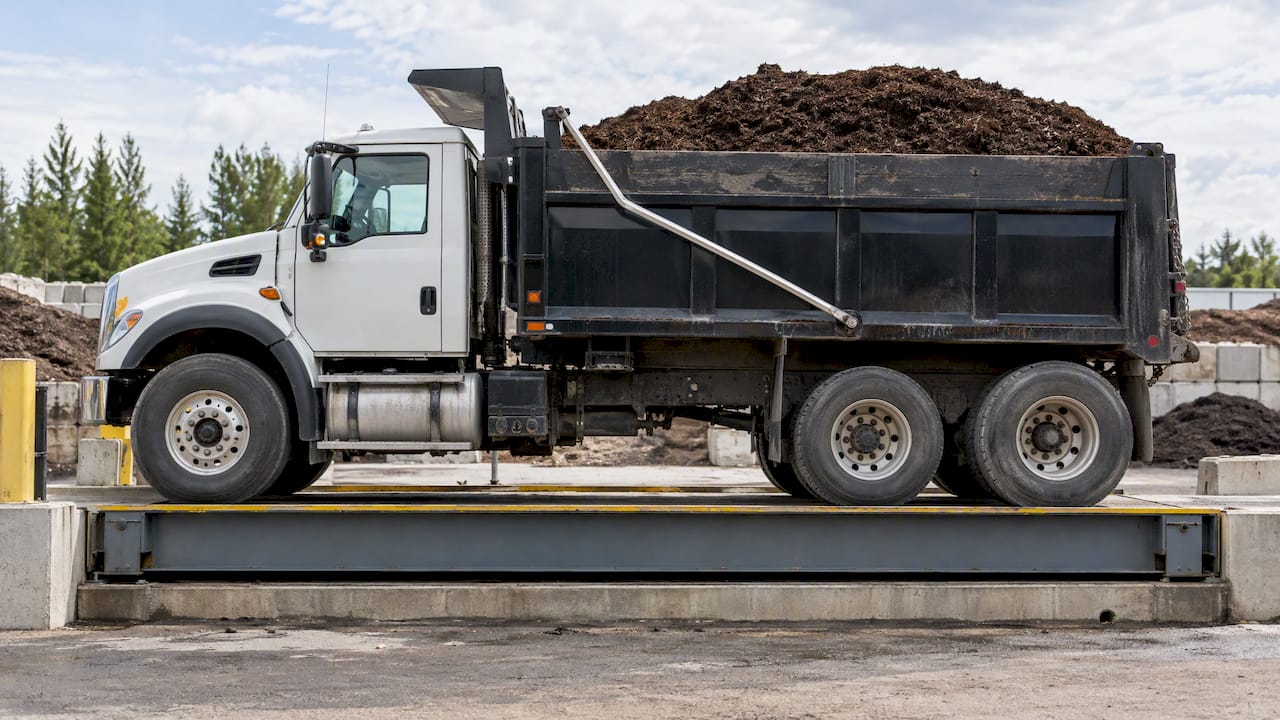
Payload capacity and box volume are two different limits, and mulch tests both. A half-ton pickup typically has a payload rating of around 1,500 to 2,000 pounds, but its box volume rarely holds more than about 1.5 cubic yards of loosely piled mulch before material spills over the sides.
That means 2 cubic yards of wet hardwood mulch, at roughly 1,800 to 2,000 pounds, can max out payload before the box is even full. Here’s how to plan around it:
- Weigh your empty vehicle’s payload rating against the expected load (volume × bulk density) before ordering.
- For wheelbarrow moves, use an 85-litre wheelbarrow as your reference: it holds about 0.11 cubic yards per level load, so a full cubic yard takes roughly 9 trips, each carrying 80 to 110 pounds depending on mulch type.
- Request pallet delivery with forklift unloading when total weight or volume exceeds what you can safely tip or shovel by hand.
- Confirm site access width and protect driveways or walkways with plywood sheeting before a loaded truck or forklift crosses them.
5. Practical guidance for verifying your delivery
We quote mulch by volume at the point of order, but we always recommend confirming weight at delivery when the load is significant. A scale ticket removes the guesswork that comes with estimating bulk density from memory or a generic chart.
On-site, we check:
- The delivery weight ticket against the quoted volume and expected bulk density.
- Moisture condition of the pile, since a recently watered or rained-on load weighs more than the quote assumed.
- Particle size consistency, since a mix heavy in fines compacts differently than coarse chips.
- Coverage depth against the standard 2 to 4 inch mulch guideline to confirm the ordered volume will actually cover the intended area.
In freeze-thaw climates, coarser mulch resists compaction and heaving better than fine, dense material, and keeping mulch clear of drainage paths prevents blockages when spring thaw hits.
Pro Tip: Order slightly coarser mulch for driveway borders and drainage edges; fine, compacted material is more prone to shifting during freeze-thaw cycles.
6. Why accurate weight estimates matter on real projects
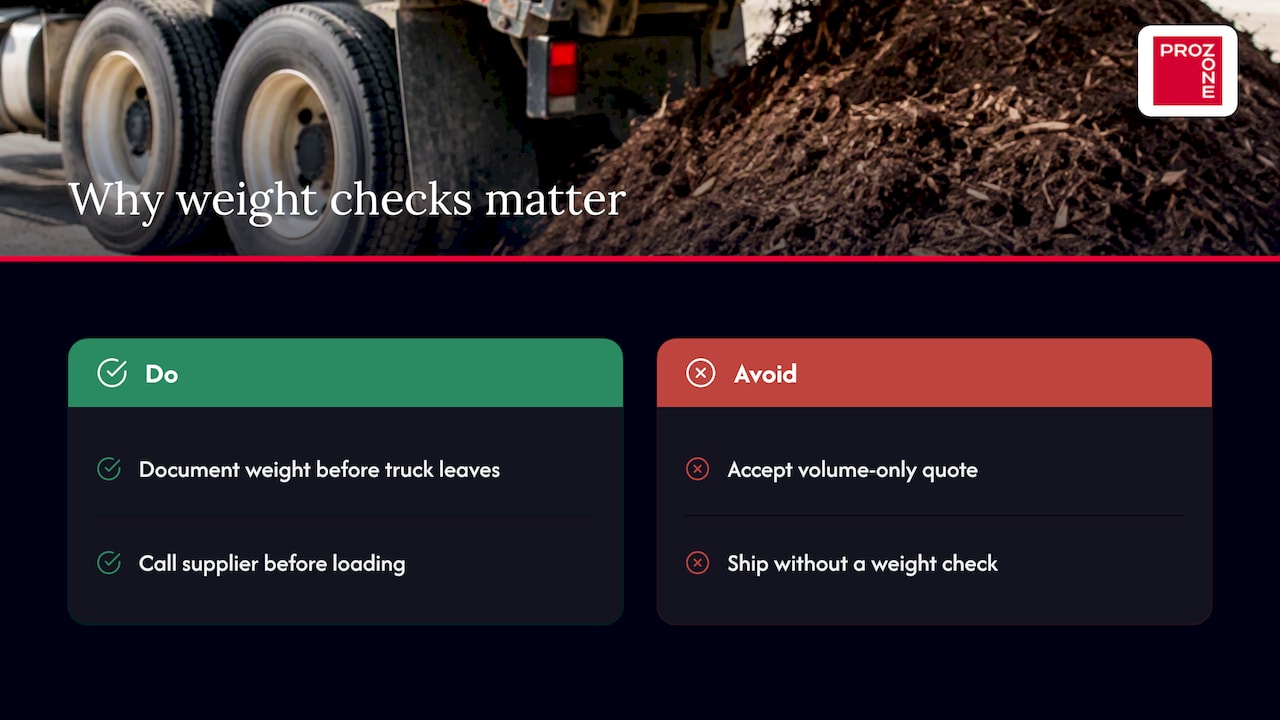
Underestimating mulch weight causes real problems: overloaded trucks, cracked driveway surfaces, and crews stuck doing extra handling that wasn’t in the original plan. We’ve seen all three stem from a quote based on volume alone.
A documented weight check, done before the truck leaves the yard, prevents disputes and keeps delivery schedules on track. For readers who want that level of handling on a mulch order or a larger material supply job, a quick call settles the details before anything gets loaded.
— ProZone
How ProZone can help with your mulch order
We supply bark and mulch chips alongside the rest of our landscape materials, and we quote by volume while confirming weight before delivery so you’re never guessing what’s arriving on your property. For loads that exceed safe hand-tipping limits, we offer pallet delivery with forklift handling, which helps manage heavy or bulk orders safely and protects your driveway surface.
Here’s what that looks like in practice:
- Flexible delivery windows arranged to accommodate project schedules.
- Free on-site consultations available within a reasonable distance for those planning larger material orders.
- Direct access to our black mulch product line and other bark and chip options through the supplies centre.
- Pallet delivery options detailed on our pallet product page for sites where loose tipping isn’t practical.
Request a free estimate through our landscape supplies centre or call us directly to get a delivery and weight-checked quote for your next mulch order.
FAQ
Will 1 yard of mulch fit in a pickup truck?
A full-size pickup box can often hold close to 1 cubic yard of loosely piled mulch, but payload rating matters more than box volume. Common wood mulches usually have a bulk density that allows most half-ton trucks to safely carry one cubic yard, though wetter or composted mulch increases weight and could approach vehicle payload limits.
How many wheelbarrows are 2 yards of mulch?
Using an 85-litre wheelbarrow as a reference, each load holds about 0.11 cubic yards, so one cubic yard takes roughly 9 full wheelbarrow trips. Two cubic yards take about twice as many trips, with each load weighing roughly 80 to 110 pounds depending on the mulch type.
How many 40 pound bags of mulch equal a yard?
It depends on the mulch’s bulk density, but at a common planning figure of 900 pounds per cubic yard, you’d need about 20 to 23 bags of 40-pound mulch to equal one cubic yard. Lighter mulches, like pine straw, would need fewer bags by weight but more by volume since bag sizing is usually based on cubic feet, not pounds.
What does 5 yards of mulch weigh?
Using a moderate planning bulk density estimate, 5 cubic yards of mulch will weigh several thousand pounds. Lighter materials like pine straw reduce total weight, while wet or composted mulch increases it substantially. It is advisable to confirm bulk density with your supplier before ordering larger loads to ensure safe handling and transport.