
A cubic yard of typical gravel weighs about 1.1 to 1.5 metric tonnes, or roughly 2,425 to 3,300 pounds. In short tons, that works out to approximately 1.2 to 1.65 tons per yard. The exact figure depends on the material, its moisture content, and how it was processed, so we always confirm density with the supplier before ordering or hauling.
Table of Contents
- How to convert cubic yards to tonnes, short tons, and pounds
- Typical weights by material: quick reference table
- Factors that change the weight of a yard of gravel
- Vehicle loading and safe hauling: payload, GVWR and practical checks
- How much extra to order, supplier units, and price band for planning
- ProZone checklist: ordering, accepting delivery, and verifying weight
- Project manager perspective: summary and practical next steps
- Order material or request a free estimate from ProZone
- FAQ
- Sources
How to convert cubic yards to tonnes, short tons, and pounds
Before placing an order, it helps to understand the units involved. One cubic yard equals 27 cubic feet, or about 0.7646 cubic metres. One metric tonne equals 1,000 kilograms, or about 2,204.6 pounds. One short ton, the unit commonly used in truck weigh tickets across North America, equals 2,000 pounds.
The core formula is simple: weight equals volume multiplied by bulk density. In metric terms, that is cubic metres times tonnes per cubic metre. In imperial terms, it is cubic yards times pounds per cubic yard.
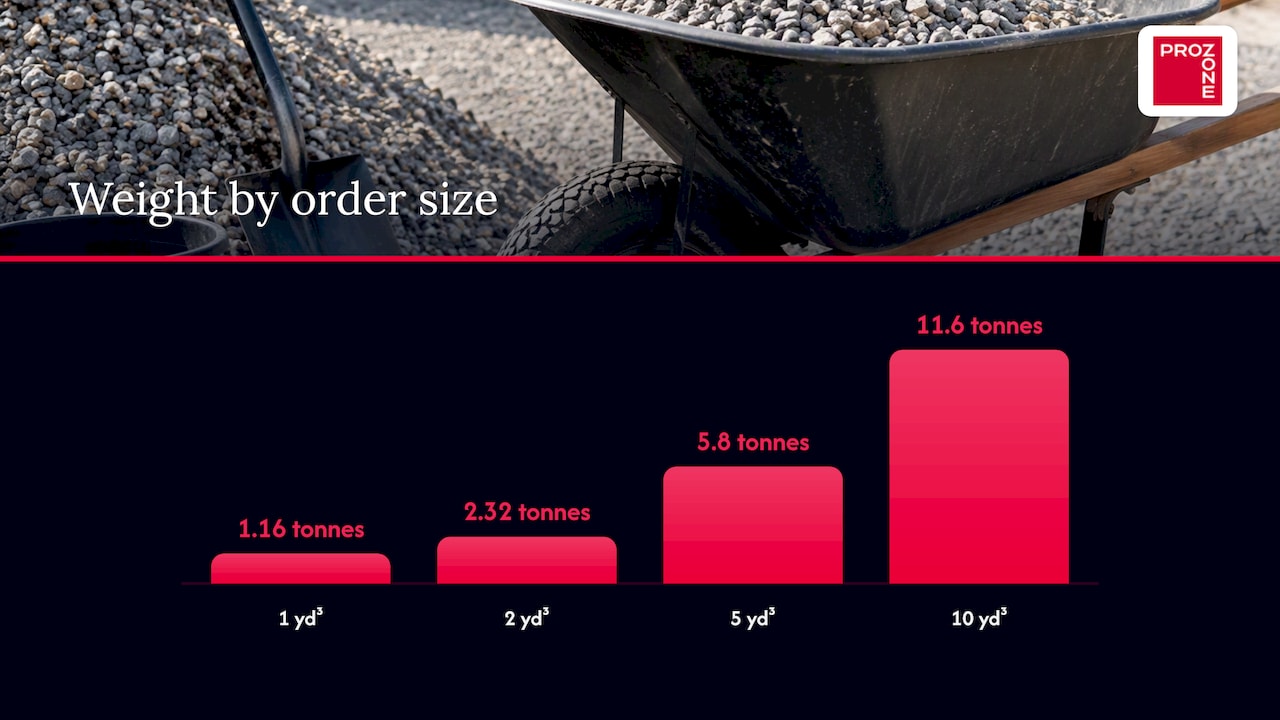
Here is how that plays out for common order sizes, using a mid-range density of 1.52 tonnes per cubic metre:
- 1 yd3: approximately 1.16 tonnes, or about 2,560 pounds.
- 2 yd3: approximately 2.32 tonnes, or about 5,120 pounds.
- 5 yd3: approximately 5.8 tonnes, or about 12,800 pounds.
- 10 yd3: approximately 11.6 tonnes, or about 25,600 pounds.
These figures shift with the specific material, which is why the next section breaks down typical densities by type.
Typical weights by material: quick reference table
Different aggregates settle at different points along that 1.1 to 1.5 tonne per cubic yard band. Crushed, angular materials used for road base tend to sit near the heavier end, while rounded, washed stone tends toward the lighter end.
| Material | Typical density | Approx. weight per yd3 |
|---|---|---|
| Crushed stone | ~1.60 t/m3 | ~1.22 t |
| Road crush | ~1.45 t/yd3 | ~1.45 t |
| Pea gravel | ~1.40 t/yd3 | ~1.40 t |
| River rock | ~1.35 t/yd3 | ~1.35 t |
| Limestone | ~1.68 t/m3 | ~1.28 t |
| Screened gravel | ~1.52 t/m3 | ~1.16 t |
A few patterns stand out when comparing these numbers:
- Angular, compacted base materials like road crush pack tighter and weigh more per yard than rounded river rock.
- Limestone and crushed stone sit near the heavy end because of their mineral density and tight particle packing.
- Local quarry sourcing and grading specification can shift any single product’s density by several percentage points, which is why we always treat a published table as a starting point, not a final number.
Factors that change the weight of a yard of gravel
Moisture is the single biggest variable in day-to-day ordering. Aggregate pulled straight from a wet stockpile can weigh roughly 5 to 12 percent more than the same material dry, simply because water fills the voids between particles.
Compaction and particle shape matter just as much for planning. A crushed, angular base material locks together and settles into a smaller footprint than a rounded river rock of the same volume, which is why crushed products often read heavier per yard.
Grading, meaning the mix of fine and coarse particles in a load, also shifts bulk density: a well-graded mix with fines packs tighter than a uniform, single-size product.
- Wet material can add measurable weight over dry estimates, particularly after rain or snowmelt.
- Crushed, angular stone typically weighs more per yard than smooth, rounded stone.
- Fines filling the gaps between larger particles increase bulk density.
- Loose, freshly dumped material occupies more volume on site than the same tonnage once it settles or is compacted.
Pro Tip: Ask your supplier whether their quoted density reflects loose or compacted material, since the difference changes both your tonnage order and your final coverage area.
Vehicle loading and safe hauling: payload, GVWR and practical checks
Before loading gravel into any vehicle, confirm two numbers: Gross Vehicle Weight Rating (GVWR), the maximum total weight a vehicle is built to carry including itself, and payload, the GVWR minus the vehicle’s own weight. Both are listed on a door-jamb sticker or in the owner’s manual.
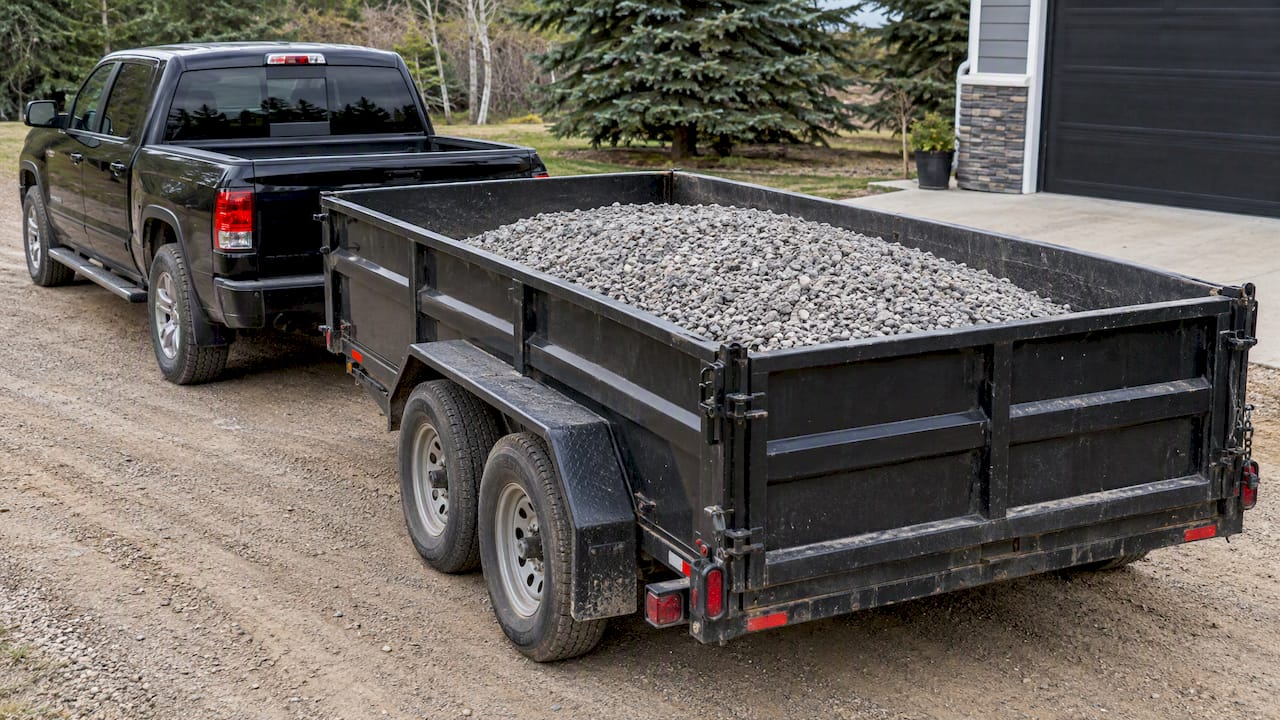
A standard half-ton pickup has a limited payload that a single cubic yard of denser gravel may approach or exceed. Add passengers, fuel, and any trailer tongue weight, and the margin shrinks further.
For heavier commercial loads, the Alberta commercial vehicle weights and dimensions guide sets out axle and gross weight limits that apply to larger trucks and trailers hauling aggregate.
- Calculate total loaded weight: material weight plus vehicle curb weight, passengers, and fuel.
- Compare that total against the vehicle’s GVWR and payload rating.
- Confirm the actual delivered weight with a scale ticket rather than relying on a volume estimate alone.
How much extra to order, supplier units, and price band for planning
Gravel compacts after placement, so ordering the bare minimum volume often leaves a shortfall once it settles. We recommend building in an overage allowance of roughly 5 to 20 percent, with the higher end reserved for base layers that will be compacted under pavement or heavy structures.
Most suppliers in our region sell by the metric tonne rather than the cubic yard, so a quote needs a stated conversion factor to compare fairly against a yard-based estimate. When a supplier quotes by weight, ask them to confirm the bulk density they used so you can back-calculate the volume you are actually receiving.
- A 5 percent allowance suits a thin, decorative topping that will not be heavily compacted.
- A 15 to 20 percent allowance suits a structural base course under a driveway or parking surface.
- Always request the per-tonne price and the assumed density together, since the two numbers determine your true cost per yard.
ProZone checklist: ordering, accepting delivery, and verifying weight
Years of coordinating aggregate deliveries across freeze-thaw cycles in the Edmonton region have taught us to treat density confirmation as a non-negotiable step, not a formality. Before the truck arrives, we ask the supplier for the product’s bulk density or conversion factor along with the exact product name, so the volume on paper matches the tonnage on the ticket.
On delivery, we request a scale ticket and check it against the product ordered and its moisture condition, since a wet load can run heavier than the dry estimate used for planning. We also specify the delivered condition, loose or compacted, up front so there is no ambiguity about final coverage.
- Confirm the supplier’s bulk density and product name before the order is placed.
- Request a scale ticket at delivery and compare it to the quoted volume.
- Specify loose or compacted delivery condition in the order notes.
- For base courses exposed to freeze-thaw cycles, select a well-graded, angular material that resists frost heave better than rounded, uniform stone.
Pro Tip: Keep the scale ticket on file for any commercial order. It is the fastest way to resolve a dispute if the delivered tonnage does not match the quote.
Project manager perspective: summary and practical next steps
The weight band for a yard of gravel is wide enough that a single published number is never good enough for a real order. Supplier density, moisture, and particle shape move the figure by hundreds of pounds per yard, and payload limits leave less margin than most drivers expect.
Confirm the density, get the scale ticket, and check the payload before the truck leaves the yard. For anything beyond a small decorative project, we recommend having ProZone confirm the numbers with you directly.
— ProZone
Order material or request a free estimate from ProZone
Getting the weight calculation right matters less once the ordering and hauling is handled by a crew that checks density, scale tickets, and payload as a matter of course. We supply Road Crush and pea rock for base work and landscaping, with Moffett truck delivery that places material exactly where your project needs it, and every delivery is backed by scale-ticket verification.
- We offer free on-site consultations for project quotes and material planning.
- Browse our landscape supplies centre for gravel, sand, and related materials available for order.
- Reach out through our contact page to request a free estimate or coordinate a delivery.
Use our online form or call us directly to get a quote built around your project’s specifics, not a generic average.
FAQ
How much does 1 yard of gravel weigh in tons?
A cubic yard of typical gravel weighs roughly 1.2 to 1.65 short tons, depending on the material and moisture content. Crushed stone and road base products tend toward the heavier end of that range.
How heavy are rocks?
Rock weight depends entirely on the mineral and how it is processed, so there is no single figure that applies to all rock. Crushed stone used in construction typically runs around 1.60 tonnes per cubic metre, while decorative river rock tends to be lighter per unit volume.
What is the weight of granite per cubic foot?
Granite is a dense igneous rock, and solid granite is considerably heavier than crushed gravel of similar size because it lacks the air gaps found in a loose aggregate pile. For crushed granite gravel products, the same density principles in our material table apply, since bulk density accounts for both the mineral and the voids between particles.
Will a yard of gravel fit in a pickup?
A cubic yard of denser gravel can weigh close to or beyond the payload rating of a standard half-ton pickup, so it often will not fit safely even if it fits physically in the box. Check your vehicle’s payload sticker and consider splitting the load or using a trailer rated for the weight.