
Concrete is not a single material. It is a family of engineered mixes, and choosing the wrong one for an Alberta project can trigger premature failure, inflated maintenance budgets, and serious liability exposure. Durability and performance depend on matching the concrete type to local conditions, and in Alberta, those conditions are unforgiving. This guide gives property developers and commercial contractors a clear, practical framework for selecting the right concrete type based on structural demands, exposure class requirements, and long-term lifecycle performance.
Table of Contents
- Why concrete type matters for Alberta projects
- Core types of concrete and their key properties
- Comparing durability: Freeze-thaw, chlorides, and real-world risk
- Expert insights: Strength, mix design, and lifecycle performance
- How to choose the right concrete for your project
- Partner with concrete specialists for your next Alberta project
- Frequently asked questions
Key Takeaways
| Point | Details |
|---|---|
| Know CSA classes | CSA exposure classes define mix requirements for durability in Alberta’s unique environment. |
| Durability is critical | High-performance and high-strength concretes significantly outperform standard mixes in freeze-thaw and chloride scenarios. |
| Evaluate lifecycle costs | Investing in the right mix up front minimizes repairs and extends infrastructure service life. |
| Expert input helps | Consult with concrete specialists for complex or high-stakes projects. |
Why concrete type matters for Alberta projects
Alberta’s climate is one of the most demanding environments for concrete in North America. Temperature swings of 40 degrees Celsius or more between seasons create relentless freeze-thaw cycles that destroy poorly specified mixes from the inside out. Surface scaling, internal cracking, and spalling are not random events. They are predictable outcomes of using the wrong concrete in the wrong exposure class.
Canada’s governing standard, CSA A23.1 exposure classes, sets minimum compressive strength, maximum water/cement (w/cm) ratio, and air content requirements for every exposure scenario. These classes are not optional guidelines. They are the baseline for code compliance, warranty protection, and public safety on roads, sidewalks, and structures.
Here is what improper concrete selection costs you in practice:
- Maintenance costs can double or triple over a 20-year lifecycle
- Premature failure on public infrastructure creates liability and project delays
- Non-compliant mixes can void warranties and trigger regulatory penalties
- Freeze-thaw damage to flatwork often appears within the first two winters
Pro Tip: Always ask your ready-mix supplier for written documentation confirming compliance with the applicable CSA A23.1 exposure class before a single truck rolls onto your site. Review our concrete flatwork guide for a deeper look at how exposure class affects flatwork specifications.
Core types of concrete and their key properties
With a clear sense of why concrete selection matters, let’s examine the main types you will encounter on Alberta job sites. Each category has a distinct mix design, strength range, and application profile.
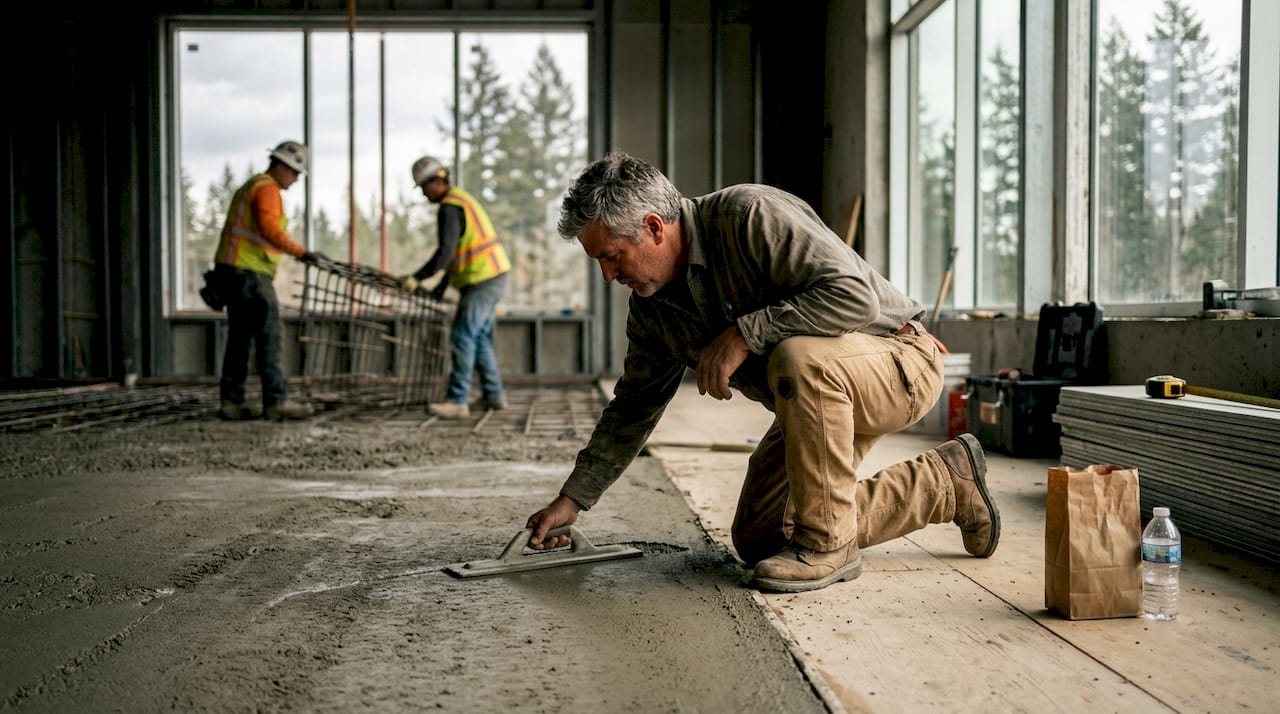
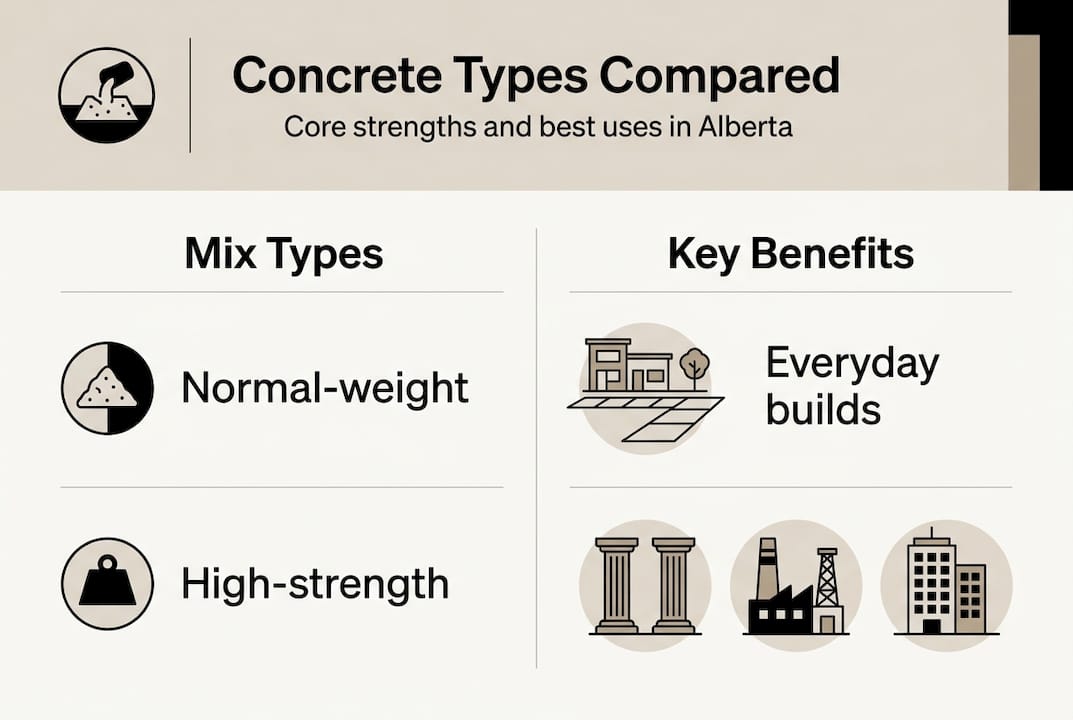
Normal-weight concrete is the workhorse of most commercial and municipal projects. It typically delivers 20 to 40 MPa compressive strength with a w/cm ratio between 0.45 and 0.60. You will find it in slabs, sidewalks, curbs, and general structural pours where exposure conditions are moderate.
High-strength concrete (HSC) pushes compressive strength to 40 MPa and beyond, often reaching 60 MPa or higher. The w/cm ratio drops to 0.25 to 0.40, which tightens the pore structure and dramatically improves load capacity. HSC is standard for columns, bridge decks, and high-rise cores.
High-performance concrete (HPC) is engineered for both strength and durability. It combines a low w/cm ratio with supplementary cementitious materials (SCMs) like fly ash and slag to resist freeze-thaw cycles and chloride penetration simultaneously. For Alberta’s parkades, bridges, and municipal infrastructure, HPC is often the most cost-effective long-term choice.
| Concrete type | Strength range | w/cm ratio | Key advantage | Common uses |
|---|---|---|---|---|
| Normal-weight | 20 to 40 MPa | 0.45 to 0.60 | Cost-effective, workable | Slabs, sidewalks, curbs |
| High-strength (HSC) | 40 to 60+ MPa | 0.25 to 0.40 | High load capacity | Columns, bridges, high-rise |
| High-performance (HPC) | 50+ MPa | 0.30 to 0.40 | Durability and strength | Parkades, infrastructure |
SCMs like fly ash and slag are not just filler. They increase durability by refining the pore structure, reducing permeability, and lowering heat of hydration. For Alberta projects, specifying SCMs is a smart move regardless of the base concrete type.
Pro Tip: For exterior flatwork in Alberta, always specify air entrainment even in normal-weight mixes. Without it, freeze-thaw damage is almost guaranteed within a few seasons. Explore our concrete repairs and construction services and our concrete repair guide to understand what happens when the wrong mix gets placed.
Comparing durability: Freeze-thaw, chlorides, and real-world risk
Knowing the main types is only half the picture. You also need to understand how they perform under the specific hazards Alberta throws at them every year.
Freeze-thaw cycles are the primary durability threat for exterior concrete in this province. Water enters the concrete’s pore system, freezes, expands, and fractures the matrix from within. Low-quality or under-air-entrained mixes can show visible scaling after just one or two winters. The damage compounds fast.
Chloride exposure from deicing salts adds another layer of risk. Chlorides penetrate the concrete and attack reinforcing steel, triggering corrosion-induced cracking and spalling. Parkades, bridge decks, and any surface exposed to winter maintenance chemicals are at high risk.
Here is how CSA A23.1 exposure classes address these risks:
- Class F-1: Moderate freeze-thaw, no deicing. Minimum f’c 32 MPa, w/cm 0.50, air-entrained.
- Class F-2: Severe freeze-thaw with deicing salts. Minimum f’c 40 MPa, w/cm 0.40, air-entrained.
- Class C-1: Moderate chloride exposure. Minimum f’c 35 MPa, w/cm 0.45.
- Class C-XL: Most extreme chloride and freeze-thaw combined. Minimum f’c 50 MPa, w/cm 0.40, controlled air content.
| Exposure class | Min. strength | Max. w/cm | Air content | Typical application |
|---|---|---|---|---|
| F-1 | 32 MPa | 0.50 | 5 to 8% | Sheltered exterior slabs |
| F-2 | 40 MPa | 0.40 | 5 to 8% | Driveways, sidewalks, curbs |
| C-1 | 35 MPa | 0.45 | As specified | Parking structures |
| C-XL | 50 MPa | 0.40 | Controlled | Bridge decks, heavy infrastructure |
“Air content of 5 to 8% is the minimum threshold for protecting exterior concrete against freeze-thaw scaling in Alberta’s climate. Anything below that range is a risk you cannot afford on a commercial project.”
For more on protecting placed concrete through Alberta winters, see our guide on protecting concrete in winter. If you are weighing material choices for a parking lot, our concrete vs asphalt durability comparison gives you the full picture.
Expert insights: Strength, mix design, and lifecycle performance
Now that you have seen the specs and standards, here is what concrete expertise and Alberta’s field experience reveal about choosing and using advanced mixes.
High-performance mixes deliver superior durability, but they demand precise quality control. Curing time, temperature management, and placement technique all matter more with HPC than with standard mixes. A poorly cured HPC pour can underperform a well-executed normal-weight pour.
The tradeoffs between mix types break down like this:
- HSC advantages: Higher load capacity, reduced section sizes, longer service life in structural applications
- HSC risks: Autogenous shrinkage increases as w/cm drops; superplasticizers and extended wet curing are essential to manage cracking
- Normal-weight advantages: Lower upfront cost, easier to place and finish, widely available
- Normal-weight risks: Higher maintenance frequency in severe exposure classes, shorter effective lifespan in harsh Alberta conditions
“Lifecycle analysis consistently favors HPC for infrastructure exposed to Alberta’s freeze-thaw and chloride environment. The higher initial investment typically pays back within 8 to 12 years through avoided repairs and extended service intervals.”
When should you bring in a materials engineer? Any project involving C-XL or F-2 exposure class, post-tensioned slabs, or structures with a design life exceeding 50 years warrants specialist input on mix design. The cost of that consultation is trivial compared to the cost of a premature failure. Learn more about the concrete repair benefits when the right mix is not specified from the start.
How to choose the right concrete for your project
With all the technical and practical knowledge in hand, here is a proven process for selecting the correct concrete for your next Alberta build.
- Define the structural requirements. What loads will the element carry? What is the design life? These answers set your minimum strength target.
- Identify the exposure class. Use CSA A23.1 to classify the environmental conditions: freeze-thaw severity, deicing salt exposure, and chloride risk. This step is non-negotiable.
- Specify performance requirements. Set minimum compressive strength, maximum w/cm ratio, air content range, and SCM type based on the exposure class.
- Select the mix and verify air entrainment. For any exterior flatwork in Alberta, air entrainment is mandatory. Confirm the target air content with your supplier before ordering.
- Request compliance documentation. Ask your supplier for written confirmation that the proposed mix meets the applicable CSA A23.1 exposure class requirements.
- Evaluate lifecycle cost, not just unit price. A mix that costs 15% more upfront but lasts twice as long in a severe exposure class is the better investment every time.
Pro Tip: Do not let schedule pressure push you into accepting a mix that does not meet the specified exposure class. One compromised pour can generate repair costs that dwarf the original concrete budget. Understanding what causes concrete to crack will help you see exactly why specification compliance matters from day one.
Partner with concrete specialists for your next Alberta project
Selecting the right concrete type is only the first step. Execution, quality control, and compliance verification are where projects succeed or fail in the field. ProZone Ltd brings hands-on experience with all Alberta exposure classes, from standard F-1 flatwork to demanding C-XL infrastructure applications.
Our team handles the full scope, from mix specification and placement to finishing and repair, so you get consistent results that hold up through Alberta winters. Whether you need construction services for Edmonton managers, a reliable concrete contractor in Edmonton, or specialized curb and sidewalk solutions, ProZone delivers work that meets code and stands the test of time. Contact us to discuss your next project and get expert guidance on mix selection and specification compliance.
Frequently asked questions
What is the main difference between normal-weight and high-strength concrete?
High-strength concrete uses a lower water/cement ratio and reaches compressive strengths above 40 MPa, making it the right choice for heavy-load structures like bridge decks and high-rise columns where normal-weight mixes would require much larger sections.
Why are air-entrained mixes important in Alberta?
Air entrainment creates microscopic bubbles that relieve internal pressure when water freezes inside the concrete. Air content of 5 to 8% is the accepted range for protecting exterior concrete against the scaling and cracking that Alberta’s freeze-thaw cycles cause.
What are CSA exposure classes and why do they matter?
CSA A23.1 exposure classes define the minimum concrete properties required for durability under specific environmental conditions. Each exposure class sets binding requirements for compressive strength, w/cm ratio, and air content that contractors must meet for code compliance.
How does high-performance concrete benefit Alberta projects?
HPC combines low permeability, high strength, and SCM-enhanced durability to resist both freeze-thaw damage and chloride penetration. Lifecycle analysis favors HPC for harsh-environment applications because reduced repair frequency offsets the higher initial material cost over the structure’s service life.