
Curing is the process of keeping fresh concrete moist and at a workable temperature so cement hydration can run its course, not simply letting it “dry.” As a rule of thumb, most slabs are walkable in 24 to 48 hours, gain significant structural strength by 7 days, and hit the conventional 28-day benchmark used for design and testing, though real strength gain continues for months afterward. Temperature and moisture control on site can shift every one of these numbers.
Table of Contents
- Concrete curing time: the timeline from pour to full strength
- Why 28 days is used: standards, testing, and the limits of the benchmark
- How temperature and moisture control strength gain
- Practical curing methods and how long to use them
- Minimums, rain, and the 90-minute rule explained
- ProZone’s field checklist for freeze-thaw climates
- The 28-day number gets more credit than it deserves
- Protect your pour with ProZone’s curing and quality assurance
- Sources
- FAQ
Concrete curing time: the timeline from pour to full strength
Concrete goes through distinct phases, and knowing what happens at each one prevents costly mistakes on site.
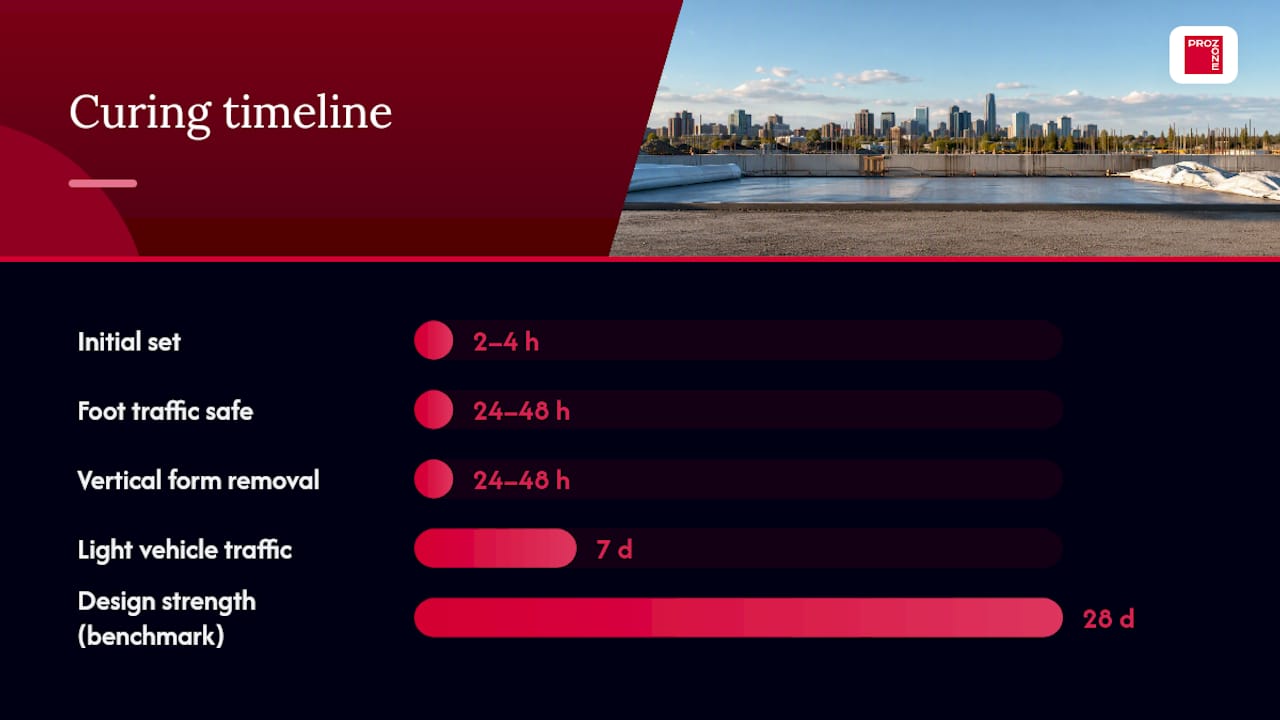
Initial set typically occurs within 2 to 4 hours of placement, depending on the mix design, temperature, and any admixtures used. This is the finishing window, the point where crews trowel, broom, or stamp the surface before it hardens too much to work.
Formwork removal timing depends on the structural role of the element. Vertical forms on walls or columns often come off in 24 to 48 hours, while suspended slabs and beams under load need longer, sometimes 7 days or more, before shoring comes out.
Traffic tolerance follows a similar staged pattern:
- Foot traffic: generally safe at 24 to 48 hours for standard mixes
- Light vehicle traffic (passenger cars, light trucks): usually acceptable around 7 days
- Full structural load and heavy equipment: reserved until the concrete has reached its design strength, typically referenced at 28 days
Here’s what surprises a lot of property owners: strength development doesn’t stop at 28 days. Concrete kept moist continues gaining strength for years, though the rate slows dramatically after the first month. That’s why the 28-day figure is a benchmark, not a finish line, a distinction the next section unpacks in more detail.
Why 28 days is used: standards, testing, and the limits of the benchmark
The 28-day number comes from a testing convention, not a biological or chemical cutoff point. ASTM C39 is the standard test method for compressive strength of concrete cylinders, and the concrete industry adopted 28 days as the standard age for reporting results because it gives a reasonably consistent, comparable strength figure across different mixes and projects.
That consistency has limits. A compilation of roughly 9,500 strength tests across 53 datasets shows 28-day results ranging anywhere from about 2,300 to 11,000 psi depending on the mix design, which tells you the number is only meaningful in context of the specific concrete being tested.
Twenty-eight days tells you what the concrete had achieved by the day someone tested it. It does not tell you the concrete stopped getting stronger, and it does not account for how the mix was cured between the pour and the test.
The American Concrete Institute treats curing as an ongoing set of actions engineers specify for slabs, pavements, and mass concrete elements, precisely because the design reference strength only holds up if the curing conditions match what the mix was built for.
How temperature and moisture control strength gain
Hydration, the chemical reaction between cement and water that produces strength, moves fastest in the first few days and then slows as available water and unreacted cement diminish. Most of the usable strength for construction purposes develops in this early window, but the reaction never fully stops as long as moisture is present.
Temperature complicates that picture in a way many contractors underestimate. Lab testing across a range of curing temperatures found that warmer curing accelerates early strength gain but can reduce long-term compressive strength compared to concrete cured at cooler, more moderate temperatures.
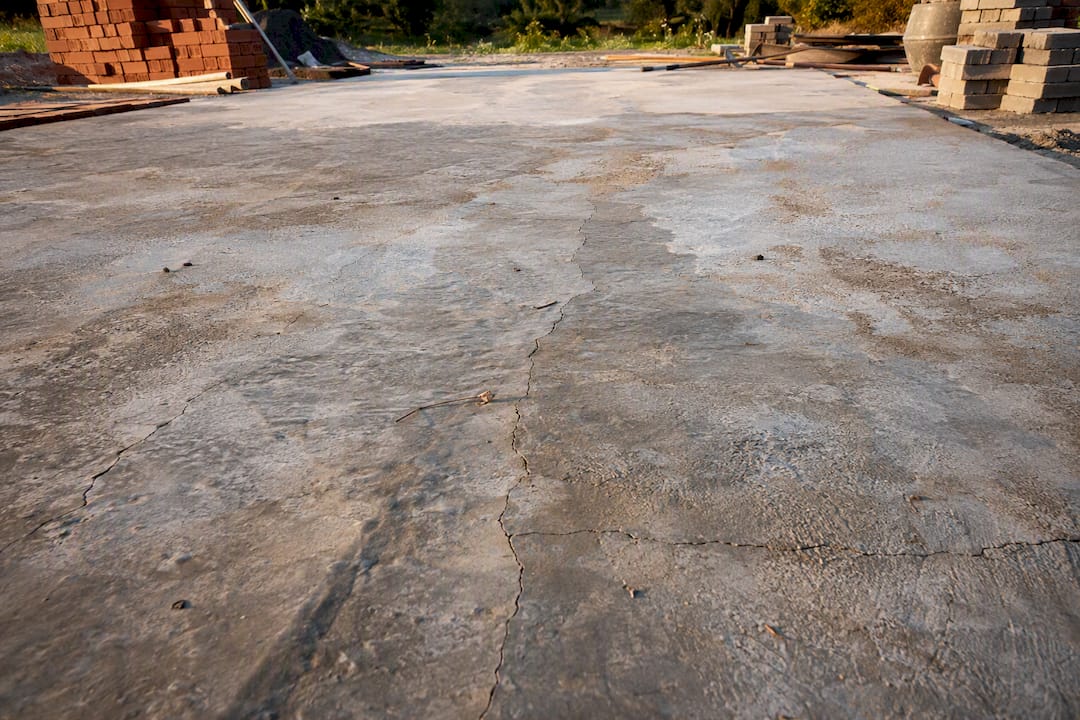
The temperature inversion effect: concrete cured at higher temperatures can test stronger at 7 days and weaker at 90 days than concrete cured cooler and slower. Mixes containing supplementary cementitious materials like fly ash or slag are especially sensitive to this, since heat can accelerate early pozzolanic reactions while depleting the pore water those reactions need later in the curing cycle.
Cold weather cuts the other way. Low temperatures slow hydration and, below freezing, can halt it entirely while introducing freeze-thaw damage risk to concrete that hasn’t developed enough strength to resist ice expansion in its pore structure.
Pro Tip: Never judge a cold-weather pour by how it looks on day two. Concrete can appear fully set while internal hydration has barely progressed, which is exactly when unprotected slabs suffer scaling and microcracking once temperatures swing.
Practical curing methods and how long to use them
Choosing the right method depends on the job, the weather, and how much labour you can commit to monitoring the pour.
- Water curing (wet burlap, ponding, continuous misting): the most effective method for maximizing strength, since it keeps the surface saturated. Best for flatwork and slabs where labour is available for repeated wetting over 3 to 7 days.
- Curing compounds and membrane-forming sealers: sprayed on immediately after finishing, these trap surface moisture without ongoing labour. They’re efficient for large-area pours but can interfere with adhesion if you plan to apply coatings or sealants later, so timing the application matters.
- Insulating blankets and heated enclosures: essential for cold-weather placements, these hold hydration heat in and keep surface temperatures above freezing during the critical early days.
- Steam curing: used mainly in precast operations to accelerate strength gain for form turnaround, though it requires specialist quality control to avoid the temperature inversion problem described above.
Most methods need to stay in place for a minimum of 3 to 7 days, longer in cold weather, and ACI curing guidance recommends extending protection whenever ambient temperatures drop below 10°C.
Pro Tip: Removing protection too early is one of the most common and preventable causes of surface scaling. If you’re unsure, leave the blanket or compound on an extra day rather than pulling it at the first sign of a hard surface.
Minimums, rain, and the 90-minute rule explained
A standard 4-inch residential slab generally needs a minimum of 6 to 7 days of moist curing before you can consider it structurally reliable for normal use, a figure consistent with regional guidance from Concrete Alberta.
- If it rains within 12 hours of placement: cover the slab immediately if it isn’t already protected; light rain on concrete that has begun set usually causes only surface texture issues, but rain on fresh, unset concrete can wash out cement paste and weaken the surface.
- The “90-minute rule” refers to the maximum time ready-mix concrete should sit in the truck or be placed after batching before it starts losing workability, not a curing timeline. Confusing it with curing minimums leads to premature finishing.
- Sealing: wait until the concrete has cured enough to release excess moisture, typically 28 days for most sealers, though some breathable products allow earlier application.
- Vehicle traffic: hold off until the slab has reached adequate design strength, generally around the 7-day mark for light loads.
ProZone’s field checklist for freeze-thaw climates
Edmonton’s freeze-thaw cycles put more stress on fresh concrete than almost any other Canadian climate condition. Prozoneltd treats the first 72 hours after placement as the highest-risk window, when moisture loss or a temperature swing can undo weeks of planned strength gain.
Crews follow procedures aligned with Alberta Safety Codes and verify curing compound coverage rates against manufacturer specifications rather than eyeballing application. Every cold-weather pour gets logged temperature readings, not guesswork, because a slab that looks fine on the surface can still be compromised internally.
A typical jobsite checklist includes:
- Confirming air-entrainment levels appropriate for freeze-thaw exposure before the pour even starts
- Documenting ambient and surface temperatures through the curing window
- Verifying full, even coverage of curing compound or blanket protection
- Timing form and protection removal against actual strength data, not the calendar alone
This discipline is what separates a slab that lasts decades from one that spalls within its first winter, a difference explored further in ProZone’s guide to how concrete curing works.
The 28-day number gets more credit than it deserves
The conventional wisdom treats 28 days like a finish line: pour, wait a month, move on. That framing undersells what the standards actually say. ASTM C39 exists to give engineers a comparable reference point, not to declare curing complete, and the research on temperature effects makes clear that rushing early strength through heat can cost you strength later.
Where most guidance falls short is treating curing as passive, something that happens automatically once the concrete is poured. It isn’t. Curing is an active process of moisture and temperature management, and the first 72 hours matter more than any date on a calendar.
If there’s one priority for readers to take from this, it’s to stop asking “how many days” and start asking “what conditions.” A slab cured properly for 5 days in controlled, moist conditions can outperform one left uncovered for 10. That’s a harder message to sell than a clean number, but it’s the one backed by the standards and the lab data.
— ProZone
Protect your pour with ProZone’s curing and quality assurance
Generic contractors often treat curing as an afterthought, covering a slab and hoping for the best. Prozoneltd builds curing protection, temperature monitoring, and quality checks into every commercial and residential pour, which means fewer callbacks for cracking, scaling, or premature failure in Alberta’s freeze-thaw climate.
Our crews manage heated enclosures for cold-weather placements, apply curing compounds at manufacturer-specified rates, and log temperatures through the critical first days, the same discipline outlined in the checklist above. For larger structural or municipal road construction projects where curing failures carry real financial risk, that level of control isn’t optional.
If you’re planning a pour and want it done to a standard that holds up through an Edmonton winter, call Prozoneltd directly or fill out the online form for a free estimate.
Sources
- ACI guide on external curing practices (preview)
- Influence of ambient temperature on high performance concrete properties
FAQ
How long does 4 inches of concrete take to cure?
A standard 4-inch slab needs a minimum of about 6 to 7 days of moist curing before it’s considered structurally reliable, though it will typically be walkable within 24 to 48 hours and continue gaining strength for weeks afterward.
What is the 90-minute rule for concrete?
The 90-minute rule refers to the maximum time ready-mix concrete should be transported and placed after batching before it loses workability. It has nothing to do with curing time, which begins after the concrete is placed and finished.
What if it rains 12 hours after pouring concrete?
Cover the slab immediately if it isn’t protected already. Concrete that has reached initial set generally tolerates light rain with only minor surface texture effects, but rain on unset concrete can wash out cement paste and weaken the surface.
What is the minimum curing time for concrete?
Most standard mixes need a minimum of 3 to 7 days of active moisture and temperature control, with cold weather often extending that window well beyond a week. Full design strength is typically referenced at 28 days, though strength continues developing for months after that.