
Expect to pay roughly $3 to $7 per square foot for a 1.5 in mill-and-overlay, or somewhat less without milling, depending on region and access. Overlay makes sense when the base underneath is sound and you need 8 to 12 more years of service; if the base is failing, replacement is the better spend. Get a core sample or professional inspection before signing anything.
Table of Contents
- Asphalt overlay cost snapshot: per square foot, per ton, and total price
- What affects the cost of an asphalt overlay
- Should you overlay or replace? The diagnostic checklist
- Budgeting a real driveway: a step-by-step calculation
- How long an overlay lasts and what keeps it there
- Freeze-thaw considerations for Alberta driveways
- What a complete asphalt overlay quote should include
- Why base condition matters more than the surface
- Get a straight answer on your driveway: request a ProZone estimate
- Sources
- FAQ
Asphalt overlay cost snapshot: per square foot, per ton, and total price
Overlay pricing splits into two categories: mill-and-overlay, where a machine grinds off the old surface before new asphalt goes down, and overlay without milling, where fresh hot-mix asphalt (HMA) goes straight on top of the existing surface.
Contractor pages from Canadian markets put standard overlay work at roughly $3 to $5 per square foot when the base underneath is in decent shape. Broader industry summaries put the full range closer to $2 to $7 per square foot once you factor in milling, thickness, and site access. Milling adds cost but avoids the garage-threshold and curb-height problems that come from simply stacking new asphalt on old.
Typical cost bands for a 1.5 in overlay:
- Overlay without milling: $2.50 to $4.50 per sq ft
- Mill-and-overlay (1.5 in): $3.50 to $7.00 per sq ft
- Cost per ton of HMA: generally $100 to $140 per tonne installed, which works out to roughly $0.70 to $1.00 per sq ft at 1.5 in of compacted thickness
By the numbers: a 1.5 in mill-and-overlay typically runs about half the cost of a full reconstruction on a per-project basis, while still adding 8 to 12 years of service life when the base underneath is sound.
Common driveway footprint cost estimates for overlays can vary widely depending on factors including location, base condition, and site specifics. Costs tend to increase proportionally with area, factoring standard rates before contingency. Site access, drainage repairs, and regional labour rates affect the final quotes.
What affects the cost of an asphalt overlay
Every quote is built from the same core line items, and understanding them is how you compare bids intelligently instead of just chasing the lowest number.
Mobilization and crew costs cover getting equipment, milling machines, pavers, and rollers to your site. Smaller residential jobs carry a higher mobilization cost per square foot than large commercial lots because fixed costs spread over less area.
Milling, tack coat, and placement make up the bulk of a mill-and-overlay bid. Milling removes the top layer of old asphalt to correct grade and profile; the tack coat is a thin asphalt emulsion sprayed on the milled surface so the new HMA bonds to the old layer instead of sliding or delaminating.
Site complexity drives real cost swings. Poor drainage, uneven base material, steep grades, tight access for trucks, and conflicts with garage thresholds or existing curbs all add labour hours.
Material grade matters more in Alberta than in milder climates. Modified binders and performance-based mixes cost more per tonne but resist the low-temperature cracking that standard mixes suffer through repeated freeze-thaw cycles.
- Mobilization and crew setup
- Milling and disposal of old asphalt
- Tack coat application
- HMA placement and compaction
- Edge work and transitions at garage doors or curbs
Pro Tip: Ask your contractor for the compaction density target in writing. Under-compacted asphalt fails years earlier than properly compacted mix, regardless of how good the material was going in.
Should you overlay or replace? The diagnostic checklist
Overlaying a failing base is generally not recommended, as the new surface may quickly reflect underlying issues such as cracks and soft spots.
Run through these four checks before choosing overlay over full reconstruction:
- Visual distress survey. Isolated cracking and minor surface wear are overlay candidates. Widespread alligator cracking, potholes, or heaving are not.
- Core samples. A core through the pavement shows base thickness and whether moisture has already compromised the aggregate base. This is the single most reliable diagnostic and costs far less than a premature redo.
- Drainage behaviour. Standing water or ponding after rain signals a grading problem that overlay alone will not fix.
- Edge condition. Crumbling or unsupported edges usually point to base failure, not just surface aging.
A 10-year evaluation of test sections in Manitoba and Minnesota found that 50 mm recycled asphalt overlays, placed with no additional surface preparation, performed well and were the least costly treatment over that period, but only where the base condition was acceptable going in. Where cracking runs deep into the base or drainage is chronically poor, that same treatment underperforms.
Think in cost-per-year-of-service rather than sticker price. An overlay at half the cost of replacement but delivering only 5 years, versus one delivering the full 8 to 12, changes the math entirely.
Budgeting a real driveway: a step-by-step calculation
Here is how to turn a per-square-foot rate into an actual number for your project, using a typical two-car driveway at roughly 950 sq ft.
- Start with area. 950 sq ft is your base measurement.
- Apply the rate band. At $3.50 to $7.00 per sq ft for mill-and-overlay, that’s $3,325 to $6,650 before extras.
- Convert tonnage if your quote is priced by the ton. At 1.5 in thickness, expect roughly 0.045 tons of HMA per sq ft, so 950 sq ft needs about 43 tons. At $100 to $140 per tonne installed, that’s $4,300 to $6,020, a useful cross-check against the per-square-foot number.
- Add contingency. Budget an extra 10 to 20% to cover unseen base repairs discovered once milling or coring exposes what’s underneath.
- Set aside a maintenance allowance. Plan for $150 to $400 every 3 to 5 years for sealcoating and crack sealing, which protects the investment you just made.
That puts a realistic all-in budget for a two-car driveway, including contingency, in the $3,700 to $7,800 range.
How long an overlay lasts and what keeps it there
A properly installed overlay on a sound base typically lasts 8 to 15 years. On a marginal base with early signs of cracking, that lifespan can drop to 4 to 6 years before reflective cracking reappears at the surface.
Maintenance is what protects that range, not luck:
- Sealcoat every 2 to 3 years to block water and UV degradation
- Seal cracks as soon as they appear, ideally within the first season
- Patch isolated soft spots before they spread under freeze-thaw pressure
- Keep drainage clear of debris so water never sits against the pavement edge
A $200 sealcoat job every few years is inexpensive against a $4,000 to $7,000 overlay. Skipping it is how a 12-year overlay becomes a 6-year one. For a deeper maintenance schedule, see our guide on extending the life expectancy of your asphalt.
Freeze-thaw considerations for Alberta driveways
Edmonton’s freeze-thaw cycle is the single biggest variable standard asphalt guides ignore, and it’s the reason a lowball quote from outside the region often fails within a few winters.
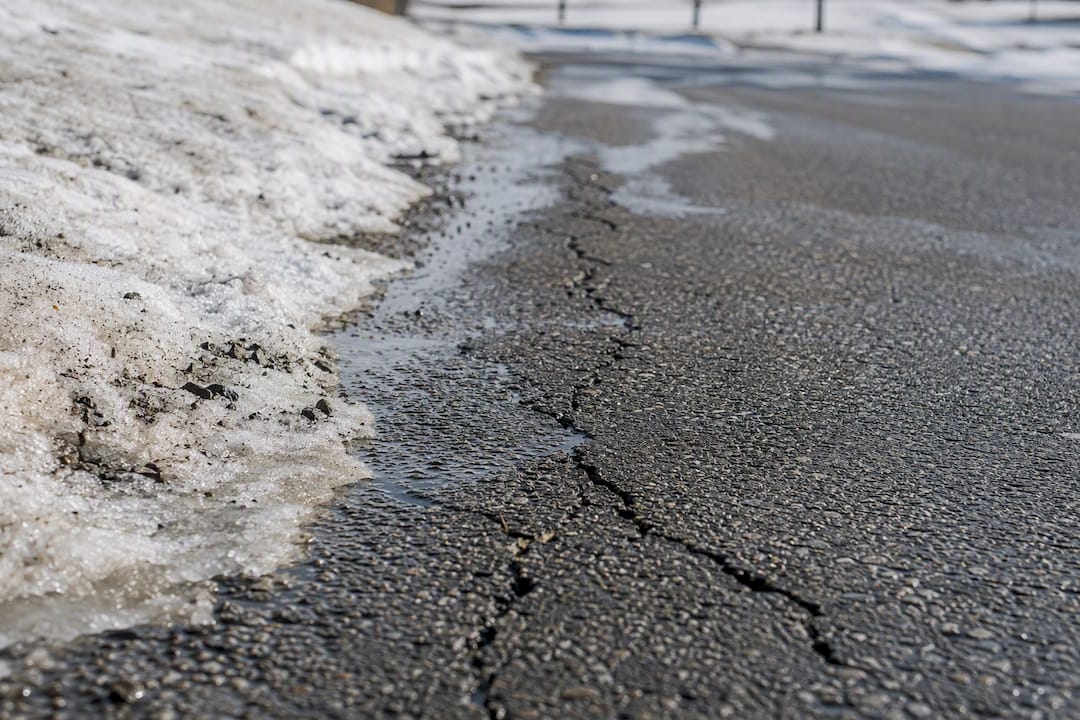
Water trapped under an overlay expands when it freezes, a mechanism called moisture pumping, and it’s the most common failure mode in wet-freeze regions. Fixing drainage before paving, not after, is non-negotiable here.
Modified binders and performance-based mixes cost more per tonne but resist the low-temperature cracking that standard HMA develops after two or three Alberta winters. Life-cycle cost analysis on wet-freeze pavements consistently shows the higher upfront material cost pays back through fewer repairs.
Pro Tip: If your contractor skips core sampling and drainage assessment before quoting, treat that as a red flag, not a shortcut. In Edmonton’s climate, that step is what separates an overlay that lasts a decade from one that fails by year three.
What a complete asphalt overlay quote should include
A vague one-page quote is the clearest sign a contractor is cutting corners you’ll pay for later.
A complete quote should itemize:
- Mobilization and equipment costs
- Milling scope (area and depth) if applicable
- HMA tonnage and mix specification, including binder grade
- Tack coat application
- Compaction density target
- Edge treatment and any drainage correction
- Written warranty terms
Ask your contractor what compaction equipment they run, what binder grade they specify for winter performance, and whether their crews hold current Alberta Safety Codes certifications. A quote significantly below the going regional rate usually means thinner mat thickness, no milling where it’s needed, or a mix that isn’t rated for this climate. Ask for references from projects at least three winters old, not just fresh installs that haven’t been tested by freeze-thaw yet.
Why base condition matters more than the surface
In freeze-thaw regions, the failures we see most often trace back to moisture trapped beneath the surface, not the asphalt mix itself. Core sampling before every overlay quote isn’t a formality; it’s what tells us whether 8 to 12 years is realistic or whether we’re recommending against overlay entirely.
ProZone crews follow Alberta Safety Codes on every project and document completed work in our project gallery so clients can see finished results before committing. Our standing guidance is conservative: if a core shows base failure or chronic drainage problems, we’ll tell you to replace, not overlay, even if overlay is the cheaper quote to write.
— ProZone
Get a straight answer on your driveway: request a ProZone estimate
An overlay only pencils out when the base underneath is sound, and the only way to know that for certain is a proper inspection, not a guess from a photo. ProZone is the, an Edmonton contractor that runs core sampling and drainage checks before quoting, rather than after problems show up two winters later. That’s the concrete difference between a quote built on Alberta Safety Codes compliance and one built on a fast estimate from a generic crew.
Before you call or submit the form, have your driveway’s approximate square footage, the age of the existing asphalt, and any visible cracking or ponding photos ready. That lets our estimator scope the job accurately on the first visit instead of revising the quote later.
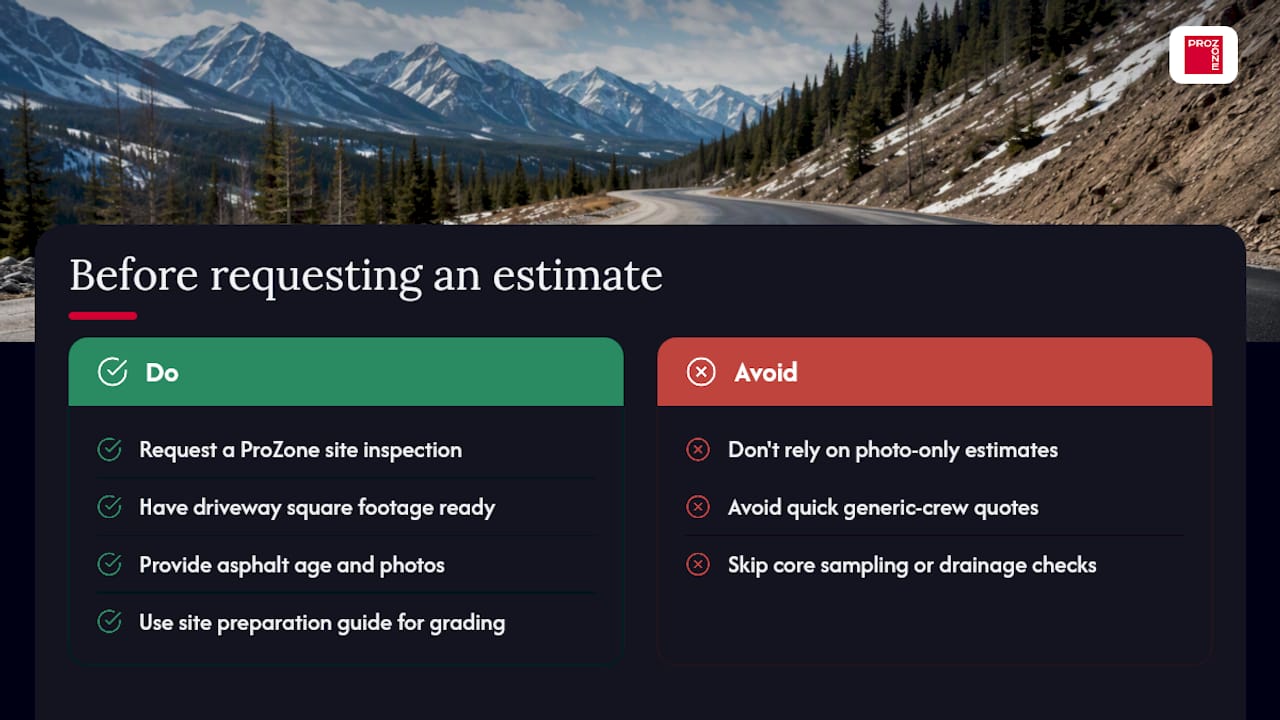
Request your free estimate through our asphalt paving services page or call ProZone directly to book a site inspection. If your project involves grading or drainage correction before paving, our site preparation guide covers what that work typically involves.
Sources
- Asphalt overlay cost-effectiveness : Manitoba TGS and Minnesota SPS-5 projects 10-year ranking of treatments (1989-1999)
- Life-Cycle Cost Analysis and Performance Comparison of Asphalt Overlays on PCC Pavements in Wet-Freeze Regions of Canada
- Development of a Performance-Based Asphalt Mixture Overlay for Usage In A Low-Budget Pavement Management System
- Asphalt overlay vs replacement 2026: Cost, lifespan & The 4 tests that decide which is right
FAQ
Is asphalt overlay worth it?
Overlay is worth it when the base underneath is sound and drainage is functioning properly. It typically costs about half of full replacement while adding 8 to 12 years of service, but overlaying a failed base wastes money because cracks reflect through within a season or two.
How much is a 20×20 asphalt driveway?
A 20×20 driveway is 400 sq ft, putting a mill-and-overlay in the typical range of roughly $3.50 to $7.00 per square foot, or somewhat less for overlay without milling.
How much is 2,000 square feet of asphalt?
A 2,000 sq ft overlay typically runs between $3.50 and $7.00 per square foot depending on whether milling is required, base condition, and site access.
How much does it cost to pave 1,000 square feet?
Paving 1,000 sq ft with a 1.5 in overlay generally costs between $2.50 and $7.00 per square foot, with the lower end applying to overlay without milling on a sound, easily accessible base.