
Concrete removal in Edmonton typically runs $2 to $8 per square foot, with most residential driveway and patio jobs landing at a wide cost range depending on slab thickness, rebar content, and site access, according to local pricing data. A standard 400 square foot slab usually costs within a broad range to remove and haul away, before permits or disposal surcharges.
Two Edmonton-specific line items catch homeowners off guard: the Edmonton Waste Management Centre charges a minimum load fee plus a per-tonne fee for special-handling material, and a residential demolition permit adds municipal fees. Frost depth also dictates timing, since Edmonton’s subgrade can stay frozen well into spring.
Your next moves are simple. Measure your slab’s length, width, and thickness, then request a written, on-site estimate from a contractor who can confirm Alberta Safety Codes compliance before any equipment shows up.
| Project size | Typical removal cost | Adds permit + disposal |
|---|---|---|
| 400 sq ft (20×20) | $800 to $3,200 | +$300 to $600 |
| 1,000 sq ft | $2,000 to $8,000 | +$400 to $900 |
Pro Tip: Get your estimate in writing before removal starts. A verbal quote over the phone almost never accounts for rebar density, slab thickness, or disposal weight, all of which move the final invoice.
Table of Contents
- How much does concrete removal cost in Edmonton?
- What drives the price of concrete removal up or down?
- How do you estimate your own concrete removal cost?
- What permits and disposal rules apply in Edmonton?
- How does Edmonton’s climate affect removal timing?
- Should you DIY concrete removal or hire a contractor?
- Get a free, written concrete removal estimate
- Sources
- FAQ
How much does concrete removal cost in Edmonton?
Pricing splits by project type because access, thickness, and reinforcement vary a lot between a driveway and a backyard patio.
- Driveways: $3 to $8 per square foot, higher end for thicker slabs (5 to 6 inches) with rebar mesh
- Patios: $2 to $6 per square foot, generally thinner (4 inches) with lighter or no reinforcement
- Sidewalks: $2.50 to $6 per square foot, narrow footprint but often tight access between property lines
- Basement or garage slabs: $4 to $9 per square foot due to confined equipment access and hand-breaking in tight spaces
Worked example: 20×20 driveway slab (400 sq ft)
- Low scenario: unreinforced, easy access, $2/sq ft = $800, plus a $150 disposal minimum
- Mid scenario: light mesh, standard access, $4.50/sq ft = $1,800, plus $250 disposal and a $230 demolition permit
- High scenario: rebar-reinforced, restricted access, $7.50/sq ft = $3,000, plus $500+ disposal for the extra tonnage
A 1,000 square foot removal follows the same math at scale. Labour and equipment typically run several thousand dollars, disposal adds a few hundred to over a thousand depending on thickness and rebar weight, permits add municipal fees, and a contingency covers surprises like buried utilities.
Thickness moves the number more than any other single factor. A 4 inch patio slab weighs roughly half of a 6 inch driveway slab per square foot, and that difference shows up directly in your disposal tonnage bill at the Waste Management Centre.
What drives the price of concrete removal up or down?
Every quote you receive breaks down to the same handful of variables. Understanding them helps you spot a lowball quote before you sign anything.
- Slab thickness: 4 inch patios cost less to remove than 6 to 8 inch driveways or garage floors
- Reinforcement: rebar and wire mesh slow demolition and require cutting tools, adding labour hours
- Site access: a backyard patio behind a fence often needs hand-breaking or a mini excavator instead of a full-size machine
- Disposal tonnage: heavier, thicker concrete costs more to haul and dump
- Traffic control and permits: driveway work near a public street may require signage or lane closures
- Buried surprises: old utility lines, contaminated fill, or a second slab underneath the visible one trigger change orders
Heavy equipment operators typically bill by the day rather than the hour once a job exceeds a few hundred square feet, and that day rate covers the machine, fuel, and a certified operator.
Pro Tip: Ask your contractor to probe for rebar and mesh during the site visit, not after the jackhammer starts. Early detection changes which equipment gets dispatched and prevents accidental damage to nearby fences, gas lines, or foundations.
How do you estimate your own concrete removal cost?
A reasonable budget takes ten minutes with a tape measure and a calculator.
- Measure length and width in feet, then multiply for total square footage.
- Measure thickness in inches (check an exposed edge or control joint).
- Convert to cubic yards: square footage times thickness in feet, divided by 27.
- Convert volume to weight using standard concrete density (roughly 150 pounds per cubic foot, or about 2 tonnes per cubic yard).
- Multiply tonnage by the local disposal rate, then add labour, equipment, and a 10% contingency.
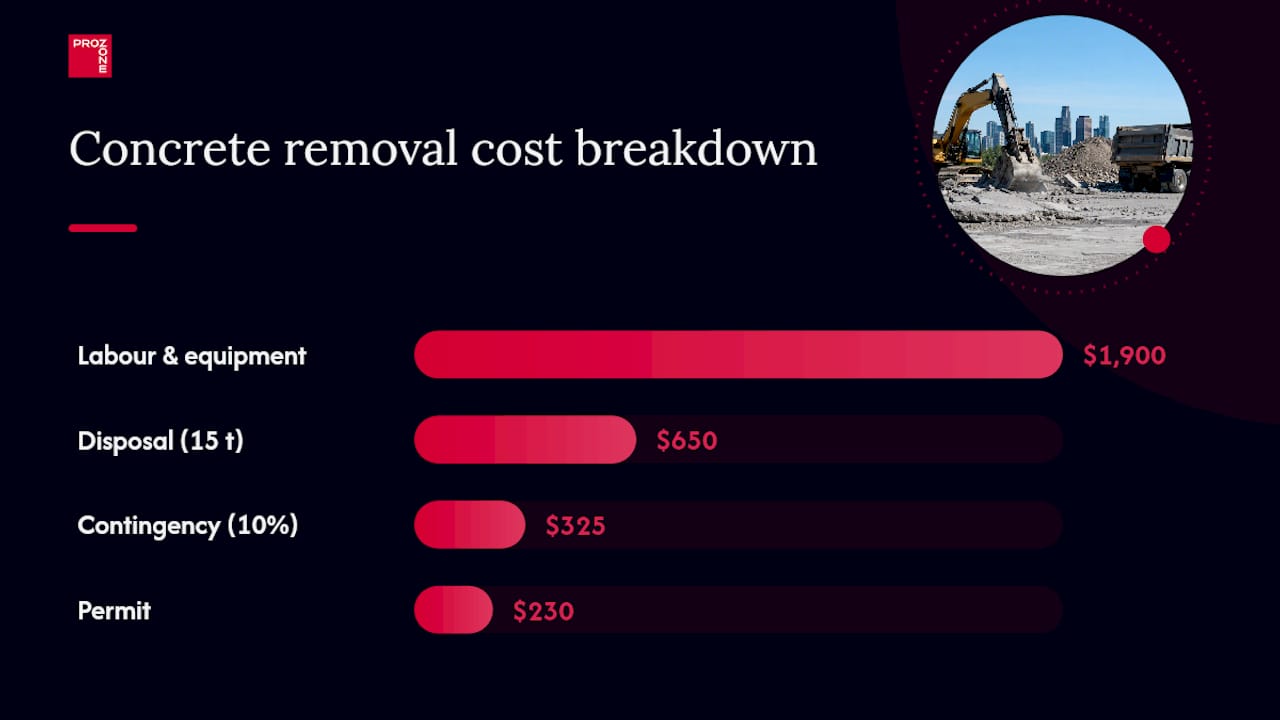
Example: a 500 sq ft slab at 5 inches thick equals about 7.7 cubic yards, or roughly 15 tonnes. At $137 per tonne for special handling loads, that’s over $2,000 in disposal alone before labour, so most crews negotiate bulk rates for clean, unmixed concrete instead of paying the special-handling ceiling.
| Cost component | Typical range (500 sq ft example) |
|---|---|
| Labour and equipment | $800 to $3,000 |
| Disposal (approx. 15 tonnes) | $400 to $900 |
| Permit | $230 |
| Contingency (10%) | $150 to $500 |
Pro Tip: Request your contractor’s disposal receipt. It confirms the load went to a proper facility and protects you if bylaw officers ever question where debris ended up.
What permits and disposal rules apply in Edmonton?
Residential demolition in Edmonton requires a permit application, and the city’s checklist lists a development permit fee of $105, a building permit fee of $120, and a safety codes fee of $4.80, totalling roughly $229.80 for a standard application. Larger commercial demolition permits scale with the contract cost of the work under the Safety Codes Building Schedule.
Disposal follows its own set of rules. The Waste Management Centre applies a minimum charge per load and a fee per tonne for material needing special handling, so mixing clean concrete with contaminated fill or garbage pushes your whole load into the higher rate tier.
Concrete slurry from saw cutting and coring is prohibited from entering storm drains or sanitary systems anywhere in Edmonton, and contractors must follow best practices for post-event cleaning of concrete surfaces to safely contain and vacuum the slurry for proper disposal. Contractors must contain and vacuum it for proper disposal.
That rule comes from the city’s Contractors Environmental Responsibility Package, and enforcement is active, not theoretical.
Pro Tip: Ask for load manifests on larger jobs, or contact GFL Environmental directly for construction and demolition recycling options. A manifest protects you if a bylaw dispute ever comes up.
How does Edmonton’s climate affect removal timing?
Edmonton’s frost line reaches roughly 1.5 metres deep some winters, and Concrete Alberta’s cold-weather guidance recommends excavating to unfrozen, undisturbed soil before any replacement pour. Clay subgrade can heave up to 75 millimetres when frozen, which cracks new concrete poured over unstable ground.
- Remove concrete any time of year, but replacement pours ideally wait until subgrade is verifiably frost-free
- Recommended subgrade prep: excavate to undisturbed soil, add a compacted granular base, and grade for drainage
- Winter options include insulating the excavation bottom or scheduling the pour for a stable weather window
- Avoid de-icing salt on new concrete for its first winter, per Concrete Alberta
Proper sub-base preparation after removal is what actually determines whether your new slab lasts fifteen years or cracks in its first freeze-thaw cycle.
Pro Tip: Never let a contractor pour on subgrade you haven’t personally seen tested. A frost pocket hiding under six inches of gravel is invisible until spring thaw pushes your new slab apart.
Should you DIY concrete removal or hire a contractor?
A small cracked patio corner might be a weekend project with a rented breaker. A full driveway slab with rebar, buried utilities, and disposal logistics is not.
- DIY-suitable: small unreinforced patch under 50 sq ft, no rebar, easy curbside disposal access
- Hire a contractor: any slab over 100 sq ft, rebar or mesh present, restricted access, or disposal exceeding a pickup truck load
Before signing a contract, ask these questions:
- Can you show proof of Alberta Safety Codes compliance and current insurance and bonding?
- Will I get a written site estimate, not just a verbal number over the phone?
- What’s your plan for slurry containment and disposal manifests?
- Does the work come with a workmanship warranty?
Watch for red flags: a quote given without a site visit, no written scope of work, no mention of a waste or slurry plan, or no reference to safety codes at all. A typical Edmonton removal project runs from site assessment to handover in three to seven working days, longer if frost conditions delay excavation or permit approval takes extra time.
Property managers juggling multiple sites should read our guide on infrastructure solutions for property managers before soliciting bids from multiple crews.
A contractor’s view on accurate quoting
Prozoneltd builds every estimate from an on-site walkthrough, not a phone guess, because rebar density and subgrade condition change the number every time. We hold to Alberta Safety Codes on every removal, backed by insurance and bonding paperwork we’ll show you before work starts. Hiring a licensed, code-compliant excavation crew protects the long-term value of what gets poured next.
Get a free, written concrete removal estimate
Prozoneltd is the straightforward alternative to guessing at removal costs from a generic online calculator or a rushed phone quote. We send a crew to walk your site, measure thickness and rebar, and hand you a written estimate that accounts for Edmonton’s disposal fees and permit requirements before any equipment arrives.
Every job runs under Alberta Safety Codes compliance, backed by insurance, bonding, and a project gallery you can review before hiring. If your slab removal is step one of a bigger job, our site preparation services carry the project through compaction and grading so your new concrete doesn’t crack its first winter.
Call Prozoneltd directly or fill out the online estimate form today to book your free on-site assessment.
Sources
- Edmonton Waste Management Centre Accepted Items and Fees | City of Edmonton
- How Much Does a Concrete Contractor Cost in Edmonton?
FAQ
How much does it cost to remove 1,000 square feet of concrete?
Expect $2,000 to $8,000 for removal and hauling alone, plus $400 to $900 in disposal fees and roughly $230 in permit costs, depending on thickness and rebar content.
How much does it cost to remove a 20×20 concrete slab?
A 400 square foot slab typically costs $800 to $3,200 to remove, with permit and disposal fees adding another $300 to $600 on top.
What is the average cost of concrete removal per square foot in Edmonton?
Most Edmonton removal projects run $2 to $8 per square foot, with thickness, rebar, and site access setting where a project lands in that range.
How do I estimate my concrete removal project cost?
Measure your slab’s area and thickness, convert that to tonnage using standard concrete density, then add labour, disposal at the local per-tonne rate, permit fees, and a 10% contingency for unexpected finds.
Does Prozoneltd offer free concrete removal estimates in Edmonton?
Yes, Prozoneltd provides a free on-site assessment and written estimate for concrete removal, covering everything from measurement to disposal planning under Alberta Safety Codes.