
Many property managers and public works officials underestimate the complexity of paving projects, assuming a simple pour and roll approach will suffice. In reality, Edmonton’s unique climate and soil conditions demand precise multi-step processes involving frost depth excavation, layered compaction, and strategic maintenance planning. Understanding these technical requirements helps you manage infrastructure projects more effectively, extend pavement life, and avoid costly premature failures. This guide walks you through inspection protocols, construction methods, maintenance strategies like micro-surfacing, permeable pavement options, and local standards that shape sustainable pavement management in Edmonton.
Table of Contents
- Key takeaways
- Understanding the basics of asphalt paving in Edmonton
- Maintenance and repair: micro-surfacing and other methods
- Permeable pavements and sidewalk reconstruction in Edmonton
- Local standards and best practices shaping Edmonton pavement projects
- Professional paving solutions for Edmonton property managers and officials
- Frequently asked questions
Key Takeaways
| Point | Details |
|---|---|
| Frost depth excavation | Excavating to the frost depth of about three to four feet prevents frost heave and premature pavement failure. |
| Subgrade and base prep | Thorough compaction of the subgrade followed by a granular base layer at least 12 inches thick creates a stable foundation for asphalt. |
| Layered asphalt design | The asphalt system uses a binder course for strength and a wearing course on top, each requiring proper compaction while the material remains hot to ensure durability. |
| Geotechnical verification | Consult a geotechnical engineer to confirm frost depth and drainage plans before breaking ground to prevent costly failures. |
| Micro surfacing benefits | Micro surfacing seals cracks and provides a structural overlay that extends pavement life by eight to twelve years. |
Understanding the basics of asphalt paving in Edmonton
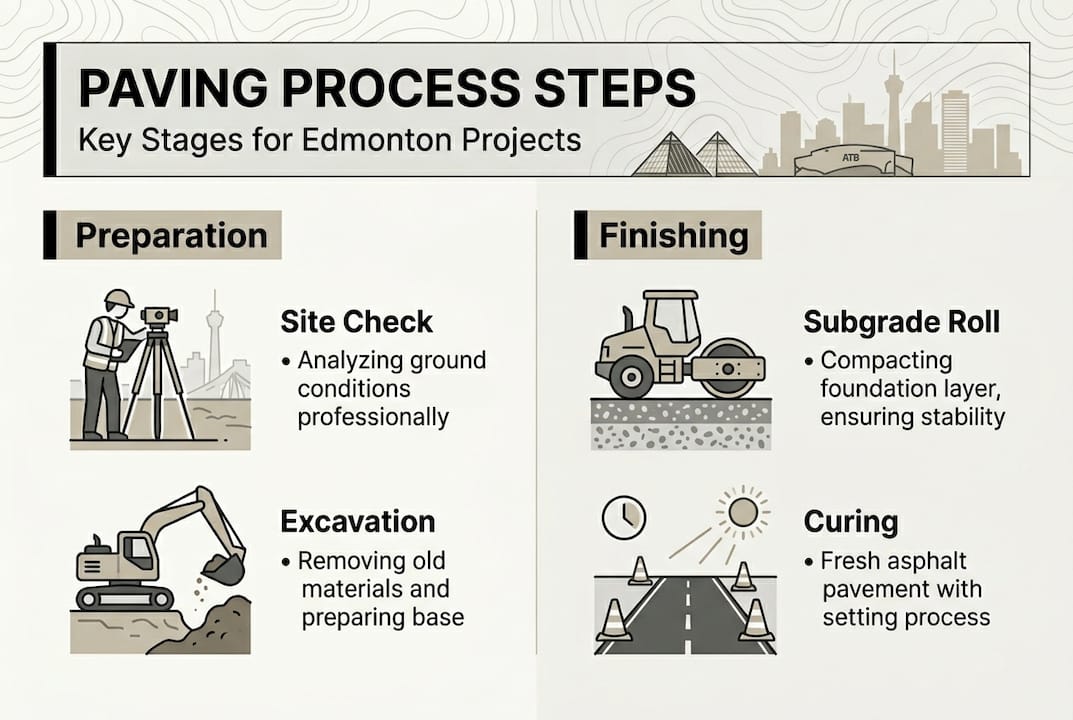
Successful asphalt paving starts with thorough site inspection focused on drainage patterns and soil conditions. Poor drainage accelerates pavement deterioration, so identifying water flow issues early protects your investment. Edmonton’s clay-heavy soils and freeze-thaw cycles create unique challenges that demand careful planning.
Excavation depth matters more than most realize. You must dig to frost depth, typically 3-4 feet in Edmonton, to prevent frost heave from lifting and cracking your pavement. Skipping this step guarantees premature failure when winter temperatures penetrate shallow bases.
After excavation, compact the subgrade thoroughly using mechanical rollers to create a stable foundation. Loose soil shifts under traffic loads, causing depressions and cracks. Next, install a granular base layer at least 12 inches thick to distribute weight and provide structural support. This base acts as a buffer between soil movement and your asphalt surface.
Asphalt installation happens in two distinct layers. The binder course uses a thicker, coarser mix for strength and load distribution. Once compacted, the surface or wearing course goes on top, providing a smooth, durable finish that resists wear from traffic and weather. Each layer requires proper compaction with heavy rollers while the asphalt remains hot and workable.
Allow 3-7 days of curing before opening pavement to traffic. Rushing this step causes rutting and surface damage. Edmonton applies Complete Streets Design & Construction Standards emphasizing sustainability and climate resilience, with 2025 updates addressing local environmental challenges.
Pro Tip: Always verify frost depth calculations and drainage plans with a geotechnical engineer before breaking ground. This small investment prevents catastrophic pavement failures that cost 10 times more to fix than proper initial construction.
For more foundational knowledge, explore asphalt paving basics in Edmonton and review detailed asphalt paving process steps. Understanding these fundamentals positions you to make informed decisions about maintenance strategies that extend your pavement’s functional life.
Maintenance and repair: micro-surfacing and other methods
Maintenance timing determines whether you spend thousands or hundreds of thousands on pavement repairs. Micro-surfacing extends asphalt life 8-12 years by sealing cracks and providing a structural overlay that prevents water infiltration. This cold-applied emulsion mix combines crushed rock, cement powder, and polymer-modified asphalt to create a durable surface layer.
Unlike sealcoating, which offers only 2-3 years of protection for newer pavements, micro-surfacing provides structural reinforcement. Sealcoating acts as a cosmetic barrier against oxidation and minor wear. Micro-surfacing actually fills ruts, corrects surface irregularities, and stops crack progression, making it far more cost-effective for aging infrastructure.
Edmonton’s maintenance arsenal includes several proven repair methods:
- Year-round asphalt patching for potholes and localized failures
- Complete concrete slab replacement when damage exceeds repair thresholds
- Mudjacking to lift and level sunken concrete slabs without full replacement
- Surface grinding to remove high spots and restore proper drainage slopes
- Specialized maintenance for oiled and gravel roads including grading and fresh aggregate application
These Edmonton pavement repair options address different failure modes at varying cost points. Choosing the right method depends on damage extent, traffic loads, and remaining pavement life.
Pro Tip: Schedule micro-surfacing when pavements show early signs of wear but before structural damage occurs. This preventive approach delays costly full overlays by a decade while using less energy and material than hot mix alternatives.
Micro-surfacing offers a sustainable, cost-effective method to maintain Edmonton roads, with 8-12 years of durable life. – Edmonton Transportation
For comprehensive repair strategies, review Edmonton road repair methods and explore specialized pothole and crack repair solutions. These resources help you prioritize maintenance investments based on actual pavement condition rather than arbitrary schedules.
Permeable pavements and sidewalk reconstruction in Edmonton
Permeable pavements represent a strategic shift in stormwater management for Edmonton properties. These systems allow infiltration through voids, reducing runoff volumes and improving water quality by filtering pollutants through underlying soil layers. This Low Impact Development approach helps meet municipal environmental goals while managing drainage challenges.
Three main permeable pavement types suit Edmonton applications: permeable concrete with interconnected voids, porous asphalt with modified aggregate gradations, and interlocking pavers with wide joints filled with permeable material. Each works effectively in Edmonton’s tight clay and expansive soils when properly designed with adequate frost depth protection and drainage layers.
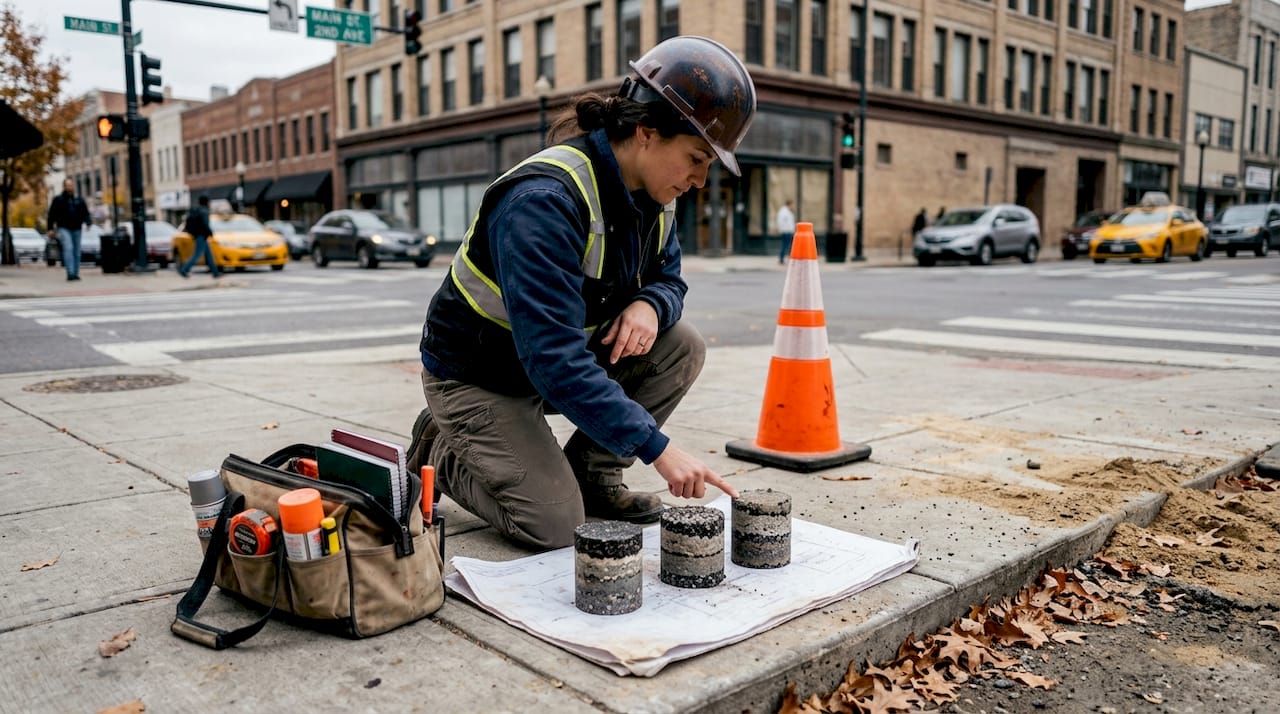
Winter maintenance requires special attention. Salt and sand applications can clog permeable pores, reducing infiltration capacity and defeating the system’s purpose. Regular vacuum sweeping removes debris before it penetrates and blocks voids. This maintenance intensity exceeds traditional pavement requirements but delivers significant stormwater benefits.
| Feature | Permeable pavement | Traditional pavement |
|---|---|---|
| Stormwater infiltration | High, reduces runoff by 80%+ | None, all runoff to storm drains |
| Initial cost | 10-20% higher | Baseline |
| Maintenance frequency | Quarterly vacuum sweeping | Annual sealcoating or patching |
| Winter salt tolerance | Moderate, clogs pores | High, no impact |
| Lifespan in Edmonton | 15-20 years with maintenance | 15-25 years |
| Environmental benefit | Significant water quality improvement | Minimal |
Sidewalk reconstruction follows a systematic process starting with removal of damaged concrete slabs:
- Remove existing concrete and haul away debris
- Excavate subgrade to specified depth, typically 6-8 inches below final surface
- Install and compact 4-6 inch gravel base for drainage and stability
- Pour 4-inch reinforced concrete slabs with proper slope for drainage
- Restore landscaping, topsoil, and grass around new sidewalk edges
Cost-share programs significantly affect project budgets. Edmonton’s neighborhood renewal often splits costs 50/50 between the city and property owners, with 2026 rates averaging $210 per meter for the property owner’s cash contribution. Understanding these financial structures helps you plan capital budgets accurately.
For detailed sidewalk services, visit sidewalk repair and reconstruction and review comprehensive permeable pavement design guidelines to evaluate whether these systems fit your property’s needs.
Local standards and best practices shaping Edmonton pavement projects
Navigating Edmonton’s regulatory landscape starts with understanding Complete Streets Design & Construction Standards Volumes 1 and 2. These CSDCS documents, updated in 2025, establish design parameters for streets, alleys, and pavements with explicit focus on sustainability and climate resilience. The updates address Edmonton’s specific challenges including extreme temperature swings and increasing precipitation intensity.
Alberta’s provincial standards complement municipal requirements. Pavement design manuals and bulletins guide thickness calculations, asphalt mix selections, and performance specifications that ensure pavements meet provincial highway standards. These technical references provide the engineering foundation for determining appropriate pavement structures based on traffic loads and soil conditions.
| Standard | Edmonton CSDCS | Alberta provincial manuals |
|---|---|---|
| Primary focus | Municipal streets, complete streets design | Highway and arterial road design |
| Update frequency | Major revision 2025 | Ongoing technical bulletins |
| Sustainability emphasis | High, explicit climate resilience goals | Moderate, performance-based |
| Pavement thickness guidance | Context-sensitive, multimodal priority | Traffic load and classification based |
| Local soil considerations | Specific to Edmonton clay and frost | General Alberta soil types |
Best practices for Edmonton pavement projects include:
- Prioritize sustainability by selecting recycled materials and energy-efficient construction methods
- Choose asphalt mixes and concrete formulations proven in Edmonton’s freeze-thaw cycles
- Design drainage systems that handle spring melt and summer storms without compromising pavement structure
- Plan construction and major repairs during optimal weather windows to ensure proper curing
- Incorporate climate resilience features like deeper frost protection and flexible joint designs
Following these local standards ensures your infrastructure investments deliver maximum longevity while meeting compliance requirements. Proper adherence reduces maintenance costs over the pavement lifecycle and minimizes disruption from premature failures.
For municipal project planning, explore municipal road construction standards and review budgeting strategies for concrete repairs. Access complete Edmonton CSDCS documentation to verify specific requirements for your next project.
Professional paving solutions for Edmonton property managers and officials
Implementing these complex paving processes correctly requires specialized expertise and equipment. ProZone delivers comprehensive road construction solutions tailored to Edmonton’s municipal and commercial infrastructure needs, ensuring projects meet both CSDCS standards and sustainability goals from initial planning through final inspection.
Their experienced teams handle everything from site preparation and frost depth excavation to final surface finishing and quality control. Services include expert concrete sidewalk repair and curb installation that aligns with neighborhood renewal programs and cost-share requirements. Whether you need full-scale road construction or targeted maintenance interventions, ProZone’s local knowledge and technical capabilities support infrastructure projects that deliver lasting performance in Edmonton’s challenging climate.
Frequently asked questions
What is micro-surfacing, and how does it differ from sealcoating?
Micro-surfacing is a cold-applied structural treatment combining polymer-modified asphalt emulsion, crushed aggregate, cement, and water that extends pavement life 8-12 years by filling ruts and sealing cracks. Sealcoating simply applies a thin protective layer lasting 2-3 years, suitable only for newer pavements without structural issues. Micro-surfacing provides actual structural reinforcement and corrects surface irregularities, making it far more cost-effective for aging infrastructure than cosmetic sealcoating.
How does Edmonton’s climate affect pavement design and maintenance?
Edmonton’s climate demands excavation to 3-4 feet frost depth to prevent frost heave damage during winter freeze-thaw cycles. Winter conditions accelerate pavement degradation through salt exposure, thermal stress, and moisture infiltration, requiring more frequent inspection and maintenance. CSDCS standards incorporate climate resilience measures specifically addressing these local challenges to ensure pavement durability.
What are the key steps in concrete sidewalk reconstruction projects?
Reconstruction starts by removing existing damaged concrete slabs and hauling debris away from the site. Contractors then excavate subgrade, install and compact a 4-6 inch gravel base, and pour new 4-inch reinforced concrete slabs with proper drainage slope. Cost-share programs like Edmonton’s 50/50 neighborhood renewal split expenses between city and property owners, with typical 2026 rates around $210 per meter for the owner’s contribution. For professional sidewalk services, visit sidewalk repair and reconstruction.
Why should I consider permeable pavement for my property?
Permeable pavement reduces stormwater runoff by 80% or more, helping meet Low Impact Development goals and reducing strain on municipal drainage systems. It filters pollutants through underlying soil layers, improving water quality before groundwater recharge. However, Edmonton winters require diligent maintenance including regular vacuum sweeping to prevent salt and sand from clogging pores and reducing infiltration capacity.
What local standards must Edmonton paving projects follow?
All municipal street and pavement projects must comply with Complete Streets Design & Construction Standards Volumes 1 and 2, updated in 2025 with enhanced sustainability and climate resilience requirements. Commercial and private projects also reference Alberta’s Pavement Design Manual and related technical bulletins for thickness calculations and mix design specifications. Following these standards ensures compliance, optimizes longevity, and qualifies projects for municipal approvals and potential cost-sharing programs.
Recommended
- Choosing the Right Paving Contractor in Edmonton: Factors to Consider – ProZone Ltd. – Home, Main office, asphalt, concrete, snow removal, Alberta, Edmonton, SherwoodPark, rubber paving, streetbond, thermoplastic, landscaping supplies
- What is asphalt resurfacing? A guide for Edmonton property managers