
TL;DR:
- Pavement damage assessment involves measuring surface and structural distresses using industry-standard methods like ASTM D6433 to determine pavement condition. Recognizing distress types, severity levels, and employing appropriate tools enable accurate PCI scoring and better maintenance decisions. Incorporating advanced technology and consistent evaluation practices helps property managers extend pavement lifespan and optimize repair budgets effectively.
Pavement damage assessment is the systematic process of identifying, measuring, and rating surface and structural distresses to determine a pavement’s condition and maintenance priority. The industry standard for this process is ASTM D6433, which defines the Pavement Condition Index (PCI) as a numerical score from 0 to 100 quantifying overall pavement health. For property managers, facility managers, and homeowners in Alberta, knowing how to assess pavement damage is not optional. Edmonton’s freeze-thaw cycles accelerate distress formation faster than in most Canadian climates, and catching problems early can reduce repair costs significantly. This guide covers the essential signs, tools, steps, and technologies you need to conduct a reliable pavement damage evaluation.
How to assess pavement damage: distress types and warning signs
Pavement distress falls into two broad categories: surface distresses and structural distresses. Surface distresses affect the top layer and include raveling, bleeding, and minor cracking. Structural distresses signal deeper failures in the base or subgrade and include alligator cracking, rutting, potholes, and shoving.
The most common distress types to recognize during any pavement inspection include:
- Alligator cracking: Interconnected cracks forming a pattern resembling reptile scales. This is a fatigue failure indicating the structural base can no longer support load.
- Edge cracking: Linear cracks running parallel to the pavement edge, often caused by poor drainage or inadequate shoulder support.
- Potholes: Bowl-shaped holes resulting from progressive alligator cracking and material loss. In Alberta, freeze-thaw cycling accelerates pothole formation through repeated ice expansion.
- Rutting: Longitudinal depressions in wheel paths caused by permanent deformation of the asphalt or base layers.
- Raveling: Progressive loss of aggregate from the surface, leaving a rough, pitted texture. Common in older Edmonton pavements exposed to de-icing chemicals.
- Bleeding: Excess asphalt binder migrating to the surface, creating a shiny, sticky film that reduces skid resistance.
- Shoving: Localized displacement of the pavement surface, typically near intersections where braking forces are high.
- Swelling: An upward bulge caused by frost heave or expansive subgrade soils, both of which are frequent concerns in Alberta.
Severity levels matter as much as distress type. ASTM D6433 classifies each distress at low, medium, or high severity, and the severity level directly affects the deduct value used in PCI calculation. A low-severity alligator crack and a high-severity one require completely different repair strategies.
Distress clustering along drainage routes or pavement edges often signals moisture infiltration or fatigue failure rather than isolated surface wear. Recognizing these patterns early allows you to address root causes rather than symptoms.
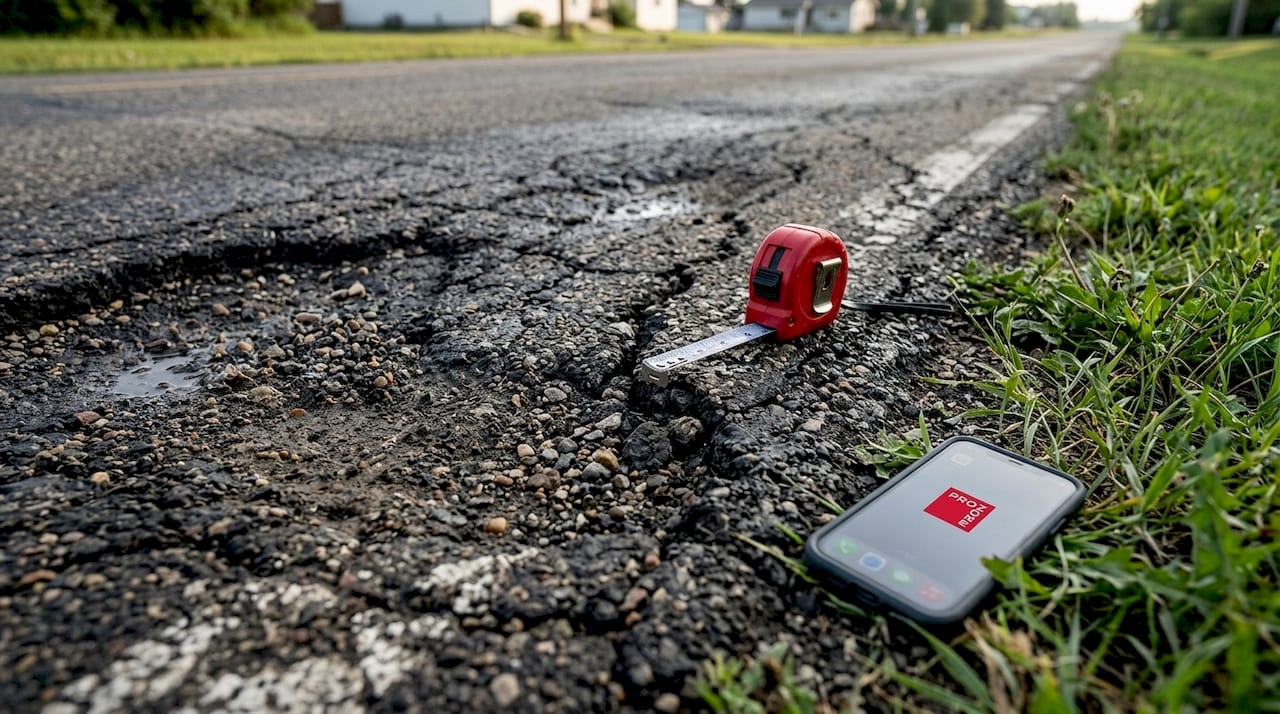
Pro Tip: When you notice cracking concentrated near catch basins or low-lying areas, suspect drainage failure first. Patching the cracks without fixing the drainage will produce the same damage within one or two freeze-thaw seasons.
What tools and methods are needed for pavement damage evaluation?
Effective pavement damage evaluation requires both field measurement tools and a structured methodology. The following sequence covers the core requirements:
- Measuring tape and straightedge: Used to measure crack lengths in linear feet, distressed areas in square feet, and rut depths in inches. These are the baseline instruments for any ASTM D6433 survey.
- Distress survey forms: Standardized recording sheets that capture distress type, severity level, and quantity using the correct units. Asphalt distresses are measured in square feet for area-based types, linear feet for cracks, and count for potholes.
- Profilometer or inertial profiler: Measures surface roughness and rut depth across a pavement section, providing objective data that supplements visual observation.
- Falling Weight Deflectometer (FWD): Applies a controlled impulse load to the pavement surface and measures deflection to evaluate load capacity and remaining structural life. FWD testing is the most reliable method for distinguishing surface distress from base failure.
- Ground Penetrating Radar (GPR): Profiles layer thickness and detects subsurface anomalies such as voids, delamination, or moisture pockets without cutting into the pavement.
- Infrared thermography camera: Detects temperature differentials on the surface that indicate moisture-related distresses or delamination not visible to the naked eye.
| Tool | What it measures | Best used for |
|---|---|---|
| Straightedge / tape | Crack length, area, rut depth | Visual PCI surveys |
| Profilometer | Surface roughness, rutting | Functional performance |
| FWD | Structural deflection, load capacity | Base and subgrade evaluation |
| GPR | Layer thickness, subsurface voids | Subsurface anomaly detection |
| Infrared camera | Surface temperature differentials | Moisture and delamination detection |
Safety during inspections is non-negotiable. Inspectors must wear high-visibility clothing and conduct surveys in dry daylight conditions. On active parking lots or roadways in Edmonton, traffic control measures should be in place before any field work begins.
Pro Tip: For most property managers conducting routine assessments, a straightedge, measuring tape, and a printed ASTM D6433 distress survey form cover 80% of what you need. Reserve FWD and GPR for situations where surface distress patterns suggest structural failure.
Step-by-step process to assess pavement damage and calculate condition scores
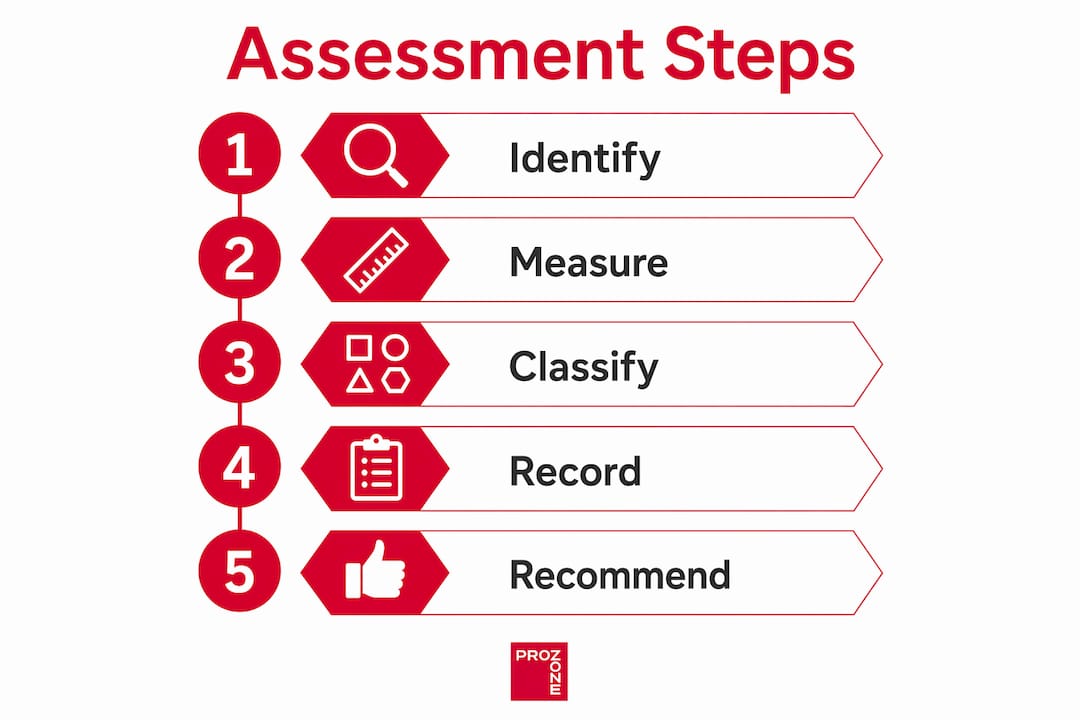
A structured pavement damage evaluation follows a repeatable sequence that produces a defensible PCI score. Here are the core steps:
- Define inspection units. Divide the pavement into sections of uniform construction, traffic loading, and condition. Parking lots are typically divided into sample units of 230 to 930 square yards per ASTM D6433 sampling protocols.
- Walk the section systematically. Move in parallel passes across the inspection unit, recording every distress type, its severity level (low, medium, or high), and its quantity using the correct measurement unit.
- Calculate distress density. Divide the measured quantity of each distress type and severity by the total area of the inspection unit. This produces a percentage that reflects how widespread each distress is.
- Determine deduct values. Use the ASTM D6433 deduct value curves to convert each distress density and severity combination into a weighted deduct value. Higher severity and greater density produce higher deduct values.
- Apply the corrected deduct value procedure. When multiple distresses are present, PCI calculations use an iterative corrected deduct value process to prevent over-penalizing a pavement with many minor distresses. This step requires the ASTM D6433 correction curves.
- Calculate the PCI score. Subtract the maximum corrected deduct value from 100. The result is the PCI for that inspection unit.
- Interpret and document the score. Record the PCI alongside the distress inventory and assign a verbal condition rating.
| PCI range | Condition rating | Recommended action |
|---|---|---|
| 85 to 100 | Excellent | Routine monitoring |
| 70 to 84 | Good | Preventive maintenance |
| 55 to 69 | Fair | Minor rehabilitation |
| 40 to 54 | Poor | Major rehabilitation |
| 25 to 39 | Very poor | Reconstruction planning |
| 0 to 24 | Failed | Immediate reconstruction |
PCI scores above 85 indicate pavement requiring only routine monitoring, while scores below 40 signal the need for major rehabilitation or full reconstruction. This threshold is particularly relevant in Alberta, where a pavement rated “fair” in October can deteriorate to “poor” after a single hard winter if preventive treatment is not applied.
Pro Tip: The most common data entry error in PCI surveys is recording crack length in square feet instead of linear feet. This inflates distress density and produces an artificially low PCI score, which can trigger unnecessary reconstruction budgets. Always verify units before calculating density.
How do advanced technologies improve pavement assessment accuracy?
Traditional visual surveys are reliable but inherently subjective. Two inspectors walking the same section can produce PCI scores that differ by 10 or more points depending on experience and interpretation. Advanced technologies address this variability directly.
AI and machine vision provide objective, automated distress identification by analyzing high-resolution images or video captured from vehicle-mounted cameras. The American Public Works Association (APWA) recognizes AI-based inspection as a method that produces comprehensive, reproducible condition data at a speed no manual crew can match. For large parking lots or road networks in Edmonton, this means more frequent condition updates without proportionally higher inspection costs.
Key benefits of technology-aided pavement inspection include:
- Reduced human variability: Machine vision applies consistent detection thresholds across every frame, eliminating the fatigue and interpretation differences that affect manual surveys.
- Faster data collection: A vehicle-mounted system can survey kilometers of pavement in a single pass, compressing multi-day manual surveys into hours.
- Infrared thermography: Detects surface cracks and moisture-induced distresses that are invisible to the eye, particularly useful for identifying delamination in Alberta’s freeze-thaw environment.
- FWD structural testing: Quantifies load-bearing capacity independently of surface appearance, preventing the common error of treating a structurally sound pavement with expensive rehabilitation or ignoring a structurally failed pavement because its surface looks acceptable.
- GPR subsurface profiling: Maps layer thickness and identifies voids or moisture pockets beneath the surface, providing data that no visual survey can replicate.
Moving from subjective manual evaluations to objective, technology-aided inspection improves the reliability and defensibility of maintenance decisions. APWA
The cost-benefit case for technology adoption depends on the size of your pavement network. For a single residential driveway, a manual survey with a straightedge is sufficient. For a commercial property manager overseeing multiple parking lots across Edmonton, investing in periodic AI-assisted surveys or contracting a firm that uses FWD and GPR testing produces data that justifies capital budgets and reduces the risk of premature pavement failure.
Common mistakes and best practices when inspecting pavement
Pavement inspections produce reliable data only when conducted consistently and completely. The following mistakes are the most frequent causes of inaccurate assessments and poor maintenance decisions:
- Relying on surface appearance alone. A pavement can look acceptable while its base layer has lost structural capacity. Surface condition and structural capacity must be assessed independently for sound maintenance decisions. Skipping structural testing leads to under-treatment of failing pavements and wasted spending on surface repairs that fail within months.
- Mixing measurement units. Recording alligator cracking in linear feet instead of square feet, or potholes in square feet instead of count, invalidates the entire PCI calculation for that distress type.
- Ignoring severity levels. Recording distress type without severity level makes it impossible to assign accurate deduct values and produces a PCI score that does not reflect actual condition.
- Adopting a patch-and-go approach. Filling potholes without investigating the base or drainage conditions that caused them guarantees repeat failures. This is especially costly in Alberta, where freeze-thaw cycles exploit any unaddressed moisture pathway.
- Inconsistent inspector training. Different inspectors applying different severity thresholds produce data that cannot be compared across inspection cycles. Calibration exercises, where multiple inspectors survey the same section and compare results, are standard practice in professional pavement management programs.
- Neglecting spatial documentation. Recording distress quantities without noting their location within the inspection unit loses the pattern information needed to diagnose causes. Distress patterns near edges or drainage are diagnostic clues, not just inventory data.
Pro Tip: Schedule pavement inspections in late spring after the frost has fully left the ground. This timing reveals the full extent of freeze-thaw damage from the preceding winter and gives you the maximum planning window before the next paving season opens.
Routine, periodic evaluations are the single most effective practice for extending pavement lifespan. A pavement inspected every two to three years allows you to apply low-cost preventive treatments at the right time, before the condition drops below the threshold where only expensive rehabilitation works. For more on connecting assessment outcomes to repair strategies, the parking lot repair guide from ProZone covers maintenance sequencing in detail.
What ProZone has learned about pavement assessment in Alberta
After working on pavement projects across Edmonton and the surrounding region, one pattern stands out clearly. Property managers who treat PCI scores as a communication tool, not just a technical number, get better outcomes from their maintenance budgets. When you present a PCI of 38 to a building owner alongside the ASTM D6433 condition table, the conversation shifts from “why does this cost so much” to “what happens if we wait another year.” That shift is where good maintenance decisions are made.
Alberta’s climate compresses the window between “fair” and “failed” faster than most property managers expect. Frost heaves can raise a PCI-rated “good” pavement to a structural concern within a single severe winter. Raveling accelerates under repeated de-icing salt applications, and edge cracking near poorly graded shoulders progresses to alligator cracking within two or three freeze-thaw seasons. The pavement inspections guide on the ProZone site covers how these regional factors translate into real cost and compliance exposure.
The practical advice is this: combine a traditional ASTM D6433 visual survey with at least one structural test, either FWD or GPR, for any pavement showing PCI scores below 55. Surface patching on a structurally compromised base is money spent twice. Choose inspectors who can explain their severity classifications and show you the deduct value curves they used. If they cannot, the data they produce is not reliable enough to base capital decisions on.
Professional pavement assessment services for Alberta property managers
ProZone provides certified pavement assessment and maintenance services across Edmonton and Alberta, with full compliance to Alberta Safety Codes and ASTM D6433 methodology. The ProZone team conducts structured distress surveys, calculates PCI scores, and integrates structural testing to give property and facility managers a complete picture of pavement condition, not just surface appearance. From initial damage evaluation through preventive maintenance and full rehabilitation, ProZone applies industry-standard protocols and advanced inspection tools to protect your pavement asset and your budget. The Alberta road maintenance guide outlines the full range of strategies available to property managers in the region. Contact ProZone today through the online form or by phone to schedule a consultation and receive a free estimate tailored to your property’s specific conditions.
FAQ
What is the Pavement Condition Index (PCI)?
The Pavement Condition Index is a numerical score from 0 to 100 derived using ASTM D6433, where 100 represents a perfect pavement and 0 represents complete failure. It is calculated by subtracting weighted deduct values based on distress type, severity, and density from 100.
How often should pavement be inspected in Alberta?
Pavement should be inspected every two to three years under normal conditions, with additional inspections following severe winters. Alberta’s freeze-thaw climate accelerates distress progression, so annual visual checks are advisable for pavements already rated below PCI 60.
What is the difference between surface and structural pavement distress?
Surface distresses such as raveling and bleeding affect only the top asphalt layer, while structural distresses such as alligator cracking and rutting indicate failure in the base or subgrade. Surface and structural assessments must be conducted independently to avoid over-treating or under-treating a pavement.
Can a homeowner assess pavement damage without professional tools?
A homeowner can conduct a basic visual inspection using a measuring tape and an ASTM D6433 distress reference guide to identify and record common distress types. For accurate PCI scoring or any pavement showing signs of structural distress, a qualified inspector with proper measurement tools is required.
What is the most common mistake in pavement damage assessment?
The most common mistake is focusing only on surface patching without evaluating the structural base, which leads to repeated failures at the same locations. Using incorrect measurement units during distress surveys is the second most frequent error, as it invalidates PCI calculations entirely.