
TL;DR:
- Proper concrete curing involves maintaining moisture and temperature to allow full hydration, ensuring maximum strength and durability. Edmonton’s cold climate requires careful planning, early intervention, and thermal protections, such as insulated blankets, to prevent freeze damage and ensure adequate curing time. Failure to initiate curing promptly and accurately can cause irreversible surface damage and compromise the slab’s long-term performance.
Concrete curing is defined as the controlled process of maintaining moisture and temperature after placement so that cement hydration can proceed and the concrete develops its full design strength. Without deliberate curing, a slab can lose a significant portion of its intended strength before it ever carries a load. For construction professionals and DIY enthusiasts working in Edmonton’s demanding climate, understanding the concrete curing process is not optional. It is the difference between a structure that lasts decades and one that cracks within its first winter.
How the concrete curing process works at a chemical level
Cement hydration is the chemical reaction at the heart of every concrete pour. When Portland cement contacts water, it produces calcium silicate hydrate, the compound responsible for binding aggregate particles into a dense, load-bearing matrix. This reaction does not happen instantly. It continues for weeks, provided that adequate moisture and a favourable temperature remain available.
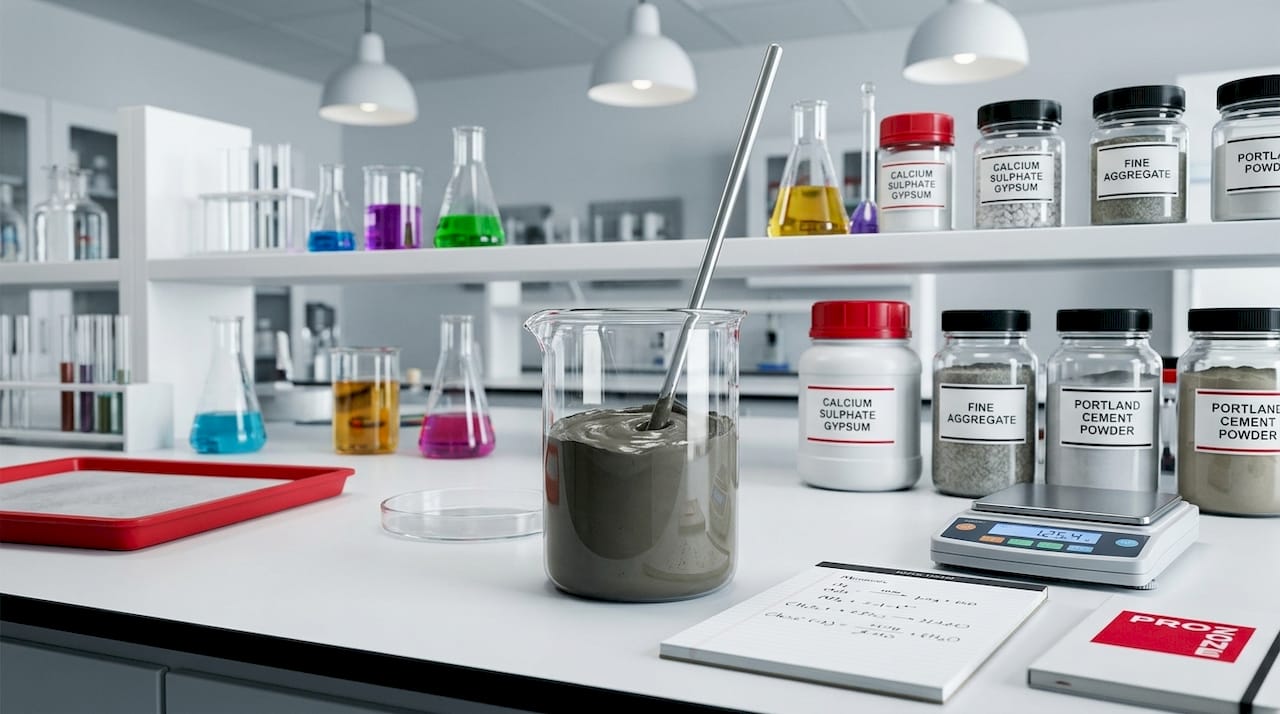
The water-cement ratio governs how much hydration is theoretically possible, but curing governs how much actually occurs. A mix designed for 30 MPa compressive strength can fall well short of that target if surface moisture evaporates in the first few hours. The concrete does not look weaker, but it is. That gap between apparent and actual strength is where most field failures originate.
Key factors that govern hydration progress:
- Moisture availability: Hydration consumes water. If the surface dries before the reaction completes, hydration stops in those zones.
- Temperature range: The optimal range is between 10°C and 32°C. Below 10°C, hydration slows measurably. Above 32°C, rapid evaporation accelerates surface drying.
- Cement type: Ordinary Portland Cement (OPC) hydrates faster than blended cements such as slag or fly-ash mixes, which require longer curing periods to reach equivalent strength.
- Slab geometry: Thin sections and exposed edges lose moisture faster than mass pours, making them more vulnerable to incomplete hydration.
Concrete that freezes before reaching approximately 3.5 MPa compressive strength suffers permanent internal damage. Ice crystal formation disrupts the forming hydrate structure, and no amount of subsequent curing repairs that damage.
What are the common methods for curing concrete?
The methods for curing concrete divide into two broad categories: those that add or retain moisture, and those that seal the surface to prevent evaporation. Each has a defined role depending on project scale, ambient conditions, and the finishing schedule.
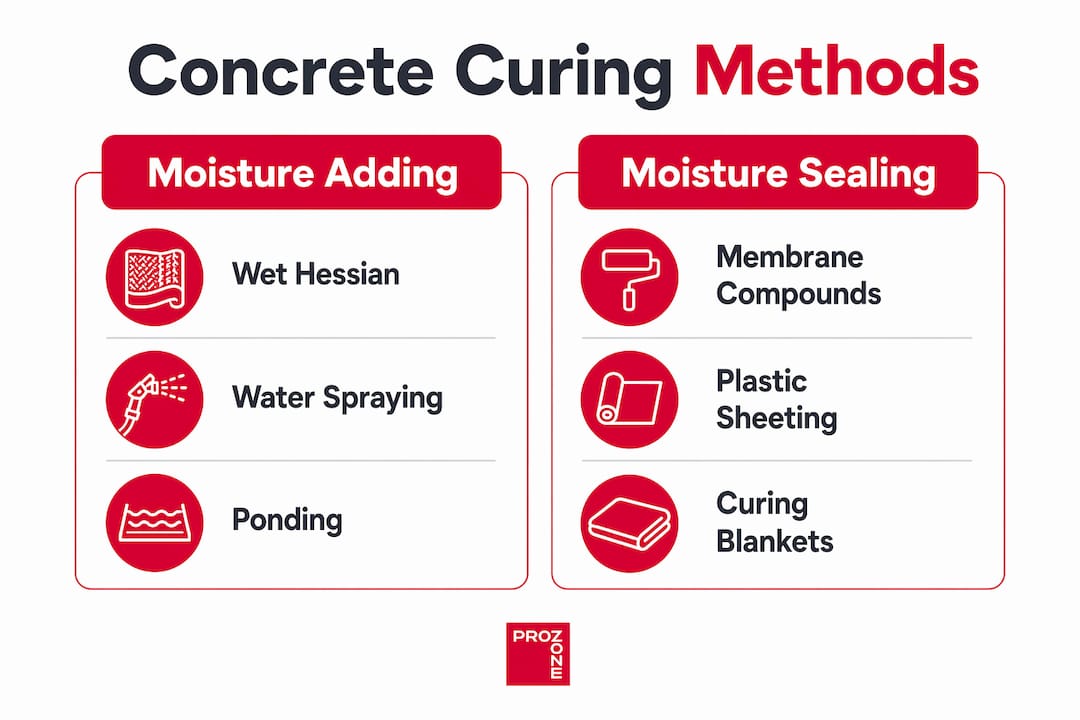
| Method | Mechanism | Best application | Limitation |
|---|---|---|---|
| Wet hessian / burlap | Retains moisture through direct contact | Flatwork, slabs, footings | Labour intensive; must stay wet continuously |
| Ponding | Standing water on surface | Horizontal slabs in warm weather | Impractical on slopes or vertical elements |
| Sprinkling / fogging | Continuous water mist | Large flatwork in hot conditions | Requires constant water supply and monitoring |
| Membrane-forming compounds | Film reduces evaporation | Large horizontal surfaces, roads | Cannot be used under bonded overlays |
| Curing blankets / insulated sheets | Retains heat and moisture | Cold weather pours | Requires monitoring for thermal gradients |
| Polyethylene sheeting | Vapour barrier over wet surface | General flatwork | Must be sealed at edges to prevent drying |
Membrane-forming curing compounds form a thin film that reduces evaporation and maintains the moisture needed for hydration. They are widely used on large horizontal surfaces such as parking lots and road bases because they replace the labour of continuous wet curing. The trade-off is that they cannot be used where a bonded overlay or coating will follow, since the film interferes with adhesion.
Wet hessian remains the most effective method for moisture retention on formed surfaces and slabs. The material must stay visibly damp throughout the curing period. Allowing hessian to dry out and rewetting it intermittently is not equivalent to continuous wet curing. Each drying cycle allows partial hydration arrest in the surface zone.
Pro Tip: When applying a membrane-forming compound, apply in two passes in perpendicular directions immediately after bleed water disappears. Patchy single-direction application leaves unprotected zones that produce surface weakness and dusting.
Why does timing matter so much in concrete curing?
Curing must begin within 30 to 60 minutes after finishing on hot or windy days, and no later than three hours under milder conditions. That window is narrow, and missing it produces irreversible surface damage regardless of how well the slab is cured afterwards.
The sequence for starting and maintaining curing follows a clear logic:
- Finish the surface to the specified texture. Do not over-work the bleed water.
- Monitor evaporation rate. If wind, temperature, or low humidity is present, deploy curing measures immediately after finishing, not after a break.
- Apply the chosen curing method uniformly across the entire surface, including edges and construction joints.
- Maintain continuous coverage for the minimum required period. Check wet coverings at least twice daily.
- Document conditions including ambient temperature, relative humidity, and any interruptions to curing coverage.
Minimum curing periods range from 7 to 14 days depending on cement type and exposure class. OPC mixes in sheltered conditions typically require 7 days. Blended cements, including slag and fly-ash mixes common in Alberta infrastructure projects, require 10 days or more because their hydration reaction proceeds more slowly. Exposed slabs subject to traffic or freeze-thaw cycling benefit from the full 14-day period.
The single most common curing error is starting too late, particularly under hot or windy conditions. The surface may appear intact, but the strength loss is permanent. Later curing cannot recover strength that was never developed in the first critical hours.
How does Edmonton’s freeze-thaw climate affect concrete curing?
Edmonton’s climate creates curing conditions that differ fundamentally from those described in temperate-climate textbooks. Ambient air temperatures below 5°C for three or more consecutive days define cold-weather concreting conditions under Canadian standards. That threshold is reached regularly from October through April in the Edmonton region.
The practical consequences for the curing process are direct:
- Hydration slows below 10°C and effectively stops near 0°C. A slab placed in cold weather without thermal protection may sit for days without meaningful strength gain.
- Freezing before 3.5 MPa causes permanent structural damage. Ice formation in the capillary pore network disrupts the calcium silicate hydrate matrix that was forming.
- Insulated curing blankets are the standard response for slabs poured in cold weather. They retain the heat of hydration and prevent surface temperature from dropping below the minimum threshold.
- Heated enclosures are required for large pours or when ambient temperatures fall below approximately minus 10°C. Propane or electric heating maintains the air temperature around the concrete, but the enclosure must be sealed to prevent moisture loss.
- Accelerating admixtures, such as calcium chloride or non-chloride alternatives, are used to advance early strength gain and reduce the window of freeze vulnerability.
- Temperature monitoring using embedded thermocouples or surface thermometers is not optional on cold-weather pours. It is the only way to confirm that hydration is proceeding and that the concrete has reached the 3.5 MPa threshold before any protection is removed.
Abrupt removal of thermal protection causes thermal shock cracking. The temperature drop should not exceed 5°C per hour until the concrete reaches ambient temperature. Gradual cooldown is as important as the initial protection.
Pro Tip: Review ProZone’s guidance on winter concrete protection before scheduling any cold-weather pour. Planning the cooldown schedule in advance, not after the blankets are already on, is what separates compliant work from costly remediation.
For projects subject to Alberta Safety Codes and municipal specifications, cold-weather curing procedures must be documented and available for inspection. Generic contractor practices that omit temperature logs or use inadequate insulation do not meet that standard.
Practical tips and common mistakes in concrete curing
The most preventable curing failures share a common cause: inadequate planning before the pour begins. Procuring curing materials after the concrete is placed is too late. The method, coverage area, and monitoring schedule must be confirmed before the truck arrives.
Edge and joint drying is the most common cause of surface cracking and strength loss, even when the slab centre is well cured. Perimeter protection using wind barriers and weighted coverings that extend beyond the slab edge is not optional on exposed sites.
- Do not confuse curing with drying. Curing promotes hydration while drying governs suitability for flooring installation. Evaporable moisture can take from 1 to 60 or more days to leave a slab. Flooring readiness requires moisture testing, not calendar counting.
- Inspect wet coverings at regular intervals. Hessian or burlap that has dried out and been rewetted does not provide equivalent protection to continuously moist coverage.
- Record curing conditions. Date, time, ambient temperature, wind speed, and coverage method should be logged for every pour. This documentation supports quality assurance and protects against liability if strength issues arise later.
- Verify strength milestones before loading. Do not assume a slab is ready for traffic or formwork removal based on elapsed days alone. Use maturity monitoring or cylinder break results to confirm actual strength gain.
Pro Tip: When working with blended cement mixes common in Alberta, extend the minimum curing period by at least three days beyond the OPC baseline. The slower hydration kinetics of slag and fly-ash cements mean that standard 7-day curing leaves meaningful strength on the table.
ProZone’s perspective on curing as a quality commitment
The field reality is that curing is treated as an afterthought on too many sites. Crews finish the pour, cover the slab with a single layer of poly, and move on. Three days later, the poly has blown off one corner, the edges have dried out, and the surface is dusting. The slab looks fine. The problem only becomes visible after the first winter, when surface cracking appears along the exact lines where curing coverage was incomplete.
What ProZone has found over years of work in Edmonton is that the projects with the best long-term performance are the ones where curing was planned with the same rigour as the mix design. That means specifying the method, assigning responsibility for monitoring, and keeping records. It also means understanding that Edmonton’s freeze-thaw cycles impose constraints that do not appear in standard curing guides written for milder climates.
The uncomfortable truth about curing is that curing isn’t about making concrete hard faster. It is about maintaining conditions that prevent harmful temperature gradients and drying, both of which cause cracking and reduce durability. Speed is not the objective. Completeness is. A slab that is cured correctly for 14 days in November will outperform one that was rushed in July every time.
— ProZone
Work with ProZone for certified concrete services in Edmonton
ProZone delivers concrete construction and maintenance services across Edmonton and the surrounding region, with curing protocols that meet Alberta Safety Codes and municipal specifications. Every pour is supported by documented temperature monitoring, appropriate curing method selection, and quality assurance records. For projects where cold-weather conditions, blended cement mixes, or tight schedules create curing risk, ProZone’s team provides the technical oversight that generic contractors do not. Explore ProZone’s full range of construction services for Edmonton or contact ProZone directly for a free estimate. Use the online form at prozoneltd.ca or call to speak with a project manager today.
FAQ
What is the concrete curing process?
The concrete curing process is the controlled maintenance of moisture and temperature after placement to allow cement hydration to continue. It produces the calcium silicate hydrate that gives concrete its compressive strength and durability.
How long should concrete be cured?
Minimum curing periods range from 7 days for ordinary Portland cement to 14 or more days for blended cements and exposed or freeze-thaw-exposed slabs. Ambient temperature and cement type both affect the required duration.
When should curing start after placing concrete?
Curing should start within 30 to 60 minutes after finishing in hot or windy conditions, and no later than three hours under mild conditions. Delayed curing causes irreversible surface strength loss that later curing cannot recover.
What is the best method for curing concrete in cold weather?
Insulated curing blankets combined with temperature monitoring are the standard approach for cold-weather pours in Edmonton. Concrete must reach approximately 3.5 MPa before any risk of freezing, and thermal protection must be removed gradually to avoid thermal shock cracking.
Is curing the same as drying?
Curing and drying are distinct processes. Curing maintains moisture for hydration, while drying refers to the loss of evaporable water that governs flooring installation readiness. Moisture testing, not calendar days, determines when a slab is ready for floor coverings.