
TL;DR:
- Facility maintenance management involves proactive planning, scheduling, and execution to preserve assets and reduce costs. Edmonton’s freeze-thaw climate requires tailored preventive schedules, asset data discipline, and digital work orders to avoid costly failures. Proper asset registry, CMMS configuration, and seasonal inspections are essential for efficient facility operation.
Facility maintenance management is the systematic, proactive process of planning, scheduling, and executing upkeep tasks to preserve asset performance, reduce operational risk, and control long-term costs. For property managers and facility owners in Edmonton, knowing how to manage facility maintenance is not optional. Edmonton’s freeze-thaw climate puts extraordinary stress on concrete, asphalt, plumbing, and HVAC systems, making reactive approaches genuinely expensive. Digital CMMS platforms and structured preventive maintenance (PM) programmes are the two tools that separate facilities running efficiently from those absorbing avoidable emergency costs.
What do you need to manage facility maintenance efficiently?
Every effective maintenance programme begins with two non-negotiables: a living asset registry and a Computerised Maintenance Management System (CMMS). Without these, scheduling decisions are based on guesswork rather than data, and guesswork is always more expensive.
Building your asset registry
An up-to-date asset registry must include installation dates, condition ratings, OEM manuals, and location data for every maintained asset. This is the foundation for accurate budgeting and scheduling. Losing this as a living document reverts your entire maintenance programme to reactive, costlier guesswork. Review and update your registry at minimum quarterly, and after every significant repair or replacement.

Selecting and configuring a CMMS
A CMMS such as Oxmaint, IBM Maximo, or UpKeep centralises work orders, tracks technician attribution, and enforces data entry standards across your team. CMMS data standardisation is what makes KPIs meaningful. Without it, your maintenance reports reflect activity volume, not performance outcomes. Configure your CMMS to capture parts used, labour hours, and photographic evidence per work order so that condition scoring and capital planning happen automatically.
Key prerequisites before launching your maintenance programme:
- Asset registry: Every asset catalogued with age, location, condition rating, and OEM documentation
- CMMS platform: Configured for your property type and team size, with mandatory data fields enforced
- Digital work orders: Replacing paper-based systems to close accountability gaps and enable real-time tracking
- Regional climate inputs: Edmonton’s freeze-thaw cycles demand specific inspection triggers for concrete, asphalt, and drainage systems
- Vendor register: Pre-qualified contractors with confirmed insurance, SLAs, and compliance with Alberta Safety Codes
Pro Tip: Before going live with any CMMS, run a two-week parallel period where technicians complete both paper and digital work orders. This surfaces data entry gaps before they corrupt your KPI baseline.
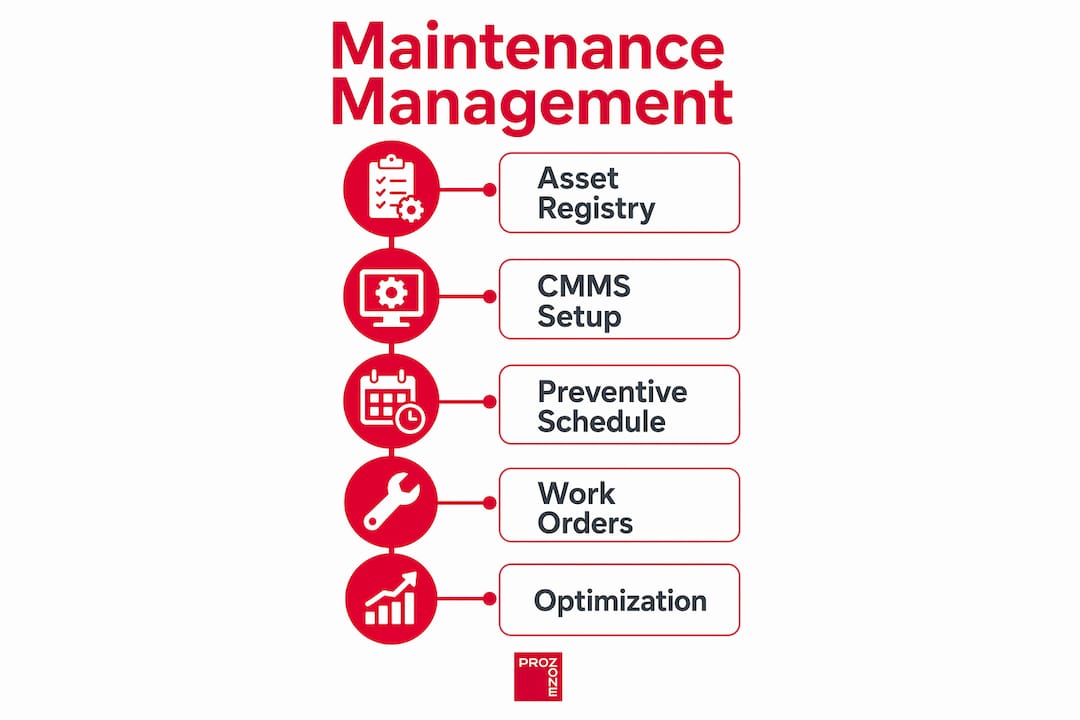
How to create an effective preventive maintenance schedule
A preventive maintenance schedule is a structured calendar of inspections and servicing tasks designed to catch failures before they occur. The goal is not to service everything on the same cycle. It is to match service frequency to asset criticality, manufacturer specifications, and real-world operating conditions.
Follow these steps to build a PM schedule that holds up in practice:
- Classify assets by criticality. Assign each asset a tier: critical (failure causes operational shutdown or safety risk), important (failure causes significant disruption), or standard (failure is inconvenient but manageable). HVAC units, fire suppression systems, and structural drainage fall into the critical tier for most Edmonton commercial properties.
- Set PM frequencies from two triggers. Calendar-based triggers (monthly, quarterly, annually) suit assets with predictable wear patterns. Usage-based triggers (runtime hours, cycle counts, vehicle kilometres) suit mechanical and electrical systems. Use both where applicable.
- Winterise before freeze-thaw season. Edmonton’s climate demands specific autumn inspections: plumbing insulation checks, HVAC filter replacements, concrete surface inspections, and drainage clearing before ground freeze. Missing these tasks in October typically results in emergency repair calls in January.
- Automate PM work order generation. Configure your CMMS to generate work orders automatically at the scheduled trigger point. Best-in-class facilities achieve PM completion rates between 85% and 95%. Rates below 70% signal scheduling overload or resource shortfalls that need immediate correction.
- Review and adjust quarterly. PM schedules are not static documents. Adjust frequencies based on accrued condition data and field feedback from your technicians. An asset running in harsh conditions may need servicing twice as often as the OEM specification suggests.
Pro Tip: PM schedules in cold climates should adjust dynamically based on real-world feedback from maintenance teams. If technicians are consistently finding the same fault at every inspection, shorten the interval rather than waiting for a failure event.
| Asset type | Recommended PM frequency | Edmonton climate adjustment |
|---|---|---|
| HVAC systems | Quarterly | Add pre-winter inspection in October |
| Plumbing and drainage | Semi-annually | Add freeze-thaw inspection in March |
| Concrete and asphalt surfaces | Annually | Inspect post-thaw in April for crack propagation |
| Fire suppression systems | Annually (code-mandated) | No seasonal adjustment required |
| Electrical panels | Annually | No seasonal adjustment required |
| Parking lot surfaces | Annually | Parking lot inspection post-winter recommended |
What are best practices for work orders, inspections, and vendor coordination?
Daily operations in facility management live or die by how well work orders are managed. A work order is the formal record of a maintenance task: who requested it, who completed it, what parts were used, and how long it took. Centralising and digitising this process is the single highest-leverage change most property managers can make.
Transitioning to digital work order management improves issue resolution times by 28%, reduces emergency repair calls by 47%, and extends equipment life by three to five years. Those are not marginal gains. They represent the difference between a facility that operates predictably and one that absorbs constant unplanned costs.
Effective work order and vendor management requires:
- Centralised work order intake: All requests, whether from tenants, inspections, or automated CMMS triggers, enter a single queue. This prevents tasks from being lost in email threads or verbal handoffs.
- Standardised data entry: Every work order must capture asset ID, fault description, technician assigned, time to complete, and parts used. Without data standardisation, KPIs become unreliable for reporting and decision-making.
- Automated escalation rules: Configure your CMMS to flag overdue work orders and escalate to a supervisor after a defined period. This removes the need for manual follow-up and closes accountability gaps.
- Vendor register with SLAs: Every contracted vendor should have a documented service level agreement, proof of insurance, and confirmed compliance with Alberta Safety Codes. Vendors without these credentials expose your property to liability.
- Audit-ready compliance reporting: Safety inspections for fire systems, elevators, and electrical panels must be scheduled, documented, and retrievable on demand. Digital records in a CMMS satisfy this requirement without additional paperwork.
| Work order approach | Resolution speed | Documentation quality | Compliance readiness |
|---|---|---|---|
| Paper-based manual | Baseline | Low (prone to loss) | Poor |
| Spreadsheet tracking | Marginal improvement | Medium | Moderate |
| Digital CMMS platform | +28% faster | High (standardised) | Audit-ready |
For routine facility cleaning and janitorial tasks, apply the same work order discipline. Cleaning schedules that are tracked digitally produce consistent results and create a paper trail that supports health and safety audits.
How to optimise maintenance to prevent failures and extend asset life
Moving from reactive to proactive maintenance is the most financially significant shift a property manager can make. The reactive “break-fix” mindset is the most common and costly mistake in facility management. The solution is measuring outcomes, not just activity.
Track these KPIs to assess and improve your maintenance programme:
- PM completion rate. Target 85% to 95% for critical systems. This is your primary indicator of scheduling and resource adequacy.
- Reactive-to-planned maintenance ratio. A healthy ratio is roughly 20% reactive to 80% planned. A ratio above 40% reactive signals that your PM programme is not catching failures early enough.
- Mean time to repair (MTTR). This measures how long it takes to restore an asset after a failure. Tracking MTTR by asset type identifies where your team needs additional training or better parts availability.
- Cost per asset per year. Aggregating labour, parts, and contractor costs by asset enables direct comparison against replacement value. When annual maintenance cost exceeds 40% to 60% of replacement value, capital replacement is typically more economical.
- Condition scoring. Assign each asset a condition score at every inspection. Over time, this data supports CapEx forecasting and prevents budget surprises.
The financial case for proactive maintenance is concrete. Undetected pipe leaks can waste over 10,000 gallons monthly, with mould remediation costs ranging from $15,000 to $50,000. A preventive repair costs approximately $200. That ratio illustrates why uniform maintenance schedules waste budget. Prioritising by asset criticality directs resources where the financial risk is highest.
Preventative maintenance programmes tailored to Edmonton’s climate also account for freeze-thaw damage cycles that accelerate surface deterioration on asphalt and concrete. Scheduling post-thaw inspections every April and pre-freeze inspections every October is not optional for Edmonton properties. It is the minimum standard for responsible asset stewardship.
Why data discipline matters more than any single tool
After working with commercial properties across Edmonton, the pattern that separates well-run facilities from struggling ones is not which CMMS they use. It is whether they treat their asset registry and work order data as strategic assets or administrative burdens.
Property managers who update their asset registry only when something breaks are not managing maintenance. They are reacting to it. The living asset registry concept is straightforward in theory but genuinely difficult to sustain in practice. It requires consistent discipline from every technician and supervisor, every time a task is completed.
The cultural shift from reactive to proactive maintenance is also harder than most managers expect. Teams accustomed to responding to failures often resist PM schedules as unnecessary until they experience the cost of a major failure firsthand. The most effective approach is to make the data visible. When technicians can see that their PM completions directly reduced emergency call-outs over a quarter, the behaviour change follows.
Emerging trends worth watching include integration of IoT sensors for real-time condition monitoring and cyber-physical system failure protocols that automatically trigger work orders when sensor thresholds are breached. These technologies are moving from large industrial facilities into commercial property management, and Edmonton properties with modern CMMS platforms are positioned to adopt them without significant infrastructure changes.
— ProZone
How Prozoneltd supports Edmonton property managers
Prozoneltd delivers certified construction and infrastructure maintenance services across Edmonton and the surrounding region, with direct experience managing the demands of Alberta’s freeze-thaw climate. From concrete and asphalt maintenance to earthworks, snow removal, and outdoor surface materials, Prozoneltd works to Alberta Safety Codes standards with premium materials that outlast generic contractor solutions. Every project is documented with the same rigour this article recommends for your internal maintenance programme. If you manage a commercial or municipal property and need a professional assessment of your exterior assets, contact Prozoneltd directly for a free estimate using the online form at prozoneltd.ca or call the Edmonton office. Do not wait for a failure event to find out what your surfaces actually need.
FAQ
What is facility maintenance management?
Facility maintenance management is the systematic planning, scheduling, and execution of upkeep tasks to preserve asset performance and control costs. It encompasses preventive maintenance, work order management, vendor coordination, and compliance tracking.
How often should preventive maintenance be scheduled?
PM frequency depends on asset criticality, manufacturer specifications, and operating conditions. Critical systems such as HVAC and fire suppression typically require quarterly to annual servicing, with additional inspections triggered by Edmonton’s seasonal freeze-thaw cycles.
What KPIs should property managers track for maintenance?
The most useful KPIs are PM completion rate (target 85% to 95%), reactive-to-planned maintenance ratio (target 80% planned), mean time to repair, and cost per asset per year. These metrics reveal whether your programme is preventing failures or simply responding to them.
Why is a CMMS worth the investment for smaller facilities?
Digital CMMS platforms improve issue resolution times by 28% and reduce emergency repair calls by 47%, even for smaller properties. The return on investment comes from avoided emergency costs and extended asset life, not from the platform features themselves.
How does Edmonton’s climate affect maintenance scheduling?
Edmonton’s freeze-thaw cycles accelerate deterioration of concrete, asphalt, plumbing, and drainage systems. Effective maintenance strategies for Edmonton properties include mandatory pre-freeze inspections in October and post-thaw inspections in April to catch surface damage before it compounds.