
TL;DR:
- Proper aggregate selection is critical for drainage, stability, and frost protection in Alberta projects.
- Different aggregate types serve specific functions, from load-bearing bases to decorative finishes.
- Local sourcing, supplier collaboration, and site-specific standards are key to avoiding costly failures.
Most project teams treat aggregate as an afterthought, ordering whatever gravel is cheapest and closest. That decision quietly causes drainage failures, unstable bases, and surfaces that crack before the first Alberta winter is over. Aggregate is not a commodity. It is a precisely engineered material category covering everything from angular crushed rock to rounded pea gravel, and each type behaves differently under load, water, and freeze-thaw stress. For property developers, landscape architects, and contractors working in Alberta, getting aggregate selection right is as important as any structural decision on the project. This guide breaks down types, applications, selection criteria, and installation best practices so you can specify with confidence.
Table of Contents
- What is landscaping aggregate?
- Key types of landscaping aggregate used in Alberta
- Selecting the right aggregate: Drainage, aesthetics, and sustainability
- Practical tips for specification and installation in Alberta
- Expert perspective: What most guides miss about landscaping aggregate in Alberta
- Get expert aggregate solutions for your Alberta project
- Frequently asked questions
Key Takeaways
| Point | Details |
|---|---|
| Aggregate types matter | Choosing the right aggregate impacts base strength, drainage, and aesthetics for every Alberta project. |
| Follow Alberta standards | Local regulations and sustainability mandates should always guide aggregate sourcing and use. |
| Proper installation is crucial | Careful specification and installation of aggregate prevent costly failures and ensure long-term performance. |
| Sustainable options available | Recycled concrete and regional reclamation practices offer eco-friendly choices for modern landscapes. |
What is landscaping aggregate?
Aggregate is a broad category of coarse to medium grained particulate material used as a base, fill, drainage medium, or surface finish in construction and landscaping. It includes crushed stone, natural gravel, sand, recycled concrete, and specialty decorative rock. What ties them together is their function: they distribute loads, manage water movement, and provide a stable platform for everything built above them.
The word “gravel” gets used loosely on job sites, but it only describes one subset of aggregate. Calling all aggregate “gravel” is like calling all lumber “wood.” The distinction matters because aggregate encompasses a range of materials beyond gravel, each with specific engineering and design uses. Using the wrong type in the wrong application is one of the most common and costly mistakes in Alberta landscaping and civil construction.
The physical properties that determine aggregate performance are particle size, particle shape, gradation, and mineral composition. Angular particles interlock under compaction, making them ideal for load-bearing bases. Rounded particles resist compaction but allow water to pass freely between them, making them better for drainage layers and decorative finishes. Gradation refers to the distribution of particle sizes within a batch. A well-graded aggregate fills voids and compacts tightly. A uniformly graded aggregate leaves more void space, which improves drainage but reduces structural strength.
In Alberta, mineral composition also matters. Limestone, quartzite, and granite all behave differently under freeze-thaw cycling. Limestone aggregate is widely used in Alberta for its availability and durability, but it must be specified correctly for the application.
The engineering value of aggregate is not in the material itself, but in how its physical properties interact with site conditions. Drainage, load, and climate all determine which aggregate performs and which one fails.
Here is what aggregate does in a professional project context:
- Structural support: Angular, compacted aggregate distributes surface loads to the subgrade below.
- Drainage management: Permeable aggregate layers intercept and redirect water before it saturates the subgrade.
- Frost protection: Properly selected and installed aggregate reduces frost heave by limiting moisture retention near the surface.
- Aesthetic finish: Decorative aggregates provide clean, low-maintenance surface textures for pathways, plazas, and feature areas.
- Erosion control: Aggregate mulch and rock cover protect exposed soil from wind and water erosion.
Pro Tip: Always separate load-bearing and decorative aggregate specifications in your project documents. A sub-base spec and a surface finish spec are completely different documents with different performance criteria. Mixing them up during procurement is where budget overruns start.
With the foundation set on why aggregates are not just generic gravel, the next step is to unpack the main types you will encounter in Alberta projects.
Key types of landscaping aggregate used in Alberta
Alberta’s construction and landscaping market draws from a mix of local pit sources, quarried stone, and processed recycled materials. Each aggregate type has a defined role, and understanding those roles saves you from expensive re-work.
Key types include crushed rock, gravel, sand, pea gravel, road crush, and drain rock, each suited to specific structural and drainage applications. Here is how they compare:
| Aggregate type | Shape | Permeability | Relative cost | Best use |
|---|---|---|---|---|
| Crushed rock | Angular | Low to moderate | Moderate | Sub-base, retaining wall backfill |
| Gravel | Rounded | Moderate to high | Low to moderate | Drainage layers, decorative fill |
| Sand | Fine, variable | Low | Low | Bedding, joint fill, screeds |
| Pea gravel | Rounded, small | High | Moderate | Pathways, playgrounds, decorative |
| Road crush | Blended angular | Low | Low | Driveways, parking pads, base layers |
| Drain rock | Large, uniform | Very high | Moderate | French drains, storm drainage, infiltration |
Crushed rock is the workhorse of Alberta sub-base construction. Its angular shape means particles lock together under compaction, creating a stable platform that resists lateral movement. It is the right call under asphalt, concrete slabs, and retaining structures.
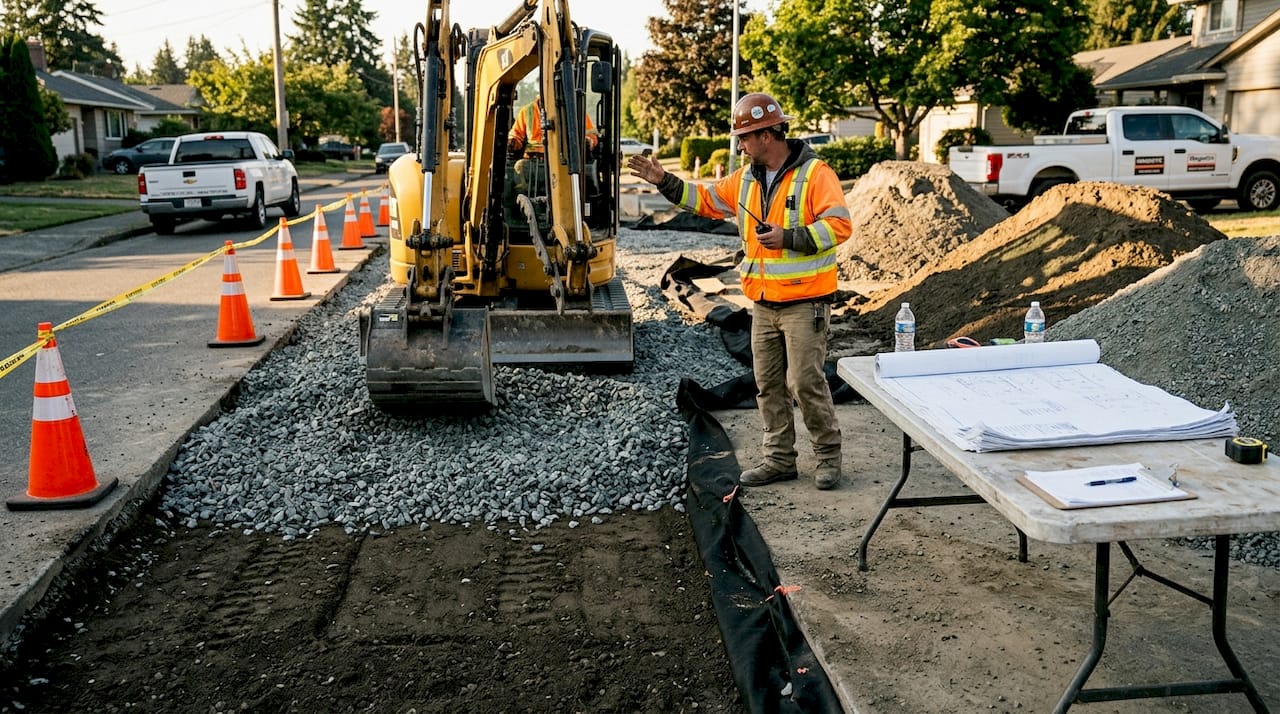
Road crush is a blended material combining crushed rock fines with coarser particles. It compacts extremely well and is the standard choice for road crush applications like driveways, parking areas, and access roads where a firm, bound surface is needed without the cost of paving.
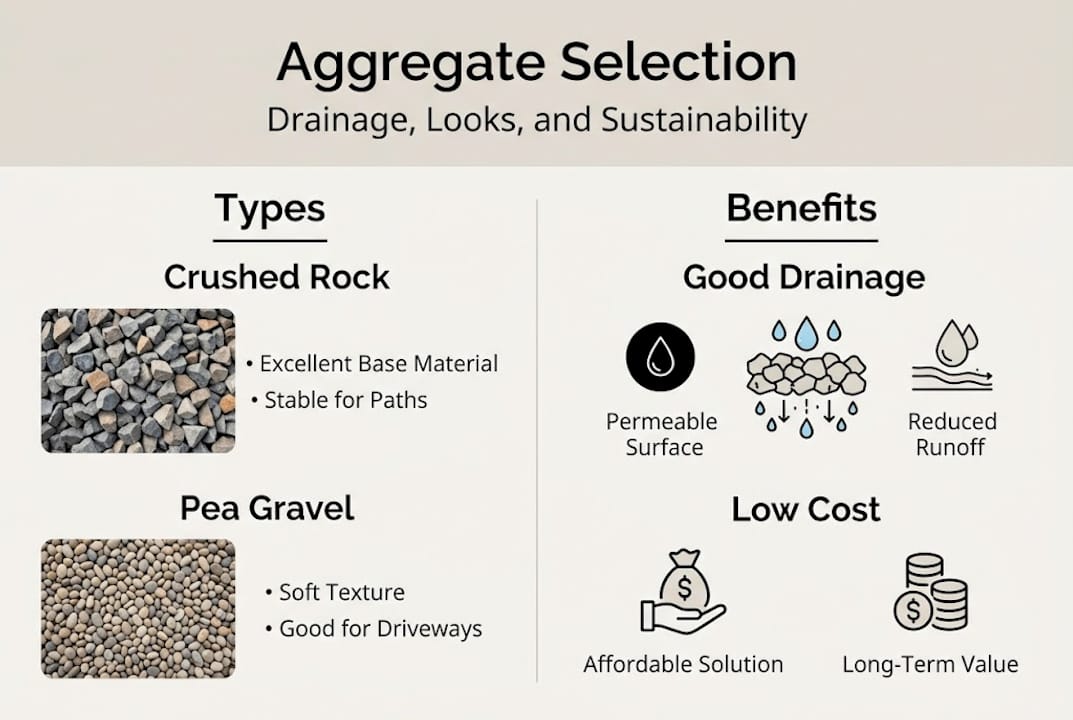
Pea gravel is one of the most misused aggregates on landscaping projects. Its small, rounded profile makes it visually appealing and comfortable underfoot, but it does not compact. That is a feature, not a flaw, when it is used correctly. Pea gravel uses include decorative ground cover, playground surfaces, and the drainage layer in French drain systems where its permeability is an asset.
Drain rock is the specialist. It is large, uniformly sized, and washed clean of fines. That uniform gradation means water moves through it quickly with minimal resistance. Use it wherever you need rapid subsurface drainage.
Here are three quick matching scenarios to guide your selection:
- Walkways and pathways: Pea gravel or compacted crushed rock depending on whether you want a permeable decorative finish or a firm walking surface.
- French drains and storm drainage: Drain rock as the primary fill, wrapped in geotextile fabric to prevent fine migration.
- Parking pads and driveways: Road crush as the compacted base, with optional crushed rock topping for added stability.
Statistic callout: Standard sub-base aggregate in Alberta typically falls in the 19 mm to 50 mm particle size range for drainage applications, while base course material for driveways is commonly specified at 19 mm minus, meaning all particles pass a 19 mm screen.
Now that we have outlined what makes up landscaping aggregate, choosing the right type for each scenario shapes the project’s success.
Selecting the right aggregate: Drainage, aesthetics, and sustainability
Professional aggregate selection is a three-axis problem. You are balancing drainage performance, visual integration, and environmental compliance simultaneously. In Alberta, that third axis is increasingly non-negotiable.
Drainage is the most technically demanding factor. Alberta’s clay-heavy soils in the Edmonton region drain poorly, which means sub-surface water management is critical on almost every project. The wrong aggregate in a drainage layer will clog with fines over time, backing up water into the subgrade and triggering frost heave and surface failure. Permeable aggregate layers must be paired with proper geotextile separation to stay effective over the project’s lifespan.
Aesthetics matter more than many engineers admit. On commercial plazas, municipal streetscapes, and high-end residential developments, the surface aggregate is a design element. Color, texture, and particle size all affect how a space reads visually. Decorative aggregate options in Alberta range from natural river rock to angular quartzite chips, giving designers real flexibility without sacrificing function.
Sustainability is where Alberta’s regulatory environment is tightening. Recycled concrete aggregate is viable for bases, and Alberta’s provincial guidelines emphasize pit reclamation as part of responsible aggregate sourcing. This means specifying recycled or locally sourced material is not just an ethical preference. It is increasingly a compliance requirement on public and municipal projects.
Here is a performance comparison across the most common aggregate selections:
| Aggregate | Drainage rate | Sustainability score | Aesthetic rating | Structural rating |
|---|---|---|---|---|
| Crushed rock | Moderate | Medium (local pit) | Low | High |
| Drain rock | Very high | Medium | Low | Low |
| Pea gravel | High | Medium to high | High | Low |
| Recycled concrete | Low to moderate | Very high | Low | High |
For aggregate sourcing in Alberta, local pit sources reduce transportation emissions and often provide material better suited to regional conditions than aggregate shipped from outside the province.
Pro Tip: The most common sub-base error we see is using a well-graded aggregate where a uniformly graded one was needed. If your drainage layer has too many fines, water will not move through it. Always confirm gradation certificates from your supplier before the material hits the site.
Sustainability best practices for Alberta aggregate projects:
- Specify recycled concrete aggregate for non-structural base layers where provincial guidelines permit.
- Prioritize local pit sources to reduce haul distances and support Alberta’s reclamation economy.
- Use geotextile separation layers to extend aggregate life and reduce replacement frequency.
- Confirm that all pit sources hold current Alberta reclamation certificates.
- Document aggregate sources in project records for future compliance audits.
With an understanding of types and their uses, the selection process drills into project requirements and Alberta’s evolving standards.
Practical tips for specification and installation in Alberta
Getting the specification right on paper is half the job. The other half is making sure the material arrives correctly and gets installed under Alberta’s demanding climate conditions. Aggregate properties and uses are defined by regional needs and standards, and Alberta’s freeze-thaw cycle is one of the most aggressive in North America.
Follow these steps for a solid aggregate specification and installation process:
- Assess the site conditions first. Conduct a soil bearing capacity test and identify the existing drainage pattern. Clay subgrades need thicker aggregate bases and positive drainage slopes.
- Define the application layer by layer. Specify sub-base, base course, and surface aggregate separately. Each layer has its own gradation, compaction, and thickness requirement.
- Set minimum compaction standards. For driveways and parking areas, base course aggregate should reach 95% Proctor density. Confirm this with on-site compaction testing, not visual inspection.
- Order material with gradation certificates. Request a sieve analysis from your supplier for every aggregate type. Do not accept material on visual inspection alone.
- Plan for moisture management during installation. Alberta’s spring thaw creates saturated subgrades. Installing aggregate on a wet, unstable subgrade defeats the purpose of the base layer.
- Compact in lifts. Never dump and compact a full depth of aggregate in one pass. Work in 150 mm to 200 mm compacted lifts for consistent density throughout the layer.
Before you place your aggregate order, run through this checklist:
- Confirmed particle size range and gradation for each layer
- Supplier-provided sieve analysis certificate
- Geotextile fabric specified and sourced for separation layers
- Subgrade preparation complete and inspected
- Compaction equipment matched to aggregate type and layer depth
- Drainage slope confirmed at a minimum of 2% away from structures
- Material delivery schedule aligned with installation sequence
Pro Tip: Cross-contamination between aggregate layers is a silent project killer. If crushed rock fines migrate into your drain rock layer, you lose the drainage capacity you paid for. Always install geotextile fabric between layers of different gradations, and never stockpile different aggregate types adjacent to each other on site.
For detailed guidance on layer sequencing and compaction standards, review the aggregate installation guidelines specific to Alberta conditions. If you are selecting surface materials for high-traffic outdoor areas, the best outdoor aggregates for Edmonton’s climate are well documented and worth reviewing before you finalize your spec.
Having explored the selection matrix, let’s close with a perspective that goes beyond the technical checklist.
Expert perspective: What most guides miss about landscaping aggregate in Alberta
Most aggregate guides are written for a national audience, which means they miss the details that actually determine success or failure in Alberta. Following a generic spec sheet without accounting for local pit variability, regional clay conditions, and Alberta’s specific freeze-thaw intensity is a reliable path to premature failures.
Here is what years of working on Edmonton-area projects have taught us: the aggregate itself is rarely the problem. The problem is the assumption that a material meeting a national standard will automatically perform under Alberta conditions. A 19 mm crushed limestone that compacts beautifully in a temperate climate may behave very differently after five freeze-thaw cycles in a clay-heavy Edmonton subgrade.
The hidden factor is the local pit source. Aggregate from different Alberta pits varies in angularity, mineral hardness, and fines content even when it meets the same nominal specification. Building a relationship with your supplier and understanding where your material comes from is not a soft preference. It is a technical advantage.
Early supplier collaboration also catches compliance issues before they become inspection failures. Projects that fail aggregate specification audits almost always trace the problem back to procurement decisions made without supplier input. Reviewing material durability in Edmonton with your supplier before ordering is a straightforward step that most project teams skip.
Ongoing site monitoring after installation matters too. Aggregate bases settle, drainage patterns shift, and fines migrate over time. A post-installation inspection at the 12-month mark catches problems while they are still inexpensive to fix.
Get expert aggregate solutions for your Alberta project
All these insights are only as useful as the team and materials you bring to your project. ProZone Ltd supplies and installs a full range of landscaping aggregates for commercial, municipal, and private development projects across Edmonton and the surrounding Alberta region. Whether you need a stable road crush base for a parking expansion, rock chips for drainage in a commercial landscape bed, or washed rocks in Edmonton for a high-end decorative finish, we source material that meets Alberta’s climate and compliance demands.
Our team works with project managers and landscape architects from specification through installation, so you are not sourcing aggregate blind. Explore our full range of construction services in Edmonton or contact us directly to request a quote for your next aggregate supply or installation project.
Frequently asked questions
What is landscaping aggregate made from?
Aggregate encompasses natural and recycled sources including crushed stone, natural gravel, sand, and processed recycled concrete, each sized and graded for specific construction and landscaping applications.
Which aggregate is best for drainage in Alberta?
Drain rock and washed gravel are the top choices for drainage applications because their large, uniform particle size allows water to move freely without clogging, even in Alberta’s clay-heavy soils.
Are recycled aggregates approved for bases in Alberta?
Yes. Recycled concrete aggregate is viable for bases under Alberta’s provincial guidelines, provided the material meets quality and reclamation standards set by the province.
How does landscaping aggregate improve project durability?
Aggregate selection impacts durability, permeability, and finish quality. The right aggregate creates stable, well-drained bases that resist frost heave and surface cracking over the long term.