
TL;DR:
- Choosing outdoor materials in Alberta requires considering climate stresses like freeze-thaw cycling, hail, UV radiation, and wind-driven rain to ensure durability. Material selection should focus on impact resistance, freeze-thaw tolerance, and low maintenance needs to reduce long-term costs and prevent early failure. Proper installation details, such as drainage gaps and material compatibility, are essential for maximizing performance and lifespan.
Outdoor materials selection is the process of choosing landscaping and construction materials optimised for climate resilience, long-term durability, and realistic maintenance requirements. In Alberta, that process is shaped by one dominant force: freeze-thaw cycling. Edmonton and the surrounding region can swing from +30°C in summer to below -40°C in winter, and those temperature extremes crack, warp, and degrade materials that perform well in milder climates. This guide applies the principles of a professional outdoor materials selection guide to Alberta conditions, covering siding, decking, retaining walls, roofing, and landscaping surfaces. The National Building Code (Alberta Edition) and Alberta Safety Codes set the minimum performance benchmarks; the goal here is to help property managers, contractors, and homeowners make choices that exceed those minimums and reduce long-term costs.
What are the key environmental factors in Alberta that affect outdoor material selection?
Alberta’s climate presents four distinct stressors that any outdoor materials selection guide must address directly: freeze-thaw cycling, hail, UV radiation, and wind.
Freeze-thaw cycling is the most destructive force. Water enters micro-cracks in porous materials, freezes, expands, and widens those cracks with each cycle. Over several winters, this process degrades concrete, natural stone, and untreated wood at a rate that surprises many first-time Alberta property owners. Materials must either resist water absorption entirely or be installed with drainage details that remove water before it freezes.
Hailstorms are a regular occurrence across central Alberta, particularly from may through august. Hail causes surface denting on metal, cracking on vinyl, and granule loss on asphalt shingles. Choosing materials with verified impact resistance ratings is not optional in this region; it directly affects insurance premiums and replacement timelines.
UV radiation at Alberta’s latitude is more intense than many residents expect. Prolonged UV exposure fades pigments, degrades polymer binders in composite products, and dries out wood fibres. Factory-applied coatings with UV inhibitors outperform field-applied paint in this environment.
Wind-driven rain is a moisture management problem as much as a structural one. A 10mm rain screen gap between cladding and the weather-resistant barrier is standard practice in Alberta. This air gap allows moisture to drain and ventilate rather than accumulate behind exterior finishes, which prevents structural rot.
Key climate stressors and their primary material risks:
- Freeze-thaw cycling: porous concrete, natural stone, untreated wood, standard vinyl
- Hail impact: standard vinyl siding, asphalt shingles, uncoated metal panels
- UV degradation: painted surfaces, polymer composites without UV inhibitors, natural wood
- Wind-driven rain: any cladding installed without a proper rain screen gap or drainage plane
Pro Tip: Always request the manufacturer’s freeze-thaw test rating before specifying any concrete paver, stone product, or cladding material for an Alberta project. A product rated for 200+ freeze-thaw cycles will outlast a cheaper alternative by a decade or more.
How to evaluate durability and maintenance needs for common outdoor materials in Alberta
Durability and maintenance are two sides of the same coin. A material may last 40 years with annual sealing, or 20 years with no maintenance at all. The right choice depends on which scenario fits your property management capacity.
The table below compares the most common outdoor building materials used in Alberta across four practical dimensions.
| Material | Estimated lifespan | Maintenance frequency | Freeze-thaw resistance | Relative upfront cost |
|---|---|---|---|---|
| Fibre cement siding | 30–50 years | Paint every 15–20 years | Excellent | Moderate |
| Engineered wood siding | 30+ years | Inspect/seal every 5–7 years | Excellent | Moderate |
| Vinyl siding (insulated) | 20–30 years | Low; wash annually | Fair to Good | Low |
| Composite decking | 25–30 years | Inspect annually; clean twice yearly | Good | Moderate-High |
| Natural wood decking | 10–20 years | Sand and seal annually | Poor without treatment | Low |
| Standing seam metal roof | 50+ years | Inspect annually | Excellent | High |
| Asphalt shingles | 15–20 years | Inspect annually | Fair | Low |
| Concrete pavers | 30–50 years | Reseal every 3–5 years | Excellent (if frost-rated) | Moderate |
| Natural stone | 50+ years | Minimal; repoint mortar as needed | Good to Excellent | High |
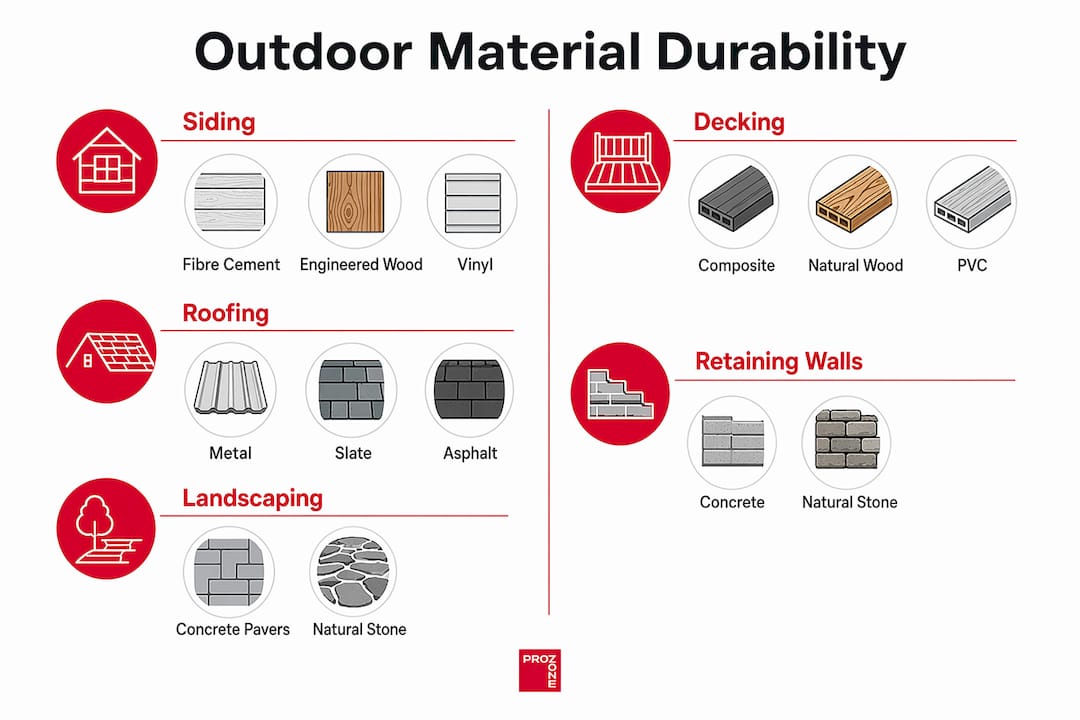
Fibre cement siding dominates Alberta’s new build market with a 42% share, driven by its fire and hail resistance. Factory-finished fibre cement resists UV fading better than field-painted alternatives and requires repainting only every 15–20 years. That maintenance interval matters significantly for property managers overseeing multiple buildings.
Composite decking resists splitting, fading, and mould better than natural wood, but it carries higher upfront costs. The trade-off is eliminating annual sanding and sealing, which reduces labour costs over the deck’s lifespan. For commercial properties with limited maintenance staff, that trade-off is almost always worth making.
Standing seam metal roofs last 50+ years and reflect solar radiant heat, reducing summer cooling costs by up to 15%. Asphalt shingles, by contrast, typically last 15–20 years in Alberta’s climate before granule loss compromises waterproofing. The lifecycle cost difference between the two is substantial over a 50-year ownership horizon.
Pro Tip: Calculate lifecycle cost, not just purchase price. Divide the total installed cost by the expected lifespan in years, then add estimated annual maintenance costs. A $15,000 metal roof that lasts 50 years with minimal upkeep often costs less per year than a $6,000 asphalt roof replaced twice in the same period.
What materials work best for siding, decking, retaining walls, roofing, and landscaping?
Each outdoor project component has a different set of performance requirements. Choosing the right outdoor building materials for each application prevents premature failure and avoids costly remediation.
Siding options for Alberta exteriors
- Fibre cement: The top-performing choice for hail resistance and fire rating. Requires painting but holds its profile and dimensional stability through extreme temperature swings.
- Engineered wood: Rated to withstand -50°C temperatures and treated with zinc borate for rot and insect resistance. Offers superior impact resistance compared to fibre cement at a similar price point.
- Insulated vinyl: Adds R-2.0 to R-2.5 to wall thermal performance. Standard vinyl becomes brittle and cracks in sub-zero temperatures; insulated vinyl reduces that risk significantly.
- Stone veneer: Excellent thermal mass and aesthetic durability. Requires proper flashing and drainage detailing to prevent moisture infiltration behind the panel.
Decking materials and realistic expectations
Natural wood decking requires annual sanding and sealing to survive Alberta winters without cracking or warping. Composite boards eliminate that annual labour but cost more upfront. For residential decks with active use, composite is the practical choice. For low-traffic applications where budget is the primary constraint, pressure-treated wood with a quality sealant is a viable alternative, provided the maintenance schedule is followed consistently.
Retaining walls in freeze-thaw environments
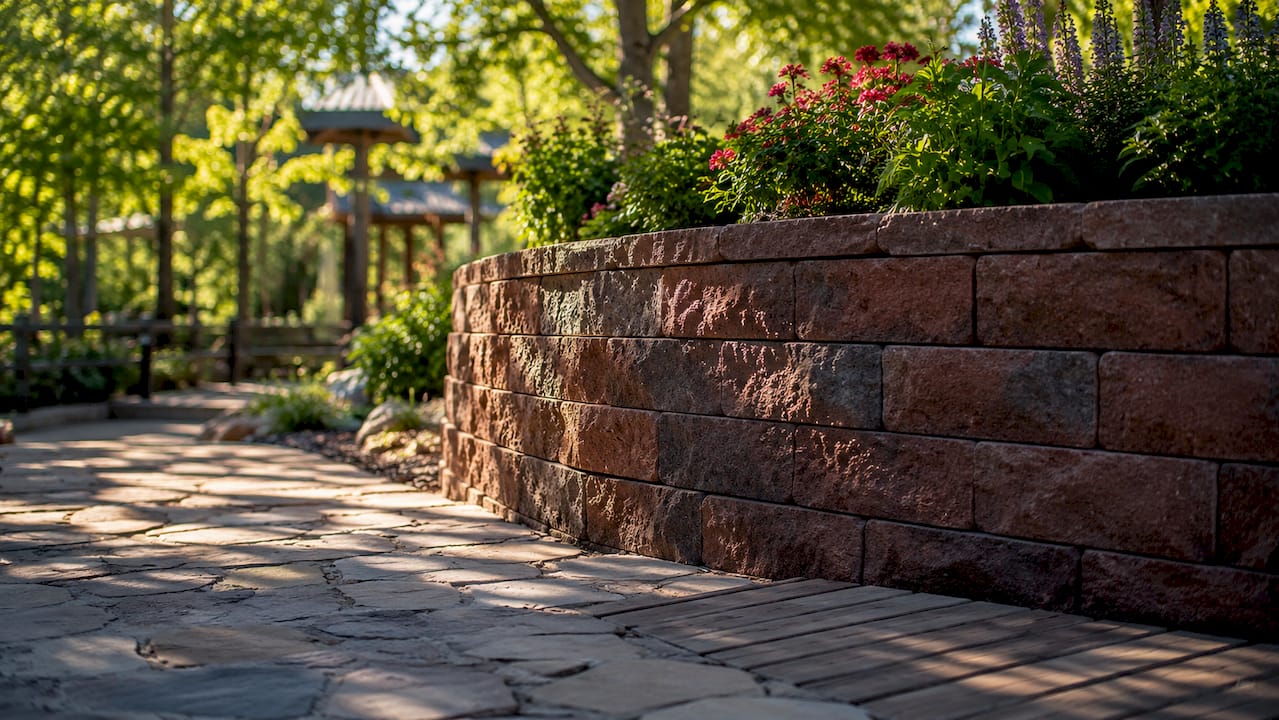
Concrete and natural stone retaining walls offer excellent resistance to freeze-thaw damage in Alberta’s climate. Proper drainage behind the wall is as critical as the material itself; hydrostatic pressure from frozen, saturated soil is the leading cause of retaining wall failure. Timber walls are lower cost but degrade faster in wet conditions and typically require replacement within 15–20 years.
| Retaining wall material | Freeze-thaw performance | Drainage requirement | Typical lifespan |
|---|---|---|---|
| Poured concrete | Excellent | Weep holes required | 40–75 years |
| Natural stone | Excellent | Gravel backfill required | 50+ years |
| Concrete block | Good to Excellent | Gravel backfill required | 30–50 years |
| Pressure-treated timber | Fair | Gravel backfill required | 15–20 years |
| Brick | Good | Weep holes required | 25–50 years |
Roofing choices for Alberta conditions
Standing seam metal is the premium choice for longevity and hail performance. Composite slate offers a mid-range option with good impact resistance and a 30–40 year lifespan. Asphalt shingles remain the most common choice due to low upfront cost, but their 15–20 year lifespan in Alberta means most property owners will replace them at least twice in a 40-year ownership period.
Landscaping surfaces built for Alberta winters
Interlocking concrete pavers are the most durable surface option for driveways, walkways, and patios. They allow individual unit replacement without disturbing the entire surface, which is a significant advantage when freeze-thaw heaving shifts a section. Decorative rock and crushed gravel drain freely, resist frost heave, and require minimal upkeep. Pea gravel works well for low-traffic garden paths and drainage beds. Avoid poured concrete flatwork without proper expansion joints and air-entrained mixes, as uncontrolled cracking is common in Alberta’s temperature range.
How to balance budget, aesthetic goals, and maintenance capacity
Choosing outdoor materials without a clear budget framework leads to either overspending on finishes or underspending on structure. A disciplined approach separates costs into two categories and prioritises accordingly.
-
Prioritise structural and envelope costs first. Foundation drainage, wall assemblies, roofing, and retaining wall construction are the components where failure is most expensive to repair. Allocate the largest share of your budget here before considering aesthetic finishes.
-
Match materials to your actual maintenance capacity. No outdoor material is truly zero-maintenance. The question is how much maintenance you can realistically commit to each year. A property manager overseeing 20 units cannot commit to annual wood deck sealing across all properties. Composite decking or concrete surfaces are the correct specification in that context.
-
Consult the National Building Code (Alberta Edition) and local architectural guidelines before finalising specifications. Some municipalities and homeowners’ associations restrict material choices for aesthetic or fire-safety reasons. Confirming compliance before purchasing materials avoids costly substitutions.
-
Forecast replacement costs, not just installation costs. A material that costs $8,000 to install but requires full replacement in 15 years costs more over 30 years than a $14,000 material with a 40-year lifespan. Build a simple cost-per-year model for each major component before committing.
-
Consider resale value and climate-specific aesthetic durability. Faded, cracked, or stained exterior materials reduce property value and signal deferred maintenance to buyers and tenants. Materials that hold their colour and profile through Alberta winters, such as factory-finished fibre cement or powder-coated metal, protect resale value more reliably than field-painted alternatives.
Consulting a landscape material selection guide specific to Alberta conditions helps property managers align material choices with both budget constraints and long-term performance expectations.
What the industry gets wrong about outdoor material selection in Alberta
The most persistent misconception in Alberta’s construction market is that certain materials are “maintenance-free.” No outdoor material is maintenance-free. Material selection should realistically match the property owner’s maintenance capacity, and that means being honest about what will actually get done each season.
The second mistake is treating installation as an afterthought once the material is chosen. A 10mm rain screen gap between cladding and the weather-resistant barrier is as important as the cladding material itself. Skipping that detail on a fibre cement installation produces the same moisture damage as using a lower-grade product. Proper fasteners, flashing, and transition joints are not optional details; they determine whether a material performs to its rated lifespan.
The third issue is pairing materials without checking expansion and contraction compatibility. Mixing materials with different expansion rates without proper transition planning leads to swelling, mould, and cracking at joints. This is particularly common where composite decking meets concrete or where metal trim meets fibre cement panels. Specifying compatible materials and detailing transitions correctly at the design stage prevents callbacks and warranty disputes down the line.
Long-term thinking is the discipline that separates experienced project managers from those who repeatedly fix the same problems. Spending an extra $2,000 on proper drainage behind a retaining wall or on insulated vinyl over standard vinyl is not a luxury. It is the calculation that keeps repair costs off the budget for the next 20 years.
— Prozoneltd
Prozoneltd: outdoor material supply and installation for Alberta properties
Prozoneltd operates in Edmonton and the surrounding region, supplying and installing materials that meet Alberta Safety Codes and perform through the province’s full climate range. The team works with property managers, contractors, and homeowners on concrete flatwork, asphalt, earthworks, and outdoor landscaping projects where material selection directly affects long-term performance. Prozoneltd sources frost-rated pavers, crushed stone, decorative rock, and gravel products suited to Alberta’s freeze-thaw conditions. Every project reflects building envelope best practices, including proper drainage detailing and material compatibility checks. Contact Prozoneltd through the online inquiry form or by phone to receive a free estimate tailored to your property’s specific requirements.
FAQ
What is an outdoor materials selection guide?
An outdoor materials selection guide is a structured framework for choosing landscaping and construction materials based on climate performance, durability, maintenance requirements, and budget. In Alberta, freeze-thaw resistance is the primary selection criterion for any exterior application.
Which outdoor materials perform best in Alberta’s freeze-thaw climate?
Fibre cement siding, engineered wood, standing seam metal roofing, frost-rated concrete pavers, and natural stone all perform well in Alberta’s freeze-thaw conditions. Each requires proper installation details, including drainage planes and expansion joints, to achieve rated lifespans.
How often does composite decking need maintenance compared to wood?
Composite decking requires periodic inspections and cleaning twice yearly but eliminates the annual sanding and sealing that natural wood demands. Natural wood decks without consistent annual maintenance typically show significant degradation within 5–7 years in Alberta’s climate.
What is a rain screen gap and why does it matter in Alberta?
A rain screen gap is a 10mm air space installed between exterior cladding and the weather-resistant barrier behind it. This gap allows wind-driven rain and condensation to drain and ventilate rather than accumulate, which prevents structural rot in Alberta’s high-moisture-load climate.
How do I calculate the true cost of outdoor building materials?
Divide the total installed cost by the material’s expected lifespan in years, then add estimated annual maintenance costs to get a cost-per-year figure. Comparing materials on this basis, rather than on purchase price alone, consistently favours higher-quality, longer-lasting options for Alberta properties.