
Permeable pavers reduce stormwater runoff volume, filter urban pollutants before they reach receiving waters, and perform reliably through Alberta’s freeze-thaw cycles when designed correctly. For property managers, facility operators, and municipal planners in Edmonton and the surrounding region, that combination of environmental performance and operational value makes permeable pavement worth serious evaluation on any site where stormwater management is a design constraint.
Key benefits at a glance:
- Stormwater volume and peak flow reduction: USGS field studies document significant peak flow reductions compared with impermeable surfaces under monitored conditions.
- Pollutant filtration: surface joints and the engineered base trap total suspended solids (TSS), heavy metals, hydrocarbons, and oil before water leaves the pavement system.
- Groundwater recharge: full and partial infiltration designs return treated water to the local water table rather than routing it to the storm sewer.
- Reduced icing and deicer use: meltwater drains into the base rather than refreezing on the surface, cutting salt and sand demand.
- Urban heat island mitigation: permeable surfaces run cooler than sealed asphalt under solar loading.
- Regulatory compliance support: permeable pavement can reduce measured imperviousness and satisfy municipal stormwater volume and peak flow targets.
If your site faces stormwater volume limits, impervious-area caps, or rising municipal infrastructure charges, permeable pavers deserve a place in your design brief.
Table of Contents
- How permeable pavers work: layers, infiltration, and drainage
- Common permeable pavement types and where each one fits
- Environmental benefits: water quality, recharge, and heat reduction
- How permeable pavers support municipal stormwater compliance
- Cold-climate performance and design guidance for Alberta
- Maintenance, lifespan, and common failure modes
- Installation cost factors and lifecycle value
- Site conditions that favour or rule out permeable pavers
- ProZone’s approach to permeable paving in Edmonton
- Get a permeable pavement estimate from ProZone
- Sources
- FAQ
How permeable pavers work: layers, infiltration, and drainage
Water enters through open joints or a porous surface layer, passes through a bedding course of clean angular stone, and then enters a reservoir base of open-graded aggregate where it is stored temporarily. From there, it either infiltrates into the subgrade, exits through a perforated subdrain pipe, or both, depending on the system design.
| Layer | Material | Primary function |
|---|---|---|
| Surface course | Interlocking pavers, porous concrete, or porous asphalt | Structural load distribution; water entry |
| Bedding course | clean angular chip | Levelling; initial filtration |
| Reservoir base | open-graded crushed stone | Stormwater storage; secondary filtration |
| Geotextile (optional) | Non-woven filter fabric | Fines separation; subgrade protection |
| Subgrade | Native or engineered soil | Final infiltration or subdrain outlet |
Three design configurations are common. A full infiltration system relies entirely on the native subgrade to absorb stored water; it suits sites with permeable soils and a low water table. A partial infiltration with subdrain system allows some water to enter the soil while a perforated pipe captures overflow; this is the most practical choice for Edmonton’s variable glacial till subgrades. A lined no-infiltration system collects and routes all water to a controlled outlet, used where contamination risk or a high water table rules out soil contact.
Subgrade testing before design is not optional. Soil infiltration rate, depth to the seasonal high water table, and proximity to groundwater supply wells all determine which configuration is safe and effective for a given site.
Common permeable pavement types and where each one fits
Choosing the right surface type depends on expected traffic loads, site geometry, and how much maintenance your team can commit to.
Permeable interlocking concrete pavers (PICP) are the most widely specified type for Canadian commercial and municipal applications. Individual high-strength concrete units interlock under load, and water passes through aggregate-filled joints rather than through the paver itself. PICP handles heavy vehicle loads, tolerates freeze-thaw cycling better than monolithic systems, and allows individual units to be lifted and replaced without disturbing the whole surface. Multi-year cold-climate monitoring confirms that PICP maintains higher subsurface temperatures and thaws faster than porous concrete or porous asphalt, a meaningful advantage in Edmonton’s climate.
Pervious concrete is a monolithic slab with a coarse, open matrix that allows water to pass directly through the surface. It suits pedestrian plazas, low-speed parking areas, and trail surfaces. Crack repair in freeze-thaw climates requires more care than with PICP because the slab cannot be partially replaced.
Porous asphalt uses a gap-graded mix that leaves void space for water passage. It is familiar to paving contractors and can be laid with standard equipment, which sometimes reduces installation cost. Thermal performance in cold climates is generally weaker than PICP.
Grass and gravel stabilisation systems (open-cell plastic or concrete grids filled with gravel or turf) suit low-traffic overflow parking, emergency access lanes, and landscaped areas. Load capacity is limited, and grass-filled systems require irrigation and mowing.
| Type | Best use | Load capacity | Freeze-thaw resilience |
|---|---|---|---|
| PICP | Parking lots, roads, plazas | High | High |
| Pervious concrete | Pedestrian, low-speed parking | Medium | Moderate |
| Porous asphalt | Parking, low-volume roads | Medium | Moderate |
| Grass/gravel grid | Overflow parking, access lanes | Low | Moderate |
For a broader look at how pavement material choices affect durability, the asphalt vs concrete parking lot guide covers structural trade-offs in Alberta conditions.
Environmental benefits: water quality, recharge, and heat reduction
Permeable pavers reduce runoff volume and peak flow while removing or trapping sediment-bound pollutants before infiltration. Calgary’s municipal stormwater guidance identifies TSS, heavy metals, oil, and grease as the primary contaminants filtered through the pavement structure. Field tests of interlocking pavers in Calgary conditions recorded high TSS and heavy metal removal rates during winter events, confirming that pollutant capture continues through cold-weather runoff periods, not only during summer rain.
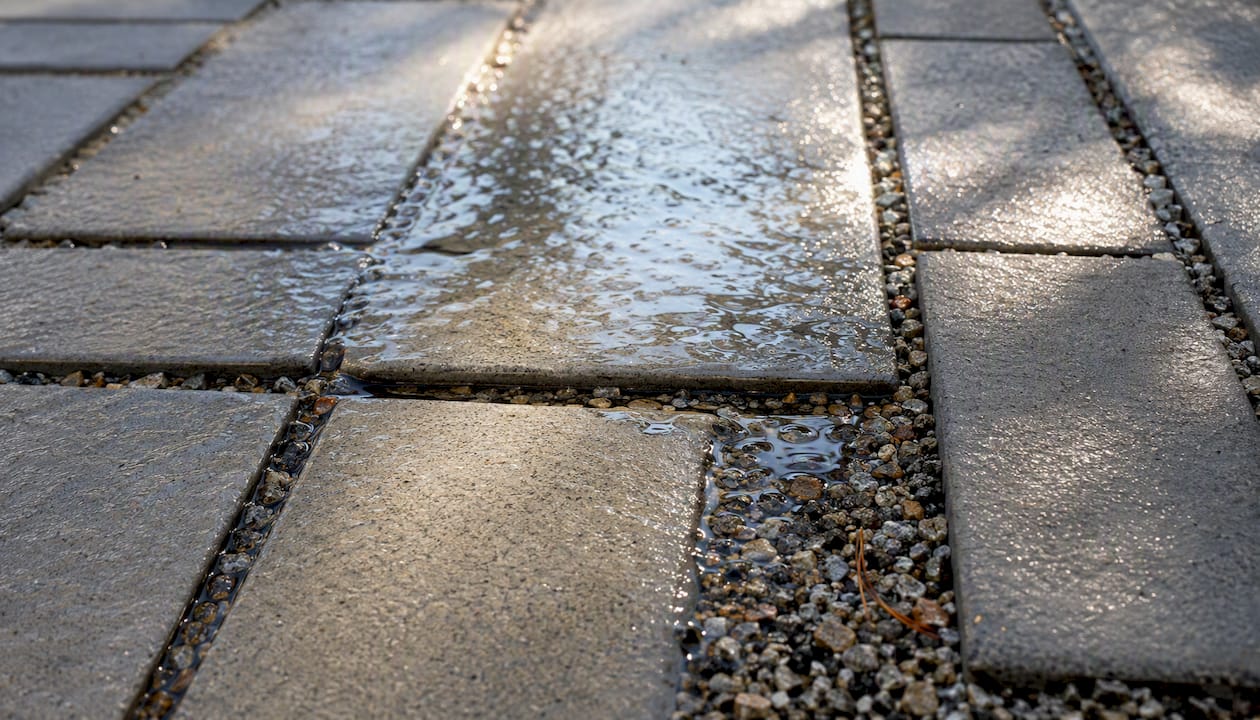
Groundwater recharge is a direct co-benefit of full and partial infiltration designs. Rather than routing precipitation to the storm sewer, the system returns treated water to the local aquifer, which supports baseflow in receiving streams. USGS monitoring found that permeable pavement can increase baseflow in receiving streams under some site conditions, a measurable improvement to the local water balance.
Permeable surfaces also run cooler than sealed asphalt. Because water evaporates from the base rather than being shed as runoff, the latent heat effect reduces surface temperatures under solar loading. This contributes to lower urban heat island intensity in dense commercial and institutional areas, which matters for tenant comfort and cooling energy loads in summer.
How permeable pavers support municipal stormwater compliance
Permeable pavement can reduce measured imperviousness and help meet stormwater volume and peak flow requirements used in Canadian municipal design guides. City of Calgary development guidance treats permeable pavement as a recognised low-impact development practice that reduces demand on municipal storm sewer systems and is suited to constrained urban retrofits.
Practical regulatory advantages include:
- Reduced impervious area credit: many municipalities count permeable pavement as partially or fully pervious, which lowers the calculated runoff coefficient for the site.
- Simplified detention sizing: attenuating peak flows within the pavement base can reduce or eliminate the need for a separate detention pond or underground tank.
- Storm sewer capacity relief: onsite volume retention reduces peak demand on downstream infrastructure, which can lower municipal servicing charges on some projects.
- Incentive programme eligibility: EPCOR’s RainWise Stormwater Rebate Programme in Edmonton lists permeable pavement as an eligible approach, with potential financial support tied to specific design and maintenance commitments.
Pro Tip: Before submitting a development application, request the municipality’s stormwater design manual and confirm which infiltration rate test method they accept (typically a field-measured saturated hydraulic conductivity test). Providing a stamped design cross-section and a written maintenance plan at the application stage reduces back-and-forth with the approvals team.
Cold-climate performance and design guidance for Alberta
Correctly designed permeable pavers perform well in Alberta’s winter conditions and can reduce surface icing and deicer demand compared with impermeable pavements. EPCOR’s guidance for Edmonton specifically notes reduced icing and lower salt use as operational benefits. The mechanism is straightforward: meltwater drains into the open-graded base rather than pooling and refreezing on the surface.
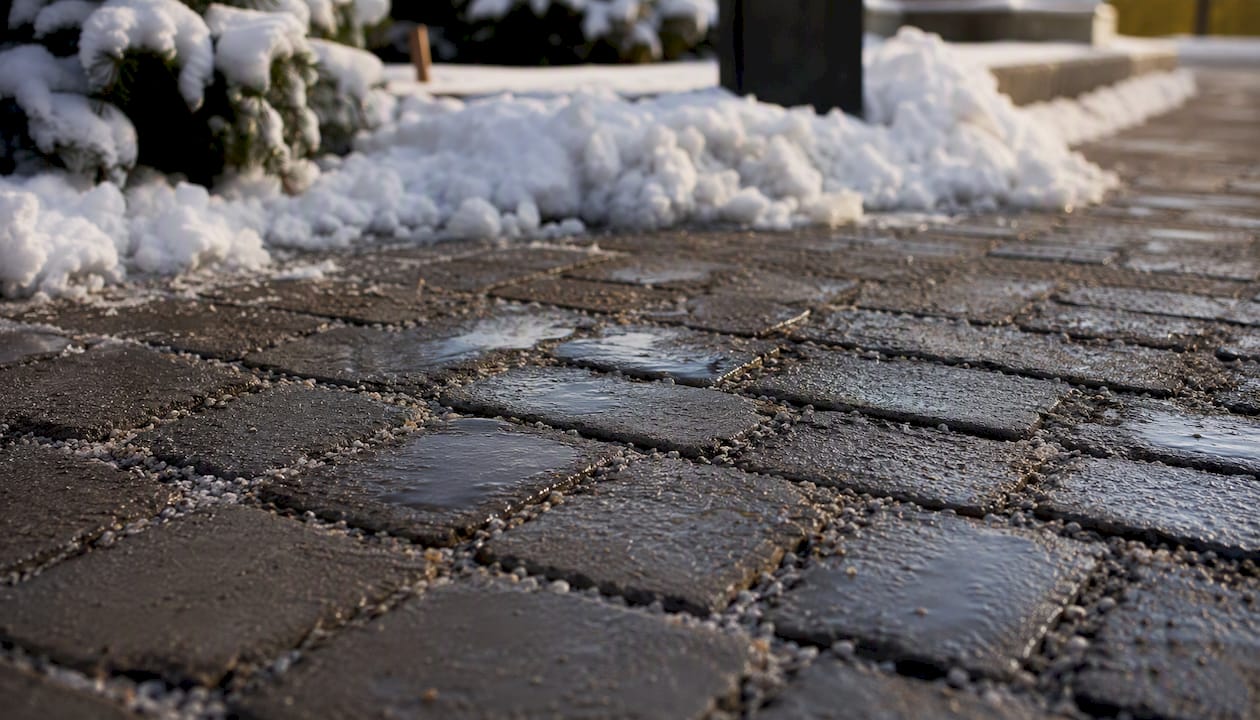
Multi-year monitoring of three permeable pavement types found that PICP systems remain above freezing at depth on melt days more consistently than porous concrete or porous asphalt, supporting continued infiltration through shoulder seasons. Ontario long-term monitoring confirmed that permeable pavements performed across seasons and retained hydraulic and water quality benefits when maintained, updating earlier assumptions about cold-climate fragility.
| Design parameter | Alberta recommendation |
|---|---|
| Base aggregate | Open-graded, angular, frost-resistant crushed stone |
| Base depth | Size to store the design storm volume |
| Subgrade testing | Field-measured infiltration rate; confirm seasonal high water table |
| Joint aggregate | Clean angular chip; avoid rounded or fine-grained fill |
| Subdrain | Include where subgrade infiltration rate is below design threshold |
| Winter sanding | Use sparingly; schedule vacuum sweeping in spring to restore permeability |
Pro Tip: Specify fractured washed drainage aggregate for the reservoir base rather than rounded pit-run gravel. Angular particles interlock under load, resist frost heave better, and maintain void space more reliably through repeated freeze-thaw cycles.
For technical guidance on base course design in Alberta paving projects, the base course paving resource covers aggregate selection and compaction standards relevant to permeable base construction.
Maintenance, lifespan, and common failure modes
With routine maintenance, permeable pavers can last 25 years or longer. The primary maintenance difference from conventional pavement is managing surface permeability: fines, sand, and organic debris accumulate in joints over time and reduce infiltration rates if not removed.
Routine maintenance tasks:
- Vacuum sweeping: the most effective method for removing embedded fines from joints; schedule at minimum once per year, typically in spring after winter sanding residue has dried.
- Targeted pressure washing: used for localised clogging in high-traffic or heavily soiled areas; direct the stream along joints rather than across them to avoid displacing joint aggregate.
- Joint stone topping: replenish joint aggregate after sweeping or washing to maintain void space and structural interlock.
- Inspection checklist: check surface infiltration rate, joint condition, subdrain outlet flow, and edge restraint integrity at least annually.
- Winter sanding management: use sand sparingly and only where traction is critical; excess sand is the leading cause of premature clogging.
Long-term Ontario monitoring found that some systems retained high infiltration rates after years of service when maintained, while unmaintained systems showed permeability reductions from embedded fines. For diagnosing early-stage pavement deterioration, the pavement damage assessment guide for Alberta provides a structured inspection framework.
| Maintenance task | Frequency | Trigger condition |
|---|---|---|
| Vacuum sweeping | Annually (spring) | Post-winter sanding residue |
| Surface infiltration test | Annually | Visible ponding or slow drainage |
| Joint aggregate topping | As needed | Joint depth below specification |
| Subdrain outlet inspection | Semi-annually | Blocked or reduced flow |
| Full surface inspection | Annually | Structural or edge restraint concerns |
Installation cost factors and lifecycle value
Upfront installation cost for permeable pavement is typically higher than basic asphalt, but lifecycle value often offsets this where storm sewer expansion or detention infrastructure costs are avoided. The cost premium reflects base depth, subgrade preparation, subdrain installation, and the contractor expertise required to achieve specified infiltration performance.
| Cost factor | Notes |
|---|---|
| Base depth and aggregate | Deeper bases for larger design storms increase material and excavation cost |
| Subgrade remediation | Poor native soils may require stabilisation or import fill |
| Subdrain and outlet works | Perforated pipe, inspection chambers, and outlet control add capital cost |
| Unit paver cost | PICP units cost more per square metre than asphalt but are individually replaceable |
| Contractor expertise | Specialised installation affects both upfront cost and long-term performance |
| Municipal charge avoidance | Reduced storm sewer demand can lower servicing levies on some projects |
| Deicer cost reduction | Lower salt and sand use reduces annual winter maintenance spend |
| Incentive programme offset | EPCOR RainWise rebates can partially offset capital cost for eligible Edmonton projects |
Budget for subgrade testing, a stamped engineering design, and a contingency for unexpected soil conditions. Warranty terms from the installer should cover both structural performance and initial infiltration rates, not just material defects.
Site conditions that favour or rule out permeable pavers
Not every site is a good candidate. A structured site assessment determines whether full infiltration, partial infiltration, or a lined system is appropriate, and whether permeable pavement is cost-effective at all.
Site qualification checklist:
- Soil infiltration rate: native soils with a measured saturated hydraulic conductivity above approximately 15 mm/hour support full or partial infiltration; slower soils require a subdrain or lined system.
- Seasonal high water table: maintain at least 600 mm of separation between the base and the seasonal high water table to prevent base saturation and frost heave risk.
- Contaminant risk: sites with known soil or groundwater contamination, or where spill risk is high (fuel stations, chemical storage), require a lined no-infiltration design to prevent contaminant mobilisation.
- Drainage area ratio: the contributing drainage area should not exceed the pavement area by more than a factor of two to three for most residential and commercial designs; larger ratios overload the base.
- Expected loads: confirm that the selected surface type and base depth meet the structural requirements for the heaviest vehicles using the site.
- Retrofit constraints: existing underground utilities, shallow bedrock, and limited excavation depth can restrict base depth and system performance.
Where subgrade conditions are marginal, a partial infiltration design with a subdrain is usually the most practical path. Where conditions rule out any soil contact, a lined system still delivers water quality and peak flow attenuation benefits even without groundwater recharge. Next steps: commission a field infiltration test, review the applicable municipal stormwater design manual, and engage a qualified installer to produce a site-specific design cross-section before committing to a specification.
ProZone’s approach to permeable paving in Edmonton
ProZone brings direct experience with Alberta’s variable subgrade conditions, freeze-thaw design requirements, and municipal stormwater approval processes to every permeable paving project. Projects begin with subgrade testing and a review of the applicable municipal stormwater standards, so the system configuration (full infiltration, partial infiltration, or lined) is matched to actual site conditions rather than assumed.
Base design follows engineered specifications using frost-resistant, open-graded aggregate, with base depth sized to the design storm volume and subdrain placement determined by measured soil permeability. ProZone’s material supply includes fractured washed drainage stone suited to reservoir base construction and rock chips for joint fill, both sourced to the angular gradations that cold-climate performance requires.
ProZone’s installation process aligns with Alberta Safety Codes requirements and includes maintenance handover documentation so property managers have a written schedule and inspection protocol from day one. For an overview of how ProZone structures permeable pavement projects for Edmonton property owners, the Edmonton permeable pavement primer covers the full scope from site assessment to post-installation maintenance.
Get a permeable pavement estimate from ProZone
ProZone delivers municipal and commercial pavement projects across Edmonton and the surrounding Alberta region, with permeable paving design and installation handled by crews experienced in cold-climate base construction and municipal approval documentation. The process starts with a site assessment, moves to a stamped design cross-section, and concludes with a maintenance and warranty package your asset management team can rely on.
To get a free estimate and discuss your site’s stormwater requirements, use the online inquiry form at Prozoneltd or call ProZone directly. Most design assessments are scheduled within one to two weeks of initial contact, with installation timelines confirmed once subgrade testing is complete.
Sources
- Permeable pavement
- Subsurface Temperature Properties for Three Types of Permeable Pavements in Cold Weather Climates and Implications for Deicer Reduction
- Permeable Pavement | EPCOR Edmonton
- Evaluating the potential benefits of permeable pavement …
FAQ
What is the main point of permeable pavers?
Permeable pavers allow stormwater to pass through the surface into an engineered base where it is stored, filtered, and either infiltrated into the soil or directed to a controlled outlet. The primary purpose is to reduce runoff volume, attenuate peak flows, and remove pollutants before water reaches municipal storm systems or receiving waterways.
What are the main drawbacks of permeable pavers?
The most common drawbacks are higher upfront installation cost compared with standard asphalt, the need for routine vacuum sweeping to prevent clogging from fines and sand, and the requirement for careful subgrade assessment before design. Sites with contaminated soils, a high water table, or very low native soil permeability require a lined system, which reduces the groundwater recharge benefit.
What is the lifespan of permeable pavers?
With routine maintenance, permeable interlocking concrete pavers can last 25 years or longer. Long-term monitoring in Ontario conditions confirmed that maintained systems retained hydraulic and water quality performance over multi-year periods, while unmaintained systems showed permeability reductions from accumulated fines.
Can you pressure wash permeable pavers?
Yes, targeted pressure washing can restore infiltration in locally clogged areas, but it works best as a supplement to vacuum sweeping rather than a replacement. Direct the stream along the joints to dislodge embedded fines without displacing joint aggregate, and top up joint stone after washing to maintain void space and structural interlock.
Are permeable pavers effective in Edmonton’s winter climate?
Yes, when designed with the correct base aggregate, base depth, and joint fill for freeze-thaw conditions. Multi-year monitoring shows that PICP systems maintain higher subsurface temperatures and thaw faster than porous concrete or porous asphalt, and EPCOR’s Edmonton guidance confirms that permeable pavement reduces surface icing and lowers salt and sand demand compared with conventional sealed surfaces.