
For most Canadian home hardscapes, aluminium metal edging is the best general-purpose paver edge restraint. It holds a smooth vertical face against the paver edge, anchors reliably into compacted aggregate, and resists the corrosion that freeze-thaw cycling and de-icing salts accelerate on lesser materials.
There are clear exceptions where a different material performs better:
- Driveways with heavy vehicle loads: full-depth precast concrete or poured polymer-modified concrete edging handles vehicular braking and turning forces that thin metal profiles cannot.
- Tight curves and radius work: flexible plastic coil edging (paver-rated, not landscape grade) bends to radii that rigid metal cannot follow without cutting.
- Decorative borders and inlay edges: precast concrete curbs, cut stone, or Barkman concrete edgers integrate visually with the paving surface and double as a design element.
- Pool decks: non-corroding aluminium or precast concrete rated for wet environments; avoid steel and untreated metal near chlorinated water.
The reason aluminium leads for general use comes down to two factors: its corrosion resistance and its mechanical behaviour under repeated freeze-thaw loading, combined with the requirement that every restraint be anchored into the compacted base aggregate rather than native soil.
Table of Contents
- Why do paver edge restraints matter?
- What are the main paver edging types?
- What are the core installation rules for paver edging?
- Which edging works best for each application?
- How long does paver edging last in Canadian climates?
- What does paver edging cost in Canada?
- Should you DIY paver edging or hire a contractor?
- What edging does ProZone recommend for Edmonton projects?
- Project manager perspective: what actually fails in the field
- ProZone handles the full scope, from base prep to finished edge
- Sources
- FAQ
Why do paver edge restraints matter?
An edge restraint does three things: it contains the paver field laterally, it preserves the interlock between individual units, and it transfers horizontal loads back into the base structure. Without a properly installed restraint, pavers migrate outward under foot or vehicle traffic, joints widen, bedding sand escapes, and the surface develops trip hazards within a single freeze-thaw season.
The Concrete Masonry and Hardscapes Association (CMHA) is explicit on this point: an acceptable edge restraint must present a smooth vertical face in full contact with the paver edge. Any gap between the restraint and the paver face allows lateral movement to begin. Once movement starts, it accelerates.
Common failure modes from inadequate edging include:
- Spreading: the paver field fans outward, opening joints and allowing sand loss.
- Heaving: restraints anchored into native soil lift with frost, pulling the edge pavers up with them.
- Rocking pavers: a single loose edge unit creates a lever that destabilises adjacent units.
One distinction worth making early: landscape edging sold for garden beds is not an acceptable restraint for interlocking pavements. Landscape edging is thin, flexible, and designed to contain mulch or soil, not to resist the lateral forces generated by a paver field under load. The CMHA technical note is unambiguous on this point.
What are the main paver edging types?
Edge restraints fall into two broad categories: factory-made units installed on site (aluminium, steel, plastic, precast concrete, cut stone) and onsite-formed restraints (poured or trowelled concrete). Each has a distinct installation method, load profile, and freeze-thaw behaviour.
Aluminium metal edging
Aluminium edging is a low-profile extruded channel that sits flush against the outer paver course. Spikes or stakes drive through pre-punched holes into the compacted aggregate base below. Because aluminium does not rust, it performs well in wet and salt-exposed conditions. Aluminium’s corrosion resistance makes it a reliable long-term choice for Canadian climates where steel would eventually oxidise.
For natural stone pavers, low-profile aluminium edging provides nearly invisible restraint when properly anchored into a dense-graded base. Thicker-gauge aluminium sections are available for vehicular applications. The profile stays rigid on straight runs and handles gentle curves; tight radii require scoring or cutting.
Pros: corrosion-resistant, long service life, low profile, professional standard for many installations.
Cons: rigid on sharp curves, requires correct spike depth into base, not suitable for open-grade bases without modification.
Steel edging
Steel edging offers greater rigidity and load capacity than aluminium at a lower material cost. It is common on commercial projects and driveways where a heavier section is needed. The trade-off in Canadian climates is corrosion: steel will rust over time, particularly where de-icing salts are applied. Galvanised or powder-coated steel extends service life, but aluminium remains the preferred choice for long-term residential installations near salted surfaces.
Pros: high rigidity, good load capacity, lower material cost than aluminium.
Cons: susceptible to rust in salt and freeze-thaw environments, heavier to handle.
Plastic edging (coil and rigid)
Plastic edging installs quickly, will not rust or rot, and the coil form bends to tight curves that metal cannot follow. However, the CMHA is clear that plastic edging must be specifically designed for interlocking pavers and must be firmly anchored into the compacted aggregate base. Standard landscape plastic edging is not an acceptable restraint for interlocking pavements.
Paver-rated plastic coil edging uses a thicker wall section and wider spike flanges than garden-bed edging. Rigid plastic edging suits straight runs on light-duty pedestrian applications. Neither form handles vehicular loads reliably.
Pros: flexible for curves, lightweight, no corrosion, fast installation.
Cons: lower load capacity, can deform under vehicle loads, must be paver-rated (not landscape grade), requires dense anchor spacing.
Pro Tip: When buying plastic edging, check the product specification for “interlocking paver” or “hardscape” rating. If the packaging only mentions garden beds or lawn edging, it is not suitable as a paver restraint.
Precast concrete edgers and curbs
Precast concrete edgers, such as the Belgard i-Con Edger, are purpose-made edge restraint units for pedestrian-rated paver systems. They sit alongside the outer paver course, are anchored with steel spikes into the compacted base, and provide a clean, finished appearance. Barkman Concrete produces compatible precast edging units that integrate with their paver lines and are widely available through Alberta suppliers.
Precast units come in partial-depth and full-depth configurations. Full-depth precast concrete or cut-stone edgings extend to the depth of the compacted base and suit heavier loads. Partial-depth units work for residential and light commercial applications when anchored correctly on compacted aggregate.
Pros: durable, visually finished, compatible with specific paver systems, good freeze-thaw resistance when properly installed.
Cons: less flexible for curves, heavier to handle, higher material cost, requires matching base preparation.
Poured and trowelled concrete (including polymer-modified products)
Poured concrete edge restraints are formed and cast on site against the outer paver course. For trowelled reinforced concrete in non-freezing areas, the minimum cross section is approximately 100 mm wide and deep enough to cover at least two-thirds of the side of the edge paver and bedding sand. In Alberta’s freeze-thaw climate, standard poured concrete carries a real cracking risk without reinforcement and proper drainage detailing.
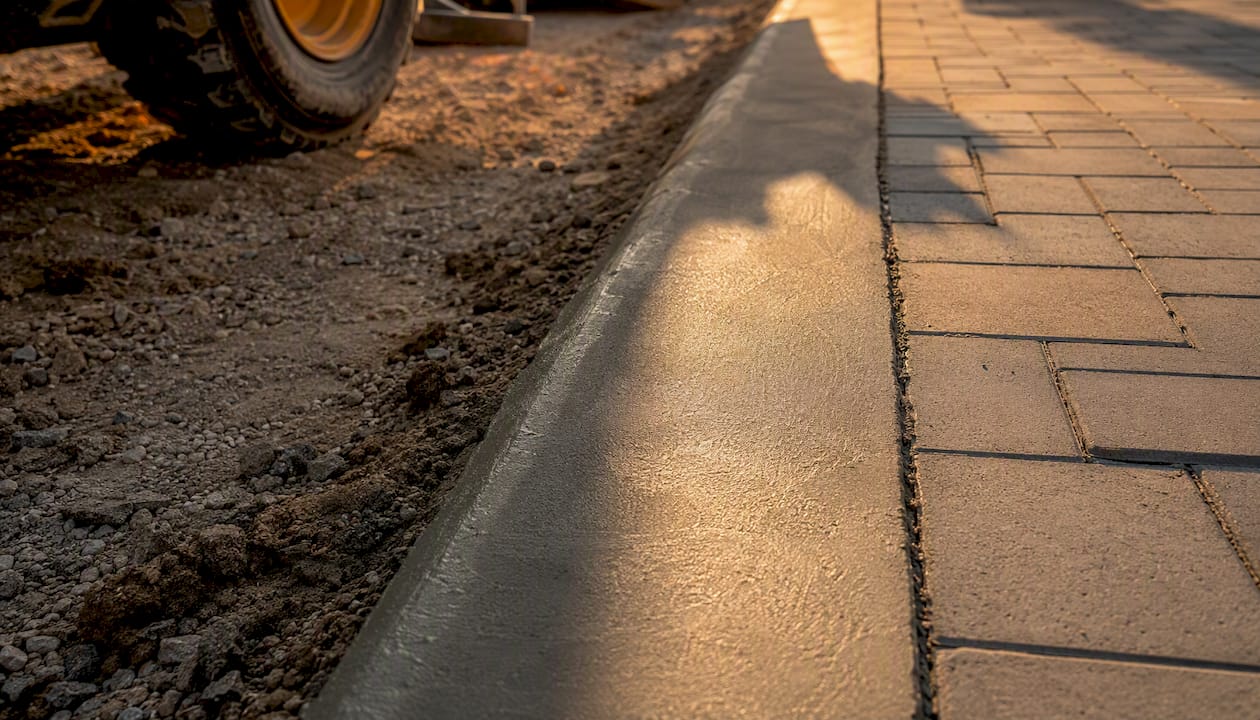
Polymer-modified, fibre-reinforced concrete edge products address this limitation. These engineered products combine concrete strength with built-in flexibility to reduce cracking under freeze-thaw cycling and work with open-grade bases where traditional concrete would fail. They represent a professional middle ground between rigid poured concrete and metal edging, and their use is growing among contractors working in cold climates.
Pros: strong, continuous restraint, no gaps, can be formed to any geometry.
Cons: labour-intensive, standard concrete cracks in freeze-thaw without reinforcement, requires curing time before paver installation proceeds.
Cut stone and decorative inlay borders
Cut stone edging, including granite, limestone, or sandstone curbs, provides the most durable and visually prominent restraint available. Full-depth cut stone units function as both edge restraint and design feature. They are heavy, require mechanical handling on larger projects, and are the most expensive option per linear metre.
Decorative inlay borders use a contrasting paver colour or format set within the field to define the edge visually. These are not structural restraints on their own; they still require a factory-made or poured restraint behind the outer course.
Pros: exceptional durability, premium appearance, long service life.
Cons: high cost, heavy, limited flexibility for curves, requires skilled installation.
Comparison of paver edge restraint options
Material cost ranges are approximate Canadian estimates and vary by region, supplier, and project scale.
What are the core installation rules for paver edging?
The single most important installation rule: always anchor restraints into the compacted aggregate base, not into native soil. Spikes driven into soil will heave with frost, lifting the edging and the adjacent paver course with it. This is the most common site inspection failure on DIY installations, and it is entirely avoidable.
CMHA technical guidance confirms that edging spikes must penetrate into the compacted aggregate base. For Edmonton’s freeze-thaw conditions, where ground movement between October and April can be significant, this rule is not optional.
Installation checklist:
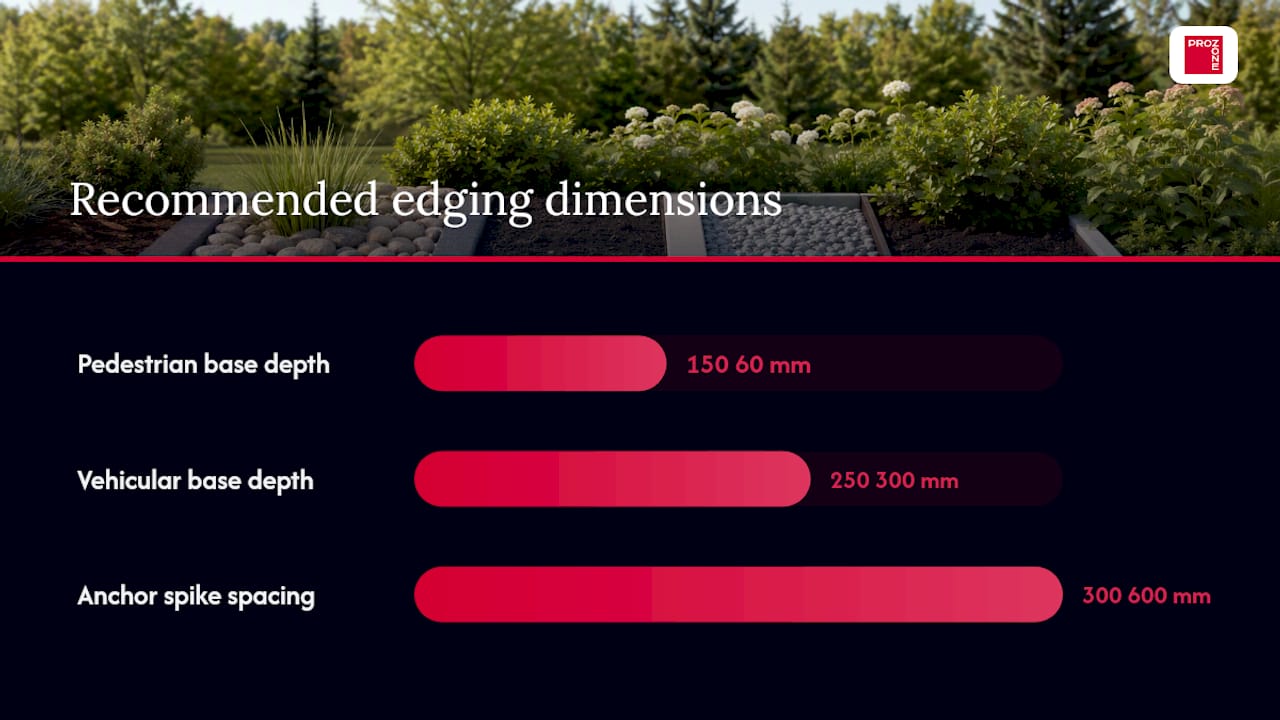
- Compact the aggregate base to the specified depth before placing any edging (typically 150–200 mm for pedestrian, 250–300 mm for vehicular applications in Alberta).
- Set the edging so its inner face presents a smooth, continuous vertical surface against the outer paver course with no gaps.
- Drive spikes or stakes through the edging flange into the compacted base at the manufacturer-recommended spacing, typically every 300–600 mm for metal and plastic edging.
- For L-shaped metal edging profiles, the horizontal flange buried under the base provides additional resistance to outward rotation.
- Verify that the top of the edging aligns with the finished paver surface or sits just below it to avoid a trip hazard.
- Backfill against the outer face of the edging with compacted material before completing the paver installation.
The “3-inch rule” refers to the requirement that the edging contact and support the full depth of the bedding sand layer plus at least the lower portion of the paver side face. In practice, this means the edging must extend deep enough to prevent sand from escaping beneath it. A restraint that only catches the top of the paver but leaves the bedding sand exposed at the base will lose sand over time, causing settlement.
Pro Tip: Use heavy-duty anchor stakes rated for hardscape applications. Standard landscaping spikes are shorter and thinner than paver-rated stakes and will not provide adequate embedment depth in a compacted aggregate base.
For a full base preparation walkthrough, the Edmonton DIY patio installation guide covers compaction depths and base layer sequencing specific to Alberta soil conditions.
Which edging works best for each application?
Matching the restraint to the application prevents both over-engineering (expensive, unnecessary) and under-engineering (early failure). The key variables are load, geometry, and exposure.
- Patio: aluminium metal edging or precast concrete edgers are the standard choice. Low profile suits most residential aesthetics. Barkman and Belgard precast units integrate cleanly with their respective paver systems.
- Walkway: paver-rated plastic coil edging handles curves well and suits light pedestrian loads. Aluminium works on straight sections. Either must be anchored into the base.
- Driveway: full-depth precast concrete, polymer-modified concrete, or heavy-gauge steel. Vehicle braking and turning forces are substantial; thin plastic or standard aluminium will deform. CSA-rated pavers and full-depth edgings are specifically recommended for cold-climate driveways.
- Pool deck: aluminium or precast concrete rated for wet environments. Avoid steel near chlorinated water. De-icing salts should not be used near pool decks; use sand or a calcium-magnesium acetate product instead.
- Planter edges: precast concrete or cut stone where the planter abuts a paved surface; these double as a structural separation between soil and aggregate base.
| Application | Recommended edging | Key reason |
|---|---|---|
| Residential patio | Aluminium metal or precast concrete | Low profile, corrosion resistance, freeze-thaw durability |
| Curved walkway | Paver-rated plastic coil | Tight radius flexibility, light pedestrian load |
| Driveway | Full-depth precast concrete or polymer-modified concrete | Vehicle load, freeze-thaw, no deformation |
| Pool deck | Aluminium or precast concrete | Corrosion resistance, no salt use |
| Planter edge | Precast concrete or cut stone | Soil separation, structural definition |
How long does paver edging last in Canadian climates?
Lifespan varies significantly by material, installation quality, and exposure to de-icing salts. Aluminium edging installed correctly into a compacted base can last for decades with minimal maintenance. Steel edging in salt-exposed locations may eventually show surface rust without protective coating. Paver-rated plastic edging typically lasts several years before UV degradation and physical impact cause brittleness. Precast concrete and cut stone edgings, when properly installed, can outlast the paver field itself.
Freeze-thaw cycling is the primary stress factor in Alberta. Edmonton averages many freeze-thaw cycles per winter season, and each cycle exerts uplift pressure on anything anchored into soil rather than aggregate. Regional hardscape suppliers confirm that denser, thicker pavers and full-depth edgings are the appropriate specification for cold-climate driveways.
De-icing salt impacts differ by material:
- Aluminium: highly resistant to chloride-based salts; no protective treatment required.
- Steel: vulnerable to salt-accelerated corrosion; use galvanised or coated sections in salt-exposed areas.
- Plastic: salts do not corrode plastic, but repeated salt-and-thaw cycles can accelerate joint movement if anchoring is inadequate.
- Precast concrete: CSA-rated concrete units resist salt scaling; avoid calcium chloride directly on concrete edgers.
- Cut stone: granite and dense limestone resist salt well; softer sandstone can spall.
Annual inspection should check for: edging that has lifted or rotated outward, spikes that have backed out of the base, gaps between the edging face and the paver edge, and any section where bedding sand is visible at the base of the restraint.
Pro Tip: After the spring thaw, walk the perimeter of your paved surface and press firmly on the outer paver course. Any rocking or movement indicates the edging has shifted. Re-drive spikes immediately before the movement propagates inward. For paver cleaning and sealing after winter, wait until the surface has fully dried and temperatures are consistently above 10°C.
What does paver edging cost in Canada?
Material costs for paver edge restraints in Canada range from roughly $2 per linear metre for basic paver-rated plastic coil edging to $60 or more per linear metre for premium cut stone curbing. Aluminium edging typically runs $3–$8 per linear metre for materials. Precast concrete edgers from manufacturers such as Belgard or Barkman generally fall in the $8–$18 range per linear metre depending on profile and region.
Installed costs tell a different story. A small residential patio perimeter (20–30 linear metres) with aluminium edging might cost $400–$900 installed in the Edmonton area, depending on site conditions. A driveway with full-depth precast concrete edging and proper base work can reach $2,000–$5,000 or more for a standard double-car width.
Key cost variables:
- Base condition: a poorly compacted or inadequate base requires excavation and rebuild before edging, adding significant cost.
- Geometry: tight curves and complex patterns require more labour time and more material waste.
- Edmonton freeze-thaw requirements: deeper base sections and heavier edging profiles add material cost compared to warmer-climate specifications.
- Access and staging: restricted access for equipment increases labour time on urban lots.
Final quotes depend heavily on site-specific conditions. A contractor who prices edging without assessing base depth and soil conditions is not accounting for the full scope of work.
Should you DIY paver edging or hire a contractor?
Small residential patios with straight or gently curved perimeters, dense-grade aggregate bases, and aluminium or paver-rated plastic edging are reasonable DIY projects for a capable homeowner. The tools required are basic: a rubber mallet, a hand tamper or plate compactor, a drill or spike driver, and a level.
DIY materials and tools checklist:
- Paver-rated aluminium or plastic coil edging (not landscape edging)
- Hardscape anchor stakes rated for paver applications
- Plate compactor or hand tamper
- Rubber mallet
- Tape measure and string line
- Level
- Safety glasses and gloves
Hire a contractor when:
- The project is a driveway or any surface subject to vehicle loads.
- The existing base is unknown, soft, or was not built to hardscape specifications.
- The site has significant grade changes or drainage concerns.
- You are using open-grade (permeable) base aggregate, which requires different edging details.
- The project involves polymer-modified concrete or full-depth precast units requiring mechanical handling.
- You need a warranty on materials and workmanship.
Common DIY mistakes include driving spikes into native soil rather than the aggregate base, using landscape edging instead of a paver-rated restraint, and setting edging before the base is fully compacted. Any of these errors will result in movement within one to two freeze-thaw seasons. For guidance on choosing a qualified paving contractor in Edmonton, check what questions to ask about base preparation and anchoring methods before signing a contract.
What edging does ProZone recommend for Edmonton projects?
Edmonton’s climate presents specific challenges that generic installation guides do not address. The city experiences significant freeze-thaw cycling through the shoulder seasons, clay-heavy soils in many neighbourhoods that retain moisture and amplify frost heave, and widespread use of chloride-based de-icing products on driveways and walkways.
For Edmonton-area residential patios and walkways, ProZone recommends aluminium metal edging as the standard specification. It handles the city’s freeze-thaw cycles without corrosion, anchors reliably into compacted Class II crushed aggregate, and requires no seasonal maintenance. For driveways, ProZone specifies full-depth precast concrete edging or polymer-modified concrete products, which provide the load capacity and freeze-thaw resilience that aluminium alone cannot deliver under vehicle traffic.
ProZone supplies and installs Barkman Concrete products, including compatible precast edging units, and works with Belgard-compatible systems for clients who have specified those paver lines. All installations follow Alberta Safety Codes requirements for base preparation and compaction, which set the minimum standard for durable hardscape performance in this climate.
ProZone’s position on edging in Alberta: the restraint is only as good as the base it is anchored into. Specifying premium edging on an under-compacted or shallow base is money wasted. The base preparation and the edging specification must be matched to the load and the climate together. In Edmonton, that means a minimum 200 mm compacted aggregate base for pedestrian applications and 300 mm for vehicular, with edging anchored fully into that base, not into the subgrade.
ProZone’s project managers inspect base conditions before recommending an edging specification. Clients sourcing materials locally through ProZone’s supply operation benefit from product warranties that apply only when installation meets manufacturer requirements, which ProZone’s crews are trained to follow.
Project manager perspective: what actually fails in the field
The most common edging failure seen on residential projects in Edmonton is not a material failure. It is an anchoring failure. Spikes driven into clay subgrade rather than compacted aggregate will back out after the first hard freeze, and the edging rotates outward within a season. The paver field follows.
The second most common failure is the use of standard landscape edging as a paver restraint. It looks similar in the bag at the hardware store, but it has neither the wall thickness nor the spike flange geometry to hold a paver field. Homeowners who use it typically call for repairs within two years.
A quick checklist for vetting any installation, DIY or contracted:
- Confirm the base depth with a probe before edging goes in.
- Check that spikes are paver-rated and long enough to reach the compacted aggregate.
- Verify the edging face is flush and continuous against the outer paver course with no visible gaps.
- Confirm backfill is compacted against the outer face before the job is called complete.
One more point: precast concrete edgers from reputable manufacturers such as Barkman or Belgard are edge restraint accessories, not walking surfaces. They should not be specified as a step edge or transition surface. Using them outside their rated application voids the product warranty and creates a liability on the site.
ProZone handles the full scope, from base prep to finished edge
ProZone provides site preparation, aggregate supply, edge restraint installation, and polymer-modified concrete curbing for residential and commercial hardscape projects across Edmonton and the surrounding Alberta region. Every project starts with a base assessment, because the edging specification follows from what the base can support, not the other way around.
ProZone’s crews work to Alberta Safety Codes standards and carry the local project experience that matters in Edmonton’s climate. Whether the scope is a residential patio perimeter with aluminium edging or a commercial driveway requiring full-depth concrete curbing, ProZone supplies the materials and installs them to manufacturer specifications. Barkman and Belgard product lines are available through ProZone’s supply operation, with warranty coverage tied to correct installation.
For larger infrastructure and road construction projects requiring concrete curbing and edge work, ProZone’s commercial division handles the full scope from excavation through finished surface.
Contact ProZone today for a free estimate. Use the online form at Prozoneltd or call directly to speak with a project manager about your site conditions and edging requirements.
Sources
- Edge Restraints for Interlocking Concrete Pavements – CMHA
- EDGE RESTRAINTS FOR INTERLOCKING
- Belgard i‑Con® Edger – Concrete Paver Edge Restraint for Patios & Walkways | Calgary Landscaping
FAQ
What edging do professional landscapers use for pavers?
Metal edging, typically aluminium, is the professional standard for most residential paver installations because of its durability, corrosion resistance, and reliable restraint when anchored into a compacted aggregate base. For driveways or heavy-load applications, professionals specify full-depth precast concrete or polymer-modified concrete edging instead.
What is the 3-inch edging rule for pavers?
The “3-inch rule” refers to the requirement that the edge restraint extend deep enough to cover the full bedding sand layer and contact at least the lower portion of the paver’s side face, preventing sand from escaping beneath the restraint. In practice, this means the edging must be set at the correct depth during base preparation, not simply placed against the top of the paver.
What is the difference between paver edging and landscape edging?
Paver edge restraints are purpose-built to resist the lateral forces generated by an interlocking paver field under load; they must present a smooth vertical face against the paver edge and be anchored into compacted aggregate. Landscape edging is designed to contain mulch or soil in garden beds and lacks the wall thickness, spike geometry, and structural capacity to function as a paver restraint.
Which paver edging type works best in freeze-thaw climates like Edmonton?
Aluminium metal edging is the preferred general-purpose choice for Edmonton’s freeze-thaw conditions because it does not corrode and anchors reliably into compacted aggregate rather than frost-susceptible native soil. For driveways, polymer-modified fibre-reinforced concrete edging or full-depth precast concrete provides the load capacity and freeze-thaw resilience required in Alberta’s climate.
Can you use plastic edging for pavers?
Yes, provided the plastic edging is specifically rated for interlocking paver applications, not standard landscape or garden-bed edging. Paver-rated plastic coil edging is useful for tight curves on pedestrian walkways and patios, but it must be firmly anchored into the compacted base at close spike spacing and is not suitable for driveways or vehicle-load applications.