
TL;DR:
- Effective Alberta construction projects depend on thorough scope definition, accurate estimate classification, and detailed work breakdown structures to prevent cost overruns and delays. Early coordination, risk-aware scheduling with CPM and PERT, and diligent verification ensure compliance and smooth close-out, with strategic foresight remaining essential over mere paperwork. ProZone offers expert support across project phases, emphasizing anticipation and planning rigor to achieve on-time, on-budget delivery in Alberta’s dynamic environment.
Cost overruns and stalled timelines are not just inconveniences for Alberta contractors. They eat into margins, damage client relationships, and create cascading problems that follow a project all the way to close-out. The difference between a project that finishes on time and on budget versus one that spirals into disputes often comes down to how well it was planned before the first piece of equipment rolled onto the site. This guide walks through every major phase of construction project planning, from scope definition and estimate classification through scheduling, coordination, and final verification, with Alberta-specific tools, real-world examples, and actionable frameworks you can put to work on your next contract.
Table of Contents
- Understanding project scope and definition in Alberta
- Decomposing project tasks: Work breakdown structure (WBS) essentials
- Choosing the right delivery method and early coordination
- Scheduling strategies: CPM and PERT for risk-managed timelines
- Verification: Ensuring compliance, payment alignment, and project close-out
- Why successful project planning is about foresight, not paperwork
- Take your Alberta project to the next level with ProZone
- Frequently asked questions
Key Takeaways
| Point | Details |
|---|---|
| Define scope with precision | Accurate project definition upfront prevents costly overruns and errors in later phases. |
| Use structured planning tools | Work breakdown structures, CPM schedules, and checklists provide clarity and control across your project. |
| Coordinate early and often | Proactively address utilities, logistics, and safety before construction starts to keep things on track. |
| Select the right delivery method | Delivery model choices impact risk, collaboration, and payment flow—choose what fits your project best. |
| Plan for compliance and payments | Match documentation and reporting to payment requirements for smooth cash flow and contract close-out. |
Understanding project scope and definition in Alberta
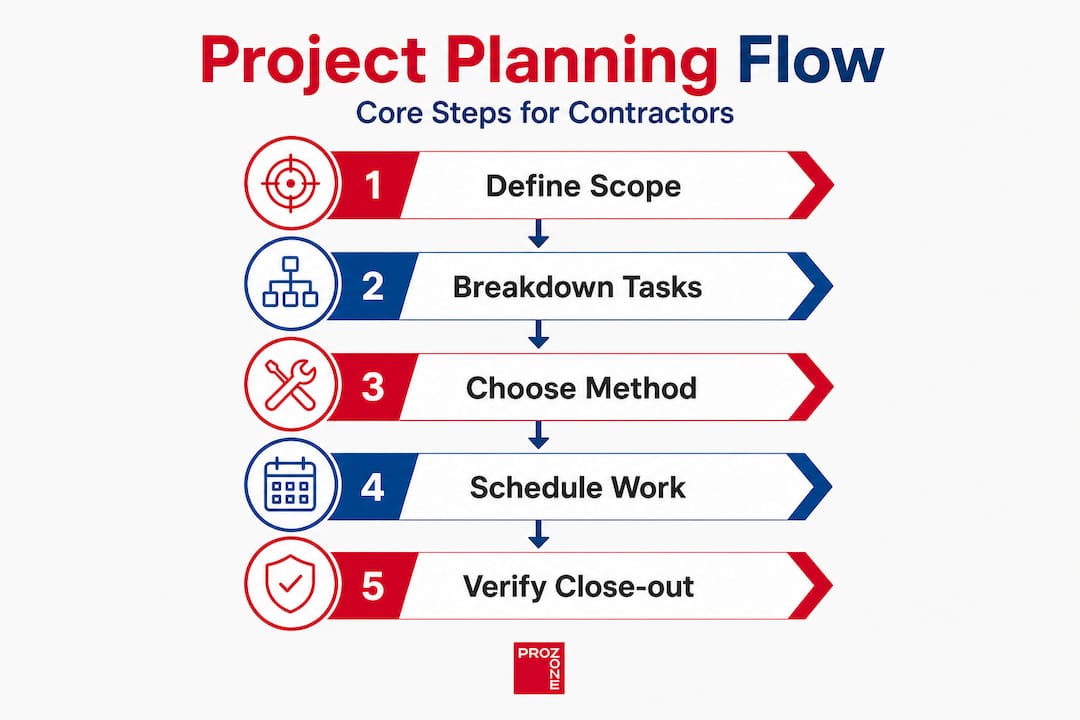
To get every project off on the right foot, the first step is clarifying its scope and estimating class. Scope definition is not a formality. It is the foundation that every budget figure, schedule milestone, and payment claim rests on. When scope is loose, everything downstream gets loose too.
In Alberta, estimate class guidance provides contractors and project owners with a structured framework for assessing how much definition exists at each stage of project development. The classification system runs from Class 5 through Class 1, with increasing levels of project definition and corresponding improvements in estimate accuracy. A Class 5 estimate, for example, is an order-of-magnitude figure based on very limited information and carries an expected accuracy range of roughly minus 30 percent to plus 50 percent. By the time a project reaches Class 2, the detailed design is substantially complete and the accuracy tightens considerably.
| Estimate class | Project definition (%) | Expected accuracy range |
|---|---|---|
| Class 5 | 0 to 2 | -30% to +50% |
| Class 4 | 1 to 15 | -15% to +30% |
| Class 3 | 10 to 40 | -10% to +20% |
| Class 2 | 30 to 75 | -5% to +15% |
| Class 1 | 65 to 100 | -3% to +10% |
Understanding where your project sits in this classification scheme helps you communicate realistic expectations to clients and set appropriate contingency reserves. Trying to hold a Class 5 estimate to Class 2 tolerances is a guaranteed path to trouble.
Common pitfalls of loose scoping include:
- Failing to define physical boundaries and exclusions before budgeting begins
- Skipping site investigations, resulting in unforeseen ground conditions that bust the budget
- Using verbal understandings instead of written scope documents, creating disputes later
- Omitting allowances for temporary works, permits, and regulatory requirements
- Allowing scope creep without formal change management
Tight scoping also shapes how you approach concrete repair budgeting and how you source landscaping materials for Alberta projects, since procurement quantities flow directly from a clearly defined scope. Similarly, following building code guidance from the outset ensures that code-driven design requirements are captured in the estimate before they become change orders.
Pro Tip: Align your scope breakdown and work documentation with your contract’s payment structures from day one. When your scope items map directly to your schedule of values, payment claims become faster and more defensible.
Decomposing project tasks: Work breakdown structure (WBS) essentials
With scope and budgeting classes established, the next task is breaking that work into manageable pieces. A work breakdown structure, or WBS, is the tool that translates a defined scope into a hierarchy of deliverables and tasks. It is not just a list. It is an organized, logical decomposition of everything the project must produce, structured so that every element can be planned, resourced, and tracked.
Construction project planning typically decomposes scope into a WBS, develops budgets grounded in realistic assumptions, and uses CPM scheduling to model dependencies and critical path. The WBS is what makes those subsequent steps possible. Without it, budgets are guesses and schedules are wishes.
“A clear WBS is your project’s backbone.”
Here is a practical step-by-step process for creating a WBS on Alberta construction projects:
- Start with the project deliverable at the top. This is the completed asset, for example, a paved access road or a concrete pad for a commercial facility.
- Break down into major phases. Typical phases include site preparation, civil works, structural works, finishing, and commissioning.
- Subdivide phases into work packages. Each work package should be assignable to a single responsible party and small enough to estimate and monitor meaningfully.
- Assign a unique identifier to every element. A consistent numbering scheme makes tracking, reporting, and referencing in contracts straightforward.
- Cross-check completeness. Every scope item defined in your contract should appear somewhere in the WBS. If you cannot find it, it is a gap.
- Map WBS elements to your payment schedule. This is the step most contractors skip, and it creates billing headaches later.
Reviewing our project gallery examples gives you a sense of how diverse project types, from earthworks to asphalt paving, benefit from structured task decomposition.
Mistakes to avoid when building your WBS:
- Creating a task list instead of a deliverable-based hierarchy
- Making work packages so large they become unmanageable or so small they create administrative burden
- Mixing deliverables and activities at the same level of the hierarchy
- Skipping the review step where estimators and field supervisors verify completeness
- Failing to update the WBS when approved changes alter scope
One often-overlooked benefit of a well-structured WBS is dispute prevention. When a client questions what was delivered, your WBS becomes a reference document showing exactly what was planned, priced, and completed. That is far more persuasive than a conversation from memory.
Choosing the right delivery method and early coordination
Once tasks are outlined, project delivery and coordination decisions lock in how responsibilities and collaboration will function. Choosing a delivery method is a key part of early project planning because it sets contractual risk allocation, decision-making, and the way parties work together from planning through construction. Get this decision wrong and you may find yourself absorbing risks you never agreed to carry.
The three most common delivery models in Alberta construction are Design-Bid-Build, Design-Build, and Construction Manager at Risk.
| Delivery method | Risk profile | Collaboration level | Typical payment structure |
|---|---|---|---|
| Design-Bid-Build | Owner retains design risk; contractor takes construction risk | Low during design | Lump sum or unit price |
| Design-Build | Contractor takes both design and construction risk | High throughout | Lump sum or target cost |
| CM at Risk | Shared risk between owner and CM | Very high throughout | GMP (Guaranteed Maximum Price) |
| Unit Price Contract | Risk shared per measured quantities | Moderate | Per unit of work completed |
For most mid-size Alberta contractors working on infrastructure, roads, and site development, Design-Bid-Build and unit price contracts are the most common. Understanding the risk allocation before signing is not optional. It shapes your contingency, your bonding requirements, and your subcontractor relationships.
Alberta Transportation’s utility coordination is structured through a dedicated process manual that provides planning tools and decision support to keep utility coordination from impeding project progress. Early coordination with utility operators is one of the most impactful things you can do to protect your schedule, particularly on roadwork and site development projects across the Edmonton region and surrounding municipalities.
Early coordination checklist for Alberta contractors:
- Confirm all utility locates and engage the relevant operators well before breaking ground
- Submit for required permits (municipal, provincial, environmental) early enough to absorb review delays
- Coordinate access with adjacent landowners, particularly on linear infrastructure projects
- Review construction service types to align subcontracted work with the delivery model
- Brief safety personnel on site-specific hazard assessments before mobilization
- Confirm road maintenance strategies for maintaining safe access during active construction
- Verify fire protection compliance requirements for new construction phases
Pro Tip: Download Alberta Transportation’s pre-construction checklists and use them as the basis for your own project kickoff package. They cover utility coordination, safety requirements, and approval milestones that are easy to miss in early planning.
Scheduling strategies: CPM and PERT for risk-managed timelines
With coordination in place, the next step is building a schedule that withstands real-world Alberta risks. Two scheduling methodologies have earned their place as standards in construction project management: the Critical Path Method, known as CPM, and the Program Evaluation and Review Technique, known as PERT.
CPM is built on the logic that certain tasks must be completed before others can begin. By mapping these dependencies and calculating the longest chain of sequential activities, you identify the critical path. Any delay on a critical path activity delays the project’s finish date. That is why CPM has become the industry scheduling standard for construction projects of virtually every size and type.
PERT complements CPM by introducing probability into duration estimates. Instead of a single fixed duration for each task, PERT uses three estimates: optimistic (best case), pessimistic (worst case), and most likely. Combining these three figures produces a weighted average duration and, importantly, a sense of the statistical spread around that average. On projects with significant duration uncertainty, like those involving ground conditions that cannot be fully known until excavation begins, PERT helps you quantify schedule risk rather than just acknowledge it.
Here is a practical step-by-step process for building a schedule that uses both methods together:
- List all activities derived from your WBS. Every work package should have at least one corresponding schedule activity.
- Define logical dependencies. Identify which activities must precede others, which can run concurrently, and where there are mandatory external constraints like permit windows.
- Estimate durations realistically. Involve field supervisors and subcontractors in duration estimation. Office-based estimates without field input are routinely optimistic.
- Apply three-point PERT estimates to high-risk activities. Focus on activities with weather exposure, complex sequencing, or unfamiliar scope.
- Calculate the critical path. Use project scheduling software to identify which activities have zero float and therefore control project completion.
- Build your baseline. Lock the schedule once it reflects realistic durations, resource loading, and known constraints. Changes after the baseline require formal change management.
- Monitor near-critical paths weekly. Activities with small float buffers can become critical as assumptions change, particularly in Alberta’s variable weather conditions.
Statistic callout: Industry data consistently shows that projects using formal CPM scheduling outperform those relying on informal or bar-chart-only approaches in terms of on-time delivery, particularly on projects exceeding $500,000 in contract value.
Alberta’s climate introduces scheduling risks that contractors in milder regions do not face. Freeze-thaw cycles affect concrete placements, spring breakup restrictions impact heavy haul routes, and early winter weather can shut down earthworks or paving operations weeks before anticipated. When planning your asphalt vs concrete advantages decisions, the seasonal performance characteristics of each material should be reflected in your scheduling assumptions.
Pro Tip: Watch near-critical paths as closely as the critical path itself. A secondary path with three days of float can become your new critical path within a week if productivity dips or a delivery is late. Treat anything under five days of float as requiring active management.
Verification: Ensuring compliance, payment alignment, and project close-out
Finishing strong means meeting compliance, payment, and documentation requirements for every phase and at project completion. Many contractors invest heavily in planning and execution, then shortchange the close-out phase. That is where disputes arise, retainage gets held, and lessons go unlearned.
Alberta provincial contract requirements show that contractor cash flow and progress payment claims are tied to approved contract price breakdowns and monthly submission timing. If your WBS and schedule of values do not align with the approved contract price breakdown, your claims will be questioned. That alignment needs to be built in from scope definition, not patched in at the billing stage.
Close-out documentation checklist for Alberta contractors:
- As-built drawings reflecting all field changes and confirmed installation locations
- Testing and commissioning records for all installed systems and structural elements
- Certificates of substantial completion and occupancy, where applicable
- Final deficiency list with documented resolution for each item
- Statutory declarations confirming payment of all subcontractors and suppliers
- Material compliance certificates and product data sheets for specified items
- Environmental compliance documentation including contaminated soil disposal records
- WHMIS records and safety documentation for the project file
Aligning your scope, WBS, and progress reporting with material supply compliance requirements means your documentation is consistent from procurement through installation to close-out. Auditors and clients can trace every material from purchase order to installed location. That traceability is your best protection in a dispute.
Pro Tip: Document work traceability continuously throughout the project, not just at close-out. Photographs with dates and locations, daily field reports, and material delivery records build a contemporaneous record that is far more credible than reconstructed documentation prepared weeks after the fact.
One more close-out practice that separates experienced contractors from the rest: the formal lessons-learned review. Capture what went right, what went wrong, and what you would change before the project team disperses. The next estimate, schedule, and coordination plan you produce will be better for it.
Why successful project planning is about foresight, not paperwork
Drilling into compliance and documentation brings us to the real heart of great project planning: thinking several steps ahead. Here is a perspective that might be uncomfortable for contractors who have invested heavily in templates, checklists, and software: tools do not plan projects. People do.
We have seen projects fail with pristine documentation. The WBS was complete. The CPM schedule was beautifully organized in the latest software. The contract price breakdown was perfectly aligned with the scope. And yet the project stalled because no one had genuinely thought through what would happen if the primary earthworks subcontractor was unavailable for three weeks, or if a key material had an eight-week lead time in a high-demand period. The paperwork was perfect. The thinking was shallow.
Alberta has a way of exposing shallow planning. Weather, supply chain disruptions, regulatory changes, and labor market fluctuations are not hypothetical risks here. They are routine. The contractors who consistently deliver on time and on budget in this province are not necessarily the ones with the most sophisticated software. They are the ones who have internalized the habit of asking “what could go wrong and what will we do if it does” at every planning stage.
This is not an argument against using CPM or building a proper WBS. Those tools matter enormously. But the maintenance strategy insights and field lessons from long-running Alberta infrastructure work teach something that no template captures: anticipation beats reaction every time. Recognizing that a spring project in the Edmonton region carries breakup restriction risk for heavy materials, and actually building a contingency plan for it, is foresight. Acknowledging that risk exists but assuming it will not materialize is wishful thinking.
The most dangerous planning failure we see is when a contractor mistakes activity for thinking. Filling out forms, populating software, and submitting documentation on time are necessary, but they are not a substitute for the strategic conversations that should happen before any document is opened. Who are the critical vendors and what are their lead times? What are the real ground conditions, not the assumed ones? What does the client actually care about most, and where will they have zero tolerance for variance? These questions do not appear on any checklist, but answering them honestly is what separates a project plan from a planning exercise.
Take your Alberta project to the next level with ProZone
If you want the confidence of expert advice and streamlined delivery, ProZone brings expertise and Alberta-proven support to your next project. From scope planning and budgeting through field execution and compliant close-out, the Edmonton construction services that ProZone provides are designed to support contractors at every phase of the project lifecycle. Whether you need reliable material supply, concrete and asphalt works, or earthworks execution backed by structured planning processes, ProZone’s experienced teams work alongside you to keep your project on track. Explore our road construction solutions or contact us to discuss how ProZone can support your next Alberta project with the planning rigor and field expertise your clients expect.
Frequently asked questions
What are the key estimate classes contractors in Alberta should use?
Contractors should use the Alberta estimate classification system, which includes Class 5 (order-of-magnitude, minus 30 percent to plus 50 percent accuracy) through Class 2 (detailed design, minus 5 percent to plus 15 percent accuracy), with each class corresponding to a defined level of project definition.
How can Alberta contractors ensure utility conflicts don’t cause project delays?
Early adoption of the Utility Coordination Process Manual and pre-construction checklists streamline planning and avoid costly site interruptions by engaging utility operators and resolving conflicts before construction begins.
What is the difference between CPM and PERT for construction scheduling?
CPM uses fixed activity durations to identify the critical path, while PERT accounts for uncertainty by modeling optimistic, most likely, and pessimistic time estimates to produce probability-weighted duration forecasts.
How do Alberta payment requirements affect contractor planning?
Payment claims in Alberta depend on contract price breakdowns and scheduled monthly submissions, so aligning your WBS and scope documentation with contract terms from the outset is essential for consistent cash flow.
Can I use the same planning approach for both small and major projects?
Yes, the framework outlined here adapts to any project size. Simply scale the detail of each step to match the project’s complexity, using lighter-touch WBS structures and shorter schedule networks for smaller jobs while applying the full methodology on major contracts.