
TL;DR:
- Regular maintenance is essential for preserving and increasing property value, especially in Edmonton’s harsh climate. It reduces deferred repairs, supports higher sale prices, and improves tenant retention through proactive care of critical infrastructure. Structured schedules, documented records, and quality contractors ensure long-term asset protection and optimal investment returns.
Regular maintenance is the single most reliable strategy for preserving and growing real estate value over time. The role of maintenance in property value extends well beyond cosmetic repairs. It protects hidden infrastructure, supports appraisal outcomes, and directly influences what buyers and investors are willing to pay. Plumbing, electrical, and structural systems drive long-term financial outcomes, tenant satisfaction, and valuation in ways that no amount of staging or landscaping can substitute. For Edmonton property owners and investors, where freeze-thaw cycles compound the cost of neglect, disciplined upkeep is a capital preservation tactic, not an optional line item.
How does proactive maintenance impact property value?
Homes with regular preventive maintenance sell for a 10%–15% premium compared to those with neglected upkeep. That premium reflects buyer confidence in the asset’s condition and their reduced expectation of post-purchase repair costs.
The impact of maintenance on value shows up in appraisals as well. Deferred maintenance lowers net operating income (NOI) multiples from 7.5x to 6.2x in commercial appraisals. That compression directly reduces what a lender or investor will offer for the property.
Tenant retention is another channel through which upkeep importance translates to dollars. Well-maintained properties justify higher rental rates and experience lower vacancy rates. Tenants who experience prompt, professional repairs are less likely to vacate, and lower turnover reduces the income disruption that erodes returns over time.
Key maintenance tasks that protect market appeal include:
- Roof inspections and repairs twice per year to prevent water infiltration
- HVAC servicing on a seasonal schedule to maintain system efficiency
- Pavement and concrete repairs before freeze-thaw cycles widen surface cracks
- Plumbing checks to catch slow leaks before they cause structural damage
- Electrical panel reviews to identify outdated components that affect insurance and appraisal
Each of these tasks addresses a system that buyers, appraisers, and lenders scrutinise during due diligence. Neglecting any one of them creates a visible liability in the transaction.
What are the financial advantages of preventive vs. reactive maintenance?
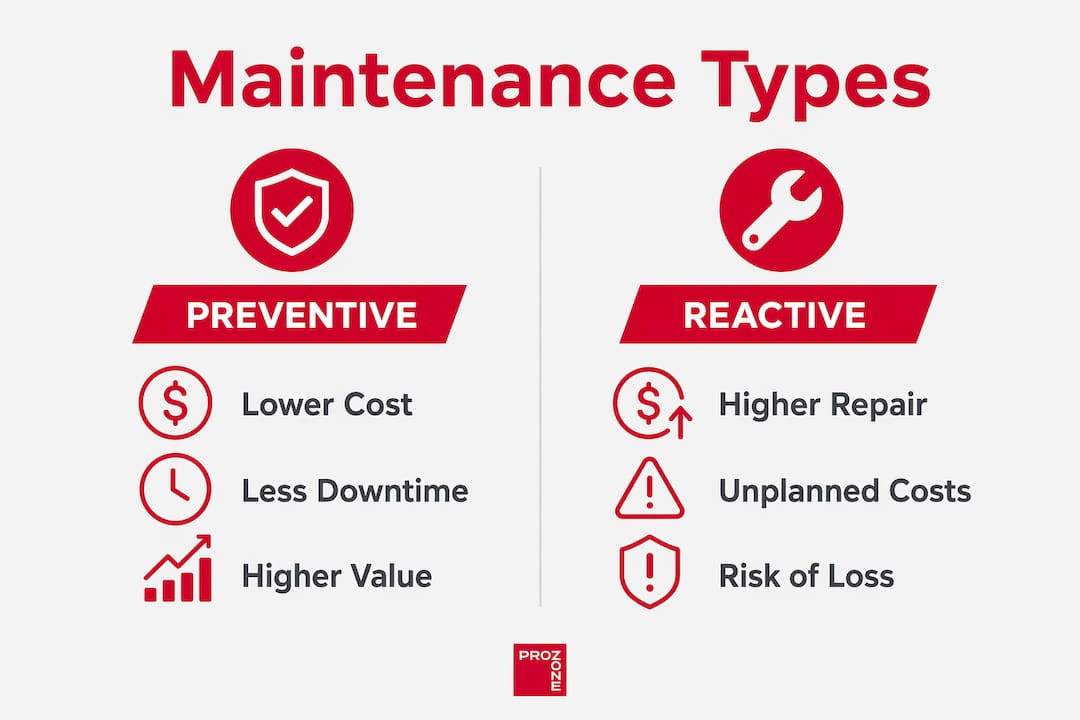
Every $1 spent on preventive maintenance saves $3–$4 in emergency repair costs by avoiding premium labour and system failures. That ratio makes preventive programmes one of the highest-return activities available to a property owner.
The financial case becomes even clearer when you account for what emergency repairs actually deliver. Reactive repairs use less durable fixes due to time pressure and parts availability, which accelerates asset depreciation and increases the probability of repeat failures. A scheduled roof repair uses properly sourced materials and adequate curing time. An emergency patch after a winter storm often does neither.
Deferred maintenance creates a compounding degradation cycle. Postponed repairs negatively affect income and asset value, forcing disruptive capital investments that compress ROI over a 5–10 year horizon. What begins as a $500 crack repair becomes a $15,000 foundation remediation if left unaddressed through two or three freeze-thaw seasons.
Preventive programmes also smooth capital expenditure. Instead of absorbing large, unpredictable repair bills, owners can budget for scheduled maintenance as a predictable operational cost. This predictability improves cash flow forecasting and makes the asset more attractive to institutional investors and lenders.
- Audit current deferred items and assign a remediation cost and timeline to each
- Establish a preventive schedule covering all major systems on a 6-month or annual cycle
- Set a maintenance reserve of 1%–2% of property value per year for residential assets
- Track all expenditures against the schedule to identify patterns and optimise future budgets
- Review contractor performance after each engagement to maintain quality standards
Pro Tip: Set your maintenance reserve as a percentage of replacement cost, not purchase price. In Edmonton’s climate, replacement costs for roofing and pavement rise faster than general inflation, so a fixed dollar reserve can fall short within a few years.
Which infrastructure areas matter most in edmonton’s climate?
Edmonton’s freeze-thaw cycle is one of the most demanding conditions a property can face. Temperatures can shift from well below freezing to above zero multiple times in a single week during spring and autumn. Seasonal inspections and early repairs are critical to long-term preservation because water that enters a crack at 2°C expands by approximately 9% when it freezes, widening that crack with each cycle.
The infrastructure areas most vulnerable to this pattern are also the ones most likely to affect appraisal and resale value.
| Infrastructure Area | Primary Risk in Edmonton | Recommended Inspection Frequency |
|---|---|---|
| Roofing | Ice damming, membrane cracking | Twice per year (spring and autumn) |
| Pavement and concrete | Surface spalling, joint failure | Twice per year plus post-thaw |
| Foundation | Water infiltration, frost heave | Annually with post-winter review |
| Plumbing | Pipe freezing, joint stress | Pre-winter and post-thaw |
| Electrical systems | Moisture ingress, aging panels | Every 3–5 years by a licensed electrician |
Pavement deserves particular attention for commercial and multi-unit residential properties. Surface spalling and joint failure are not just aesthetic issues. They create liability exposure, accelerate sub-base deterioration, and signal deferred maintenance to any buyer or appraiser who walks the site. Rubber paving solutions offer one approach to reducing freeze-thaw surface damage in high-traffic areas.
Pro Tip: Schedule your pavement and concrete inspections in late March or early April, after the last hard freeze but before spring traffic loads peak. This is when damage from the winter cycle is fully visible and repairs are most cost-effective.
How does maintenance documentation influence resale and investor confidence?
A well-documented maintenance history reduces buyer uncertainty and price negotiation risk. Inspection reports, service records, and maintenance contracts function as objective proof of asset condition, shifting the burden of doubt away from the seller.
During buyer due diligence, the absence of records is treated as evidence of neglect. A buyer who cannot verify when the roof was last serviced or when the HVAC was replaced will discount their offer to account for the unknown risk. That discount is almost always larger than the actual cost of the deferred work.
“Property owners who maintain detailed maintenance logs gain leverage during sales or refinancing because these documents reduce lender and buyer perceived risk.”
Maintenance records also affect capitalization rates in commercial transactions. Deferred maintenance drives higher capitalization rates and increases perceived investment risk beyond repair costs alone. A higher cap rate means a lower valuation at the same income level. Documented, consistent upkeep signals lower risk, which supports tighter cap rates and higher asset pricing.
For investors managing multiple properties, structured maintenance contracts with certified contractors provide the documentation trail automatically. Each service visit generates a record, and the contract itself demonstrates a professional management approach to any lender or prospective buyer.
What strategic maintenance practices maximise long-term property worth?
Strategic upkeep is not simply doing repairs when things break. It is a planned programme that aligns inspection cycles, contractor quality, and capital reserves with the asset’s lifecycle and regional climate demands.
The following practices define the difference between reactive property management and a disciplined investment approach:
- Annual lifecycle planning: Map every major system’s expected service life and replacement cost. Roofing in Edmonton typically lasts 20–25 years. Asphalt pavement requires resurfacing every 15–20 years depending on traffic and maintenance. Knowing these timelines allows you to build reserves before the expense arrives.
- Certified contractor selection: Contractors who follow Alberta Safety Codes and use specified materials deliver predictable outcomes. Certified contractors using quality materials protect long-term asset value by preventing the substandard work that generates repeat failures and liability exposure.
- Climate-integrated scheduling: Align maintenance windows with Edmonton’s seasonal calendar. Seal coating and crack filling must occur above 10°C to cure properly. Snow removal contracts must be in place before the first snowfall, not after.
- Preventive versus reactive ratio tracking: A well-managed property should spend the majority of its maintenance budget on scheduled work, not emergency calls. If reactive spending exceeds 30% of total maintenance costs, the preventive programme needs review.
| Approach | Cost Profile | Asset Impact | Risk Level |
|---|---|---|---|
| Preventive maintenance | Predictable, lower per-event cost | Extends system life, supports value | Low |
| Reactive maintenance | Unpredictable, 3–4x higher per event | Accelerates depreciation | High |
| Deferred maintenance | Lowest short-term cost | Compresses ROI, reduces appraisal value | Very High |
For residential investors, the Edmonton property maintenance guide provides a practical framework for scheduling and prioritising upkeep tasks across the calendar year.
Prozoneltd’s view: maintenance is quiet wealth preservation
The most common mistake I see among property investors in Edmonton is treating maintenance as a cost to minimise rather than a return to optimise. The logic seems sound on the surface: defer the repair, preserve cash flow, address it when it becomes urgent. In practice, that approach transfers value from the owner to the buyer at every transaction.
What makes this particularly costly in Alberta is the climate. The freeze-thaw cycle does not wait for a convenient budget cycle. A crack that is $400 to fill in October becomes a $6,000 sub-base repair by May if water has been cycling through it all winter. I have seen this pattern repeat on commercial lots, municipal pathways, and residential driveways with predictable consistency.
The properties that hold and grow their value over a 10-year horizon share one characteristic: their owners treat maintenance as a scheduled programme, not a crisis response. They use certified contractors, keep records, and build reserves before they need them. That discipline shows up in appraisals, in tenant retention, and in the confidence buyers bring to the negotiating table.
Prozoneltd’s approach to infrastructure maintenance in Edmonton is built on exactly this philosophy. Quality materials, Alberta Safety Code compliance, and documented service delivery are not premium extras. They are the baseline for work that actually protects the asset.
— Prozoneltd
Protect your edmonton property investment with Prozoneltd
Prozoneltd delivers certified construction and infrastructure maintenance services across Edmonton and the surrounding region. From asphalt laying and concrete screeds to snow removal and earthworks, every service is executed by contractors who follow Alberta Safety Codes and use quality materials specified for Alberta’s climate demands. Prozoneltd’s maintenance programmes are structured to prevent the deferred repair cycles that erode property value and compress investor returns. Whether you manage a single residential property or a commercial portfolio, explore Prozoneltd’s Edmonton infrastructure solutions to find the right maintenance programme for your asset. Contact Prozoneltd directly through the online form or by phone to receive a free estimate tailored to your property’s needs.
FAQ
Does maintenance really increase home sale price?
Maintained properties sell for 10%–15% more than comparable neglected ones. Buyers price in the risk of unknown repairs, so documented upkeep directly supports a higher asking price.
How much should i budget for annual property maintenance?
A standard reserve is 1%–2% of the property’s replacement cost per year. In Edmonton, climate-related wear on roofing, pavement, and plumbing can push that figure toward the higher end for older assets.
What happens to appraisal value when maintenance is deferred?
Deferred maintenance causes appraisal deductions of 8%–18% depending on severity. In commercial appraisals, neglect also compresses NOI multiples, reducing the asset’s income-based valuation.
Why does maintenance documentation matter during a sale?
Detailed maintenance logs reduce lender and buyer perceived risk, which translates to stronger offers and fewer price concessions during negotiation. Without records, buyers assume the worst and adjust their bids accordingly.
How does edmonton’s climate affect maintenance priorities?
Freeze-thaw cycles stress cracks and joints in pavements, roofing, and foundations, making spring and autumn inspections non-negotiable. Damage that appears minor in October can become a major capital expense by spring if left unaddressed.